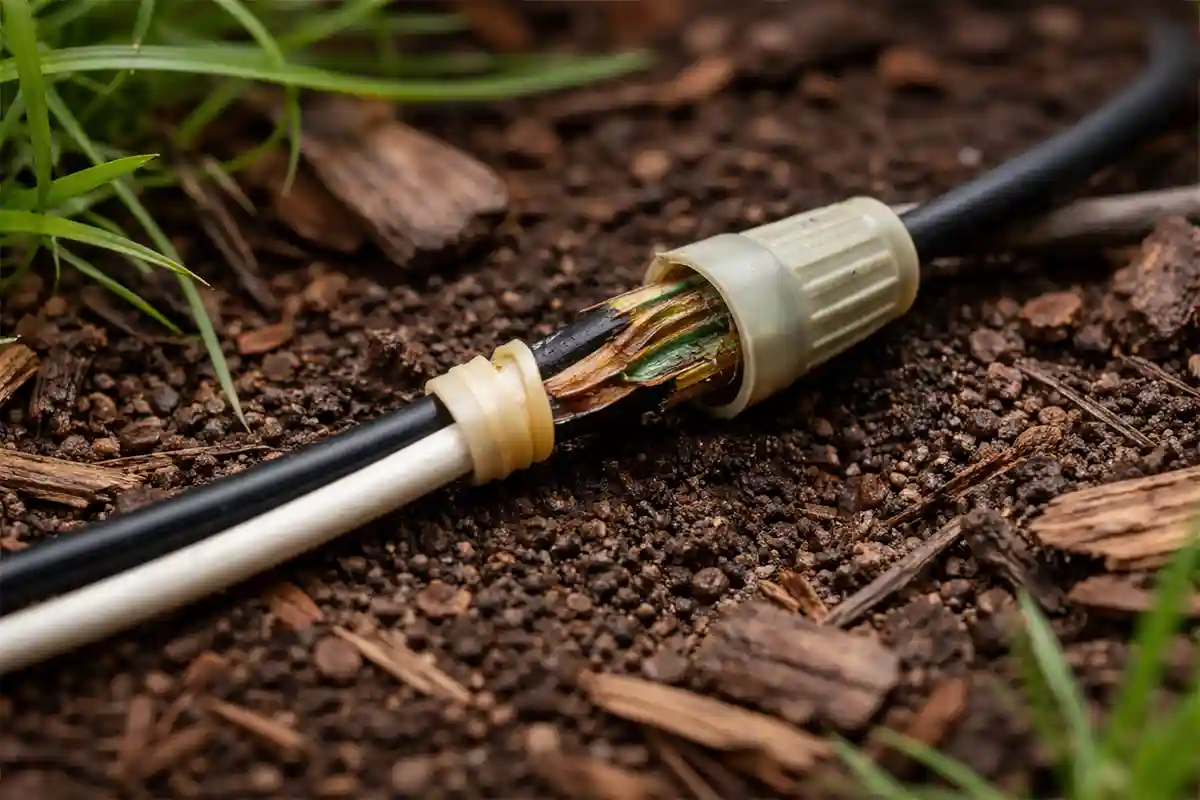
Loose outdoor wiring connections are wires that are not fully clamped, fully seated, or fully sealed inside a connector or terminal. That small gap creates unstable power flow, which shows up as flicker, dimming, or random outages, and it can also create heat at the connection point.
✔️ The safest “permanent” fix is not just tightening. It is cleaning back to solid copper, choosing a connector that matches the environment, and sealing the splice so moisture and movement cannot work it loose again.
In real yards, this often starts with normal life. A dog digs near a path light base and shifts a buried splice just enough that the lights still work, but they blink when the ground is wet. Or a pet door area gets constant foot traffic, the soil compacts and settles, and a shallow splice slowly loosens until one section of lights turns weak and yellow.
You will usually notice the problem first at night: one fixture looks normal, the next looks washed out, and then the whole run “comes back” after you wiggle a wire or the ground dries out.
Why Loose Connections Get Worse Outdoors
A loose contact point increases electrical resistance, and resistance creates heat at that exact spot. Heat speeds up oxidation on copper and terminal metals, which reduces contact area even more. Outdoors, that cycle accelerates because moisture and oxygen reach the metal faster, especially in connectors that are not fully sealed.
⚠️ You’ll usually see inconsistent behavior rather than a complete shutdown. Lights may be bright on dry evenings and dim after rain, or they may flicker when multiple fixtures turn on at the same time. What changes next is the connection begins to “carbonize” or discolor internally, so even re-tightening stops working for long.
Where Loose Outdoor Wiring Connections Usually Hide
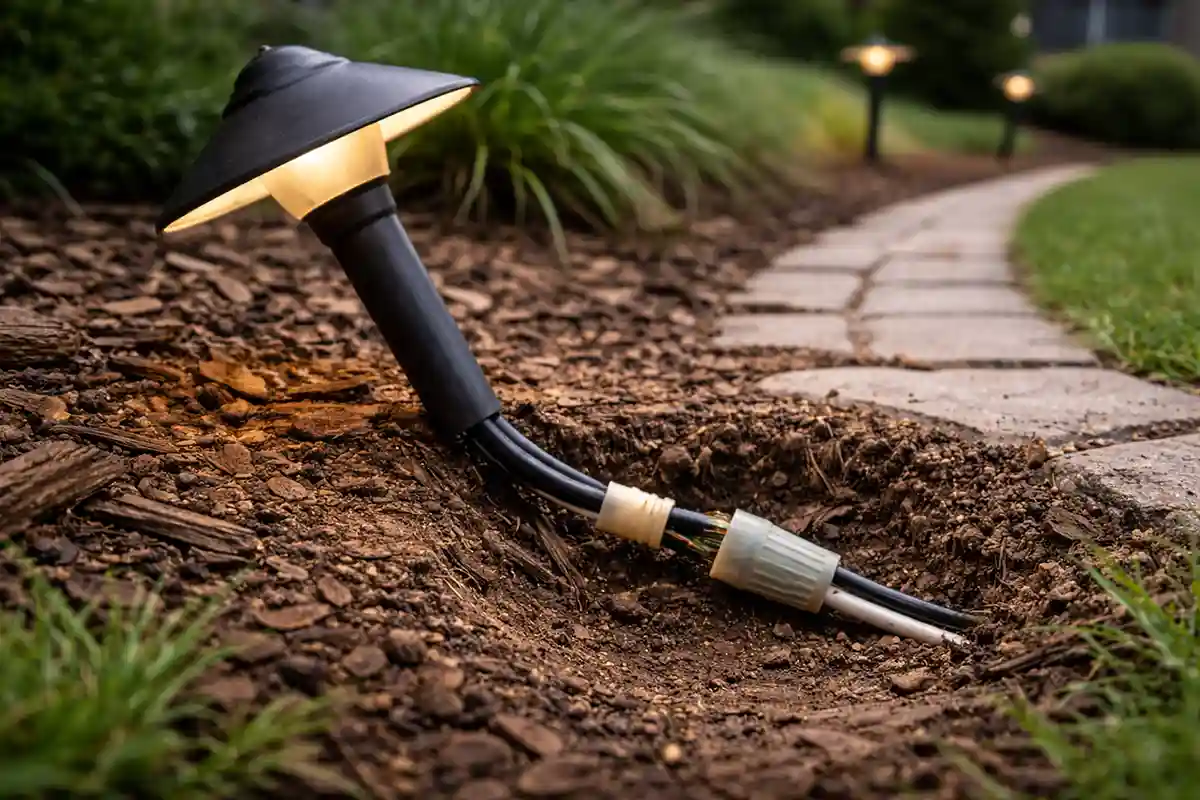
Most loose connections show up in three places: underground splices, fixture base terminals, and transformer output terminals. Underground splices are the most common because soil moves with frost, irrigation, roots, edging work, and pet digging. Fixture bases loosen when wires are tugged during bulb changes or when the stake shifts in soft ground.
💡 A practical cue is cable tension. If a wire feels tight like a guitar string near a fixture, the splice is being pulled and will loosen again. As tension continues, the copper strands start snapping one by one, and the connector may still hold a partial connection, but not enough to stay stable through temperature swings and wet conditions.
Safety Mini Checklist Before You Touch Anything
✔️ Turn off power at the transformer and unplug it from the outlet before opening any connector.
⚠️ If the transformer plugs into a GFCI, confirm it stays off by testing a light that was on moments ago.
✔️ Work with dry hands and dry ground, and avoid opening splices right after irrigation or rain.
⚠️ If you see melted plastic, scorched insulation, or a burnt smell, stop and plan for replacement of that section, not a “tighten-only” fix.
After you power down, what you’d notice is whether the cable jacket is nicked or crushed near the splice. What changes next is your repair plan: a clean cut-back and rebuild is safer than trying to reuse compromised copper.
Step-by-Step Permanent Fix Method
Start by exposing the splice carefully with a hand trowel so you do not nick the cable jacket. Cut power first, then open the connector and inspect the copper strands; any green, black, or powdery residue means you should trim back to bright, solid copper. Strip fresh insulation to the connector’s spec, keep strands tight, and make sure the wires fully bottom out before you compress or twist.
💡 Next, rebuild the splice with strain relief. Leave a gentle service loop so the wire is not under tension when the ground settles. What you’d notice after a correct rebuild is the connector feels solid with no wire wobble, and the insulation meets the connector evenly. What changes next is the system stops “acting weather-sensitive,” because the connection is no longer reacting to damp soil and temperature swings.
If the cable jacket is damaged near the splice, treat it as a cable issue, not only a connector issue. The broader signs and fixes are covered in Underground Lighting Cables Damaged? Causes, Signs, and How to Fix Them.
Connector Comparison: Twist-On vs Gel-Filled vs Heat-Shrink
Twist-on connectors are fast, but they are the least forgiving outdoors because they rely on friction and do not inherently block moisture. They can work above ground in protected housings, but in damp soil they often loosen as the copper oxidizes.
✔️ Gel-filled connectors are usually the best choice for direct-burial low-voltage splices because the gel displaces air pockets and slows moisture contact with metal. What you’d notice is fewer “rainy-night flickers,” and what changes next is the splice stays stable through irrigation cycles and seasonal humidity.
Heat-shrink waterproof splices can be excellent when installed correctly, but they are sensitive to technique. If the shrink is uneven, if the sealant does not fully flow, or if you shrink over dirty copper, the splice can look perfect and still fail later. In areas where water tracks along the cable, sealing becomes even more important, which is why the pathways for moisture are explained in Why Water Gets In Through Cable Entry Points.
| Connector Type | Moisture Protection | Best Use Case | Long-Term Reliability | Common Failure Risk |
|---|---|---|---|---|
| Twist-On (Wire Nut) | Low (not sealed) | Above-ground, protected housings | Moderate indoors, low underground | Loosening from soil movement, corrosion from moisture exposure |
| Gel-Filled Direct Burial | High (gel displaces moisture) | Underground landscape lighting splices | High when properly installed | Improper insertion depth, wire gauge mismatch |
| Heat-Shrink Waterproof Splice | Very High (sealed tubing with adhesive liner) | Permanent outdoor or wet-location repairs | Very high if installed correctly | Incomplete shrink seal, sealing over oxidized copper |
Common Mistakes That Cause Repeat Failures
⚠️ One common mistake is reusing oxidized copper because the lights turn on immediately, even though the contact area is already compromised. Another is burying the connector under tension, so the first soil shift pulls it loose again. A third is mixing connector types or wire gauges without matching the connector’s rated range, which creates a loose fit that no amount of tightening truly solves.
✔️ Pet-heavy yards add a predictable mistake: splices placed too close to fixture bases where digging and stake movement are most frequent. What you’d notice is the same two or three lights keep misbehaving, and what changes next is a pattern of recurring corrosion and intermittent outages in that zone.
Mini Troubleshooting Flow for Fast Isolation
Start at the first light that looks dim or flickers and trace backward toward the transformer one connection at a time. Check for a connector that feels loose, looks wet inside, or shows discolored copper when opened. If multiple lights are dimming together, suspect a splice upstream that feeds that entire branch.
💡 After each adjustment, watch for what changes next: brightness should stabilize immediately and stay consistent when other fixtures turn on. If the problem returns only after rain or irrigation, treat it as a sealing issue rather than a tightening issue, and rebuild that splice with a connector designed for wet environments.
When Repeated Failures Signal a Deeper Electrical Pattern
If you repair a connection properly and a different section fails weeks later, the pattern may indicate cumulative stress across the system. Multiple marginal splices can each add small resistance, and together they push voltage below stable operating range at the far end of the run. In that situation, the system appears “haunted,” but the real issue is distributed weakness rather than a single loose point.
⚠️ You’ll usually see the lights fade as you move farther down the run, with the last fixtures looking the weakest. As that imbalance continues, heat starts building at the weakest splice, and that extra heat speeds up oxidation faster than anywhere else in the system. That accelerated degradation makes the failure appear random, even though it follows load and distance patterns.
At this stage, repairing one visible connector without evaluating the rest of the run often leads to another service call within the same season.
How Corrosion Alters Long-Term Stability
Corrosion is not just surface discoloration; it reduces effective conductive surface area and weakens copper strands. Even a tight connector cannot compensate for metal that has already lost structural integrity. As corrosion advances, the connection becomes more sensitive to moisture cycles and temperature swings.
💡 If you trim back copper more than once at the same location, that indicates environmental exposure is ongoing. The underlying mechanisms and spread patterns are detailed in Corrosion in Outdoor Light Connections, and they show why sealing and strain relief matter as much as mechanical tightness.
If corrosion is left alone, the first thing you’ll see is flickering on damp evenings. Keep ignoring it, and you move past simple connector repairs into full cable replacement.
How Voltage Drop Interacts with Connection Quality
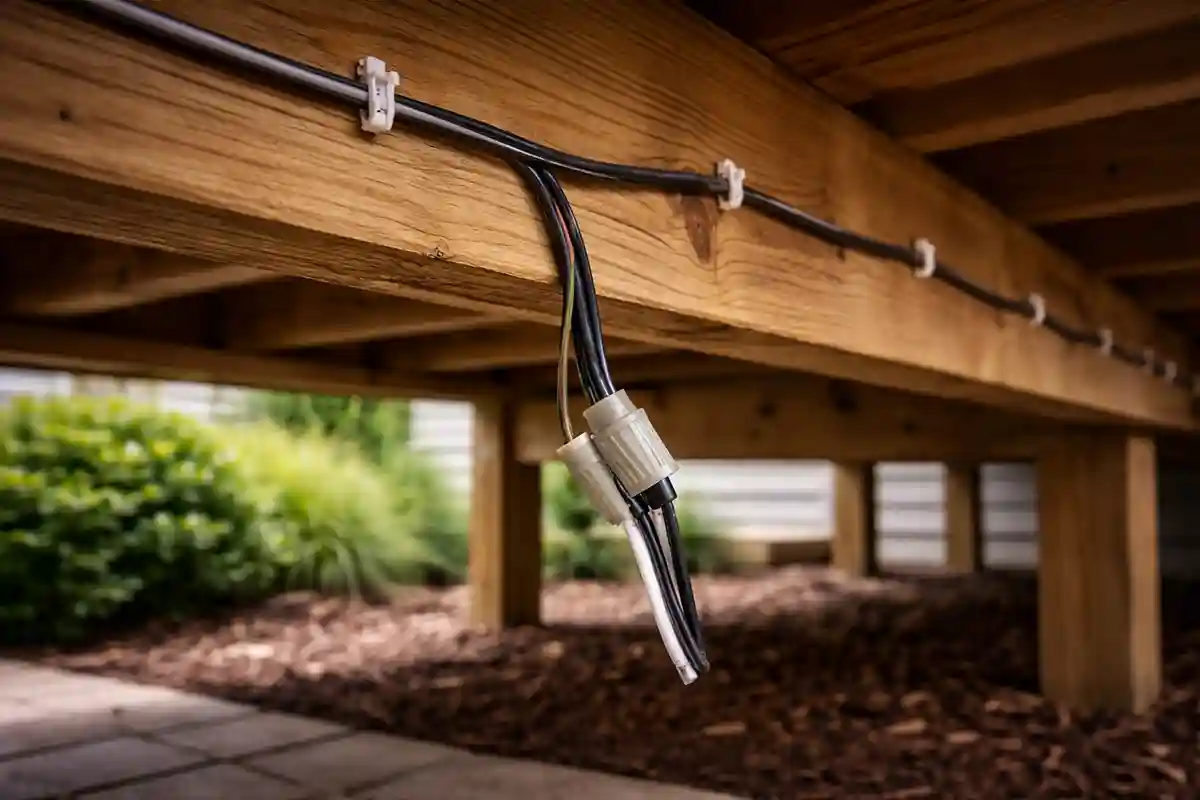
Voltage drop naturally occurs as electricity travels through cable length. In small systems with short runs, this drop is minimal and rarely visible. In extended pathway or perimeter lighting systems, however, design margins can already be narrow before any splice degrades.
✔️ When even one connector develops added resistance, distant fixtures may fall below optimal operating voltage. The broader load and cable-length interaction is explored in Voltage Drop in Outdoor Lighting Systems, which explains why balanced branching and proper gauge selection matter.
Boundary Conditions That Require Professional Evaluation
Low-voltage landscape lighting is generally safe to service, but there are limits. If you see melted insulation at transformer terminals, persistent GFCI trips, or repeated connector overheating despite clean rebuilds, the issue may involve load imbalance or transformer failure. In those cases, continuing to rebuild splices will not correct root cause instability.
⚠️ If the insulation feels brittle along long stretches or cracks when you bend it, replacing the cable is safer than patching sections together. Aging cable typically feels stiff and may show visible splits along the jacket. Once that happens, water can work its way in at multiple points, not just at a single splice.
When connection failure patterns extend beyond isolated physical disturbance, system-wide evaluation becomes the safer investment.
Designing a System That Stays Stable for Years
Permanent reliability comes from combining proper connector choice, correct burial depth, and thoughtful strain relief. Gel-filled direct-burial connectors, slack loops at fixtures, and burial below typical digging depth reduce both moisture exposure and mechanical stress. Seasonal inspection before peak use allows early detection of slight loosening before oxidation accelerates.
💡 In pet-active yards, moving splices away from high-traffic areas helps prevent constant disturbance. After relocating them, failures tend to stop clustering in the same spots. Over time, maintenance becomes less frequent, even with heavy irrigation and repeated freeze-thaw cycles.
Outdoor electrical systems operate in constantly shifting soil and weather conditions. Stability comes from anticipating those shifts and engineering connections that tolerate movement rather than resisting it rigidly.
For broader guidance on electrical safety principles that influence outdoor installation standards, the National Fire Protection Association provides foundational safety codes that shape best practices.