Why Outdoor Lights Stop Working: Main Causes, Checks, and Fixes

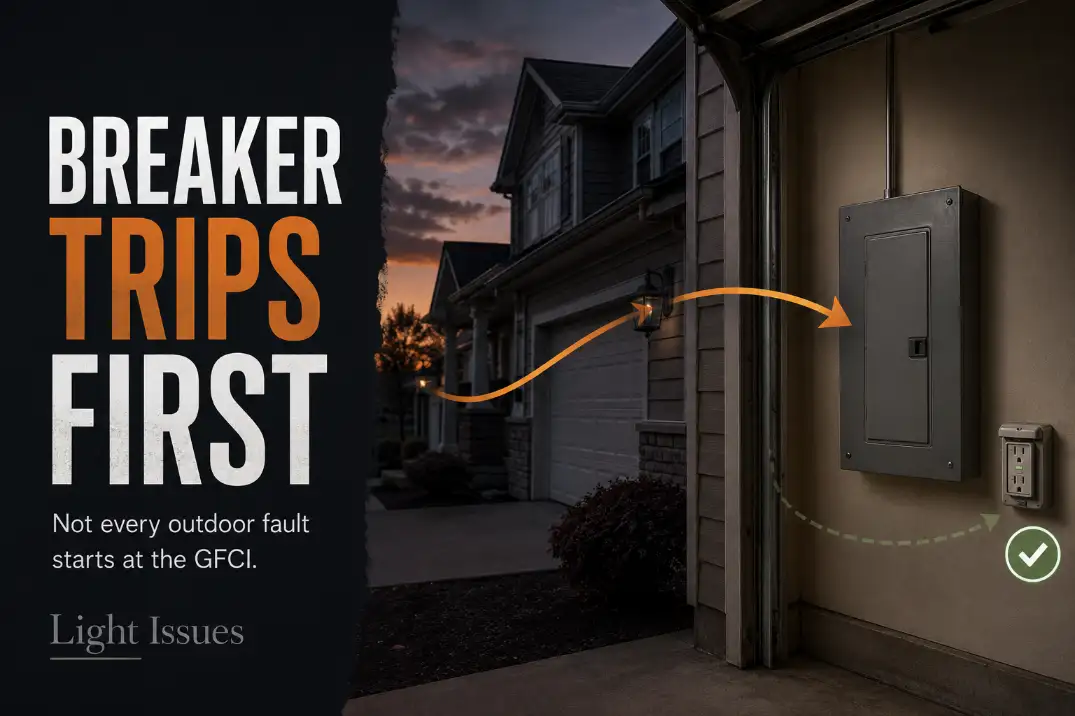
Outdoor lights stopped working with bold cover text and overlay showing power, moisture, control, and wiring failure points

Outdoor lights usually stop working because one layer of the system has failed: power supply, controls, wiring, moisture protection, fixture electronics, or solar charging. The fastest diagnosis is not replacing every bulb. It is identifying the failure pattern first: all lights are out, one fixture is out, one run is out, the lights fail after … Read more

Outdoor Lights Have Inconsistent Power? Start Here

Outdoor pathway lights with inconsistent power showing bright fixtures near the transformer and dim or dark fixtures farther down the run

If outdoor lights have inconsistent power, the quickest way to diagnose it is to sort the problem into one of four patterns: all lights unstable, one branch unstable, only far-end lights weak, or lights that fail after a delay. Those patterns usually point to different causes. If every fixture cuts out together, start at the … Read more

Transformer Problems in Low-Voltage Systems

Outdoor low-voltage landscape lighting transformer with one dim branch and overlay showing the likely fault path

Most low-voltage transformer problems are diagnosed incorrectly for one reason: people start with the transformer instead of the failure pattern. If nothing works, the first checks belong on the input side. If the lights run for 10 to 30 minutes and then drop out, thermal overload moves to the front of the line. If only … Read more

Outdoor Lights Lose Power Under Walkways? Causes & Fix

Homeowner inspecting underground outdoor lighting cable where it runs beneath a walkway.

Quick Solution Summary When outdoor lights lose power exactly where the wiring passes under a walkway or driveway, the issue usually comes from cable damage, compression, or moisture intrusion at that crossing point. Hard surfaces like concrete, pavers, or asphalt create pressure zones beneath the soil. Over time, the weight from foot traffic, vehicles, and … Read more

New Outdoor Lights Not Getting Power? Fix It Fast

Electrician checking wiring when newly installed outdoor lights are not receiving power from the main electrical line.

Quick Solution Summary If newly installed outdoor lights are not receiving power from the main electrical line, the problem usually lies somewhere along the circuit path between the breaker panel and the first lighting fixture. In most residential systems, electricity flows through a switch, GFCI outlet, junction box, or transformer before reaching the lights. A … Read more

Outdoor Lights Shut Off When Sprinklers Turn On? Fix It Fast

Backyard landscape lights shutting off as sprinkler irrigation system turns on.

Quick Solution Summary If your outdoor lighting circuit loses power the moment your irrigation system turns on, the problem usually comes from moisture exposure, a shared GFCI outlet, or underground wiring damage near sprinkler lines. In many homes, landscape lighting transformers and irrigation controllers are plugged into the same outdoor outlet. When sprinkler valves activate, … Read more

Deck and Patio Lights Not Working After Winter? Fix Guide

Outdoor deck and patio lights not working after winter in a backyard.

Quick Solution Summary If deck or patio lights stop working after winter, the most common causes are moisture intrusion, corroded wire connections, tripped GFCI outlets, or damaged underground cables. Outdoor lighting systems endure months of cold temperatures, snow accumulation, and repeated freeze-thaw cycles. These conditions slowly weaken electrical components. During winter in northern states such … Read more

Pathway Lights Not Receiving Power After Yard Work?

Pathway lights not receiving power after yard work due to damaged underground landscape lighting cable.

Quick Solution Summary If your pathway lights stopped receiving power right after yard work, the most common cause is accidental damage to underground low-voltage lighting cables. Landscape lighting wires are typically buried only 4–6 inches below soil, making them easy to cut or pull loose during activities like planting shrubs, installing irrigation lines, edging garden … Read more