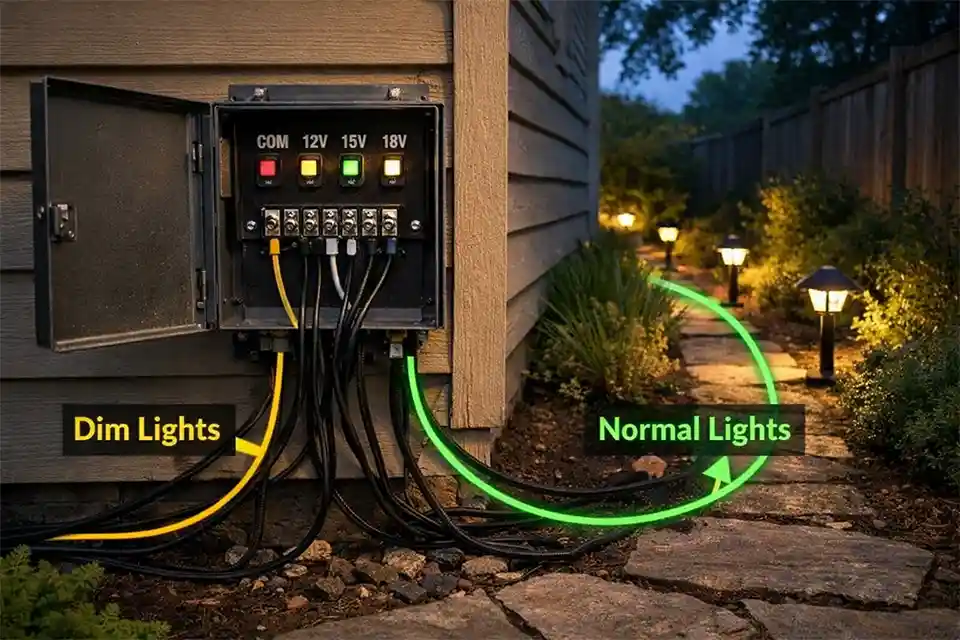
Most low-voltage transformer problems are diagnosed incorrectly for one reason: people start with the transformer instead of the failure pattern. If nothing works, the first checks belong on the input side.
If the lights run for 10 to 30 minutes and then drop out, thermal overload moves to the front of the line. If only the far fixtures are weak, or one branch is dead while another is fine, that is usually a delivery problem, not a transformer problem.
That distinction matters because low fixture voltage is only a symptom. The mechanism could be overload inside the transformer, a bad output connection, a wet or damaged cable run, or simple voltage drop over distance.
In many 12-volt systems, LED fixtures still behave acceptably at about 10.5 to 12.5 volts at the fixture. Once readings fall below roughly 10.0 volts under load, dimming and unstable driver behavior become much more likely. The real job is not proving that voltage is low. It is proving where it is being lost.
Quick diagnostic checklist
- Nothing turns on: verify receptacle power, breaker, GFCI, timer, and any reset or fuse before blaming the transformer
- System runs, then shuts off after 10 to 30 minutes: suspect overload or thermal protection
- Transformer output looks normal with little load, then drops sharply under load: suspect overload or a faulted branch
- One zone fails while others stay normal: suspect downstream cable, splice, or fixture-path damage
- Transformer terminals hold near the selected tap, but the last fixtures read under about 10.0V: suspect voltage drop or resistance in the run
- Failures appear after rain or irrigation: suspect moisture-related leakage before assuming internal transformer failure
Before replacing the fixture, it helps to understand the most common reasons outdoor lights stop working around the home.
Start here: which failure pattern are you actually seeing?
Nothing works at all
A fully dead system is the point where people waste the most time. If the transformer shows 0V output, do not jump straight to internal failure. First confirm the unit is actually receiving line power. Check the receptacle, breaker, GFCI reset, timer setting, and photocell behavior if one is in the chain. On some units, the real fault is a resettable breaker or internal fuse rather than the transformer windings themselves.
This is also where cosmetic clues mislead people. A cool, silent transformer with no output is often dealing with an input-side problem. An overloaded transformer usually leaves a different trail: heat, buzzing, repeated shutdown, or a warm housing after it has been energized for a while.
If this wider no-power pattern is affecting the whole landscape system, Outdoor Lighting Power Supply Issues: Why Lights Keep Losing Power is often closer to the real diagnosis than replacing the transformer first.
It works, then dies warm
This is one of the most useful patterns in the whole category. A transformer that powers the lights normally, then shuts off after 15 to 20 minutes, is telling you more than a dim fixture ever will. That usually points to thermal protection caused by overload, heat buildup, or an abnormal branch load.
A practical operating target is to keep sustained load at about 70% to 80% of rated capacity. On a 150-watt transformer, that usually means roughly 105 to 120 watts is the comfortable zone. Running close to nameplate rating can work for a while, but it becomes much less forgiving in direct sun, enclosed mounting locations, or hot climates where ambient temperatures can exceed 95°F before dusk.
Only one branch is failing
A transformer usually does not pick one branch to punish while feeding the others perfectly. If one side of the yard is dark and another side is steady, the problem is more often downstream: damaged cable, failed splice, or a connection that has gone high-resistance under load. That is why Outdoor Lights Not Working on One Side of the Yard is often the better next read than another transformer article.
The first checks that actually change the diagnosis
Confirm the line side before touching the low-voltage theory
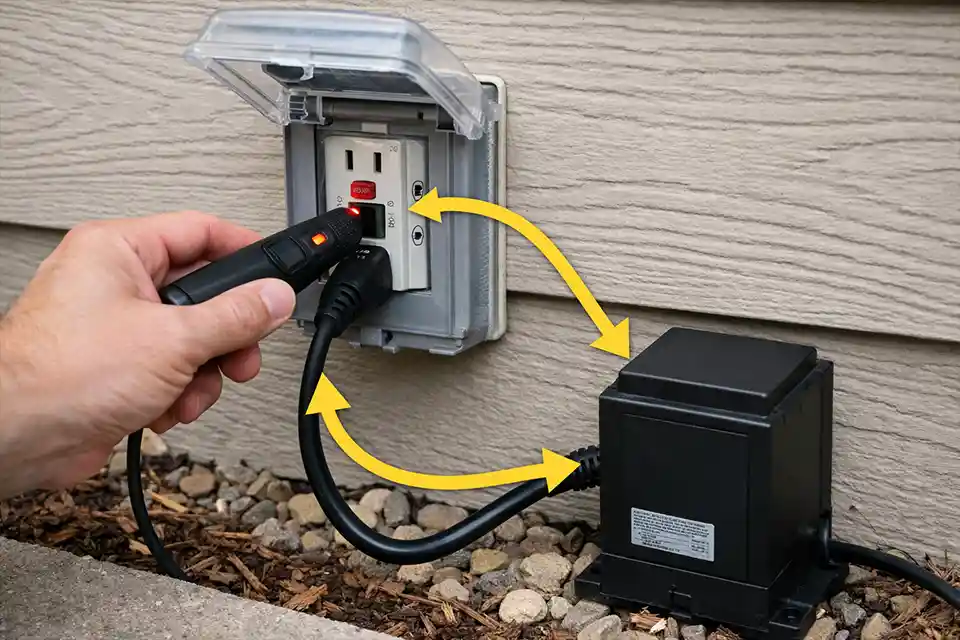
It sounds basic, but it changes the entire direction of the diagnosis. A transformer cannot produce stable low-voltage output if the receptacle is dead, the breaker has tripped, or the GFCI has opened.
A timer problem can also mimic transformer failure, especially when users assume that an unexpected schedule change is the same thing as an electrical fault.
The mistake people overestimate is “the transformer just died.” The mistake they underestimate is “the transformer never had reliable input power in the first place.”
Test unloaded, then test again under load
A cold transformer with minimal load can look healthier than it really is. Measure at the secondary terminals first with the system disconnected or lightly loaded, then again after the system has been running for 15 to 20 minutes under normal load.
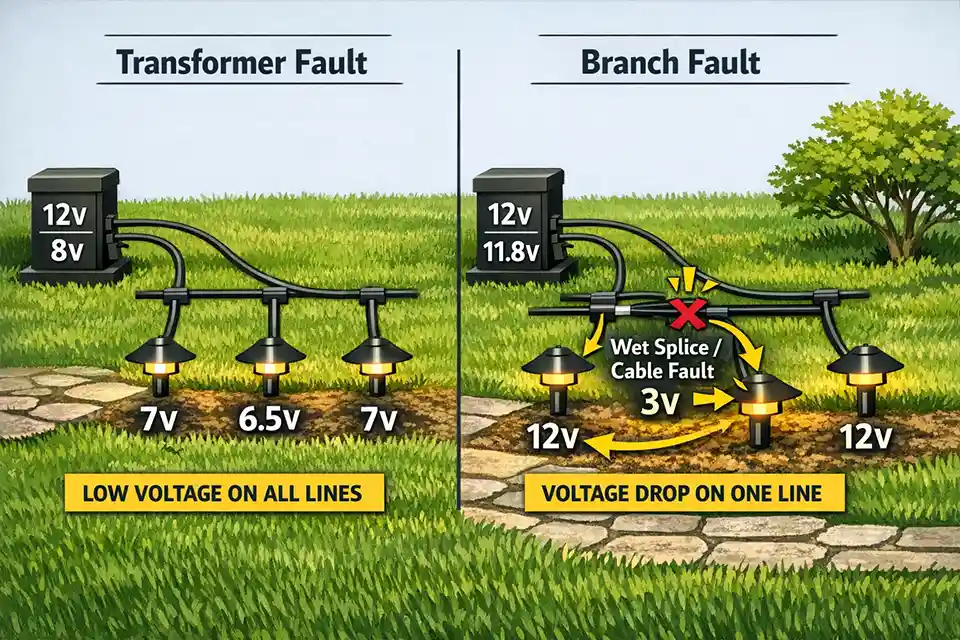
If output starts near the selected tap and then collapses at the transformer terminals themselves, the transformer or its immediate output side becomes a stronger suspect.
If the transformer terminals stay reasonably stable but the far fixtures fade, you are not looking at the same kind of failure.
That points back toward cable length, wire gauge, branch design, or resistance at splices. In those cases, Voltage Drop in Outdoor Lighting Systems is the more useful framework.
Isolate branches before swapping parts
This is the fastest test many homeowners skip. Disconnect one branch at a time and watch what changes. If the system stabilizes when one run is removed, that is a much stronger clue than replacing lamps, guessing at timers, or buying a bigger transformer.
Pro Tip: Branch isolation often reveals a wiring fault faster than direct transformer testing because it changes the load pattern immediately. A transformer that looks weak may only be reacting to one bad run.
What your voltage reading actually means
| Reading or pattern | More likely meaning | Best next move |
|---|---|---|
| 0V at the secondary | No input power, reset/fuse issue, or internal failure | Verify line power first |
| Normal output unloaded, low output loaded | Overload or faulted branch | Reduce load and isolate branches |
| Stable transformer terminals, weak far fixtures | Voltage drop or resistance in the run | Inspect run length, splices, and conductor size |
| Shutdown after 10–30 minutes | Thermal protection | Check real connected load and heat conditions |
| One branch disconnected and system recovers | Downstream wiring fault | Repair that branch before replacing the transformer |
What people usually blame first — and why that’s often wrong
A dead zone is usually not a bad transformer
If one branch is dead while another branch remains bright, the transformer has already proved it can still supply the system. The more likely explanation is cable damage, splice corrosion, or a connection fault that only affects one path.
This gets even more likely in older systems, where buried connections and seasonal ground movement create resistance long before the transformer itself fails.
The same goes for end-of-line dimming. Outdoor Lights Losing Power at the End of the Line is often the missing piece because the visible symptom looks like weak supply even when the real mechanism is loss along the route.
A bigger transformer can hide the real fault
Upsizing is one of the most tempting wrong fixes in low-voltage systems. Yes, a larger transformer can sometimes overpower a marginal run enough to make the lights look better for a while. But if the real problem is a wet splice, damaged underground cable, or a branch with abnormal resistance, a bigger transformer is masking the fault, not curing it.
That is especially true after rainfall or irrigation events. If the system trips or misbehaves only when conditions are wet, Why Your Outdoor Light Works Fine Until It Rains is usually more relevant than upsizing the transformer.
When the transformer really is the problem
Output collapses at the terminals, not just at the fixtures
This is the point where the diagnosis gets sharper. If the transformer itself cannot hold voltage at its own output terminals under a known reasonable load, the problem is no longer just out in the yard. That could mean overload, heat-damaged output connections, degraded internal protection, or a transformer that is simply aging out.
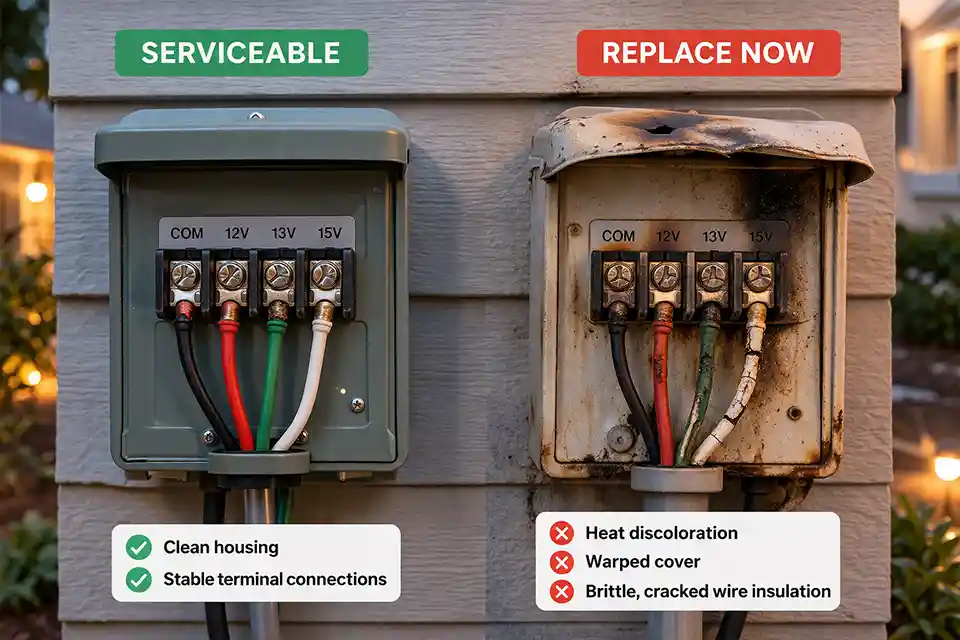
Loose terminals and darkened copper can imitate internal transformer failure surprisingly well. A quick retightening helps only if the conductor ends are still sound.
If insulation has gone brittle, copper is discolored, or the connection has clearly been running hot, the issue is larger than “one loose screw.” Corroded Wire Splices Outdoors also matters here, because transformer-side heat and splice-side resistance often belong to the same failure chain.
Heat shutdown under a reasonable load
Once the load is clearly below about 80% of capacity, the terminals are clean, and the branch faults have been isolated, a transformer that still overheats is running out of excuses.
If the unit repeatedly trips under moderate load, hums loudly, or gets hot enough that you would not keep a hand on the housing for more than 2 to 3 seconds, that is no longer ordinary maintenance territory.
One thing that gets missed in the field is age. A transformer can still “work” and still be the wrong thing to trust. Years of near-capacity use, repeated wet-dry cycling, and heat stress can leave it operational but unreliable.
When replacement makes more sense than one more fix
Replacement becomes the better decision when the transformer has crossed from adjustable to unreliable. If the line side is stable, the branch loads are reasonable, the suspect run has been isolated, and output still sags at the transformer terminals after warmup, further tinkering usually wastes time.
The same is true when there is visible housing discoloration, persistent buzzing under normal load, or repeated thermal cycling even after the obvious external causes have been removed.
Pro Tip: Multi-tap transformers are not meant to put every branch on the highest tap. Higher taps are for the longest runs. Putting short runs on 15V can solve one problem while creating another.
Questions people usually ask
Can a bad transformer still show voltage with no load?
Yes. A transformer can look normal with little or no load and still fail once the full system is connected. That is why unloaded readings are not enough by themselves.
Why does the system fail after rain but work when dry?
Because the transformer may be responding to a fault, not creating it. Moisture can increase leakage at damaged cable, weak fixture seals, or bad splices. Dry weather can temporarily hide the same fault without actually fixing it.
For a practical university troubleshooting reference on dim lights, overload, and cable-run faults, see Iowa State University Extension.