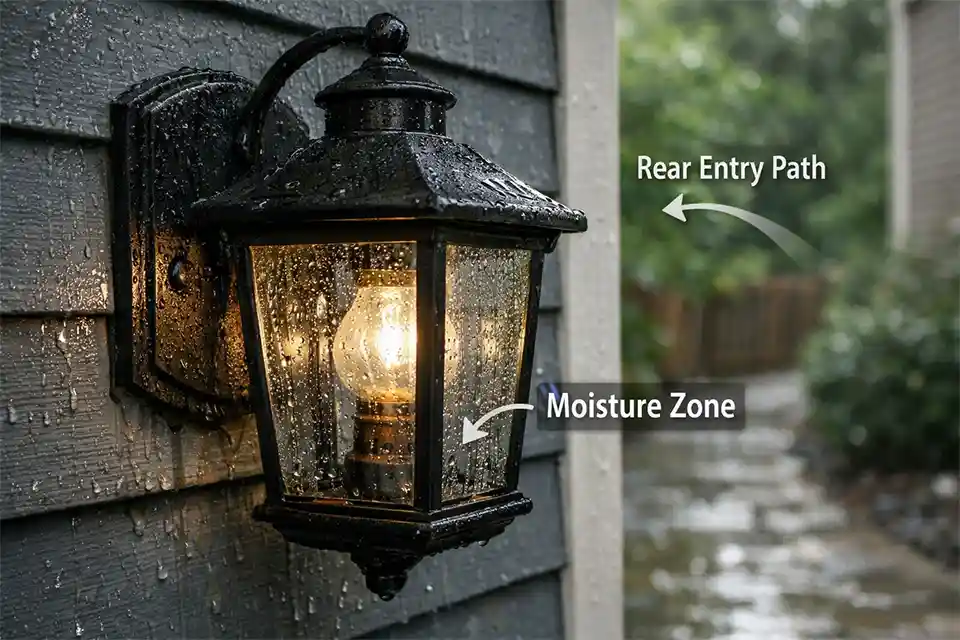
If an outdoor light fails during rain or within 10 minutes to 24 hours after a storm, the problem usually is not the bulb. It is usually a moisture path. The first question is not “What part should I replace?” but “Did one fixture get wet, or did one wet section take down part of the system?”
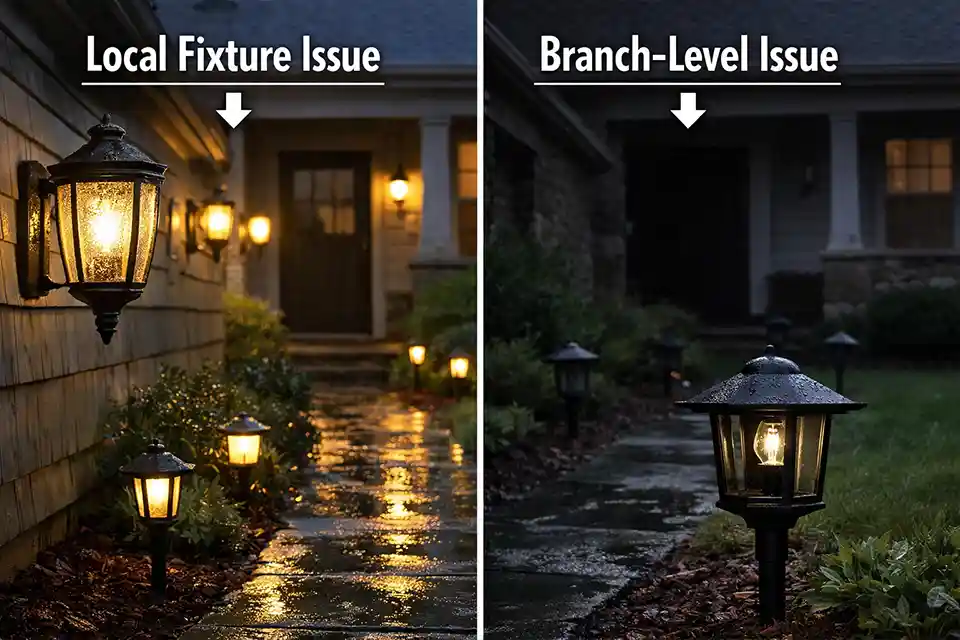
Start there. If only one light fails and you can see haze, droplets, or a water line inside the lens, the most likely cause is local water intrusion. If several lights go out together, especially after rain, the problem is more likely a shared splice, a GFCI trip, a wet junction point, or a low-voltage branch issue.
A second clue is recovery time. If the light comes back after 6 to 12 dry hours, moisture is probably changing the electrical path without fully destroying the part yet. If it stays dead for 24 to 48 hours, corrosion, contact damage, or component failure move much higher on the list.
That is the difference people often miss: flicker, dimming, or a dead light after rain is the symptom. The mechanism is usually water reaching a weak seal, socket, splice, box, or cable entry that should have stayed dry.
The first decision tree that actually saves time
Most people waste the first hour on the wrong question. This is the faster split.
One fixture fails after rain
That usually points to a local problem at the fixture: failed gasket, cracked lens, rear-entry leak, bad socket, or trapped moisture that does not drain correctly.
Several fixtures fail together
That usually points to a shared failure path: wet splice, GFCI leakage, transformer-side issue, power feed interruption, or cable damage affecting one branch.
It works again after drying
That usually means moisture-sensitive leakage or an unstable connection, not a permanently dead lamp.
It does not recover after 24 to 48 hours
That shifts the odds toward real corrosion, damaged contacts, failed LED driver, or a connection that now fails wet or dry.
Rain usually reveals a weak point that already existed. It rarely creates a brand-new problem by itself.
What rain usually reveals vs what it rarely causes
Not every explanation deserves equal space.
Most likely: water reaches a place that should stay dry
This is the dominant pattern. It may be a failed lens seal, a loose cap, a rear mounting gap, a cable opening, or a splice that is no longer protected well enough. If the problem starts after moderate rainfall of roughly 0.25 to 1 inch, that is not “extreme weather.” That is usually a weak point being exposed.
Next most likely: corrosion that becomes unstable when wet
A corroded connection may keep working in dry conditions for months, then start flickering, dimming, or failing when humidity stays high or rain drives moisture into the joint.
That is one reason a resealed fixture can seem fixed until the next storm. In that situation, Corroded Wire Splices Outdoors is often more useful than replacing another lamp.
Also common: protective shutdown
If a GFCI trips during rain or shortly after, that is not random inconvenience. It usually means leakage current found a path to ground somewhere in the wet section. A single reset that holds may be a brief event. Repeated wet-weather trips are a decision point, not a nuisance.
Less likely than people think: “the rain was just too much”
Outdoor lighting should tolerate normal weather. Ordinary rain is not the diagnosis. A fixture that cannot survive routine storms already had a sealing, drainage, rating, or connection problem.
What to check first before you open anything
Start with the easiest high-value clues
Look for moisture that lasts too long
A faint temporary haze can happen after a sharp temperature change. That alone does not prove failure. But visible droplets, streaking, or pooled moisture that remain for more than 24 hours in mild weather are not normal.
That points to poor sealing, poor venting, or a water-entry path that is not clearing. If that is what you see, Why Is There Condensation Inside My Outdoor Light Fixture? is the closest internal match.
Check whether the outage is local or shared
One dead light usually means one wet fixture or one local connection. A whole section going dark means stop staring at the fixture head and start thinking about splices, feed path, GFCI, transformer, or damaged cable.
Track the timing
Failure during rainfall, or within a few hours after, usually points to direct intrusion or wet leakage. Failure the next morning after a long storm often points to slower moisture migration through the rear of the fixture, through a cable entry, or into a buried connection.
The weak point people miss most often
The visible face of the fixture gets blamed first. The hidden path is often behind it.
Rear mounting plate and junction box leaks
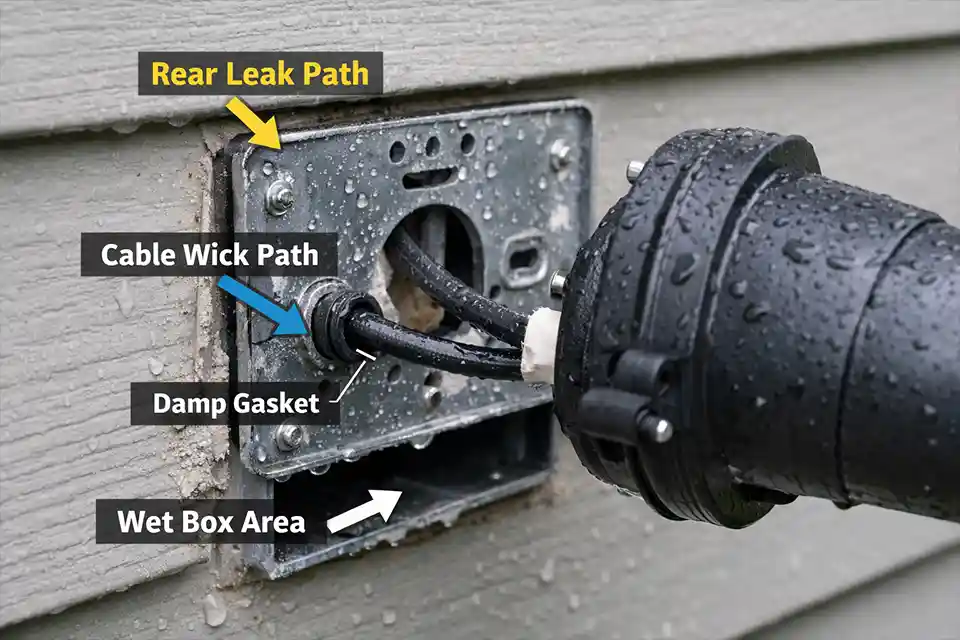
On wall-mounted fixtures, water may enter from the back, not the front. A loose mounting base, compressed foam gasket, unsealed top edge, poor siding contact, or box that lets water collect behind the fixture can send moisture directly toward live connections. The front glass may look fine while the real leak path is completely hidden.
Cable entry points
This is one of the most underestimated causes. Water does not always pour in through a dramatic crack. It can wick in slowly along the cable path or through a small opening around the wire entry.
When the failure shows up after several hours of rain rather than immediately, this becomes more likely. That is where Why Water Gets In Through Cable Entry Points matters more than another bead of sealant around the lens.
Wet splices below grade or near mulch
Landscape lighting often fails below the visible fixture. If the system drops out near planting beds, low spots, or heavy mulch zones, the weak point may be at a buried splice or hub rather than inside the fixture body.
Outlet-side moisture and weatherproof covers
When a rain-related failure is tied to an outdoor receptacle or GFCI, the issue may be at the cover, the receptacle box, or the device enclosure rather than the light head itself. If the cover does not close tightly, if the gasket has flattened, or if moisture gets into the box, the system may trip even though the fixture looks dry.
If the light is low-voltage, the failure path changes
Low-voltage systems fail in patterns. Those patterns are useful.
Near fixtures stay on, far fixtures fail first
That usually points to weak voltage at the end of the run, a failing splice, a damaged cable section, or a transformer-side connection problem that rain made worse.
One branch goes dark after storms
If one zone repeatedly fails after wet weather, suspect a shared splice, hub, or cable segment running through a wet area before blaming multiple fixtures.
Transformer areas get overlooked
A transformer enclosure or secondary-side connection can stay damp long after visible rain ends. When the outage is branch-wide in a low-voltage system, Transformer Problems in Low-Voltage Systems is usually the more useful path than swapping fixtures one by one.
Branch-level power loss should move up the list
If multiple lights fail together, especially after a storm, Outdoor Lighting Power Supply Issues Losing Power becomes more relevant than a local fixture diagnosis.
What people usually misread first
They overestimate the bulb
A bulb can fail, but when the failure is tightly tied to rainfall, it is usually not the main story. If a new lamp also flickers, goes dim, or dies after the next storm, the bulb was never the root fix.
They underestimate hidden corrosion
A connection can look “mostly fine” and still be one storm away from failure. Slight corrosion can raise resistance just enough that wet conditions push it over the edge.
They treat a GFCI trip as the problem
The GFCI is usually reacting to the problem. If it trips only during wet weather, treat that as a leakage clue, not as something to bypass mentally.
They assume visible condensation is always harmless
Brief fog that clears quickly is one thing. Visible droplets that remain for more than 24 hours, especially with intermittent outage, are not harmless weather mist.
Wet-rated vs damp-rated matters more than people think
This is one of the easiest installation mistakes to miss because both products may be marketed as outdoor fixtures. But the rating matters. A damp-rated fixture may survive under a covered porch where wind-driven rain rarely reaches it.
That same fixture can fail early on an exposed wall corner, gate post, or open driveway edge where rain strikes directly. A wet-rated fixture is built for more direct exposure.
This matters most when the same model works well in one area and fails repeatedly in another. That is usually not random quality variation. It is often an exposure mismatch. If a light has failed repeatedly in an exposed position, resealing alone may be the wrong fix because the fixture may never have been the right type for that location.
Pro Tip: If the fixture under the porch keeps working while the matching exposed fixture fails after storms, stop troubleshooting them as if they are the same environment. They are not.
Rain-related failure that is not really rain-related
A few lookalike problems can waste a lot of time if you do not rule them out early.
Storm reset or power return issue
If all lights went out after a storm and stay out with no visible moisture pattern, check for a tripped breaker, a timer reset, or a power supply issue before opening fixtures.
Control problem that only seems weather-related
A photocell, timer, or sensor failure can overlap with storm timing and make rain look guilty when it is only coincidental.
Existing cable damage exposed by wet soil
Rain can lower the margin on a cable that was already nicked, compressed, or poorly spliced. The storm did not create the underlying damage, but it made the failure easier to trigger.
When repair stops making sense
There is a point where one more reseal becomes maintenance theater.
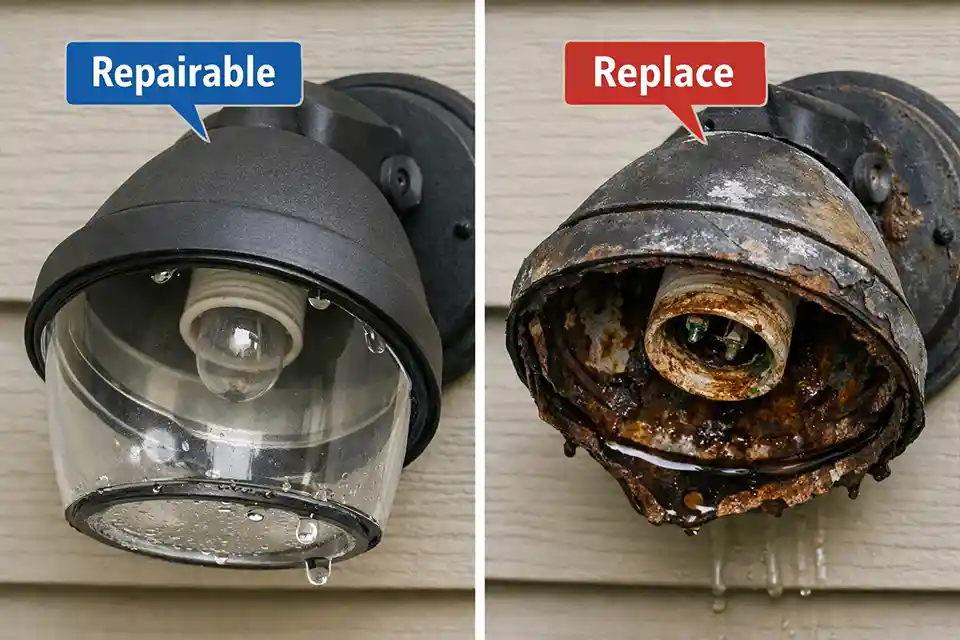
Repair is still reasonable when
- the housing is intact
- the lens is not cracked
- the weak entry point is visible
- the socket contacts still look clean
- the failure is recent, not repeating across months
- the fixture is otherwise in good structural condition
Replacement makes more sense when
- corrosion is visible on the socket shell or driver compartment
- water has pooled inside more than once
- the body is warped, cracked, or badly chalked
- the outage returns after 1 to 2 storms despite correction
- the fixture is roughly 7 to 10 years old and already deteriorating
- the rating is wrong for the exposure
Repeated wet-weather GFCI trips also mark a boundary. If the device trips again after reset during the next rain, the right move is isolation and diagnosis, not more resets.
Quick comparison guide
| What you see after rain | More likely cause | What matters most next |
|---|---|---|
| One fixture has droplets inside | Local fixture intrusion | Check seal, socket, rear entry |
| Several lights fail together | Shared splice, GFCI, branch feed | Diagnose branch before fixture replacement |
| Light returns after 6–12 dry hours | Moisture-sensitive leakage | Find the wet path before damage worsens |
| Light stays dead for 24–48 hours | Corrosion or component damage | Inspect contacts, driver, or replace |
| GFCI trips only in wet weather | Leakage to ground | Isolate wet section, do not keep resetting |
| Far-end low-voltage lights fail first | Weak splice, cable loss, transformer issue | Check run layout and feed path |
| Covered fixture works, exposed one fails | Rating or exposure mismatch | Verify wet-rated suitability |
Quick diagnostic checklist
- Visible moisture remains inside the fixture for more than 24 hours
- Failure starts during rain or within 24 hours after it
- One light fails alone while others stay on
- A whole branch drops out after wet weather
- The light comes back after drying, then fails again in the next storm
- A GFCI trips only in wet conditions
- Far-end low-voltage fixtures fail before near ones
- Corrosion, white residue, green buildup, or darkened contacts are visible
The fastest useful diagnosis is not “replace what looks old.” It is “find whether rain is exposing a local fixture weakness, a shared wet connection, or a system-level branch problem.” Once that split is clear, most of the wasted fixes disappear.
For broader wet-location and GFCI safety guidance, see the Electrical Safety Foundation International.