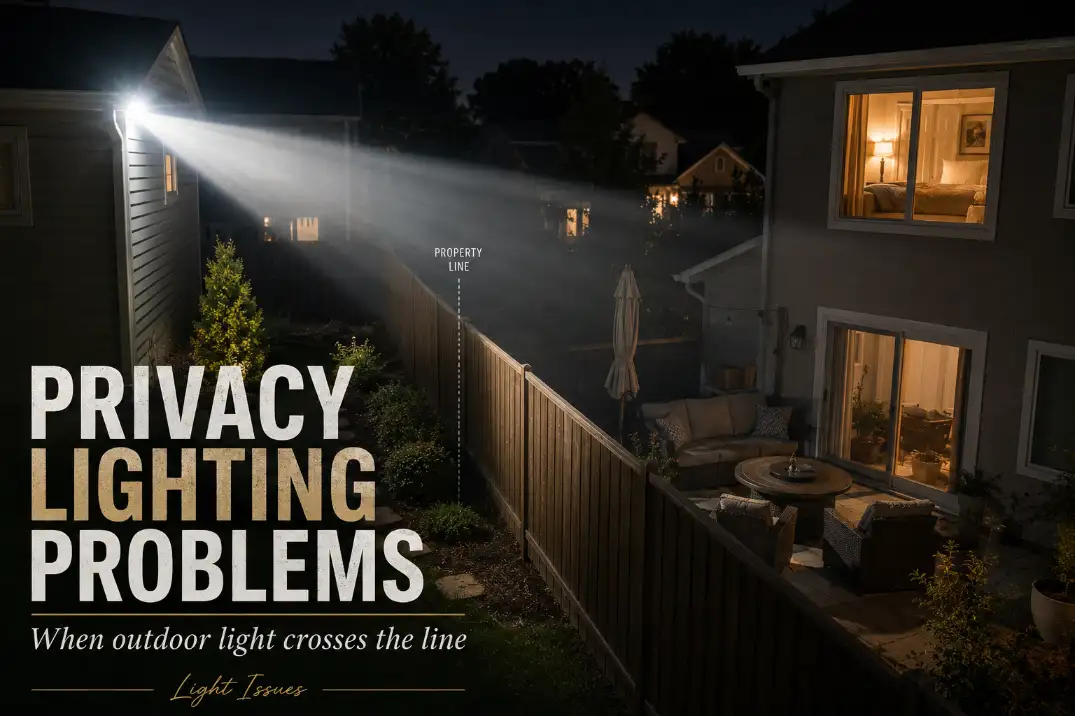
Outdoor lighting privacy problems happen when a light crosses a visual boundary: a property line, bedroom window, patio, shared fence, or nighttime comfort zone.
The fixture may be installed for safety, but once the source is visible from the wrong place, it starts to feel less like protection and more like exposure.
The first checks are simple. Can someone outside the target area see the bulb, LED board, or reflector? Does the beam rise above a 6-ft fence? Does a motion light stay on longer than 30–120 seconds after movement stops?
A faint porch glow is usually not the issue. A 2,000-lumen floodlight aimed sideways into a window is. If the light creates a visible shadow on a neighbor-facing curtain, patio wall, or fence after 15 minutes of full darkness, the problem is usually beam control, not just brightness.
The Main Types of Outdoor Lighting Privacy Problems
Most privacy complaints are not caused by one bad bulb. They come from a mismatch between fixture type, aim, height, runtime, and the space being lit.
Light trespass crosses the property line
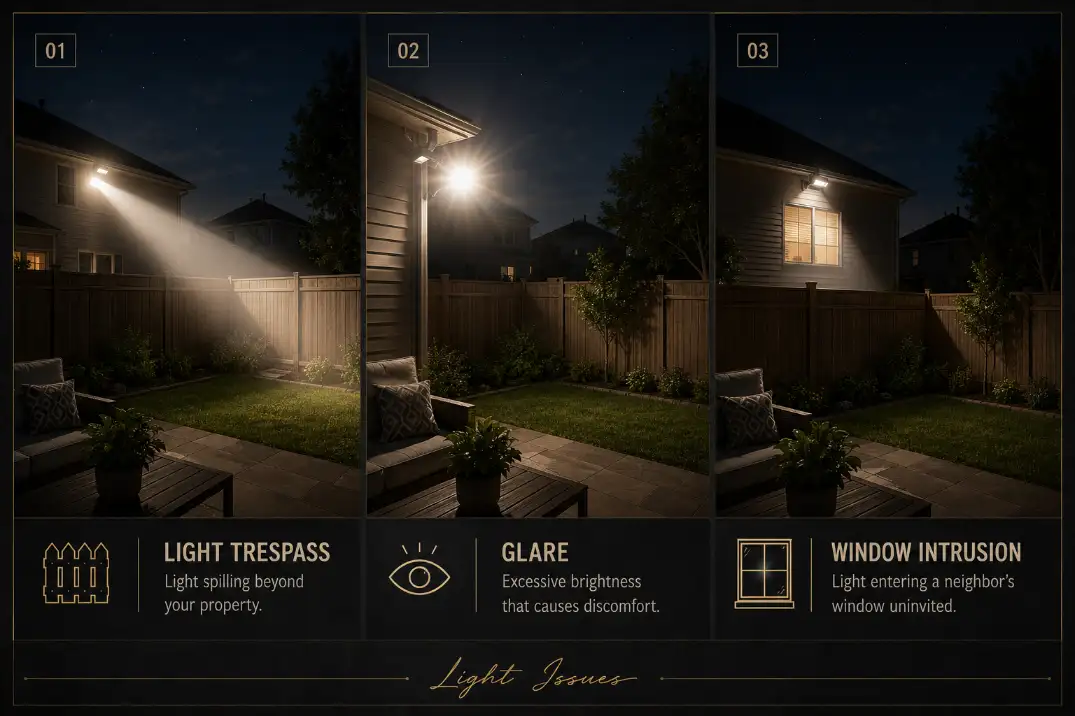
Light trespass is the physical spill of light beyond the area it is supposed to serve. In residential yards, that usually means light landing across a fence, onto a neighboring wall, through a window, or over a shared driveway.
This is the core privacy problem because the light owner may not experience it directly. From the fixture side, the beam can look useful. From the receiving side, it may feel like a spotlight.
Glare exposes the light source
Glare happens when the eye sees the bright source itself. A neighbor may ignore a little glow on the ground, but a visible LED chip, bare bulb, or shiny reflector from a bedroom window is different.
This is why reducing lumens does not always solve the complaint. If the source remains visible, the light still feels intrusive. The issue is not only how much light exists. It is whether the brightest part is pointed into someone else’s line of sight.
Window intrusion feels more personal
A light shining into a bedroom, bathroom, nursery, or second-story window is more sensitive than light hitting a driveway edge. The receiving surface matters. Light on pavement is a visibility issue. Light on curtains is a privacy issue.
For windows, the key question is not “Is my yard too bright?” It is “Can the beam or source be seen from inside someone else’s normal living space?”
Motion nuisance turns a reasonable light into a problem
A motion sensor light can be neighbor-friendly when it turns on briefly and predictably. It becomes irritating when it fires every few minutes because of branches, pets, traffic, wind, or an oversized detection zone.
A 45-second activation near a side gate is usually manageable. A 10-minute delay beside a bedroom window is not. If the light itself is acceptable but the trigger pattern is wrong, the fix is usually sensor aim, sensitivity, and timer control before fixture replacement.
Quick Privacy Lighting Check
Use this after full darkness, not at sunset. Dusk hides many of the problems that become obvious later.
- Stand at the property line at normal eye height, about 5–6 ft above ground.
- Look for the bare bulb, LED surface, or shiny reflector.
- Check whether the beam rises above fence height.
- Watch whether a motion light stays on longer than 2 minutes.
- Look for bright hot spots beside dark gaps.
- Recheck after rain, snow, or irrigation because reflective surfaces can multiply the perceived impact.
- Compare the color temperature: 2700K–3000K feels softer near homes than 4000K–5000K.
Privacy Lighting Thresholds That Actually Matter
The difference between normal outdoor lighting and a privacy problem is usually visible if you know what to measure.
Source visible from the property line
If the bulb, LED board, or reflector is visible from the fence line, sidewalk, neighboring patio, or upper window, treat it as a glare risk. A fixture can be modest in lumens and still feel harsh when the source is exposed.
This is one of the most useful field checks because it avoids the wrong argument. The issue is not whether the fixture is “too bright” in theory. The issue is whether someone else can see the light engine.
Beam above a 6-ft fence
A 6-ft fence blocks view, not necessarily light. A fixture mounted 8–12 ft high can clear that fence easily if it is aimed flat or outward.
Fence-line privacy lighting fails when fixture height beats the privacy screen. If the beam travels above the fence instead of dying on the ground, the light is likely doing more than the task requires.
Motion delay longer than 2 minutes near windows
A motion light near a side yard, garage, or driveway should usually turn off quickly. For most residential walking and unlocking tasks, 30–120 seconds is enough.
A delay of 5–10 minutes may make sense for a long driveway or work area, but near a neighbor’s bedroom it often becomes the complaint. The longer the light stays on, the less it feels like a response to motion and the more it feels like constant intrusion.
Cool color near bedrooms and patios
Color temperature does not replace shielding, but it changes how harsh the light feels. Warm white around 2700K–3000K is usually easier to live with near homes. Cooler 4000K–5000K light can look crisp, but it often feels sharper near bedroom windows, patios, and pale exterior surfaces.
Pro Tip: If a privacy-sensitive light is already aimed and shielded correctly, warming the color temperature is often the final polish. If the beam is still crossing the fence, color temperature is not the real fix.
Why Brightness Is Usually Not the First Thing to Fix
Brightness matters, but it is rarely the best first diagnosis. Direction decides whether light is useful or invasive.
A 700-lumen fixture aimed into a window can cause more privacy trouble than a 1,600-lumen fixture aimed straight down at a driveway. The receiving person does not experience the lumen rating. They experience the beam path, source visibility, and how long the light stays on.
Direction beats output
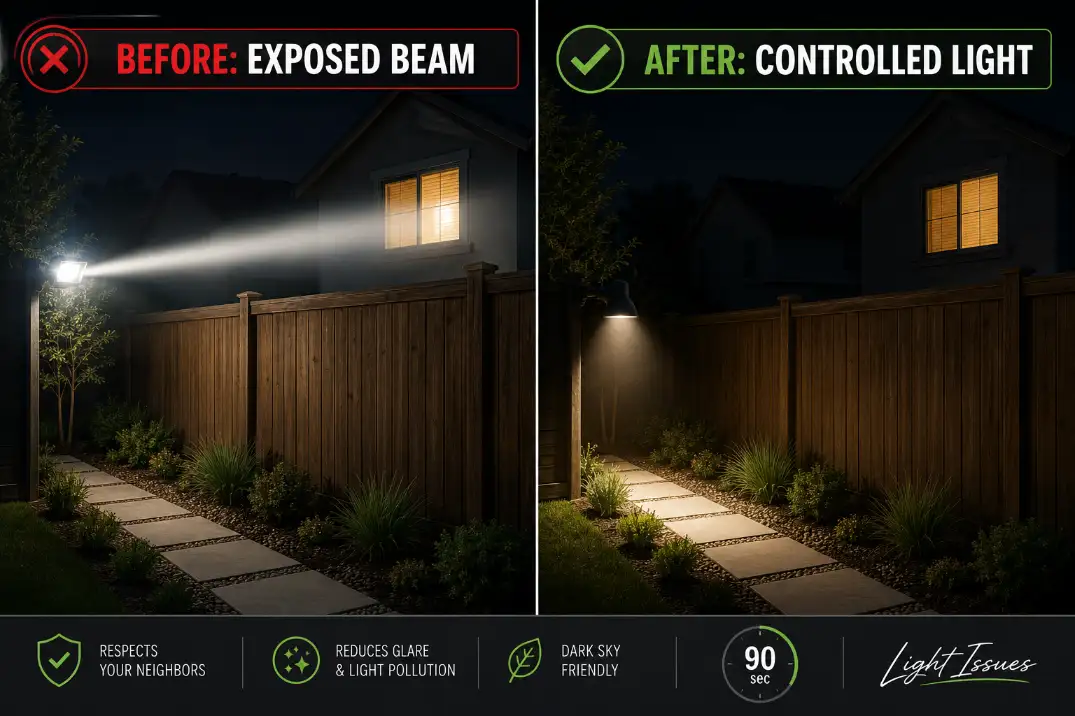
If the brightest part of the beam lands at the fence, on a neighboring wall, or above the target surface, the fixture is misdirected. Lowering brightness may reduce the complaint slightly, but it also reduces useful light where you actually need it.
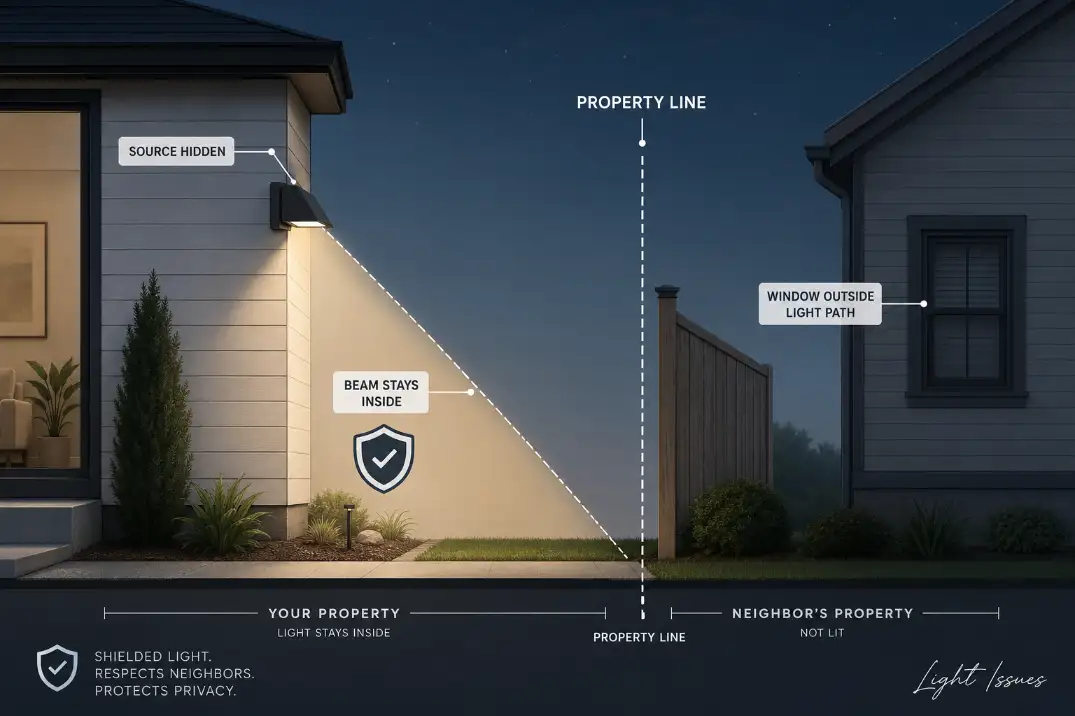
The better first move is to aim the beam so it dies on your own ground surface: a walkway, step, gate, driveway edge, or entry area.
Shielding beats dimming
A shield, hood, visor, louver, or full-cutoff fixture removes light going in the wrong direction. A weaker bulb simply makes the same mistake less intense.
If the bulb or LED board is visible from the side, choose a fixture where the source is recessed. You should see the surface being lit, not the glowing engine of the light.
Runtime changes the emotional weight
A light that turns on for 60 seconds when someone enters a driveway is not perceived the same way as one that shines into a window from 7 p.m. to 6 a.m.
Timers, motion delays, and dimmers often solve privacy complaints more cleanly than brightness changes. In residential areas, 30–120 seconds is usually enough for walking, unlocking, checking movement, or reaching a gate.
Where Privacy Problems Usually Start
The location matters as much as the fixture. Some parts of a property are naturally more privacy-sensitive.
Backyards need zones, not blanket brightness
Backyards often fail when one powerful light tries to cover everything: grill area, lawn, fence line, seating area, side gate, and walkway. That usually creates harsh exposure and poor comfort.
A better backyard uses smaller pools of light. Keep light low, warm, and aimed at task surfaces. Seating areas usually feel better with soft side lighting or low-level path lighting than with overhead floodlighting.
If the yard has a mix of bright patches and dark gaps, the problem may be broader than privacy. Uneven distribution is often a sign that one fixture is doing the job of several smaller lights.
Neighbor windows are line-of-sight problems
When the complaint involves a window, treat it as a sightline issue first. Stand where the window is, or as close as you can safely get from your side, and check whether the source or beam is visible.
A 6-ft fence does not automatically solve this. A fixture mounted 8–12 ft high can clear the fence easily if it is aimed flat. Second-story windows are even more sensitive because they sit directly in the path of high-mounted security lights.
Shared fences punish bad height
Fence-line lighting fails when the fixture is mounted higher than the barrier and aimed outward. This is common in narrow side yards, townhomes, and homes with close setbacks.
For shared fences, the safest lighting is low, shielded, and aimed inward. Path lights, recessed step lights, and downward wall fixtures usually create fewer privacy issues than broad floodlights.
Patios can feel exposed even without trespass
Not every privacy problem affects a neighbor. Patio lighting can make your own outdoor space feel like a stage if the light is too high, too cool, or aimed from above.
A patio that looks pleasant from the house may feel uncomfortable when people sit under the fixture. Bright overhead light flattens faces, exposes the seating area, and makes the surrounding yard feel darker. Softer side lighting usually protects privacy better than a ceiling-mounted glare source.
Fixtures That Most Often Cause Complaints
The fixture type does not decide everything, but some fixtures make privacy harder from the start.
Twin-head floodlights
Floodlights are not bad because they are bright. They are bad for privacy when they are used as broad backyard lighting instead of short, targeted task lighting.
A floodlight tilted only 20–30 degrees below horizontal can still send glare across a fence or toward an upper window. Near property lines, it should point steeply downward and inward.
Open decorative wall lights
Coach lights, lantern sconces, and open-bottom fixtures often expose the bulb from the side. They may look warm and residential, but they can still produce glare if the glowing source faces a neighbor or patio.
Frosted glass can soften the source, but it does not fully solve bad placement.
High-mounted security lights
Higher mounting improves reach, but it also increases spill risk. A light mounted 10–12 ft high has a clearer path over fences, shrubs, and privacy screens.
If the beam has to travel far to be useful, that is a clue the fixture may be in the wrong place. Find where the beam actually lands before deciding whether the fixture is strong enough.
Uplights and wall washers
Accent lights are easy to underestimate because they are decorative, not “security” lights. But an uplight aimed at a tree, wall, or column can bounce light into windows, especially after rain or snow.
In privacy-sensitive areas, use narrower beams, warmer color, and tighter aiming. If the reflected surface is pale stucco, white siding, glass, wet concrete, or snow, assume the light will travel farther than it looks on a dry night.
The Best Fix Order
Do not solve privacy lighting randomly. The order matters.
1. Aim the beam inside the property
For most wall lights and floodlights, the beam should land on the useful surface within your property, often about 10–20 ft from the fixture depending on mounting height and task area.
If the brightest area lands on the fence, neighbor’s siding, upper wall, or window line, it is aimed too far outward.
2. Hide the source from side view
A privacy-safe fixture hides the bulb or LED from normal viewing angles. Full-cutoff, recessed, hooded, or louvered fixtures are usually better near property lines than exposed floodlights or open sconces.
The routine fix stops making sense when the source stays visible after aiming. At that point, the fixture itself is the limitation.
3. Shorten the schedule
Use motion sensors, timers, dimmers, or smart controls so the light operates only when needed. A dusk-to-dawn fixture near a neighbor’s bedroom creates more conflict than a controlled light that activates briefly.
If a motion light keeps firing because the sensor sees a street, tree, branch, animal path, or passing car, the sensor pattern is the priority. The fixture may not need replacement; the detection zone may need correction.
4. Warm the color
Warm white light around 2700K–3000K is usually better around homes than cool 4000K–5000K light. Cooler light can feel sharper, especially near bedrooms, patios, and pale exterior surfaces.
Color temperature is not a substitute for shielding, but once the beam is controlled, it can make the result feel less harsh.
5. Replace or split the fixture when control is impossible
A poorly placed fixture can be the deeper issue. If one light is trying to cover four tasks, replacing it with a stronger model usually makes the privacy problem worse.
Two or three lower-output fixtures aimed at separate task areas usually create less trespass than one powerful fixture trying to cover everything.
Decision Guide: Which Privacy Problem Are You Solving?
| What you notice at night | Most likely issue | Best first fix | When to go deeper |
|---|---|---|---|
| Neighbor can see the bulb or LED | Direct glare | Shield or replace with recessed fixture | Source stays visible after aiming |
| Light lands on curtain or window shade | Window intrusion | Aim down and shorten runtime | Beam still reaches window after adjustment |
| Motion light turns on every few minutes | Sensor nuisance | Reduce sensitivity and delay | Sensor cannot avoid street, trees, or pets |
| Backyard feels exposed | Overhead or overwide lighting | Use lower, warmer, zoned lighting | One fixture is lighting the whole yard |
| Fence blocks view but not light | Mounting height problem | Aim inward and lower beam angle | Fixture is mounted too high for the location |
| Patio feels like a stage | Poor comfort lighting | Replace overhead glare with side or low lighting | Seating area needs a layered lighting plan |
What Weather and Site Conditions Change
Privacy lighting problems are not static. The same fixture can behave differently by climate and season.
In humid Florida neighborhoods, wet pavement, pool screens, glossy paint, and glass can reflect more light than expected. After rain, a beam that seemed controlled may become more visible from the side.
In dry Arizona yards, pale stucco, gravel, and concrete can bounce light sideways. The fixture may be aimed down but still feel intrusive because the surrounding surfaces are bright.
In northern states, snow can turn a modest light into a broad reflector. A fixture that feels acceptable in October may feel harsh in January when snow reflects light upward into windows.
In coastal California or Southeast homes, wind and salt air can loosen adjustable fixture heads. A floodlight that was aimed correctly in spring may sag or rotate by fall. If it keeps drifting, tightening the knuckle is temporary; the fixture hardware may need replacement.
Before It Becomes a Neighbor or HOA Problem
Outdoor lighting privacy issues are easier to solve before they turn into a dispute. The best response is specific, not defensive.
First, inspect the light from the receiving direction if possible. At minimum, stand at the fence line, sidewalk, side yard, or opposite window and look back toward the fixture.
Second, make the obvious corrections: aim the beam down, hide the source, shorten the timer, reduce sensor sensitivity, and warm the color.
Third, if a neighbor complains, offer a concrete change. “I can lower the beam and set the timer to 90 seconds” is better than arguing that the light is not very bright.
Finally, check local rules if the issue continues. Some HOAs, municipalities, and dark-sky ordinances address glare, fixture shielding, operating hours, or light crossing property lines. The rules vary, but the practical standard is consistent: useful light should stay where it is needed.
How This Pillar Connects to More Specific Privacy Problems
A privacy-safe lighting plan is not one universal fix. It depends on the setting.
If the issue is a backyard, the solution is usually softer zones instead of one bright floodlight. If the problem is a neighbor’s window, the priority is line of sight: source visibility, beam height, and runtime.
If the complaint involves repeated nighttime activation, the sensor pattern matters more than the fixture’s label.
Floodlights deserve special caution because they are often used as all-purpose backyard lights even though they are designed for short, targeted coverage.
Patios need a different approach because the goal is comfort and privacy, not simply illumination. Shared fences require the strictest beam control because there is little distance for spill light to fade.
That is the main rule: diagnose the privacy failure before choosing the product. Light trespass, glare, window intrusion, motion nuisance, floodlight overreach, patio exposure, and shared-fence spill may look similar at night, but they are solved differently.
The Best Privacy-Safe Outdoor Lighting Setup
A good setup does not make the entire property bright. It lights the right surfaces and keeps the source out of the wrong sightlines.
For most homes, that means warm 2700K–3000K light, shielded fixtures, downward aiming, short motion delays, and separate fixtures for separate tasks. The goal is not darkness. The goal is control.
If a light helps you see a step, unlock a door, identify movement, or use a driveway without shining into someone else’s window or making your own patio feel exposed, it is doing its job.
If it turns another person’s bedroom, fence line, or seating area into part of your lighting plan, the fixture needs to be corrected.
For broader official guidance, see the National Park Service outdoor lighting principles.