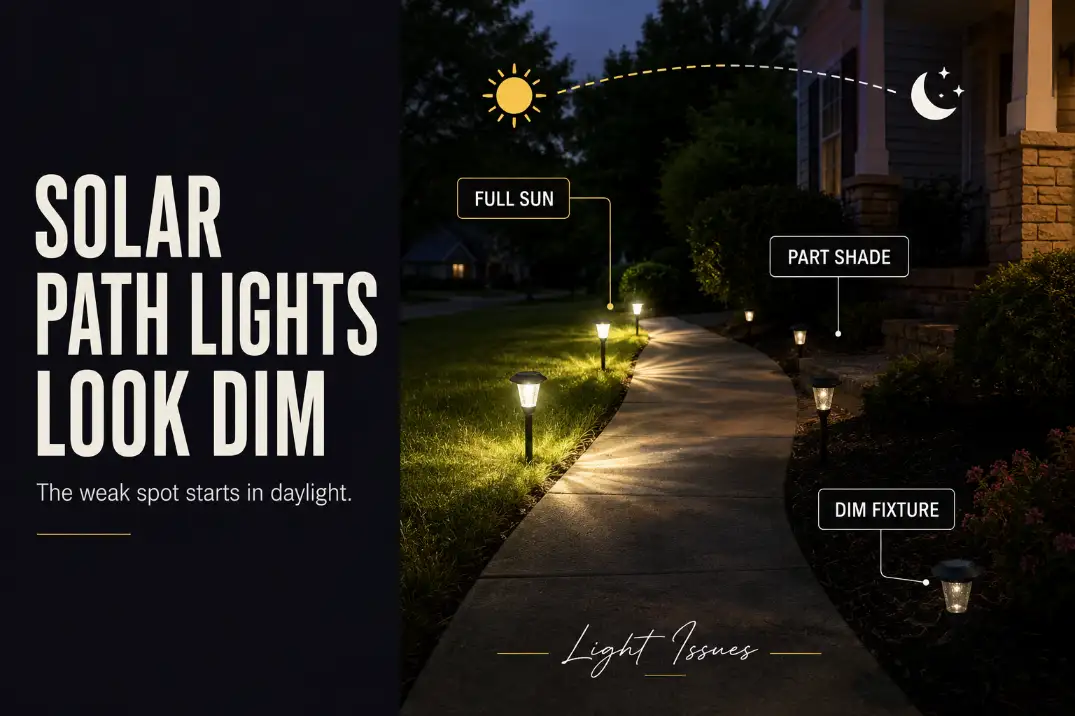
Solar path lights usually look dim and uneven because the row is not charging evenly. The dim part is an energy problem: dirty panels, weak batteries, poor sun exposure, or low-output fixtures.
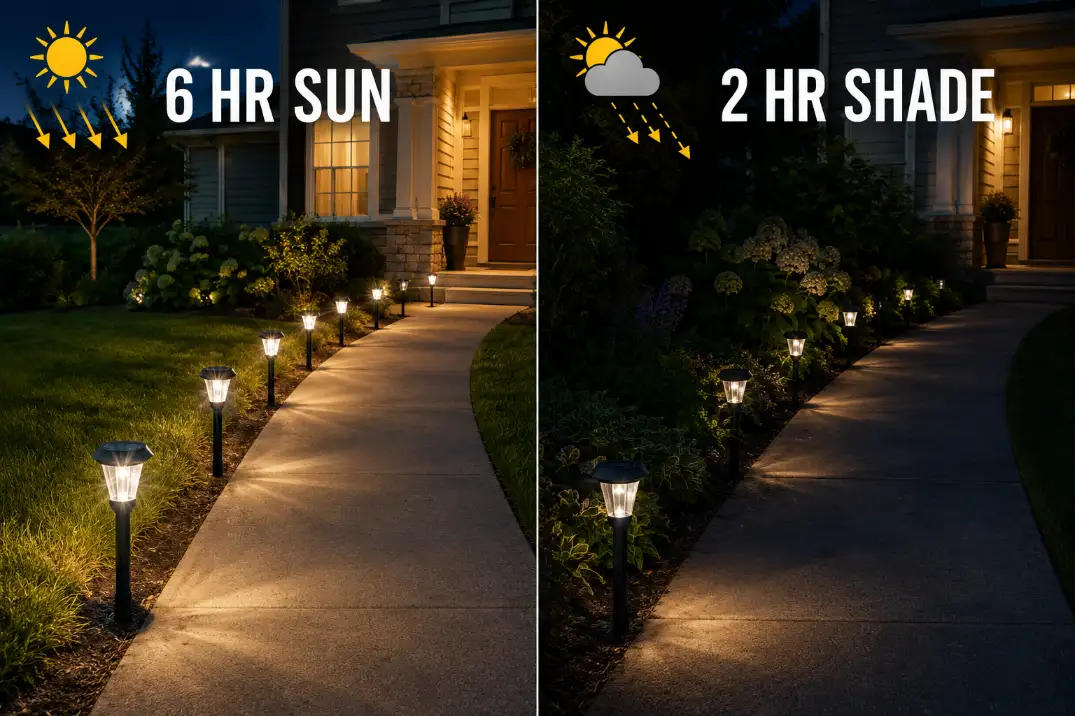
The uneven part is a consistency problem: one light may get 6–8 hours of direct sun while the next gets only 2–3 hours behind shrubs, porch shade, a fence, or a roof overhang.
The first fix is not replacing the whole set. Read the pattern first. If a fixture is dim as soon as it turns on, check panel dirt, sun exposure, and product output. If it starts bright but fades within 2–4 hours, suspect weak battery storage or poor daily charging.
If every light runs shorter after a cloudy week, that may be normal. If the same one to three fixtures fail after clear days, the problem is local.
The Short Answer: Uneven Solar Lights Usually Start With Uneven Charging
Solar path lights look uneven at night because each fixture acts like its own small lighting system. Every light has its own solar panel, rechargeable battery, dusk sensor, and LED. A wired path light row may share one transformer and cable run, but solar path lights do not share one power source.
That difference matters. A solar path light can look weak even when the LED still works, because the fixture did not store enough daytime energy. When several lights along the same walkway receive different amounts of usable sunlight, the row becomes patchy after dark.
Dimness is the symptom; charge imbalance is often the mechanism
The visible symptom is dim light. The underlying mechanism is usually weak energy capture or weak energy storage. That is why replacing the glowing part of the fixture does not always solve the problem.
A clean fixture in open sun may still look weak if the original product is only a soft marker light. A good fixture may also look weak if its panel sits under moving shade for most of the afternoon. Before blaming the fixture, compare how much direct sun each light actually receives.
The same bad spot can ruin a new fixture
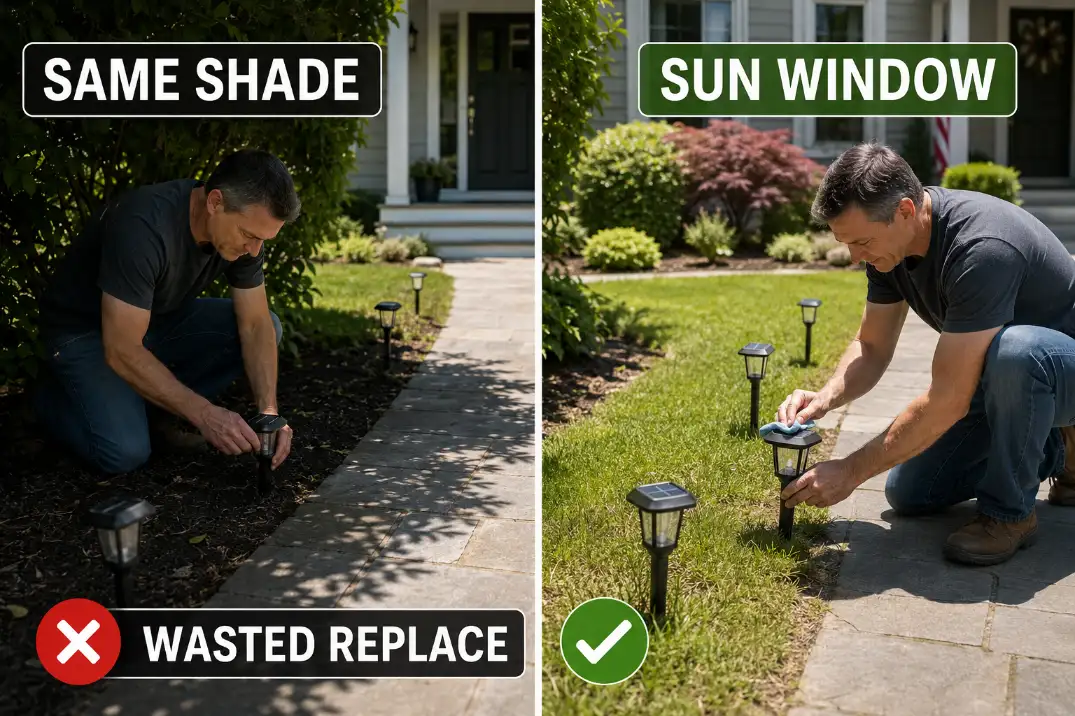
The most common wasted fix is installing a new solar path light in the exact same shade pocket. The fresh battery may make the new fixture look better for a few nights, but the site condition has not changed. If the panel still gets too little sun, the new light will start behaving like the old one.
A better first test is simple: move the weak light into the sunniest position for one or two clear days. If it improves, the location was the main problem.
Quick Pattern Diagnosis
Use the nighttime pattern before buying batteries, adding more lights, or replacing the set. The goal is to separate a charging problem from a battery problem, spacing problem, sensor problem, or low-output product limitation.
| Pattern | Most likely cause | Best first move |
|---|---|---|
| Dim as soon as it turns on | Dirty panel, poor daytime charge, or low-output fixture | Clean the panel and compare direct sun hours |
| Starts bright, fades in 2–4 hours | Weak battery storage or poor daily recharge | Test after one full sunny day |
| Same shaded lights fail nightly | Local sun exposure problem | Move one fixture to a sunnier spot |
| Whole set weak after cloudy week | Weather or seasonal runtime loss | Wait for a clear charge day before replacing parts |
| Lights are bright but walkway has dark gaps | Spacing, beam spread, or aim | Adjust layout after brightness is stable |
| One light turns on later than the others | Sensor sees porch, street, or reflected light | Check nearby light sources at dusk |
The strongest diagnostic signal is consistency. If every light loses runtime after several cloudy days, the system may simply be undercharged. If the same fixture fades early after a sunny day, that fixture’s location, panel, battery, or sensor needs attention.
What Homeowners Usually Misread First
The mistake is not usually ignoring the light. It is judging the light only after dark. With solar path lights, the nighttime result is mostly a delayed report on daytime conditions.
Bright-looking shade is still shade
A front walk can look bright to the eye while a small solar panel receives very little direct sunlight. Open shade, tree-filtered light, porch shade, and fence shadow are not the same as direct sun on the panel.
This is the condition people often overestimate: general brightness around the fixture. The panel needs usable exposure, not just a bright-looking yard.
In a Midwest yard with summer tree canopy, the panel may be shaded by midafternoon. In a Florida yard, humid film and plant growth can reduce charge even when the walkway looks open. In a dry Arizona yard, dust can dull the panel surface faster than the homeowner expects.
If several fixtures along the same route are losing charge, the broader issue may be closer to Why Your Solar Outdoor Lights Aren’t Charging and How to Fix It than to a simple path-light placement mistake.
Dirty panels can look like weak batteries
Dust, pollen, sprinkler minerals, mildew film, salt residue, and leaf debris can reduce panel performance enough to make a marginal fixture look tired. This does not always look dramatic. A slightly cloudy panel can still appear “clean enough” from the walkway.
Clean the panel with a soft damp cloth, let the fixture charge through one full sunny day, and compare its output that night. If brightness improves, the fixture was not simply worn out.
If it improves briefly but fades again within a few nights, battery storage or poor exposure may still be involved.
Pro Tip: Clean the solar panels before moving or replacing fixtures. One sunny-day test can tell you whether the problem is charge capture, not just the fixture itself.
Some solar path lights are markers, not walkway lights
Some cheap solar path lights are designed to mark the edge of a path, not to illuminate the walking surface evenly. That distinction explains many disappointing installations. The lights may be working, but their output is too soft to create a smooth, usable walkway glow.
This is the condition people often underestimate: the fixture’s original ceiling. A low-output solar light can look acceptable when new, then become visibly patchy as soon as one or two fixtures receive less charge than the rest.
The Mechanism: Daytime Charge Becomes Nighttime Unevenness
Solar path lights do not become uneven only at night. They become uneven during the day, then reveal that unevenness after dusk.
Panel exposure controls the starting point
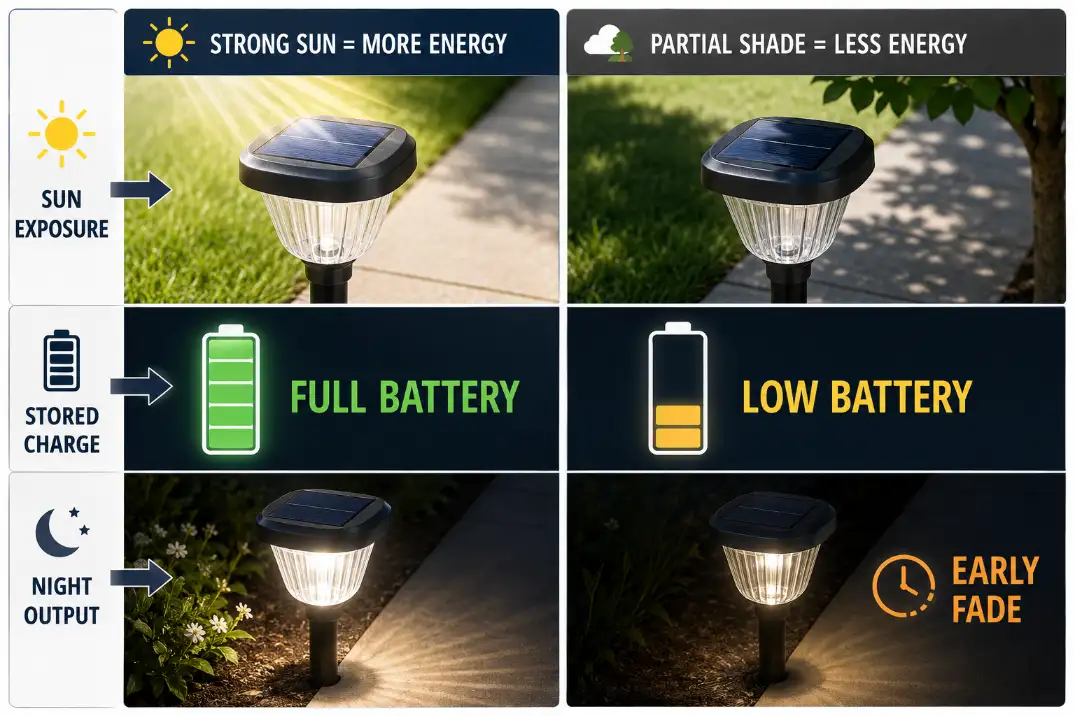
The solar panel collects energy during the day. If one fixture gets 6–8 hours of direct sun and another gets only 2–3 hours of interrupted light, those two batteries do not start the night equally charged.
A light that is already dim at dusk often points to poor charge capture, a dirty panel, or a low-output fixture. A light that starts strong but fades after 90 minutes or a few hours points more strongly toward weak battery storage or an incomplete daily recharge.
Battery capacity controls the fade
The rechargeable battery decides how long the fixture can maintain useful output. As the battery ages, it may still accept some charge but fail to hold enough energy for a stable evening.
That is why runtime matters more than the first few minutes of brightness. A fixture that glows weakly for 8 hours is different from a fixture that starts bright and dies after 90 minutes.
The first may be low-output by design. The second is more likely losing battery capacity or failing to charge fully.
Fix Solar Path Lights in the Right Order
The best first fix is to clean the panels, compare direct sun hours, and test runtime after one sunny day before replacing batteries or fixtures. That order prevents the most common mistake: changing parts before proving the location can support the light.
1. Compare direct sun hours
Watch the row in late morning, midafternoon, and early evening. Mark which lights get direct sun and which fall into moving shade. A solar path light with a practical 6-hour sun window will usually outperform one with only a short 2-hour window, even if both are new.
If one fixture is weak, move it to the brightest location for a day or two. If it recovers, the fixture is not the main problem. The old position is.
2. Remove small shade and panel obstructions
Trim grass that leans over the panel. Cut back shrubs that cover the fixture by midsummer. Straighten tilted lights so the panel faces open sky. Clean cloudy panel surfaces gently.
Overgrown planting is easy to miss because the light may still be visible from the walkway while the panel is partly blocked from above.
A shrub that was harmless in spring can shade a 12–18 inch fixture by summer. If plant growth is part of the pattern, Solar Garden Lights Blocked by Overgrown Bushes is the more direct fix path.
3. Replace batteries only after a fair charge test
Battery replacement makes sense when the fixture is intact, dry inside, clean, and still fades much earlier than the others after one full sunny day.
It makes less sense when the fixture receives less than about 4–5 hours of direct sun as a practical troubleshooting threshold. A new battery may help briefly, but it will still be undercharged in the same weak location.
Also check the fixture condition before buying batteries. If the housing is cracked, contacts are corroded, or water has entered the battery compartment, replacement may be more practical than patching one small part.
4. Re-space only after brightness is stable
Do not solve weak charging by adding more lights too early. More fixtures can hide dark gaps, but they do not make a shaded fixture charge better.
First make the existing lights perform as evenly as possible. Then adjust the layout. Most small residential path lights look smoother around curves, steps, and entry transitions when spacing is closer to 4–6 feet than 8–10 feet.
If the lights are bright but the walkway still has dark breaks, Why Pathway Lights Have Dark Gaps Between Them explains that layout problem more directly.
When the Usual Fix Stops Making Sense
Some solar path light problems are not worth chasing fixture by fixture. The site may simply be asking too much from a small self-contained solar light.
Deep shade beats most small solar fixtures
A walkway under mature trees, a north-facing wall, a roof overhang, or a covered entry may never give small solar path lights enough charging time. Cleaning panels and replacing batteries can help briefly, but the basic sun window is still weak.
If a fixture cannot realistically get about 4–5 hours of direct sun, a better solar path light may still disappoint. A remote-panel solar fixture can help when the panel can be placed in a sunnier spot while the light stays near the path. Otherwise, a wired low-voltage path system may be the more reliable solution.
Replacing the fixture is wasted if the shade stays
The new light is not really a new solution if it goes back into the same bad charging location. It may look brighter for a few nights because the battery is fresh, but the same shade pattern will start pulling it down again.
A better rule is simple: move before replacing. If moving the weak fixture into sun fixes the output, the fixture was not the first problem.
Solar Unevenness vs Wired Path Light Unevenness
Solar and low-voltage path lights can both look dim and uneven, but the cause pattern is different. Solar problems are usually local to each fixture. Wired problems often follow cable layout, voltage, transformer load, or connection quality.
| Pattern | Solar path lights | Low-voltage path lights |
|---|---|---|
| One fixture is dim | Usually shade, dirt, battery, or local sensor exposure | Often splice, connection, fixture, or local damage |
| End of the row is dim | Not usually a shared-line issue | Often voltage drop or cable layout |
| Worse after cloudy weather | Common with solar | Usually unrelated unless moisture is involved |
| Improves after moving fixture | Strong sign of sun exposure problem | Usually only changes aim or beam direction |
| All lights dim after adding fixtures | Not relevant to self-contained solar lights | Often transformer load or voltage drop |
If your path lights are wired instead of solar, do not use solar troubleshooting logic. A wired system that gets dimmer after added fixtures is a different problem, and Landscape Lights Dimmer After Adding Fixtures fits that situation better.
Other Causes That Can Make Solar Path Lights Look Uneven
Once charging, batteries, and spacing are ruled out, a few smaller factors can still change the way the row looks after dark.
Sensors can change timing, not just brightness
A solar path light near a porch light, streetlight, garage coach light, reflective window, or bright security fixture may turn on later than the others. That delay can make the row look uneven even when the battery is not the main issue.
Timing problems are different from runtime problems. If one light turns on late but then runs steadily, check what the sensor sees at dusk.
If it turns on normally but fades early, look back at charge and battery storage. For timing-related cases, Solar Lights Not Turning On Near Streetlights is a better match.
Aim can make a healthy light look weak
Some path lights are bright enough, but their beam falls into grass, mulch, or planting instead of the walkway. That creates the impression of low brightness because the walking surface remains dark.
If the fixtures glow strongly but the path still looks poorly lit, Why Path Lights Shine Into Grass Instead of the Walkway is closer to the real problem.
Questions People Usually Ask
Should I replace all solar path lights if only a few are dim?
Not first. Clean the panel, move one weak fixture into full sun for a day or two, and compare it that night. If it improves, the location is the problem. If it stays dim in good sun after cleaning, the battery or fixture is more likely failing.
Why do my solar lights look worse in winter?
Winter reduces charging time. Shorter days, lower sun angle, cloudier weather, and snow or ice on panels can all reduce runtime. The key distinction is whether every light gets weaker together or the same few fixtures fail earlier than the rest.
Are brighter solar path lights always better?
No. Brighter lights can make uneven spacing, glare, and poor aim more obvious. The goal is steady path guidance, not maximum brightness. A moderate fixture placed in reliable sun and aimed at the walking surface usually looks better than a brighter fixture sitting in shade.
The Best Way to Fix Dim and Uneven Solar Path Lights
Solar path lights usually look dim and uneven when each fixture receives a different amount of usable sunlight during the day, stores a different amount of battery charge, and produces a different level of nighttime output. That is the core pattern to solve.
Start with the conditions that control charge: direct sun, clean panels, plant shade, nearby artificial light, and battery runtime after one sunny day. Then decide whether the fixture needs a new battery, a better position, tighter spacing, or a different lighting system.
The fix that wastes the most time is replacing a fixture without changing the poor charging condition around it. The fix that works more often is simpler: equalize the sun exposure first, confirm runtime second, and replace parts only after the light has had a fair chance to charge.
Since this problem starts with how much daytime energy each small fixture can store, the U.S. Department of Energy offers a useful baseline for understanding the panel-and-battery side of outdoor solar lighting.