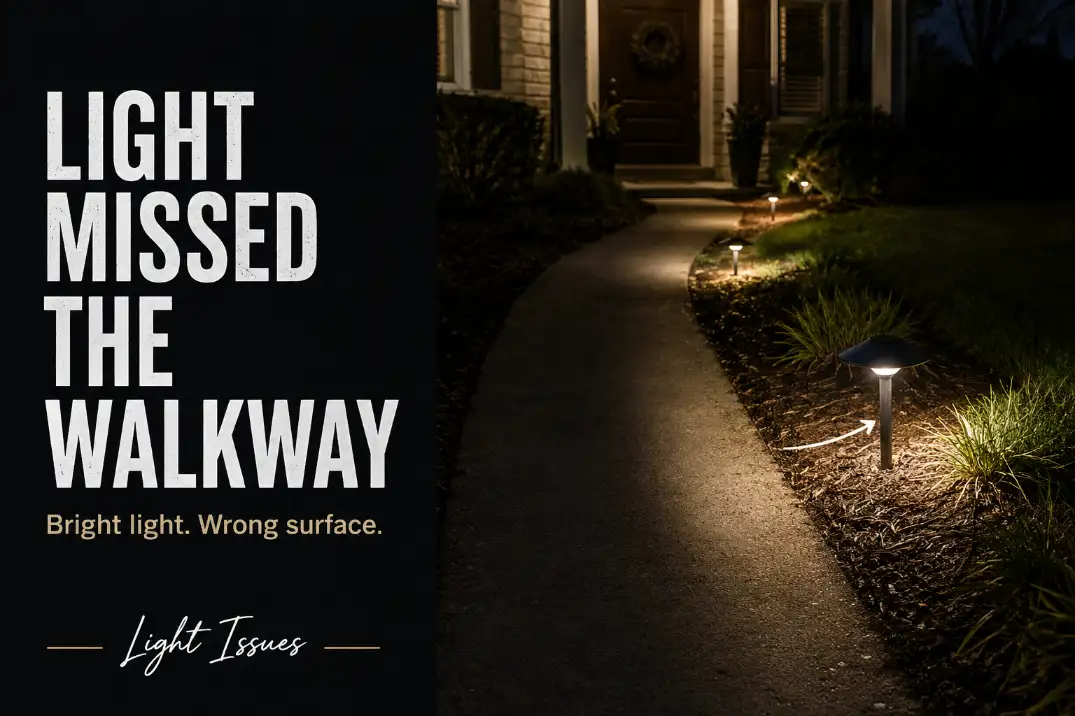
Path lights usually shine into grass instead of the walkway because the fixture is placed too far from the walking edge, tilted away from the path, buried behind plant growth, or using a head that throws light outward instead of across the surface.
Start with three checks: where the brightest pool lands, whether the stake leans even 5 to 10 degrees, and whether the fixture sits too far beyond the path edge, often more than about 12 inches for many short residential path lights. This is not the same as a weak-light problem.
If every fixture is dim, voltage, lamp output, or transformer load may be involved. If the fixture is bright but the grass is brighter than the walkway, geometry comes first.
When more than half the visible light lands in lawn, mulch, or planting bed, buying a brighter bulb usually makes the wrong surface brighter.
The Real Problem Is Usually Beam Placement
A path light does not need to flood the yard. It needs to place a controlled pool of light across the walking surface so the edge, direction, and next step remain readable. When the grass glows and the walkway still feels uncertain, the system is not necessarily underpowered. It is spending useful light in the wrong place.
The brightest spot tells the truth
The most useful nighttime check is simple: stand 20 to 30 feet back and look for the brightest part of each light pool. A healthy path light should place useful light on or across the path edge.
If the brightest patch sits 6 to 18 inches into the lawn or planting bed, the fixture is doing work, but not walkway work.
This is why replacing bulbs often disappoints. A stronger lamp does not move the beam. It usually makes the grass brighter, increases contrast, and can make the walkway feel even less balanced.
Yard glow is not walkway coverage
Grass, pale mulch, light gravel, and wet leaves can reflect enough light to make the yard look “lit” from the porch. That can fool you into thinking the path is covered.
The better test is to walk the path at normal pace. If your foot placement still falls into shadow every few steps, the glow beside the path is cosmetic.
For a broader version of this same targeting problem, Outdoor Lights Miss the Target Area explains why a fixture can look active while the useful area remains underlit.
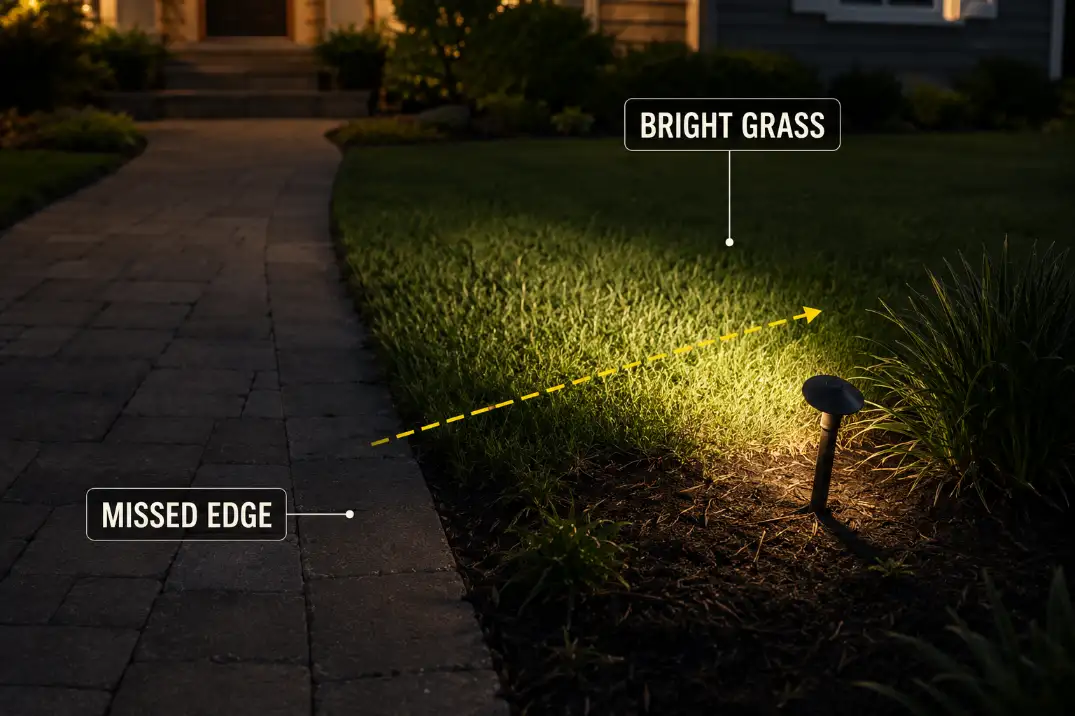
Why Path Lights Drift Off the Walkway
Most grass-facing path lights fail for physical reasons before electrical ones. Low voltage problems can cause dimming, flicker, or partial failure, but a bright fixture aimed at grass is usually a placement, angle, or fixture-head issue.
The fixture sits too far from the path edge
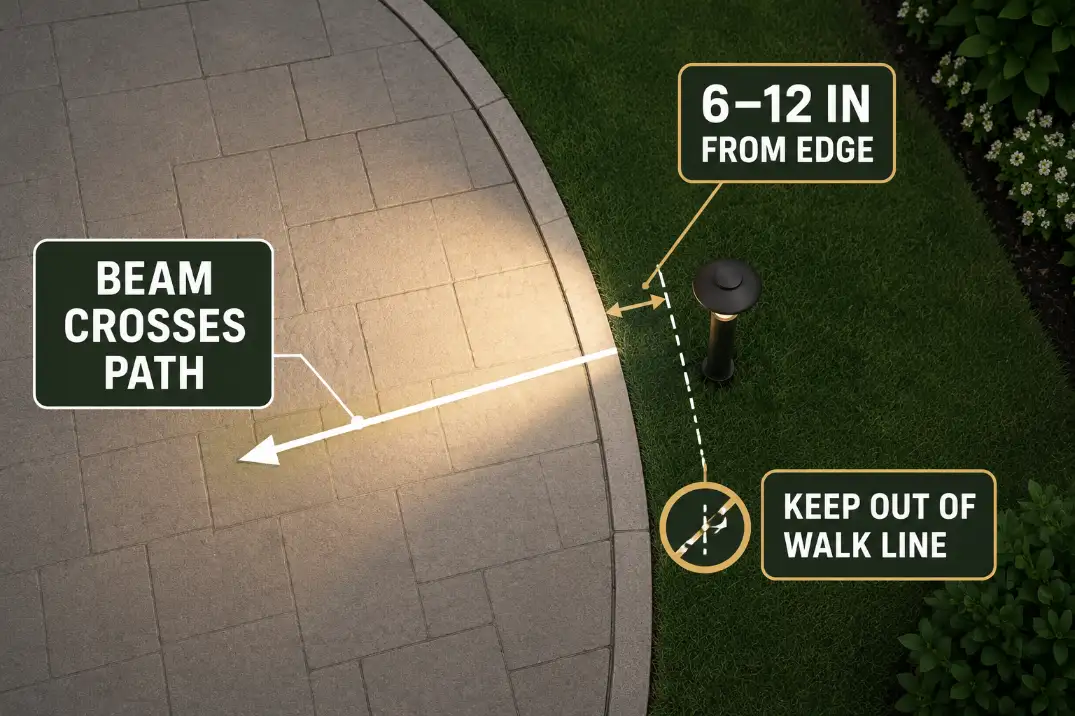
Many residential path lights work best when the stem sits close enough for the beam to cross the walkway edge, often about 6 to 12 inches from the hardscape depending on the head shape and planting. Push the fixture 18 to 24 inches into the bed, and the brightest part of the beam may never reach the walking line.
This often happens after edging, new mulch, or plant growth changes the bed boundary. The fixture still looks neatly placed, but the light now lands short.
The stake is leaning after soil movement
A small lean matters. A stake leaning 5 degrees away from the path can move the beam noticeably. A 10-degree lean can turn a path light into a lawn accent.
This is common after irrigation, freeze-thaw movement in northern states, or soft soil after 24 to 48 hours of rain. In dry climates, the same thing can happen when loose soil around the stake no longer holds after repeated watering. Straightening the fixture once may not last if the stake is sitting in unstable soil.
Path lights placed directly in turf are especially vulnerable. Mowing, edging, foot traffic, and sprinkler spray can push them out of alignment over a season. A light in the mowing zone may look corrected tonight and be aimed back into grass next month.
The cap throws light outward instead of across the path
Not every path light head controls light the same way. Some mushroom-style caps spread light broadly around the fixture. Some open lenses glow outward with little direction. Better shielded heads can place more of the beam down and across the walking surface.
This does not mean one style is always wrong. It means adjustment has limits. If the fixture head cannot aim or shield the light, you may straighten the stake and still get a bright ring in the grass.
Pro Tip: Adjust path lights after dark, not by daytime alignment. A fixture can look square in daylight while the optics inside the head still throw the useful beam away from the path.
The Fix People Usually Try First Is the Weakest One
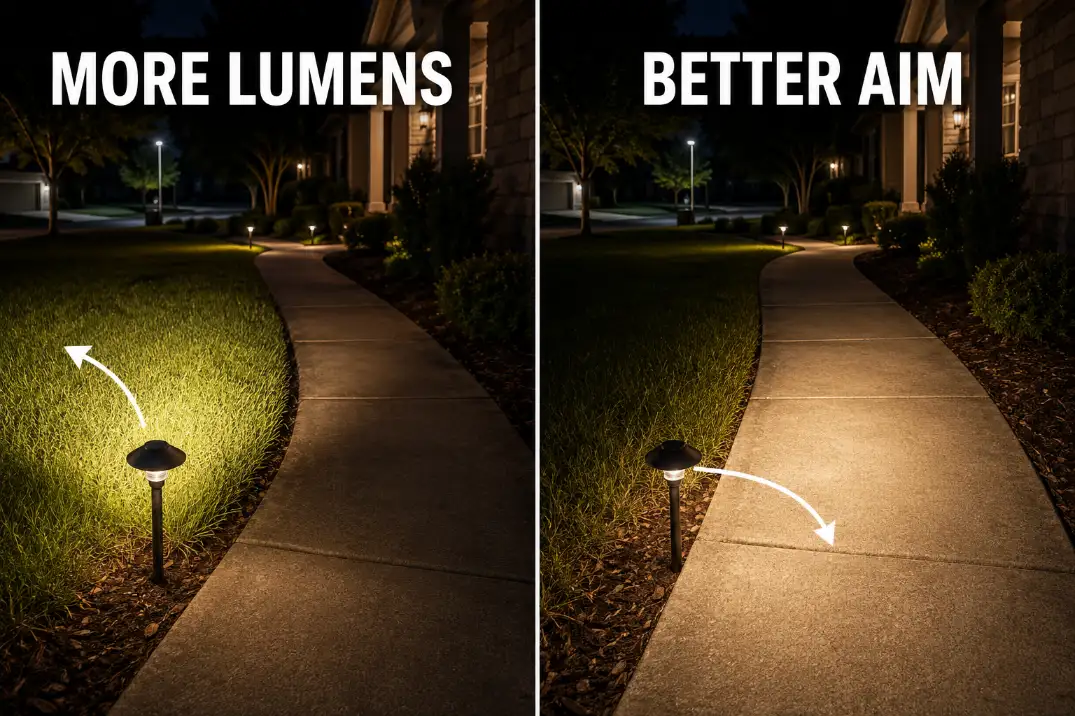
The most common wasted fix is adding brightness before correcting aim. It feels logical because the walkway looks dark. But if the grass is already bright, the system has enough output to reveal the area. The light is simply landing in the wrong place.
More lumens can make the problem louder
A 300-lumen fixture aimed badly can perform worse than a 150-lumen fixture aimed well. The brighter fixture may make turf, mulch, or plant texture dominate the scene while the walkway edge still reads poorly. It can improve curb appeal from the street without improving walking comfort.
A walkway needs readable edges and steady direction cues. It does not need every nearby surface to glow.
If the issue is not grass spill but irregular pools along the walking line, Pathway Lights Look Uneven at Night is the closer diagnosis. In this case, though, aim and beam landing point should be fixed before spacing.
Electrical checks come after the geometry test
There is one clear exception: if all fixtures on the run are weak, fading, or dimmer toward the end, then voltage drop or load balance may be involved. But if one fixture shines strongly into the grass while the path stays dark, a voltage test is not the first move.
Use this rule: bright but misplaced usually means placement; weak everywhere usually means power, lamp output, or transformer load.
For a full power-side diagnosis, use Low Voltage Path Lights Not Working: Step-by-Step Diagnosis after you rule out beam direction.
How to Move the Light Back Onto the Walkway
The fix should move from reversible to structural. Do not redesign the whole run until one fixture has been tested properly.
Reset the fixture at night
Turn the system on after dark and adjust one light at a time. Press the stake vertical, rotate the head toward the walkway, and judge the result from normal walking height. Wait 10 to 15 seconds after each adjustment before deciding, because your eyes need a moment to read contrast.
The goal is not to make the fixture look centered from above. The goal is to make the walking surface readable from the direction people actually approach.
Move the stake closer to the edge
If rotation does not move enough light onto the walkway, shift the fixture closer to the path. A move of 4 to 8 inches can change coverage more than a brighter bulb.
Keep the fixture outside the walking line, but close enough that the beam crosses the edge instead of dying in the bed.
On curves, light the walking line, not the outline of the curve. A fixture on the outside of a bend may look aligned with the border while throwing most of its pool into grass. The useful test is whether the inside edge, turn, and next step read clearly as you walk.
Clear plants only when they are the real blocker
Low ornamental grasses, liriope, hostas, seasonal annuals, and mulch mounds can intercept the lower beam before it reaches the path. A plant only 8 to 12 inches tall can block a low fixture if it sits directly between the head and the walkway edge.
Do not over-prune a bed just to save a bad light location. Trim minor growth first. If the plant shape is intentional and the light is buried behind it, move the fixture instead.
Quick Diagnostic Comparison
| What You See at Night | More Likely Cause | Best First Move |
|---|---|---|
| Grass is bright, walkway edge is dim | Fixture aimed or placed wrong | Rotate, level, or move the stake |
| Whole run is weak or fading | Voltage/load issue | Test power before changing placement |
| Beam misses after rain or irrigation | Stake leaning in soft soil | Reset stake and stabilize soil |
| Light works on straight path but misses at curve | Beam follows border, not walking line | Aim toward the walking line |
| Beam reaches path but surface still looks dull | Dark or wet walkway material | Recheck after the surface dries |
| Plant bed glows but foot placement feels uncertain | Beam blocked or too deep in bed | Clear obstruction or relocate fixture |
When Adjustment Stops Making Sense
Sometimes the standard fix runs out of room. That usually means the layout and fixture type are fighting each other.
The bed is too wide for the fixture
If shrubs, edging, irrigation lines, or cable location force the fixture deep into the planting bed, a short path light may not throw useful light far enough. At that point, repeated aim tweaks become maintenance, not repair.
The better fix is to relocate the fixture closer to the path, change the fixture head, or use a different lighting approach for that section.
The walkway surface absorbs more light than the grass
Dark pavers, wet concrete, black mulch edges, and heavily textured stone can make a correctly aimed light look weaker than it is. After rain, a dark walkway may need several hours to dry before the beam pattern reads normally again.
The distinction is important. If the beam edge reaches the path but the surface still looks dull, the material is absorbing light. If the beam edge never reaches the path, the fixture is misplaced.
The layout is decorative, not functional
Some path lights are installed mainly to decorate the planting bed. That is not automatically bad, but it should not be judged as walkway lighting. If the fixtures sit behind plants, point toward lawn texture, and leave the walking line in shadow, they are accent lights in practice.
For a wider placement correction, Fix Poor Outdoor Light Placement is the better next step because the problem is no longer one tilted fixture. It is the lighting layout.
A Better Night Test Before You Call It Fixed
Do the final check from three positions: the street, the middle of the walkway, and the front door. From each position, the path edge should read without the fixture head becoming the brightest object. You should see where to step, not stare into the lamp.
A good correction usually looks calmer, not brighter. Some spill onto grass is normal, especially beside narrow concrete walks. The problem is when the grass becomes the main lit surface and the walkway feels like the leftover area.
If the lawn remains brighter after two careful night adjustments, stop treating the issue as a bulb problem. The fixture is either in the wrong place, using the wrong head, or trying to light a path from too far inside the bed.
For broader guidance on aiming outdoor light only where it is needed, see DarkSky International.