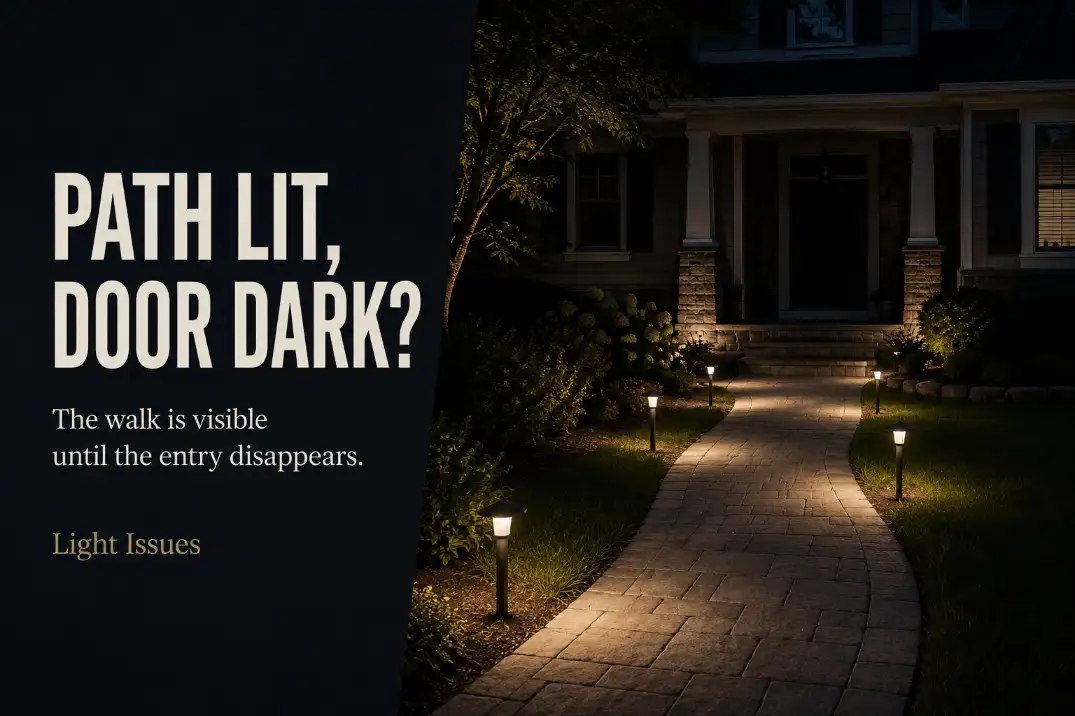
A front walk is not truly lit just because the path edges glow. It works only when the light carries a person from the arrival point to the actual door without a dark pause, unclear turn, or missing porch handoff.
That is where many front walk lights fail. They make the first stretch of the walkway look finished, but the final approach still feels uncertain. From the sidewalk or driveway, the visitor can see the path, then lose the entry in the last few feet before the porch.
This is not mainly a fixture-count problem. It is a route-continuity problem. The lighting has to connect the curb view, walking line, bend, porch edge, final approach, and door lead-in as one readable nighttime route.
The useful test is not how the fixtures look in daylight. It is whether someone walking after full dark can understand where to go next before they have to guess.
Path Ends Too Early
The first layout failure is a path-light sequence that stops before the entry decision point. The walkway may look balanced from the street, but the last pool of light fades before the porch, step, landing, or front door becomes readable.
This happens when path lights are placed as a border instead of a route. The fixtures follow the lawn edge, planting bed, or walkway curve, but they do not ask where the person needs the next visual cue. A clean row of lights can still leave the visitor stranded at the point where walking turns into arriving.
The final light on the walk often matters more than the first one. If that last fixture is too far from the porch edge, the eye sees the walkway behind it but not the destination ahead. The path looks finished as a landscape feature, while the entry still feels detached.
That is different from ordinary pathway light dark gaps. A dark gap in the middle of a path interrupts walking rhythm. A dark gap near the door interrupts arrival. It makes the person slow down, search for the next surface, and guess where the entry begins.
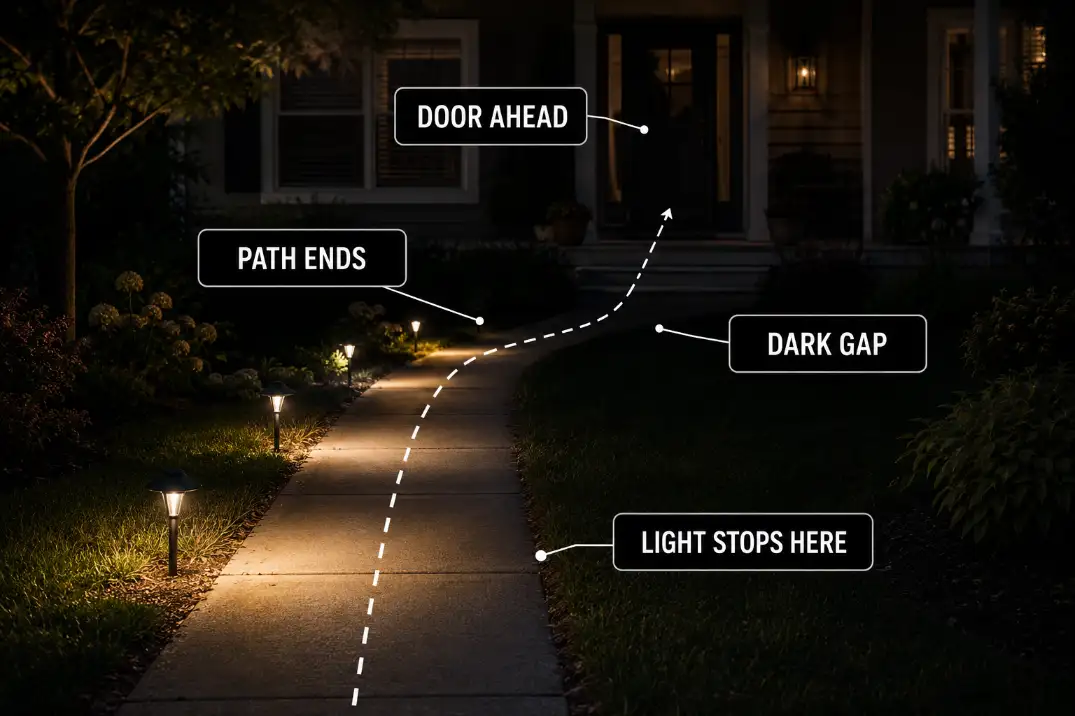
The practical rule is simple: the last path light should not only mark where the walkway has been. It should help reveal where the person is going next.
Dark Porch Gap
The porch gap is the handoff zone between the end of the walkway lighting and the beginning of the entry. It can be only a few feet wide, but if it falls dark, the whole front approach feels unfinished.
This gap often sits between the final path light and the first porch light. During the day, it looks like normal transition space. At night, it can hide the porch edge, a low step, a threshold change, a railing post, a planter, or the point where the walkway widens into a landing.
A bright porch light does not automatically solve it. If the porch fixture throws most of its light onto the wall, ceiling, or door face, the visitor may see the house without seeing the walking surface. The door is visible, but the landing still does not feel connected to the walk.
This is where front walk lighting overlaps with step visibility without becoming a full step-light problem. If the porch edge itself disappears, the issue may need a deeper look at porch lights that hide steps, but this page’s main concern is the route handoff before that point.
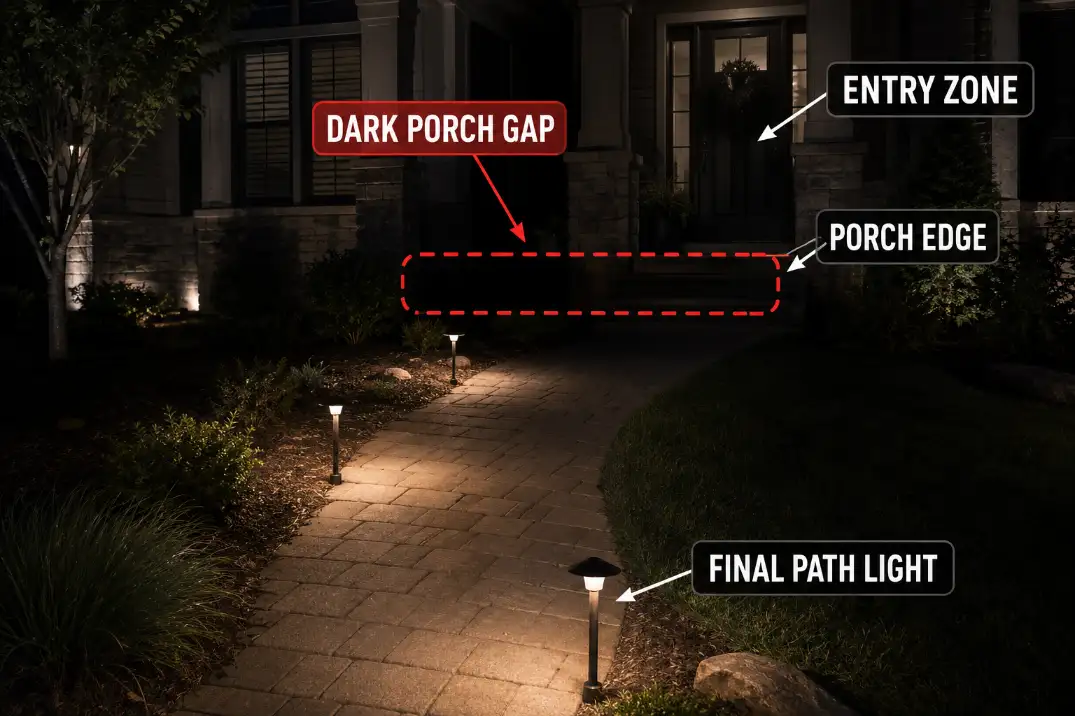
Judge this gap from the arrival direction, not from the porch looking outward. If the walkway looks bright but the porch edge does not read from the curb, driveway, or normal guest approach, the handoff is broken.
The fix is not always more brightness at the door. Often the better layout move is softer overlap between the last path cue and the first entry cue.
Walkway Bend
A bend breaks the route when the light follows the decorative curve but not the walking decision. The fixtures may appear evenly spaced, yet the person reaches the turn and loses the next cue toward the door.
On a straight front walk, the entry may stay visible beyond the path lights. On a curved or angled walk, the next segment can disappear behind landscaping, porch columns, a railing, a garage wall, or the house corner. The walker has light near their feet, but the destination is no longer obvious.
A bend needs guidance through the turn, not just lights before and after it. If the inside curve is too dark, the walking line can feel like it cuts across the lawn. If the outside curve glows but the door direction does not, the path may photograph well from the street while still failing in motion.
This is why the real test is movement, not spacing. Stand at the bend and ask whether your eye naturally finds the next lit surface and the door direction. If the bend feels like a pause instead of a turn, the front walk lighting is not carrying the route.
Final Approach Zone
The final approach zone should be treated as its own lighting zone, not leftover space after the path lights end. This is where the person slows down, turns toward the door, looks for the handle, checks the step or landing, and shifts from walking to entering.
That zone has a different job from the early walkway. The first part of the path tells someone where to begin. The last few feet tell them how to arrive.
The light here should be continuous but not harsh. If the final approach is too dim, the door feels detached. If it is too bright or aimed into the eyes, the surface may technically be illuminated while still feeling uncomfortable. The goal is readable ground, readable edge, and a clear destination.
This is also where walkway lighting glare and guidance becomes relevant. A light can point at the right area and still fail if it creates a bright spot that makes the surrounding entry feel darker.
A useful final approach usually has three visible pieces:
- the last part of the walking surface
- the porch or landing edge
- the door plane or entry cue
Those pieces do not need equal brightness. They need connection. The eye should not have to jump from a bright path to a black landing, then from a black landing to a bright wall fixture.
If the front walk narrows, turns, or meets a raised porch, this final approach deserves more attention than the early straight section. The tighter the arrival zone, the less room there is for lighting gaps.
Door Lead-In
The door lead-in is the final cue that makes the entry feel like the destination. It may come from soft light on the door area, a readable entry plane, a visible handle zone, a house number area, or a gentle overlap between path and porch lighting.
The common mistake is lighting near the door without leading to the door. A bright wall sconce can make siding glow while the entry point remains unclear. A decorative porch fixture can light the ceiling while the lower door area and threshold stay weak. A path light can point toward the porch without making the door feel like the endpoint.
The lead-in should connect the walking route to the entry target. It does not need to blast the front door. Too much brightness can flatten the scene or create glare that makes the darker walking surfaces harder to read.
If the address plaque or number area is part of the entry cue, make sure it supports the route rather than competing with it. A number that glows but does not help someone understand the door location can create a separate focal point. For that specific issue, see house number lights that are hard to read at night.
The best lead-in is quiet. The walker should not notice the lighting pattern. They should simply understand that the path ends at the correct door.
Night Walk Test
The night walk test should start where a visitor starts, not where the homeowner already knows the route. Begin at the curb, driveway, sidewalk, or normal parking approach after full dark. Dusk still fills in weak transitions, so it can make a broken route look better than it is.
Walk slowly and notice where your eyes hesitate. The failure point is usually not the brightest or darkest spot by itself. It is the place where the next move stops being obvious.
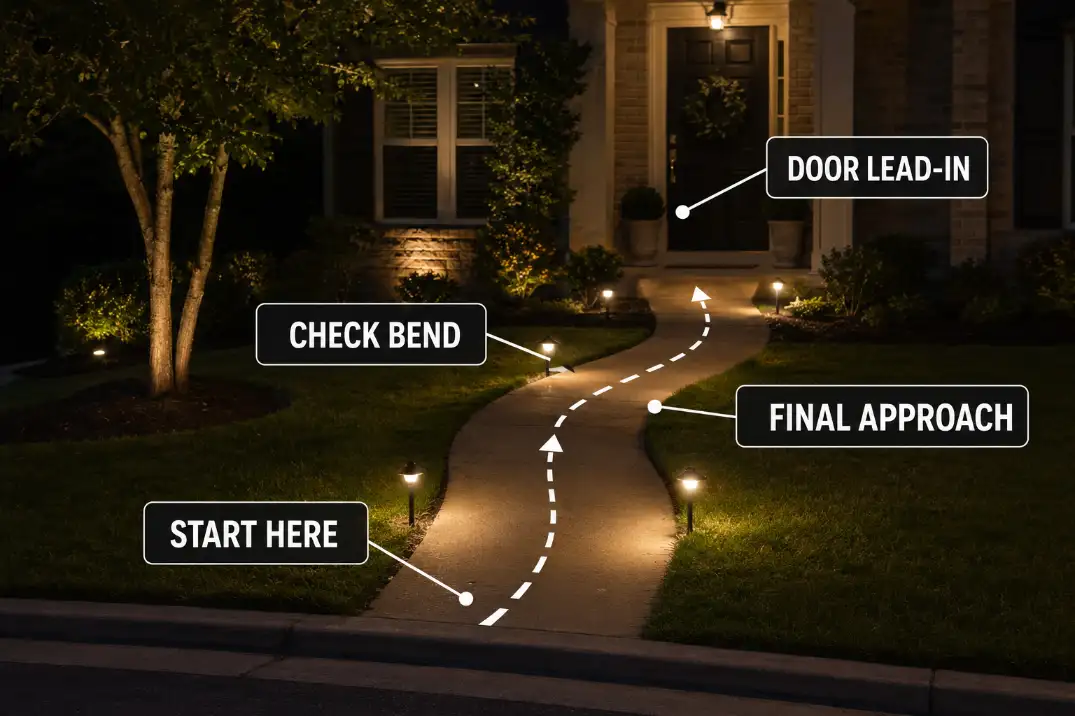
Use this compact check:
- Can you see where the path begins from the arrival point?
- Does the next cue stay visible through the walkway bend?
- Does the final path light connect to the porch or landing?
- Can you read the porch edge before stepping onto it?
- Does the door feel like the clear destination?
- Is any light shining into your eyes instead of onto the route?
- Does a phone photo from the street reveal a gap you missed in person?
If the path looks lit but the door disappears, the lighting is stopping too soon. If the porch is bright but the last few feet feel uncertain, the handoff is missing. If the door is visible but the ground before it is not, the lead-in is too isolated.
The standard is not “more lights.” The standard is one readable route from arrival to entry. The front walk, final approach, and door should feel connected before anyone has to guess where to step next.
For a neutral reference on keeping outdoor lighting useful, targeted, and low-glare, see DarkSky’s Five Principles for Responsible Outdoor Lighting.