Why Your Solar Outdoor Lights Aren’t Charging — And How to Fix It
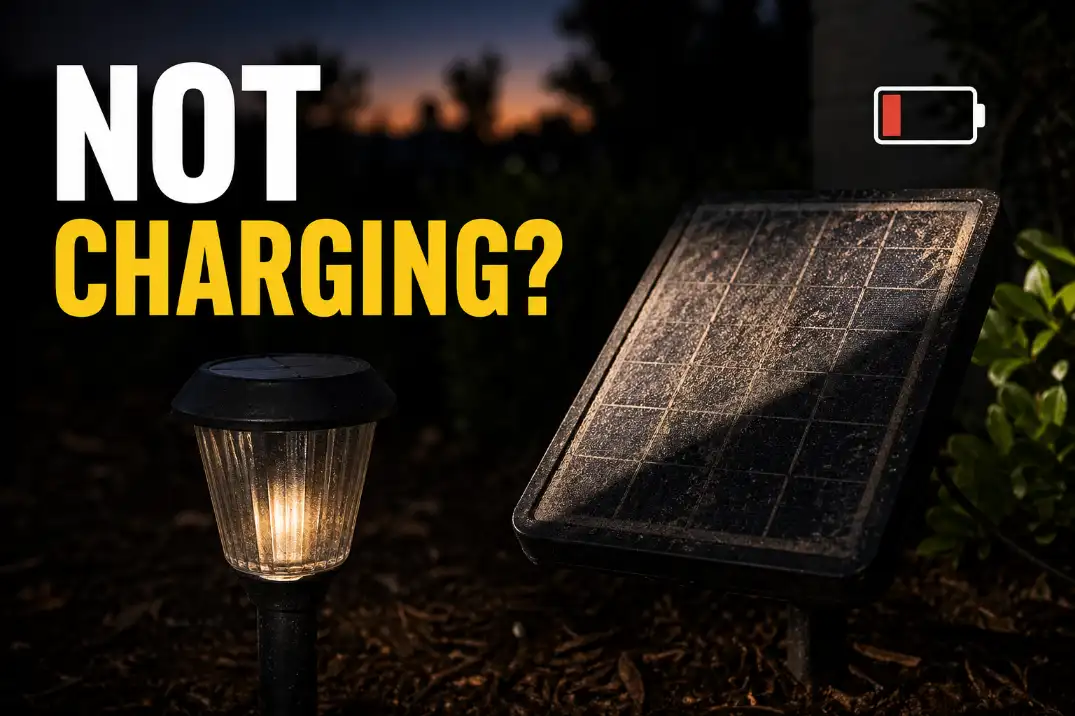
Most solar outdoor lights stop charging because the panel is not getting enough usable sun, the rechargeable battery is worn out, or corrosion has interrupted the charging path.
Start with the fixes that rule out the most: clean the panel, confirm the switch and battery are seated correctly, give the light 6–8 hours of direct sun, then test it in full darkness after one sunny day.
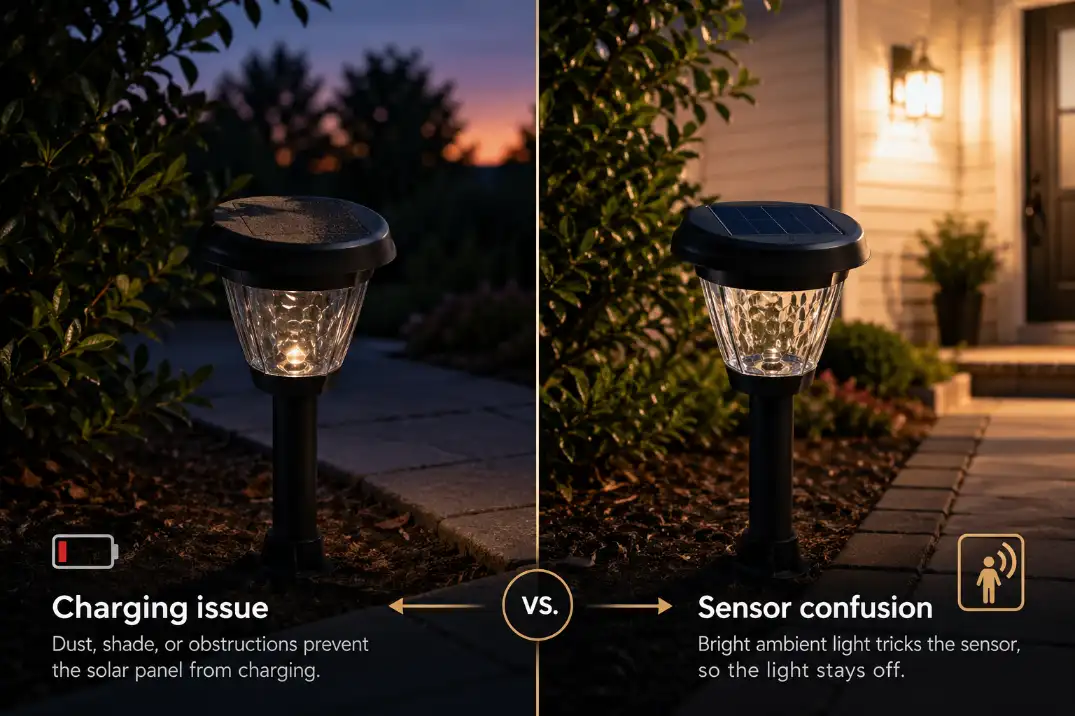
A charging failure is different from a light that simply will not turn on. If the light works when you cover the panel but stays off near a porch lamp or streetlight, the sensor is probably being fooled.
If it glows weakly, dies after 30–90 minutes, or still runs less than 2 hours after a strong sunny charge, the battery, contacts, or panel circuit deserve attention before you keep cleaning the lens.
Start With the Checks That Rule Out the Most
Do not replace the whole fixture first. Many solar lights that look dead are only undercharged, switched off, dirty, or using a tired battery.
Clean the panel before judging the battery
Wipe the solar panel with a damp microfiber cloth and dry it. Dust, pollen, hard water spots, bird droppings, and sprinkler mineral film can block enough light to shorten runtime even when the panel does not look terrible. This is common in dry Arizona yards, windy areas, and beds where irrigation overspray hits the fixture every morning.
After cleaning, give the light one full sunny day before judging the result. If runtime improves from less than 1 hour to 4–6 hours, the battery and LED are probably still usable. If nothing changes, the problem is deeper than surface dirt.
If the light is new, rule out setup mistakes
New solar lights often fail for boring reasons. Check the on/off switch, remove any battery pull tab, confirm the battery is facing the correct direction, and make sure the battery spring is pressing firmly against the cell. Some models also need a first full charge before they behave normally.
Do not diagnose a new light after one cloudy afternoon. Put it outside in direct sun for a full day, then test it after dark. If several new lights from the same pack fail while others work, compare battery seating and switch position before assuming the whole set is defective.
Check sun exposure honestly
“Bright outside” is not the same as direct charging sun. A solar panel beside shrubs, under a roof edge, near a fence, or below tree canopy may receive daylight without receiving enough energy.
A useful test is to look at the panel at 10 a.m., 1 p.m., and 4 p.m. If it is shaded during two of those three checks, placement is probably the real repair. If the same light also flickers, turns on inconsistently, or fails after several different fixes, the broader troubleshooting path in Why Solar Lights Stop Working is a better next step than repeating the same cleaning routine.
The Most Common Cause Is Still Poor Charging Sun
If the light worked when new but slowly became unreliable, poor charging sun is usually more likely than a failed LED. Small solar fixtures have limited panel area and small batteries, so they do not have much margin when shade increases.
Shade that looks harmless can still be enough
Tall grass, overgrown shrubs, patio furniture, mailbox posts, and seasonal tree growth can block the panel for part of the day. The light may still turn on at night, which makes the location seem acceptable, but short runtime tells the truth.
A healthy solar path light in summer may run 6–10 hours after a strong charge. A light undercharged by shade may fade in 1–3 hours. That difference matters more than whether the panel “gets some light.” If the fixture receives daylight but not direct sun, Sun Exposure Issues Solar Lights explains why outdoor brightness alone is not a reliable charging test.
Roof edges, trees, and seasons change the result
A roof overhang creates a predictable shade line. A tree creates a moving shade pattern that changes with season, leaf density, and sun angle. In northern states, winter sun sits lower, so a spot that worked in July may fail in December.
This is why moving a solar light 2–3 feet can make a real difference. The goal is not just a prettier layout; it is a panel position that gets direct sun long enough to refill the battery. When the main obstruction is canopy shade, Solar Outdoor Lights Not Charging Under Tall Trees is the more specific diagnostic path.
When Cleaning and Moving the Light Does Not Work
Once the panel is clean and the light has had one full sunny day, stop repeating the same fix. Move to the parts that actually store or transfer the charge.
The battery may charge but not store enough
Rechargeable batteries wear out quietly. A failing battery may accept a small charge, but voltage drops quickly once the LED turns on. That is why a light may glow for 20 minutes, dim fast, and die before midnight.
For many small outdoor solar lights, 1–3 years is a realistic rechargeable battery life. Heat, deep discharge, repeated cloudy stretches, and moisture inside the housing can shorten that. In hot climates, enclosed plastic housings can become much warmer than the surrounding air, which speeds battery aging.
The practical threshold is simple: if a light receives 6–8 hours of direct sun and still runs less than 2 hours for several nights in a row, battery replacement makes more sense than cleaning the panel again. For battery-specific symptoms, see Why Are My Solar Light Batteries Dying So Quickly?.
Use the correct rechargeable battery
Replace like-for-like. If the old battery says 1.2V NiMH AA, do not swap in a regular alkaline AA just because it fits. Solar lights are designed to recharge specific battery types, and the wrong chemistry can cause poor performance or stop the charging cycle from working correctly.
After installing a replacement battery, give the light one full sunny day before judging it. A new battery tested after only an hour of weak sun may look defective even when it is fine.
Pro Tip: Take a photo of the old battery label before removing it. Match the voltage, size, and chemistry before buying replacements.
Corrosion breaks the charging path
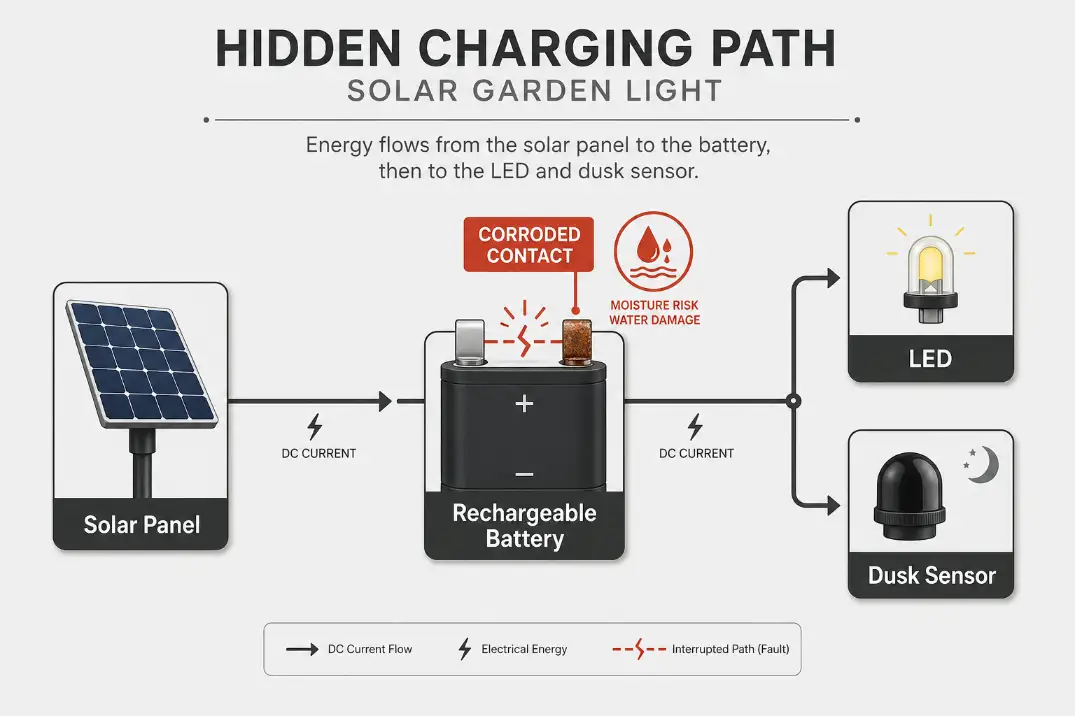
Corrosion is not just a cosmetic problem. It interrupts the current path, so the battery may never receive a proper charge even if the panel is producing power.
Remove the battery and inspect the metal tabs. White, green, rusty, or powdery buildup is a sign that moisture has reached the compartment. If the contacts are only slightly dull, clean them gently and reseat the battery firmly. If the spring tension is gone, the tab is broken, or the compartment stays wet after 24 hours of dry weather, the routine fix has reached its limit.
Do Not Mistake Sensor Trouble for Charging Trouble
A solar light can charge correctly and still refuse to turn on. That happens when the dusk sensor sees artificial light and thinks it is still daytime.
The clue is how it behaves in darkness
If the light turns on when you cover the panel with your hand but stays off near a porch light, garage light, landscape spotlight, or streetlight, the battery is probably not the main issue. The sensor is being tricked.
This is one of the most common misreads. People replace batteries when the useful fix is moving the fixture away from artificial light or changing the sensor angle. Solar Lights Not Turning On Near Streetlights covers that pattern more directly.
Use a dark-room test before buying parts
Bring the light into a dark garage, closet, or covered box after a sunny day. If it turns on strongly, charging is happening. If it stays dim or dead in full darkness, continue with the battery, contacts, panel, or fixture housing.
This test separates the symptom from the mechanism. The symptom is “the light does not come on.” The mechanism may be poor charging, battery failure, corrosion, sensor interference, or panel damage.
Quick Fix Guide by Symptom
| Symptom | Most likely cause | Best first fix | When to move on |
|---|---|---|---|
| New light never charges | Switch, pull tab, or battery seating | Confirm setup and give 1 sunny day | Compare with another light from the set |
| Runs 30–90 minutes, then dies | Weak charge or old battery | Clean panel and charge fully | Replace battery if no improvement |
| Works when panel is covered | Sensor sees artificial light | Move away from porch or streetlight | Replace only if sensor never responds |
| Whole row fades early | Poor shared location | Move lights into stronger sun | Replan layout if shade is unavoidable |
| One light fails, others work | Battery or contact issue | Reseat battery and clean contacts | Replace fixture if contacts are damaged |
| No response with good battery | Panel, wiring, or circuit damage | Inspect panel and wiring | Replace if housing or panel is compromised |
Check Panel and Wiring Damage Last
Panel failure is less common than poor sun or battery wear, but it does happen. Look for a cracked panel, a cloudy or yellowed cover, a loose plug on remote-panel models, or a cable that has been pinched, chewed, or pulled loose.
This is where routine fixes stop making sense. If the light has a known-good rechargeable battery, clean contacts, direct sun, and full darkness for testing but still does nothing, the panel circuit or internal board may be beyond practical repair. On very low-cost fixtures, replacing the light is usually more reasonable than chasing a sealed internal fault.
Weather Can Reduce Runtime Without Being the Root Problem
Cloudy days, snow cover, heavy rain, and short winter daylight can reduce charging without meaning the light is broken. After a stormy stretch, a healthy solar light should usually improve after 1–2 clear days.
In humid Florida yards, moisture and corrosion may show up before the battery fully fails. In Midwest spring weather, several cloudy days can make a normal light look weak. In coastal California, marine layer mornings may delay charging. The real test is recovery: if the light improves when sun returns, the system was weather-limited. If it stays weak through several clear days, the battery, contacts, or panel path is the better suspect.
Pro Tip: Do serious troubleshooting during a sunny stretch. A cloudy-week test can make a usable light look worse than it is.
Final Check Before You Replace the Light
After a fair test, the decision is simple: 4–6 hours of runtime means the charging system is still usable, less than 2 hours points to the battery or contacts, and no response with a known-good battery points to panel, wiring, or fixture failure. If the housing is cracked, the battery compartment keeps getting wet, or the panel is physically damaged, replacement is usually the smarter fix.
For broader official guidance on outdoor solar lighting, see the U.S. Department of Energy.