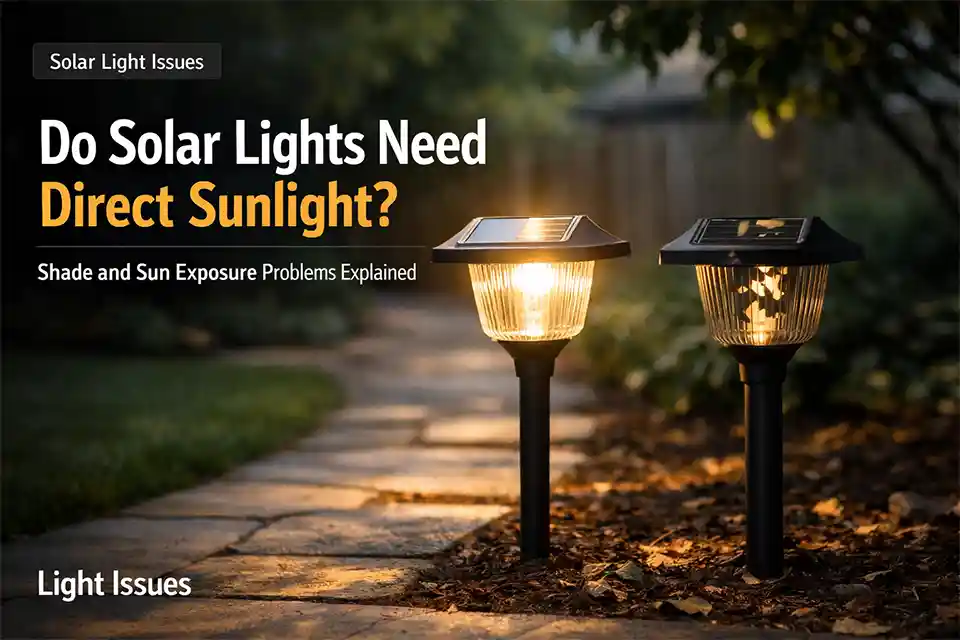
No, solar lights do not need full direct sunlight all day to work. But most of them charge faster, run longer, and behave more consistently when they get several hours of direct sun. That distinction matters because the usual search intent here is not really about solar theory.
It is about a practical frustration: the lights turn on, then fade too early, act inconsistent, or seem dead even though the panel “gets daylight.” In most yards, weak sun exposure is a more likely cause than a failed LED or switch. For many standard pathway lights, 6 to 8 hours of direct sun is a reliable target.
Some decorative units can still do reasonably well with 3 to 4 hours of strong direct sun, but partial shade all day usually produces shorter runtime and weaker output.
The first checks that actually separate causes are simple: look for shade on the panel between about 10 a.m. and 3 p.m., compare one weak light to an identical light in open sky, and check whether the problem is limited to the shadiest side of the yard.
The short answer most people actually need
If your solar lights are dim, shutting off early, or not lasting through the night, the first question is not “Are the batteries bad?” It is “How much real sun is hitting the panel?”
What direct sunlight changes
Direct sun mainly changes two things: charging speed and nightly runtime. A light can still collect some energy in bright indirect conditions, but the reserve is usually smaller. That is why a solar light in a bright-looking side yard may still fail by 9 or 10 p.m. while the same fixture in open sky lasts until morning.
What shade usually does in real yards
Shade usually does not make the light fail instantly. It causes short charging cycles, weaker battery replenishment, and less consistent performance from one day to the next. That is why the problem often looks confusing at first. The light may work after a very bright day, then perform poorly after a partly cloudy day or after tree shadows shift a little earlier in the afternoon.
A practical threshold
For many small path lights, less than about 4 hours of strong direct sun is where performance often becomes unreliable. Around 4 to 6 hours can still be workable, but runtime tends to become more seasonal and less predictable. Once you get into the 6 to 8 hour range, performance usually becomes more stable.
If only one light in the set has failed, this guide to fixing solar lights that stopped working can point you in the right direction.
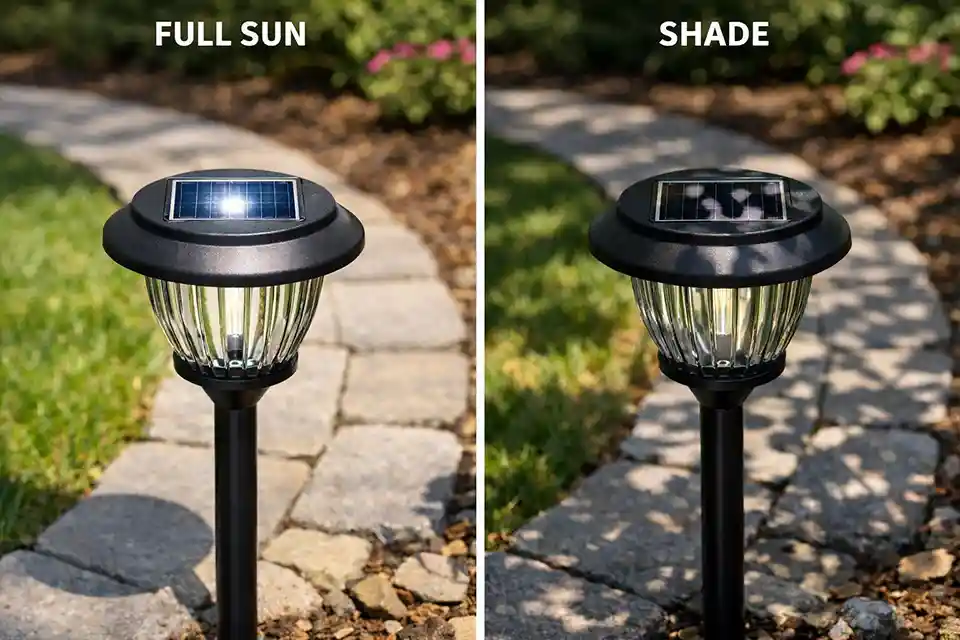
Can solar lights charge in the shade?
Yes, but that answer gets overused in a misleading way. They can charge in the shade, but “can charge” is not the same as “will run well.”
Light shade versus dense shade
Light shade for part of the day may still produce acceptable results, especially with low-output decorative fixtures. Dense canopy shade, porch shadow, fence shadow, or a north-facing side yard is different. In those spots, the panel may receive enough light to trigger the system at dusk but not enough stored energy to keep the light useful for long.
That is why Solar Outdoor Lights Not Charging Under Tall Trees is such a close match for this pattern. Under tree cover, the problem is usually chronic undercharging rather than a sudden part failure.
Why this gets misread so often
People tend to judge the yard with their eyes, not the panel with the sun path. If the area looks bright to a person, it feels reasonable to assume the panel is charging well. But filtered daylight through leaves is not equivalent to open-sky exposure at the panel surface. That is the gap that causes a lot of unnecessary battery replacement.
How to tell shade problems from battery problems
The symptom can look the same in both cases: dim output, early shutoff, or inconsistent runtime. What matters is the pattern.
Signs that point to shade first
If several lights weaken only along one shaded side of the yard, that points to location before it points to hardware. If performance got worse after nearby branches or shrubs grew 6 to 18 inches into the panel’s exposure window, the site changed even if the fixture did not. If one matching light still performs well in open sun, that comparison is more useful than most guesswork.
Signs that point to the battery instead
A battery becomes the stronger suspect when the fixture already gets strong open-sky exposure, the panel is clean, and performance is still poor after 12 to 24 months. Heat matters here. In places like Arizona or inland Southern California, batteries can age faster over 1 to 2 summers even when daytime charging is strong.
The common fix that wastes time
Battery replacement is the fix people reach for first because it feels concrete. But if the light still gets only 2 to 4 hours of direct sun, a new battery often gives a short improvement and then lands right back in the same weak pattern.
If the light already has decent exposure and still burns through batteries unusually fast, Why Are My Solar Light Batteries Dying So Quickly becomes the more relevant diagnostic path.
The fastest test before buying anything
Most people do not need a new part first. They need a better comparison.
Day one: relocate one fixture
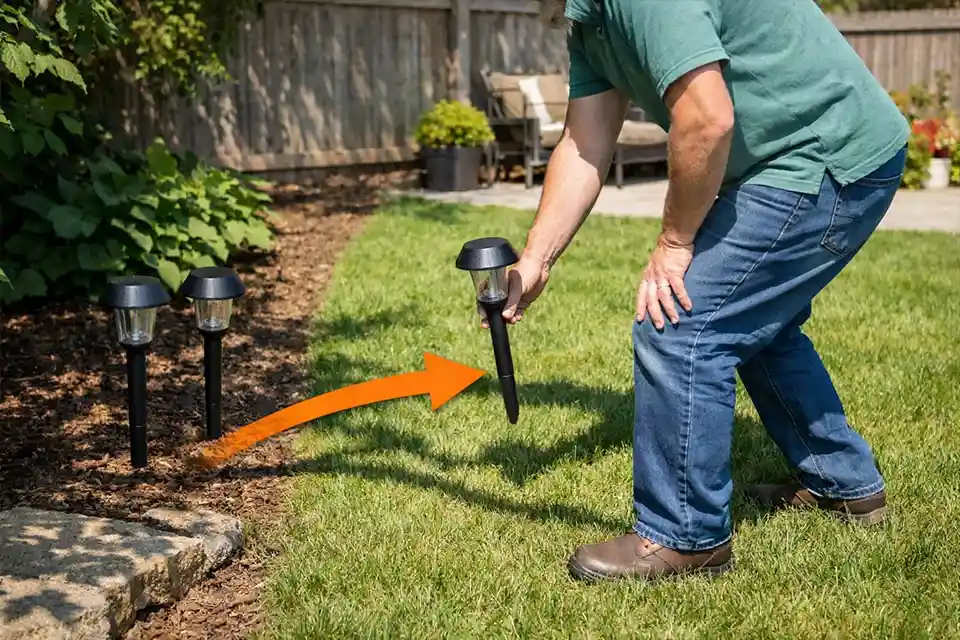
Move one weak light to a spot that gets at least 6 hours of unobstructed sun. Leave another matching unit where it is. This is a better test than replacing multiple batteries at once because it isolates the location variable.
Day two: judge runtime, not just dusk brightness
A light can appear normal for the first hour after sunset and still be undercharged. What matters is whether it remains useful later in the evening. For many small solar lights, 6 to 10 hours after a good charging day is a healthy result. If the relocated light clearly outlasts the shaded one after 1 or 2 bright days, you have enough evidence to stop guessing.
Pro Tip: Check the location in the same season the problem shows up. A spot that works in June may lose several charging hours in October as the sun angle drops and shadows move earlier.
Why solar lights turn off early after a sunny day
This is one of the most common search variants around this problem, and the answer is usually narrower than people think.
The yard may not be as sunny as it looks
The panel may have missed the strongest charging window even on an otherwise bright day. Rooflines, tree branches, fences, and even a taller neighboring shrub can block direct exposure during late morning or early afternoon. That can be enough to cut the stored charge even when the yard seems bright overall.
The battery may be aging, but not always first
A weak battery can absolutely cause early shutoff. But when several lights fail in the shadiest zone and one open-sky unit still performs well, that is not a battery-first pattern. People often overestimate cold weather and grime because both are visible. They underestimate repeated partial charging because it is less obvious but often more important.
Dirty panels matter less than placement
A cloudy cover, pollen film, or sprinkler mineral residue may reduce output by roughly 10% to 15%. That is real, but it is rarely the main reason a light drops from an 8-hour runtime to 2 hours. A location losing half of its best charging window is usually the bigger problem.
That is where Why Your Solar Outdoor Lights Aren’t Charging and How to Fix It fits best: after you have checked whether the site is simply too shaded.
What changes under different yard conditions
Trees and landscape growth
This is the condition people most often underestimate. A light may have worked well for a year or two, then slowly declined because the canopy widened or shrubs rose above panel height. A branch spread change of 12 to 24 inches can materially change the charging window.
Winter and lower sun angle
In northern states, a location that gets 6 hours of direct summer sun may get only 3 or 4 useful winter hours once rooflines and bare branches start casting longer shadows. The obvious explanation is cold. The more useful explanation is often reduced direct exposure.
Covered porches and side yards
Some locations are just poor solar sites no matter how often the battery gets replaced. Covered porch edges, narrow side passages, and north-facing beds may stay bright enough to fool the eye while still giving the panel very little usable direct sun.
When relocation makes more sense than repair
At some point, the standard fix stops making sense. If a fixture is installed in dense canopy shade, under a covered overhang, or along a side yard with only brief sun exposure, repeated battery swaps and repeated panel cleaning become maintenance theater. The location is doing most of the damage.
| Exposure condition | Likely result | Best next step | Common wasted fix |
|---|---|---|---|
| 6 to 8 hours direct sun | Reliable charging and longer runtime | Clean panel, monitor battery age | Replacing working parts |
| 4 to 6 hours mixed sun | Fair but inconsistent runtime | Raise or relocate fixture | Assuming all daylight counts equally |
| 2 to 4 hours direct sun | Early dimming or shutoff | Move the light to open sky | Repeated battery replacement |
| Heavy midday shade | Chronic undercharging | Trim growth or change lighting type | Treating dirt as the main problem |
| Full sun but poor runtime after 12 to 24 months | Battery aging more likely | Replace battery or fixture | Blaming shade without testing |
If the light still struggles after you confirm good exposure, How to Fix Solar Lights With Uneven or Dimming Output is the better next step.
Questions people usually ask
Do solar lights need direct sunlight to charge at all?
No. They can charge in indirect light and light shade. The real issue is that indirect charging is usually slower and weaker, so nighttime runtime tends to drop.
Why do some solar lights work in shade better than others?
Usually because the fixture uses less power, has a somewhat larger panel, or stores energy more efficiently. Low-output decorative lights can tolerate weaker charging better than brighter path or accent fixtures.
Should you move the light first or replace the battery first?
Move it first when the site gets less than about 6 hours of direct sun or sits under obvious tree cover. Replace the battery first only when the fixture already has good exposure and the battery age makes failure plausible.
For broader official guidance on solar photovoltaic basics, see the U.S. Department of Energy.