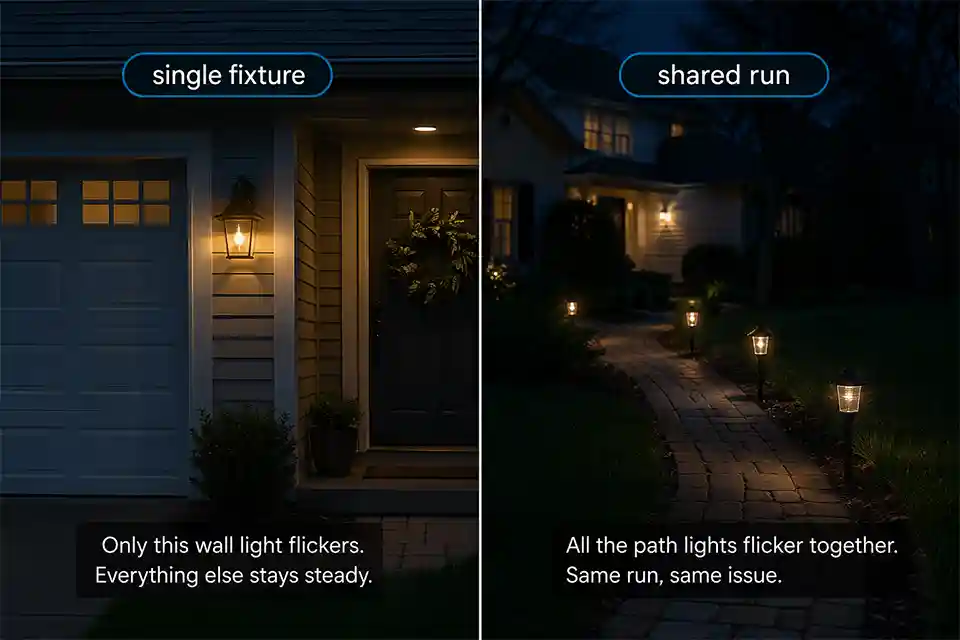
Outdoor lights usually flicker for fewer reasons than people think. In most cases, the pattern points first to a loose or aging connection, moisture affecting a splice or fixture, or unstable power showing up only under real load.
The fastest way to narrow it down is not to start with the bulb. Start with two questions: is one light flickering by itself, or are several lights flickering together? And is this a 120-volt exterior fixture, like a porch, garage, or flood light, or a 12-volt landscape system fed by a transformer?
Those two distinctions do real work. One wall light that begins fluttering after 5 to 10 minutes usually points toward a socket, fixture lead, or heat-sensitive LED driver.
Several path lights flickering together, especially near the end of a long run, point much more strongly toward voltage drop, a wet splice, transformer trouble, or a shared upstream connection.
Flicker that appears within 6 to 24 hours after rain is also a very different clue from flicker that starts the same day a new lamp was installed.
Start with the pattern, not the part
Most outdoor-lighting advice still makes the same mistake: it treats every possible cause as if it deserves equal weight. It does not. The pattern is usually more diagnostic than the hardware you can see.
One light flickers by itself
If a single porch light, garage entry light, coach light, or flood light flickers while the rest of the exterior lighting looks normal, stay local first. The most likely trouble spots are the lamp, socket, fixture leads, backplate connections, or the internal driver if the fixture uses integrated LEDs.
That does not mean the bulb is always the fix. It means the problem is still close enough to the fixture that jumping straight to transformer or panel theories usually wastes time.
Several lights flicker together
Once two or more lights on the same run or circuit flicker together, a single bad bulb falls down the list fast. At that point, the better suspects are a shared splice, unstable feed, transformer issue, voltage drop, poor neutral connection, or another upstream wiring problem.
That is where Outdoor Lighting Power Supply Issues: Losing Power becomes more useful than general bulb advice. Flicker is not always a full power-loss problem, but shared instability often starts in the same places.
Flicker is not the same as full shutoff
A flickering light is still energized, just not steadily. A light that goes completely dark and then returns usually points more toward a timer, photocell, thermal cutoff, GFCI, or another control-side problem. People often lump these symptoms together and end up fixing the wrong thing.
If your light is cycling fully off rather than fluttering, Outdoor Lights Working Intermittently is the closer diagnosis path.
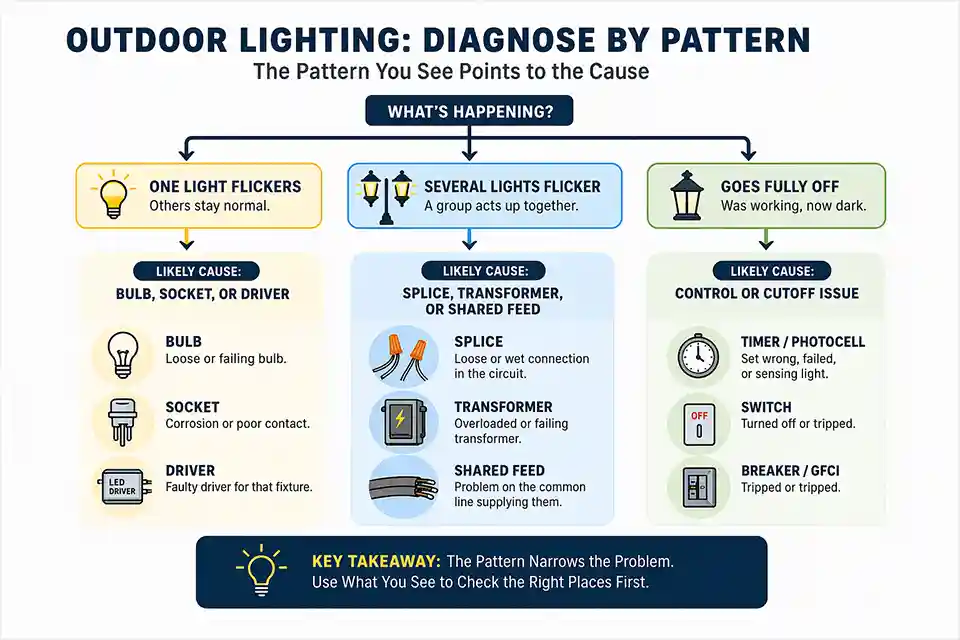
Pattern to likely cause: the fastest read
Starts after 2 to 10 minutes
This usually points to heat. A weak terminal warms up, metal expands, contact pressure changes, or an LED driver drifts out of stable operation. If brightness drops by roughly 10% to 30% before the fluttering starts, heat-sensitive connections move high on the list.
Appears 6 to 24 hours after rain, sprinklers, or heavy humidity
This usually points to moisture intrusion. Water does not need to flood a fixture to cause flicker. A small amount at a cable entry, wire connector, socket base, or buried splice can create unstable conduction first and a total failure later.
Happens when another load turns on
If the lights flicker when an HVAC unit, garage door opener, pool pump, or irrigation controller starts, stop treating the fixture as the whole story. A weak shared connection, poor neutral, overloaded circuit, or broader supply instability becomes more plausible.
Shows up first on the farthest path lights
That is a classic low-voltage clue. When the last fixtures on a 12-volt run flicker before the first ones do, the problem usually has more to do with voltage drop, overload, or transformer capacity than with random fixture failure.
Starts right after a lamp, switch, timer, or smart-control change
That moves compatibility higher on the list. On standard fixtures, the new lamp may be the issue. On integrated LED fixtures, the trigger may be a photocell, timer, smart switch, or other control that the driver does not handle well.
Before assuming the fixture is broken, review the common reasons why outside lights won’t turn on.
The causes that deserve attention first
Loose or aging connections
This is still the most common cause overall. Outdoor lighting lives through rain, humidity, freeze-thaw movement, summer heat, and small vibration cycles. A terminal can be just loose enough to create unstable current without failing completely. That is why flicker often appears before a full outage.
If the flicker changes when the fixture, box, or splice area is lightly touched, the odds shift even harder toward a connection problem. On older systems, Aging Outdoor Wiring Problems: Dim and Failing Lights is often the better companion read than another round of bulb swapping.
Moisture in a splice or fixture
This ranks unusually high outdoors because the damage can stay subtle for a while. A connector does not need to be visibly flooded to behave badly. Moisture often shows up first as fluttering, dim-then-bright cycling, or a problem that appears at night and seems better the next day.
This is especially common on path lights, deck lights, fence-post fixtures, and older wall lights with tired seals. In those cases, Why Outdoor Lights Fail After Rain is the more relevant comparison than a generic wiring checklist.
Voltage drop on long low-voltage runs
This matters most on path-light and landscape-light systems that were expanded over time. The farthest fixtures become the first visible weak point. A 12-volt system that falls to around 10.5 to 11 volts under load may still produce light, but not always stable light. “It still turns on” is not the same thing as “the system is healthy.”
Failing driver, transformer, or control component
This is where modern outdoor lighting changes the diagnosis. With a standard fixture, the lamp and socket are separate suspects. With an integrated LED fixture, the driver and internal assembly matter more, so replacement often becomes sensible sooner.
On landscape systems, the transformer is usually the bigger suspect when a whole zone flickers together.
That is why Transformer Problems in Low-Voltage Systems belongs in the diagnosis path before anyone starts replacing multiple fixtures.
Bulb failure or lamp incompatibility
Possible, yes. Most likely overall, no. It becomes persuasive when one fixture started flickering right after a lamp change and the symptom disappears with a known compatible outdoor-rated replacement. If multiple lights are flickering together, bulb swapping is usually just a delay tactic.
Quick diagnostic checklist
- One fixture flickers alone: inspect the lamp, socket, fixture leads, and local connections first.
- Several lights flicker together: move upstream to a shared splice, transformer, feed, or neutral.
- Flicker begins after 2 to 10 minutes: suspect heat-stressed terminals or a failing driver.
- Flicker appears 6 to 24 hours after rain: suspect moisture before bulb failure.
- Farthest path lights flicker first: suspect voltage drop or overload.
- Flicker changes when the fixture or box is touched: suspect a loose connection.
- Flicker appears when other equipment starts: suspect circuit instability or an upstream feed issue.
Why the obvious fix often wastes time
The first wasted move is replacing every bulb on the run. The second is tightening a darkened or corroded connection and assuming that counts as a permanent repair. The third is blaming one visible fixture when several lights are flickering together.
Those moves feel efficient because they are easy. They usually are not. A connection that has already browned insulation, lost clamp force, or corroded deeply is often past the point where retightening makes sense.
Pro Tip: On low-voltage systems, measure voltage with the lights on at night, not during the day with no load. A no-load reading can make a weak system look healthier than it really is.
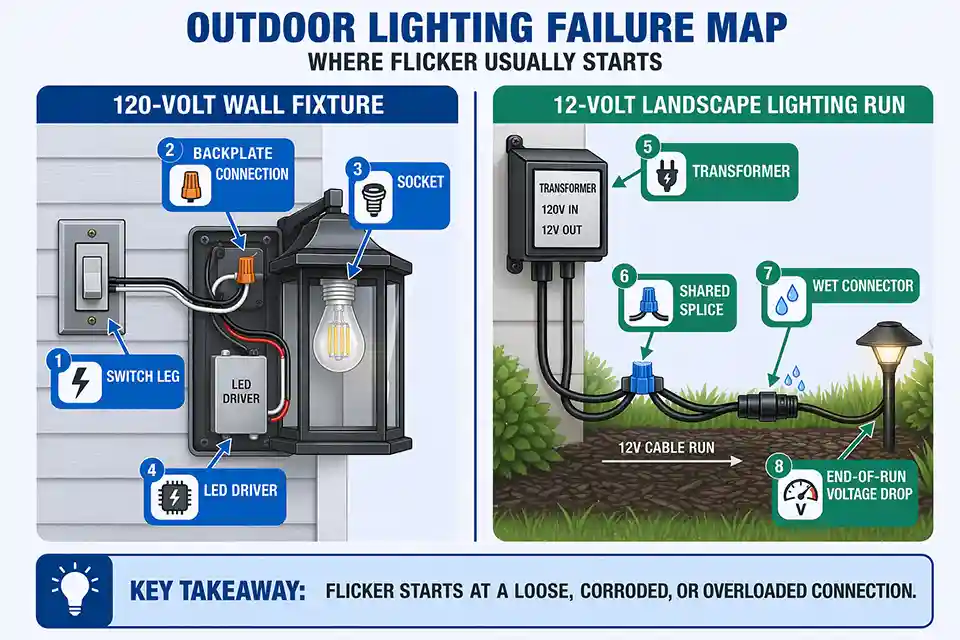
When repair stops making sense
Replace the part instead of nursing it along when
- the socket is loose or heat-darkened
- the wire insulation is stiff, brittle, or browned
- the connector no longer clamps firmly
- the same splice has already been repaired once
- moisture keeps returning because the fixture no longer seals
At that point, the problem is usually not a one-time glitch. It is a degraded component or assembly.
Bring in a professional sooner when
- several exterior lights flicker at the same time
- the flicker is paired with buzzing, heat, or a burnt smell
- breakers or GFCI devices trip
- the symptom appears when larger loads start
- you suspect a shared neutral, panel-side issue, or unstable feed
This is the point where routine DIY logic stops being smart. Outdoor flicker can be cosmetic-looking right up until it is not.
Practical comparison guide
| Symptom pattern | More likely cause | Less likely cause | Best next move |
|---|---|---|---|
| One porch light flickers alone | Socket, bulb, fixture lead, internal driver | Main feed failure | Open the fixture and inspect local connections |
| Several path lights flicker together | Transformer, shared splice, voltage drop | Random bulb failures | Check loaded voltage and common splices |
| Flicker starts after 5–15 minutes | Heat-stressed terminal or driver | Purely cosmetic corrosion | Recheck after warm-up and inspect for heat damage |
| Flicker follows rain or irrigation | Moisture intrusion or wet splice | Isolated lamp issue | Inspect seals, cable entries, and buried connectors |
| End-of-run lights flicker first | Long-run voltage drop or overload | Switch failure | Review load, run length, and transformer capacity |
Questions people usually ask
Can a bad bulb still be the reason?
Yes, especially if one fixture started flickering right after a lamp replacement. But once several lights are involved, the bulb drops down the list quickly.
Are integrated LED fixtures harder to troubleshoot?
A little. With a standard fixture, the lamp and socket are separate suspects. With an integrated LED fixture, the driver and internal assembly matter more, so replacement often becomes practical sooner.
Is slight flicker ever normal?
A brief startup quiver can happen on some systems, but repeated flicker, growing instability, buzzing, or heat is not a normal outdoor-lighting condition.
For broader official guidance on flickering lights and wiring hazards, see the CPSC Guide to Home Wiring Hazards.