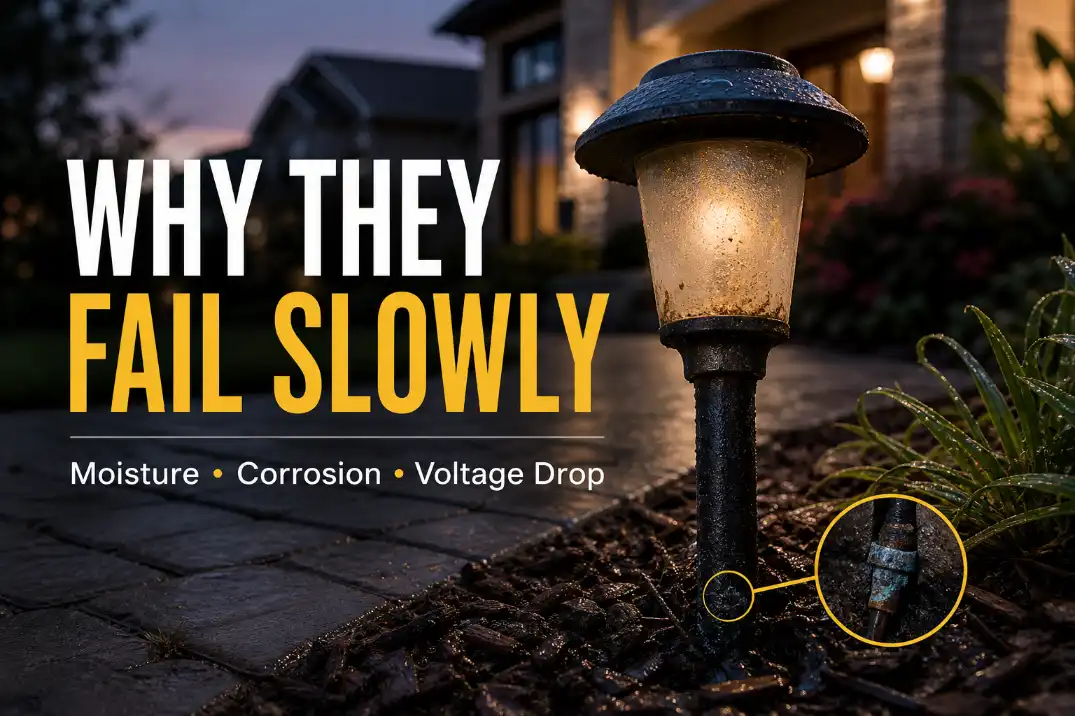
Outdoor lights usually stop working over time because the system gets weaker in layers. Moisture reaches a splice, a connector corrodes, a fixture seal hardens, a cable gets nicked, a transformer starts running near its limit, or a photocell stops reading light correctly.
The fastest useful diagnosis is pattern-based: one dead fixture points to a local lamp, socket, or splice; far-end dimming points to voltage drop; failure after rain points to moisture or a GFCI issue.
Age matters, but it is rarely the whole answer. A 3-year-old system in sprinkler spray can fail before a 10-year-old fixture under a dry porch roof.
A solar light that once ran 6–8 hours but now fades after 1–2 hours is aging differently from a wired path light that gets weaker at the end of a cable run. The symptom is what you see. The mechanism is usually resistance, leakage, weak charging, or control failure.
Start With the Failure Pattern, Not the Bulb
The most common mistake is treating every old outdoor light as a worn-out bulb problem. Sometimes it is. But if several lights are dim, if the problem follows rain, or if the same section fails repeatedly, the bulb is usually just the easiest part to blame.
One Light Failed
When one fixture is dead and nearby lights are normal, start local. The likely causes are a bad lamp, failed LED module, loose socket contact, damaged fixture, or weak splice feeding that one light.
This is the situation where a simple replacement or connection repair can make sense. If the fixture body is dry, the cable is intact, and the rest of the run is strong, there is no reason to rebuild the whole system.
The Far End Is Dim
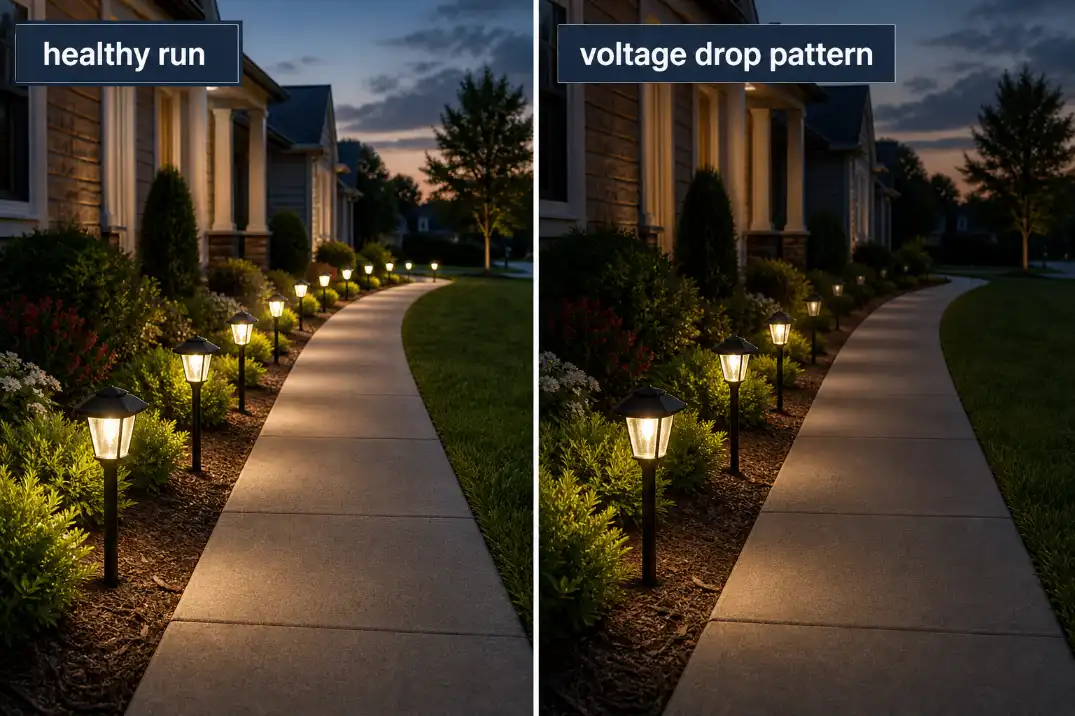
When the first few lights are bright but the last few look weak, the issue is usually power delivery. In low-voltage landscape lighting, a run that starts near 12 volts but drops closer to 9 volts at the far end can create visible dimming.
That pattern is not caused by every fixture suddenly wearing out at the same time. It usually comes from cable length, undersized wire, added fixtures, weak connections, or transformer load. If this is the main symptom, Voltage Drop in Outdoor Lighting Systems is the more specific repair path.
It Fails After Rain
Rain-linked failure is more useful evidence than most people realize. If outdoor lights work during dry weather but fail after rain, irrigation, or heavy humidity, moisture is entering a place that should stay electrically stable.
A fixture that dries out and works again after 24–48 hours is not fixed. It is cycling between failure and temporary recovery.
It Turns On at the Wrong Time
If the light works but turns on during the day, stays off at night, or behaves differently after a power outage, the fixture may not be the aging part. The control device may be. Timers, photocells, motion sensors, and smart controls can all fail gradually or drift out of their normal behavior.
Quick Diagnostic Checklist
| What you see | More likely cause | What to check first |
|---|---|---|
| One fixture is dead | Local lamp, socket, splice, or fixture | Swap lamp/module, inspect socket and connector |
| Last lights are dim | Voltage drop or overloaded run | Compare brightness near transformer and far end |
| Works until rain | Moisture intrusion or ground fault | Check wet splices, seals, GFCI behavior |
| GFCI trips repeatedly | Leakage current or water-exposed part | Stop resetting and isolate the wet/faulty section |
| Solar light fades after 1–2 hours | Weak battery or poor charging | Compare runtime after a full sunny day |
| Light turns on at wrong time | Photocell, timer, or sensor issue | Clean sensor lens and check timer schedule |
The Parts That Usually Age First
Outdoor lights live through UV, rain, irrigation, soil movement, insects, mulch, heat, freezing temperatures, and repeated on/off cycles. The part that fails first is often not the fixture housing. It is usually the connection that lets power reach the fixture.
Splices and Connectors
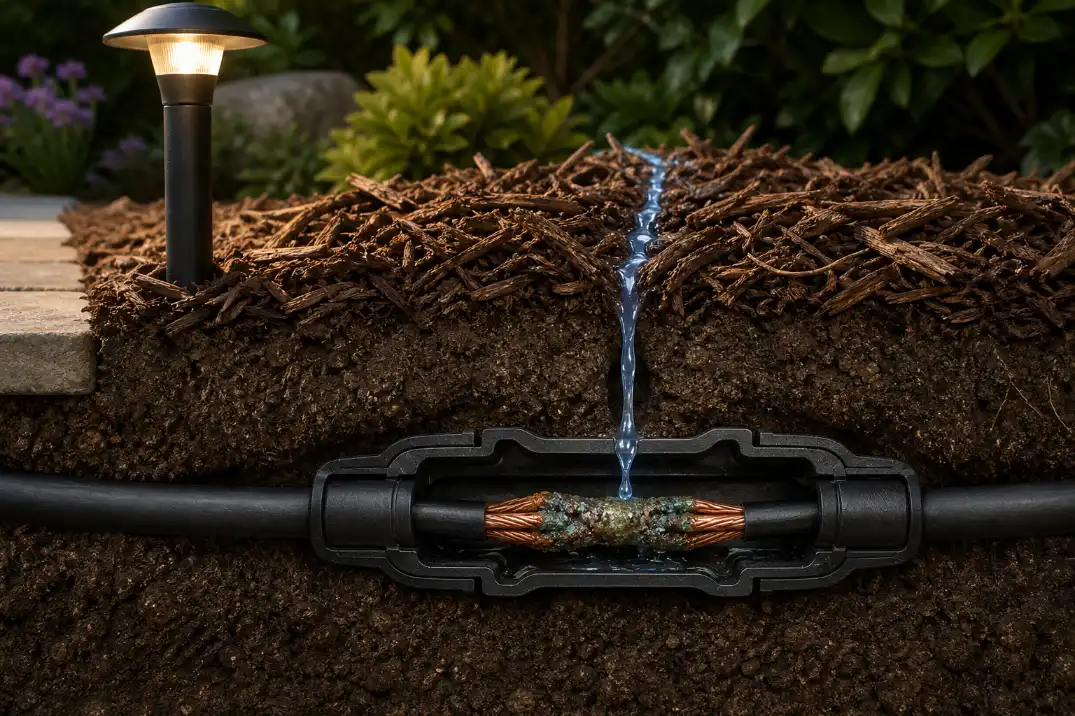
Wire connections are one of the first weak points in aging outdoor lighting. They sit close to mulch, wet soil, irrigation spray, and freeze/thaw movement. A connector can work for a year or two, then slowly develop oxidation, loosen, or allow moisture inside.
Corrosion is not just a stain. It increases resistance. More resistance means less voltage reaches the light, and the weak point can become more unstable as current flows through it. A slightly corroded splice can be enough to make one fixture flicker, dim, or fail only when the soil is damp.
This is why connection inspection matters more than repeated bulb replacement. If you find green, white, or darkened metal at multiple splices, Corrosion in Outdoor Light Connections is a better guide than a basic lamp swap.
Fixture Seals and Lenses
Gaskets, silicone seals, plastic lenses, and cable entries age under outdoor exposure. In hot desert climates, plastic can become brittle. In northern states, freeze/thaw cycles can open small gaps. In humid regions such as Florida, moisture can linger long enough to accelerate corrosion inside the fixture.
A little temporary fogging is not always a disaster. The practical threshold is persistence. If moisture remains inside the lens for more than 24 hours after dry weather returns, or droplets appear repeatedly after mild rain or temperature swings, the fixture is no longer managing moisture well.
Cable Insulation
Low-voltage cable is durable, but shallow cable is vulnerable. Many residential landscape lighting cables sit only 3–6 inches below mulch or soil. That is close enough to be hit by edging tools, aerators, shovels, rodents, or irrigation work.
A nicked cable may not fail immediately. It may keep working until water reaches the copper, the insulation gap widens, or soil movement exposes the damage. If the lights started failing after yard work, suspect cable injury before assuming every fixture aged out.
Moisture Makes Old Weak Points Show Up
Moisture does not always destroy an outdoor light instantly. More often, it exposes weak points that were already aging. A fixture may work in dry weather, flicker during irrigation, then fail after a storm.
Condensation Is Different From a Leak
Brief lens fogging after a temperature swing can be normal if it clears the same day. Standing droplets, water pooling inside the lens, or moisture that remains longer than 24 hours is more serious.
The difference matters because condensation may be managed by improved ventilation, cleaning, or replacing a seal. A leak usually means water is entering through a failed gasket, cracked lens, loose cable entry, or bad fixture joint.
GFCI Trips Are Not Nuisance Behavior
If outdoor lights trip a GFCI, repeated resetting is not a repair. A GFCI reacts when current leaks where it should not, and wet outdoor components make that more likely.
A trip that happens immediately suggests a stronger fault. A trip that happens after rain, sprinkler cycles, or 10–30 minutes of runtime often points to moisture or a component that fails under load. For that exact pattern, Outdoor Lights Tripping GFCI Outlets gives a more focused safety diagnosis.
Exposure Changes the Life Span
Readers often overestimate what “outdoor rated” means. Outdoor rated does not mean immune to sprinkler spray, salt air, wet mulch, pool chemicals, or standing water.
A fixture under a covered porch may last many years with little visible decline. The same fixture beside a sprinkler head or near coastal moisture may show cloudy lenses, corroded contacts, or intermittent output in 2–4 seasons. Placement can shorten life as much as product quality.
When Power Delivery Is the Real Problem
Aging fixtures get blamed for many problems that begin upstream. This is especially common in low-voltage systems that were expanded over time.
A Transformer Is Not Just On or Off
A transformer can still turn on and still be part of the problem. The output needs to stay stable under load. Many low-voltage lighting systems are designed around roughly 12 volts, but the acceptable field range depends on the transformer, fixture type, and layout. What matters practically is comparison: voltage near the transformer should not be healthy while the far end is dramatically weaker.
A useful rule is to avoid running the transformer at its full rating. Keeping total connected lighting load below about 80% of transformer capacity is a safer long-term target. A 150-watt transformer, for example, is more comfortable around 120 watts of connected load than at the full 150 watts.
Added Lights Can Create New Aging Problems
A system that worked well when installed may become marginal after extra fixtures are added. The transformer may be near its limit, the cable may be feeding too much load at the end, or older connectors may add enough resistance to make the whole run weaker.
That is why “it worked for years” does not rule out power delivery. It may have worked for years before the load, connections, and cable condition crossed the line.
When the Control Device Ages Instead of the Light
Not every outdoor light failure is about power or moisture. Sometimes the light itself is fine, but the device telling it when to operate has become unreliable.
Photocells Can Fail Slowly
A photocell may stop reading daylight accurately because the lens is dirty, yellowed, shaded, or affected by nearby artificial light. If an outdoor light turns on during the day or stays off at night while power is present, the sensor deserves attention before the fixture is replaced.
Nearby porch lights, streetlights, reflective glass, or newly installed landscape lighting can also confuse a photocell. That is not fixture failure; it is control interference.
Timers Drift, Reset, or Lose Programs
Timers can also make old lights look broken. Mechanical timers wear. Digital timers can lose programs after outages. Smart controls can fail because of weak Wi-Fi, incorrect schedules, or app settings.
If the lights work manually but not on schedule, follow the control path first. The more specific troubleshooting route is Outdoor Lights Not Turning On After Timer or Photocell, especially when the system behaves normally only in manual mode.
Pro Tip: If a light turns on manually but not automatically, do not start by replacing the fixture. Prove whether the timer, photocell, or sensor is sending power at the right time.
Solar Lights Age Differently
Solar outdoor lights fail over time in a different way from wired lights. The most useful measurement is runtime after a full sunny day.
A healthy solar light may run 6–8 hours after strong sun, depending on battery size, panel quality, and season. If the same light now fades after 1–2 hours under similar conditions, the likely issue is battery storage, panel output, corrosion at the battery contacts, or poor sun exposure.
Cleaning the solar panel can help, but it is often overestimated. If the battery no longer holds charge, a clean panel cannot restore lost capacity. For deeper solar diagnosis, Why Solar Lights Stop Working is the better companion guide.
When Routine Repairs Stop Making Sense
Small repairs are smart when the failure is isolated. They become wasteful when the system is aging as a system.
Repair One Local Failure
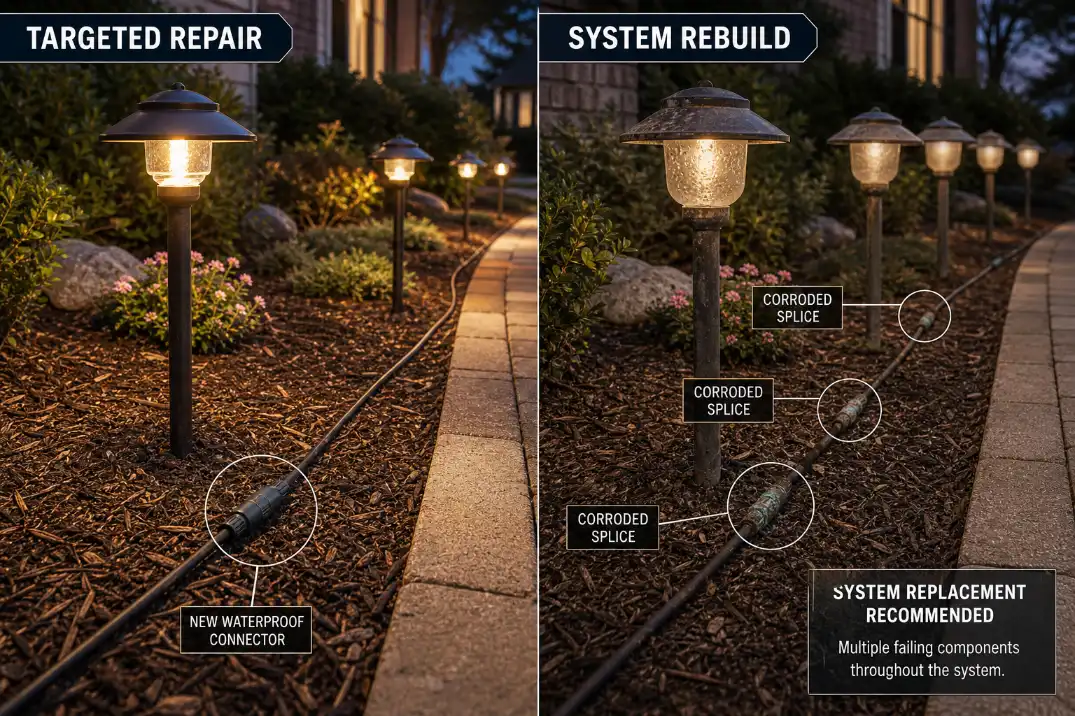
Repair makes sense when one fixture is dead, nearby fixtures are normal, the cable is intact, and the fixture is not full of water. In that case, replace the lamp or LED module, clean the socket contact, remake the splice, or replace the single fixture.
This is targeted repair. It solves a local failure without turning a small problem into a full project.
Inspect the System After Repeated Wet-Weather Failures
If two or three fixtures act up after rain, the issue is no longer just one bad light. Check the cable route, wet mulch areas, low spots, splice locations, and fixture bases. Moisture is probably exposing a pattern.
This is where many quick fixes fail. Replacing the most visibly worn fixture may make the yard look better, but it will not fix wet connectors feeding the same run.
Replace or Rebuild When the Pattern Is System-Wide
If three or more fixtures on the same run have corrosion, repeated dimming, cloudy lenses, brittle wiring, or moisture inside the housings, system-level repair is usually smarter. That may mean new direct-burial-rated connectors, rerouted cable, better fixture placement, transformer resizing, or replacing a full run instead of chasing failures one by one.
Older wiring deserves the same judgment. If cable insulation is brittle, routes are unknown, or lights fail in different locations after yard work, Aging Outdoor Wiring Problems That Cause Dim or Failing Lights is more useful than another fixture-by-fixture repair.
What Actually Extends Outdoor Light Life
The best long-term fix is not simply buying heavier fixtures. It is reducing the stresses that cause premature failure.
Keep splices out of constantly wet mulch when possible. Use connectors rated for wet locations or direct burial where the installation requires them. Do not let mulch pile 2–3 inches against fixture bases, because wet organic material can hold moisture against cable entries and metal housings for days. Aim sprinkler heads away from lights, especially fixtures with lenses, seams, or ground-level cable entries.
For low-voltage lighting, avoid adding every new fixture to the far end of an old run. Balance cable layout, transformer capacity, and fixture load. For solar lights, clean panels several times per season and judge performance by nighttime runtime after a full sunny day, not by whether the LED briefly turns on.
Outdoor lighting will age, but it should not need constant resets, dry-weather luck, or repeated bulb swaps to stay useful. When the pattern points to moisture, voltage loss, control failure, or system-wide wear, fixing the mechanism matters more than replacing the most visible part.
Questions People Usually Ask
Can old outdoor lights fail only when wet?
Yes. A light can work in dry weather and fail after rain if moisture reaches a weak splice, cable entry, socket, or fixture seal. If the same problem repeats after every storm, treat it as a moisture fault, not random aging.
Is it worth replacing bulbs first?
Only when the failure is local. If one light is out and nearby lights are normal, a lamp or LED module check is reasonable. If multiple lights are dim, flickering, or rain-sensitive, replacing bulbs first often wastes time.
When should I replace the whole outdoor lighting run?
Consider replacement or system rebuild when several fixtures on the same run show corrosion, cloudy lenses, brittle wiring, voltage loss, or repeated wet-weather failure. Three or more related failures on one run usually point beyond a single bad fixture.
For broader official guidance on outdoor electrical safety, see the Electrical Safety Foundation International.