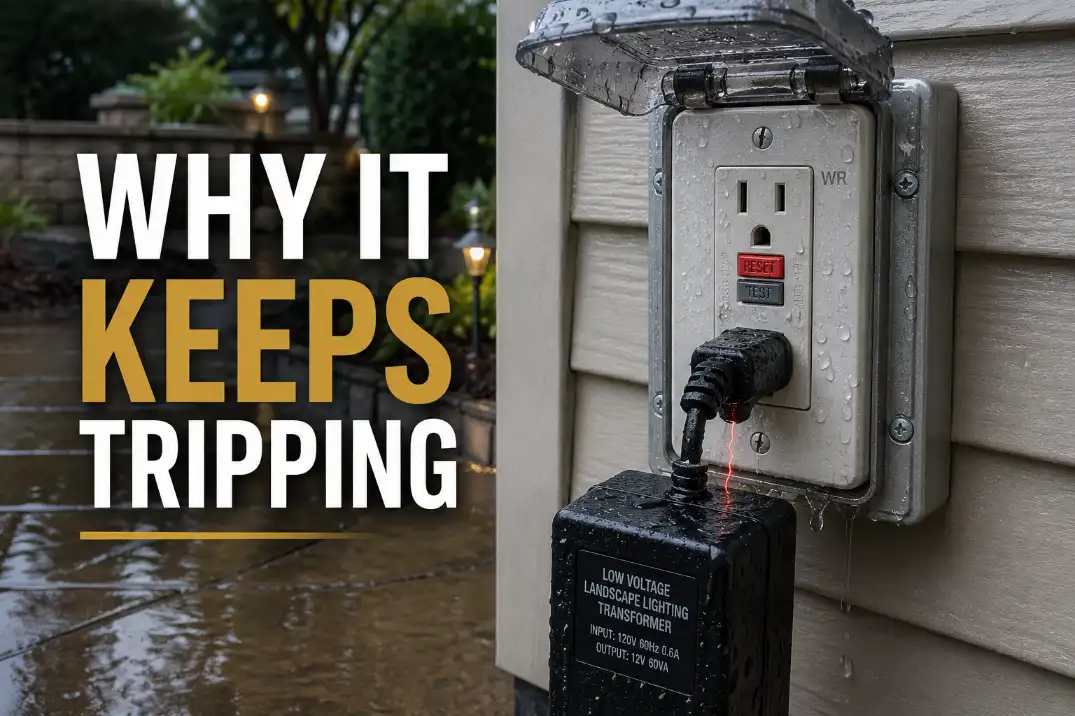
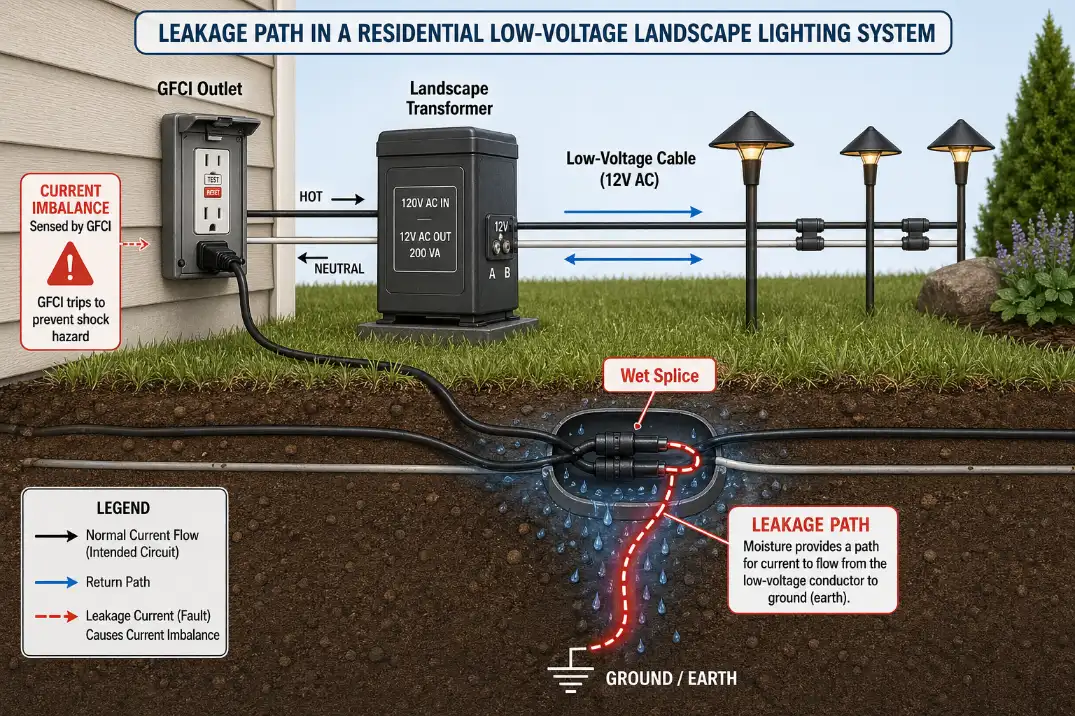
Outdoor lights that trip a GFCI outlet after rain are usually exposing a small leakage-current problem, not pulling too much power. A GFCI can shut off when the outgoing and returning current differ by about 5 milliamps, so a damp plug, wet splice, cracked fixture, or water inside a box can trip it even when the lights look normal.
The first useful checks are simple: whether the outlet holds with the lights unplugged, whether the trip happens only after rain or sprinklers, and whether it trips instantly or after 10–30 minutes.
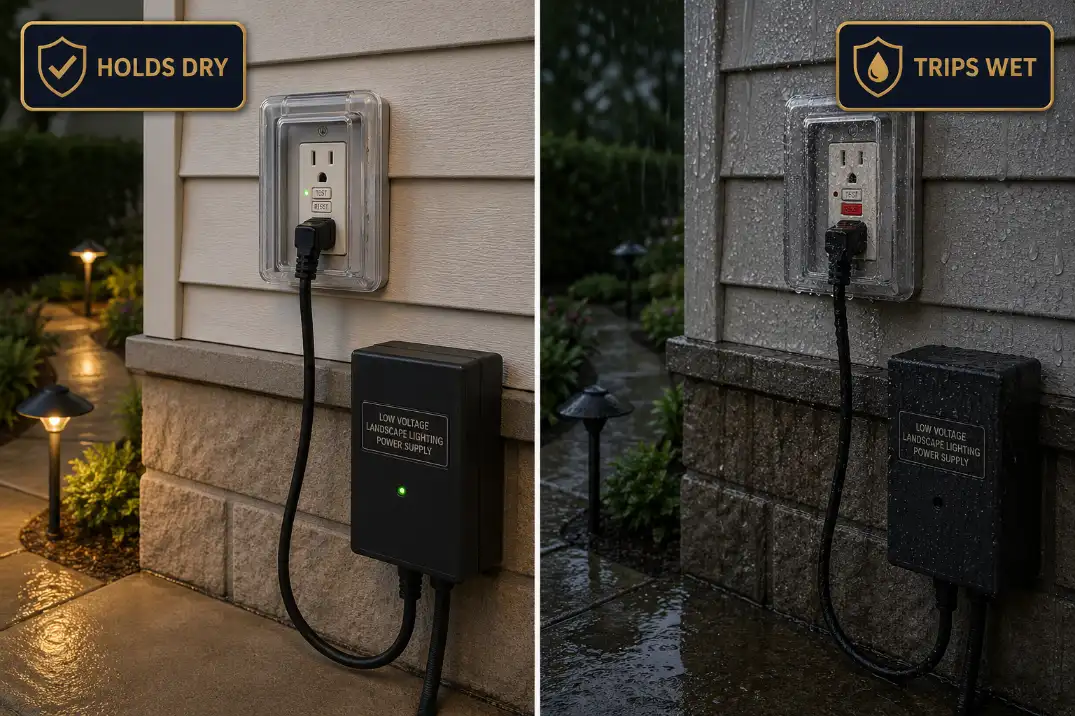
This is different from a dead outdoor lighting circuit. A dead circuit may show no reset behavior at all. A GFCI problem often resets, works briefly, then fails again when moisture or load exposes the weak point.
Reset is a test, not a repair. If the outlet holds dry for 24–48 hours but trips after the next storm, the GFCI is probably revealing a downstream outdoor fault rather than causing the whole problem.
What the GFCI Trip Pattern Tells You First
Trips instantly when the lights turn on
An instant trip is the least forgiving pattern. It usually points to a direct fault, a soaked plug connection, damaged cord, failed transformer, or water bridging contacts inside a fixture or junction box.
Do not keep forcing the reset button. If the outlet trips the moment the lighting load turns on, the GFCI is doing exactly what it is supposed to do.
This is where it helps to separate a GFCI trip from the broader reasons outdoor lights stop working. A bad timer, open cable, failed transformer, or loose connection can also shut lights down, but they do not all create the same reset-and-trip pattern.
Trips only after rain, sprinklers, or dew
This is the most common version. The lights may run normally in dry weather, then fail after a thunderstorm, irrigation cycle, pressure washing, or a humid overnight soak. In Florida humidity, coastal California air, or Midwest spring rain, outdoor fixtures can stay damp long after the visible surfaces look dry.
A practical threshold: if the GFCI holds with the lights unplugged but trips again after the system has been wet for even one cycle, suspect the lighting system before blaming the outlet. If it only recovers after 24–48 dry hours, moisture is not incidental; it is part of the failure.
Trips after 10–30 minutes
A delayed trip often means the weak point appears after warmth, load, or moisture movement changes the electrical path. A transformer may run for several minutes before the fault shows. A fixture may heat slightly, shift trapped moisture, then leak enough current to trip the GFCI.
This pattern is easy to underestimate because the system appears to “almost work.” But a healthy outdoor lighting setup should usually hold through a normal 4–8 hour evening run in dry conditions. If it repeatedly trips in the first half hour, something is still unstable.
Trips with the lights unplugged
If the GFCI trips with nothing plugged in, the outdoor lighting is not the first suspect. The GFCI device, outlet box, upstream wiring, or another downstream load may be involved. A worn GFCI can fail, especially in weather-exposed locations, but that conclusion should come after the no-load test, not before it.
GFCI, Breaker, Transformer, or Timer?
One reason this problem gets misdiagnosed is that several devices can shut outdoor lights off. The fix depends on which one actually dropped out.
| What shut off? | What it usually means | First useful check |
|---|---|---|
| GFCI outlet | Leakage current, often moisture-related | Unplug the lighting load and reset the outlet |
| Panel breaker | Overcurrent, short, or circuit-level issue | Check whether other loads on the circuit also failed |
| Transformer | Low-voltage overload, internal fault, or bad connection | Test transformer without fixture runs attached |
| Timer or photocell | Control failure or misread light condition | Bypass or manually test the control if safe |
| One fixture branch | Local splice, fixture, or cable fault | Disconnect branches one at a time |
The GFCI is not measuring brightness, bulb condition, or whether the outdoor lights are useful. It is comparing current leaving and returning on the circuit. That is why a small wet path can matter more than the total wattage of the lights.
The Most Common Outdoor Failure Point: Plug, Cover, and Box
A cover that only works empty is not enough
Many outdoor outlets have covers that protect the receptacle when nothing is plugged in. That does not mean they protect a landscape lighting transformer while it is plugged in for hours every night. If the cover cannot close fully over the plug, rain can still reach the connection.
A proper in-use cover should shield the outlet while the transformer cord is connected. The cord should exit downward without holding the cover open. If the plug sits sideways, presses against the cover, or leaves a visible gap, the setup may work in dry weather and fail every time wind-driven rain hits the wall.
Water can enter from behind the box
People usually look at the front of the outlet first. That is reasonable, but water often enters from above, behind, or along the wall. Failed caulk, a loose wall plate, cracked siding, or a box that is not sealed to the surface can let water reach the back of the receptacle.
This is why an outlet may look dry from the front while the GFCI still trips. The visible symptom is the reset button popping. The mechanism is moisture creating a current path where one should not exist.
A missing drip loop can carry water into the outlet
If a cord runs downward into the receptacle without a low loop before it enters the cover, water can follow the cord toward the plug. A small drip loop below the outlet gives water a place to fall away before it reaches the connection.
Pro Tip: Look at the cord path during or right after rain. If water beads are running along the cord toward the outlet, the cover may not be the only problem.
Why Low-Voltage Landscape Lights Can Still Trip a GFCI
Low-voltage landscape lighting confuses people because the fixtures may be 12 volts, while the GFCI outlet is on the 120-volt side feeding the transformer. The GFCI still protects the receptacle and anything plugged into it. A wet plug, failed transformer housing, damaged primary-side cord, or internal transformer fault can still trip the outlet.
The low-voltage side also matters indirectly. A damaged branch, waterlogged fixture, or corroded connection can overload or destabilize the transformer. Some failures show up as transformer shutdowns; others show up as GFCI trips depending on where the leakage path forms.
If the system works until the weather changes, the issue often overlaps with why an outdoor light works fine until it rains. The useful distinction is this: the rain is the trigger, but the vulnerable component is still the thing that needs repair.
Where to Inspect Before Replacing Parts
Start at the outlet and transformer area
Begin where the 120-volt connection is exposed to weather: the outdoor receptacle, plug, in-use cover, transformer cord, and mounting area. This is often faster and more productive than opening every fixture first.
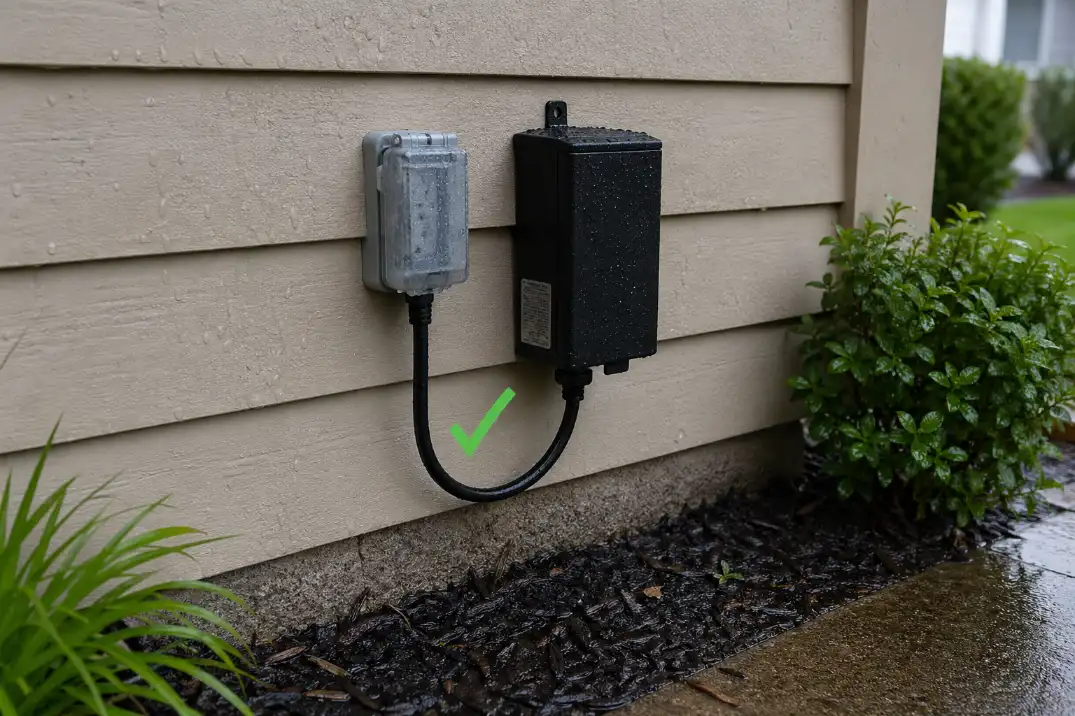
Look for a cover that does not close, a plug sitting in pooled water, scorch marks, a loose receptacle, cracked plastic, water stains, or a transformer mounted where runoff hits it. The transformer should not sit directly on wet soil or mulch. Even a few inches of elevation can reduce repeated wetting.
Move to fixture housings and sockets
If the outlet area looks sound, inspect fixtures that sit low, face upward, collect mulch, or receive sprinkler spray. Water inside a fixture does not need to be dramatic. A damp socket, fogged lens, stained interior, or water line inside the housing is enough to matter.
This is where many readers overestimate fixture ratings. “Outdoor rated” does not mean immune to poor angle, aging gaskets, cracked seals, or standing water. It means the fixture was built for outdoor use under suitable installation conditions.
Check splices and cable entry points
Corroded splices are often the real failure in older systems. A buried or mulch-covered connection may work for years, then start tripping the GFCI after wet weather. Green-blue corrosion, swollen connectors, blackened copper, brittle insulation, and water inside a wire nut are decision-useful signs.
Cable entry points also deserve attention because water can travel along the jacket and into a fixture or box. If the pattern keeps returning after bulbs or covers are replaced, the next useful check is often how water reaches the wiring path.
Problems involving water entering through cable entry points rarely disappear just because the visible surface dries.
A Short Isolation Test That Saves Time
Remove the lighting load first
Unplug the transformer or disconnect the lighting load from the GFCI, then reset the outlet. If the GFCI holds for several hours with nothing connected, the outlet is less likely to be the main cause. If it trips with no load attached, stop chasing fixture problems and investigate the receptacle, GFCI device, or upstream wiring.
Do not bypass the GFCI or move the lights to an unprotected outlet as a workaround. That may make the lights turn on, but it removes the protection that is warning you about the fault.
Add the system back in stages
If the GFCI holds empty, plug in the transformer without turning the lights on if your setup allows it. Then activate the timer or photocell. Then reconnect lighting branches one at a time. The point is to find the moment the fault appears.
When one branch causes the trip and another does not, stop testing at the outlet. The answer is now downstream. Inspect the fixtures, cable, and connectors on that branch instead of replacing unrelated parts.
Use weather as a diagnostic clue
Dry-weather testing can miss a wet fault. If the system passes when everything is dry but fails after irrigation runs, the moisture source may be mechanical rather than rain. Sprinkler overspray can hit outlets, transformers, fixture heads, and splices at the same time.
That pattern has a different repair path than a random bad outlet. If the trip consistently lines up with watering, the problem may be closer to outdoor lighting losing power when irrigation starts than to a general electrical failure.
Fixes That Actually Change the Outcome
| Symptom | More likely cause | Better fix | Fix that often wastes time |
|---|---|---|---|
| Trips only after rain | Moisture in outlet, fixture, splice, or box | Dry, inspect, reseal, or replace the failed outdoor-rated part | Repeatedly pressing reset |
| Trips instantly | Direct fault, wet plug, damaged cord, or failed transformer | Disconnect load and isolate components | Replacing bulbs first |
| Trips after sprinklers | Water spray reaching electrical points | Redirect spray, raise connections, improve covers | Wrapping wet parts in tape |
| Trips with no load | Bad GFCI, wet box, or upstream issue | Test/replace outlet or call electrician | Digging up lighting cable first |
| Trips after 10–30 minutes | Load/heat-related fault or moisture shift | Test transformer and branches separately | Assuming it is harmless humidity |
Electrical tape is one of the weakest outdoor repairs when used as a moisture fix. It may hide the problem for a few days, but it can also trap water against the connection. Silicone can also disappoint when it is smeared over the wrong place; it may block drainage while failing to seal the actual entry point.
For damaged outdoor connections, the repair usually means replacing compromised connectors, cutting back corroded copper, using proper weather-rated splice methods, and relocating vulnerable joins out of wet soil or mulch. If the failure involves corroded outdoor wire splices, cleaning the outside of the connector is rarely enough.
When the Standard Fix Stops Working
Drying is useful only as a test
Letting the outlet, fixture, or transformer dry can help confirm a moisture pattern. It is not a final fix if the trip returns after the next storm. If the system needs a full dry day before it behaves, the installation is still letting water reach an electrical path.
At that point, the decision is whether the part can be restored or should be replaced. A flexible gasket that was pinched may be reseated. A cracked fixture body, corroded socket, brittle cord, or water-damaged transformer is usually beyond a cosmetic fix.
Replacing the GFCI first is not always wrong, just often early
A bad GFCI does happen. It becomes a stronger suspect when the outlet trips with nothing plugged in, will not reset after drying, feels loose or damaged, or is visibly weathered. But if the GFCI holds empty and trips only when the outdoor lights are connected after rain, replacing the outlet first is a low-value move.
The better order is pattern, isolation, inspection, then replacement. That sequence prevents the common loop of installing a new GFCI, enjoying two dry nights of success, and watching the same trip return after the next rain.
Questions People Usually Ask
Can a bad bulb trip a GFCI?
It can, but it is not usually the first suspect when an entire outdoor lighting run trips. A single failed bulb is more likely to cause one fixture to go dark, flicker, or behave oddly. If the whole system drops the GFCI, look first at shared parts: outlet, transformer, plug, cable branch, junction box, or wet splice.
Is it safe to keep resetting the GFCI?
No. One reset after disconnecting the load can help with diagnosis. Repeated resets while the same wet system is connected are not a repair. The GFCI is warning that current may be leaving the intended path.
Why does it trip only sometimes?
Intermittent trips usually mean the fault depends on moisture, heat, load, or movement. A fixture may be dry at noon and wet inside at night. A splice may pass current when dry and leak after irrigation.
If the symptom changes from clean tripping to dimming or flickering, compare it with other flickering outdoor light causes before assuming the GFCI is still the main story.
The practical takeaway is simple: outdoor GFCI trips are not solved by guessing which part looks most suspicious. They are solved by reading the trip pattern, isolating the load, and repairing the first place where moisture or damage gives current a path it should not have.
For broader official guidance on how GFCIs respond to ground faults, see the Occupational Safety and Health Administration.