Outdoor lights that work intermittently usually have an unstable power path, not a mystery bulb problem. The first useful question is whether one fixture, one section, or the entire lighting zone is affected.
The second is whether the problem follows rain, irrigation, darkness, heat, or time. A light that flickers when touched points toward a loose splice or socket; a whole zone that shuts off after 10–30 minutes points more toward transformer heat, overload, or an LED driver issue.
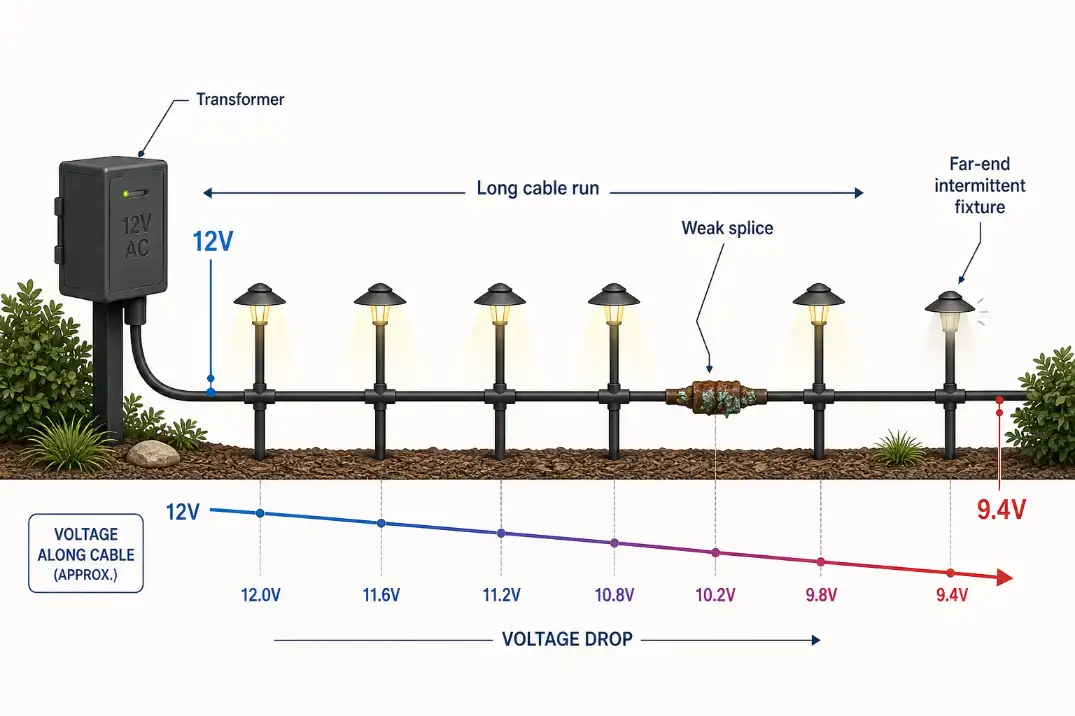
The biggest mistake is treating every intermittent light as the same failure. Low-voltage landscape lights fail differently from 120-volt porch lights, garage sconces, and post lights. In a healthy 12-volt landscape run, many fixtures should receive roughly 10.8–12 volts under load.
If the far end drops near 9–10 volts, dimming and random shutoff become much more likely.
Quick Diagnostic Checklist
Use the behavior to narrow the search before replacing parts.
- One fixture flickers when touched: loose splice, socket corrosion, fixture lead, or failing LED module.
- Several far-end lights dim or cut out: voltage drop, undersized wire, or a weak downstream connection.
- Whole zone shuts off after 10–30 minutes: transformer heat, overload, driver failure, or power supply protection.
- Failure appears after rain or sprinklers: moisture inside a splice, fixture, outlet box, or cable entry.
- Lights cycle around dusk: photocell placement, reflected light, timer setting, or sensor confusion.
- GFCI must be reset: stop treating it as flicker; this may be a ground-fault or water-intrusion problem.
- Solar lights only fail some nights: charging time, battery health, shade, or nearby light hitting the sensor.
First, Identify the Type of Intermittent Failure
Flicker or pulsing
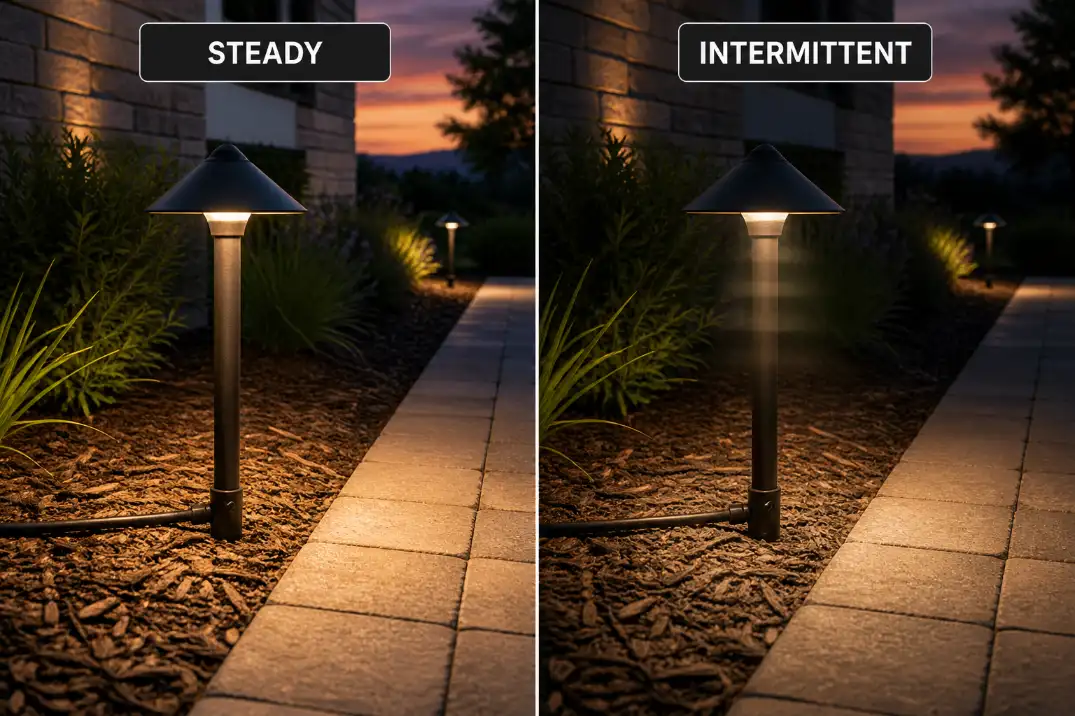
Flicker usually means the power path is unstable. A loose connector may pass current for a moment, then lose contact when the fixture moves, the cable warms, or moisture changes resistance. This is especially common where fixture leads meet the main cable in mulch beds.
A bad bulb can flicker too, but it should not be your default assumption. If swapping in a known-good bulb does not move the symptom, stop buying bulbs and inspect the connection.
Full shutoff and later recovery
When a light or whole zone turns off completely and then comes back later, think heat, overload, protection circuitry, or a failing driver. A transformer that works at startup but cuts out after 20 minutes is behaving differently from a single light that blinks when tapped.
This delayed failure often gets misread as a timer problem. A timer usually fails by schedule. Heat-related faults fail after runtime.
Works only when dry
If the lights work on dry days but fail after rain, sprinkler cycles, heavy dew, or snowmelt, moisture moves to the top of the list. A buried splice sitting 1–2 inches under wet mulch can dry enough to work again, which makes the problem feel random. It is not random; it is moisture-sensitive.
For a more specific rain-triggered pattern, see why your outdoor light works fine until it rains before replacing fixtures that may only be reacting to water intrusion.
Fails only at the far end
If the first lights on the run stay bright while the last few dim, blink, or fail, voltage drop is more likely than a bad timer. Long cable runs, too many fixtures downstream, small wire gauge, and corroded splices all make the far end weaker.
In many low-voltage systems, a difference of 1.5–2 volts between the transformer and the failing fixture is enough to matter.
Most Likely Causes, Ranked
1. Loose or corroded connections
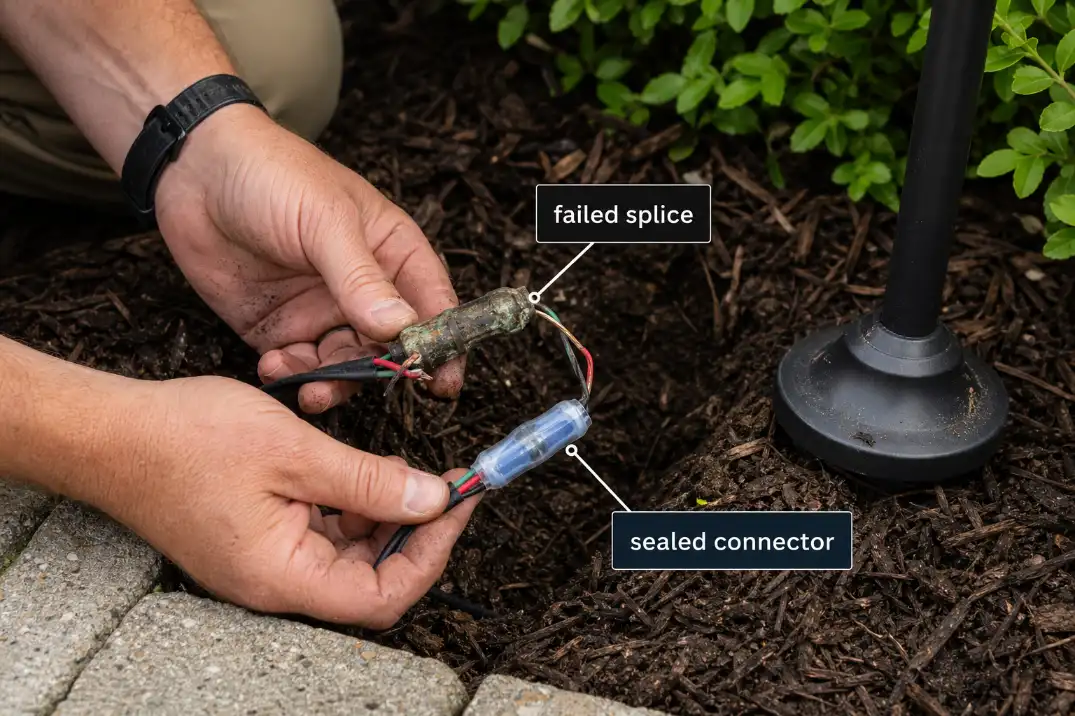
This is the first place to look when one fixture or one small group acts up. Outdoor splices live in wet mulch, compacted soil, irrigation spray, freeze-thaw cycles, and humid air. Even a connector that looks acceptable from the outside can have oxidation inside.
The useful clue is movement. If the light changes when the fixture head, stake, or cable is moved, the connection is the leading suspect. A proper fix means remaking the splice with an outdoor-rated waterproof connector, not wrapping the old connection with electrical tape.
When the failure seems tied to a weak contact point, loose outdoor wiring connections is the better next step than replacing the transformer.
2. Moisture inside the fixture or splice
Moisture is often underestimated because the light may recover after drying. In humid climates such as Florida, a wet connector may stay damp for 24–48 hours after rain. In dry desert areas like Arizona, the same connector may dry quickly enough that the issue appears less often.
Look for green corrosion, water droplets inside lenses, cracked gasket edges, soil packed around fixture bases, and splices sitting in low spots. A fixture near sprinklers, swimming pools, driveway runoff, or coastal salt air has a shorter margin for error.
Moisture problems can also explain why a light works during a quick test but fails overnight. Condensation can form after temperature drops, especially when warm daytime air gets trapped inside a fixture and cools after dark.
3. Voltage drop along the cable run
Voltage drop is not always dramatic. Sometimes the light only looks slightly weaker until the system ages, more fixtures are added, or one splice becomes resistive. Then the far end starts acting intermittent.
Measure voltage while the system is running, not with the lights disconnected. A transformer may show normal output without load, then sag when all fixtures are on. If the transformer reads around 12 volts but the failing fixture reads 9.4 volts under load, the symptom is not cosmetic. The fixture may be starved.
For systems where the last fixtures are the unreliable ones, voltage drop in outdoor lighting systems explains the cable-run problem more directly.
4. Transformer overload, heat, or LED mismatch
A transformer can cause intermittent operation in two opposite ways. The familiar one is overload: too many fixtures, too much wattage, poor ventilation, or an aging power supply. The system turns on, heats up, shuts down, cools, and later works again.
The less obvious issue is mismatch. Some older transformers or drivers do not behave well with very low LED loads or mixed fixture types. This can create pulsing, blinking, or unstable startup even when the total wattage seems far below the transformer rating.
Do not replace the transformer only because lights flicker. Replace or upgrade it after checking load, heat, output voltage, fixture compatibility, and whether the entire zone is affected.
5. Integrated LED driver failure
Modern outdoor fixtures often use integrated LED boards instead of replaceable bulbs. When the driver starts failing, the fixture may flicker, shut off after warming, buzz, shift color, or work only on cooler nights.
This is more likely when one fixture misbehaves while nearby fixtures on the same cable stay stable. If the fixture body becomes unusually hot, the light cuts out after 10–20 minutes, and the wiring tests normally, the driver or integrated LED assembly may be near the end of its life.
6. Photocell or timer confusion
Photocell problems usually show up around dusk, dawn, or near competing light sources. Streetlights, porch lights, reflective windows, car headlights, and bright wall surfaces can cause a sensor to misread darkness.
This is different from voltage drop or loose wiring. A photocell problem usually affects the whole controlled group, not one fixture halfway down the run. If the lights behave strangely only around scheduled on/off periods, outdoor lights not turning on after timer or photocell issues is the more focused diagnostic path.
What People Usually Replace Too Soon
Bulbs
Bulb swapping is useful as a test, not a strategy. Replace one suspect bulb with a known-good one. If the problem stays with the fixture, the bulb is not the cause.
Timers
Timers are easy to blame because they control the schedule. But a timer rarely makes one individual fixture flicker while the rest of the zone stays steady. Resetting the timer five times does not fix a wet splice.
Transformers
A transformer can absolutely be the issue, especially when the whole zone cycles off. But replacing it before measuring voltage and load can be expensive guesswork.
Electrical tape
Ordinary electrical tape is not a permanent outdoor splice repair. Water can travel along the cable jacket and enter from the side. Once corrosion starts, covering it rarely restores a clean electrical path.
GFCI outlets
A tripping GFCI is not an annoyance to work around. It is a warning that current may be leaking where it should not. If your outdoor lights repeatedly trip a GFCI, use outdoor lights tripping GFCI outlets as the next troubleshooting path and stop repeatedly resetting the outlet.
Low-Voltage vs 120-Volt Outdoor Lights
Outdoor lighting problems become clearer once you separate the system type.
Low-voltage landscape lighting
Low-voltage systems usually involve a transformer, buried cable, fixture leads, splices, and multiple lights on one run. Intermittent behavior often comes from voltage drop, corroded connectors, overloaded transformers, damaged cable, or failing fixture modules.
These systems are more forgiving to inspect, but they are not immune to poor repairs. Bad splices in wet soil can keep returning until the connector type and location are corrected.
120-volt exterior fixtures
Porch lights, garage sconces, wall lights, post lights, and some security lights may be line-voltage fixtures. Intermittent operation here can involve a wall switch, breaker, GFCI, fixture box, photocell, internal driver, or water inside the electrical box.
This is where DIY troubleshooting should narrow quickly. If there is visible water inside the fixture box, damaged insulation, buzzing, heat discoloration, repeated breaker trips, or any shock sensation from metal parts, stop using the fixture and call a qualified electrician.
Decision Table: What to Check Next
| What you see | Most likely area | Quick test | Stop-and-call threshold |
|---|---|---|---|
| One light changes when touched | Local splice, socket, fixture lead | Inspect connection with power off | Damaged insulation or 120V fixture wiring |
| Far-end lights dim or fail | Voltage drop or downstream splice | Measure voltage under load | Cable damage under hardscape |
| Whole zone dies after 10–30 minutes | Transformer heat, overload, driver issue | Check load and transformer temperature | Burning smell, buzzing, repeated shutdown |
| Failure follows rain or irrigation | Moisture intrusion | Inspect wet splices and fixture seals | GFCI/breaker trips repeatedly |
| Cycling only at dusk | Photocell or timer | Shield sensor from stray light | Line-voltage controls or unknown wiring |
| Solar lights fail some nights | Weak charge, battery, shade | Confirm full sun exposure and battery age | Fixture sealed and non-serviceable |
Practical Fix Order
Start with the failure pattern, not the part that is easiest to buy.
- Identify the affected area. One fixture, one section, far end, or full zone.
- Note the trigger. Rain, sprinklers, dusk, cold, heat, runtime, or movement.
- Swap one known-good lamp if applicable. Use this only to rule the bulb in or out.
- Inspect local connections. Open suspicious splices and look for corrosion, looseness, or water.
- Measure voltage under load. Compare transformer output with the problem fixture while lights are on.
- Check transformer load and ventilation. Heat-related shutdowns need load and placement checks.
- Separate sensor issues from wiring issues. Dusk-only cycling points toward photocell logic, not cable failure.
- Stop if protection devices trip. A GFCI or breaker that repeatedly trips needs fault diagnosis.
For solar fixtures, the process changes. There is no transformer or buried low-voltage run to blame. Intermittent solar lights are usually tied to weak charging, shaded panels, aging rechargeable batteries, dirty panels, or sensor confusion. If your fixtures are solar, why your solar outdoor lights are not charging is the better repair path.
Pro Tip: If a splice has failed once from moisture, replace the connector and improve its location. Reusing the same low, wet spot often makes the repair temporary.
When to Stop Troubleshooting and Call a Pro
A simple low-voltage splice repair is one thing. Repeated safety-device trips, line-voltage fixture problems, and water inside electrical boxes are different.
Call a qualified electrician or outdoor lighting technician if:
- A GFCI or breaker trips more than once after reset.
- A fixture smells hot, buzzes, sparks, or shows scorch marks.
- You see water inside a 120-volt outdoor fixture box.
- Cable insulation is cut, chewed, crushed, or exposed.
- A transformer repeatedly shuts down even after reducing load.
- More than 25–30% of the fixtures or splices on a zone show corrosion or recurring failure.
That last point matters. When failures move around the system, the problem is no longer just one connector. Aging cable, poor splice locations, undersized wire, moisture exposure, and transformer strain may be working together. At that stage, repeated small repairs can cost more than rebuilding the weak run correctly.
Questions People Usually Ask
Why do my outdoor lights work some nights but not others?
The system is probably near a failure threshold. A small change in moisture, temperature, battery charge, voltage, or load can decide whether the light works that night.
Can a bad photocell make only one light flicker?
Usually no. A photocell normally controls a whole fixture or group. One flickering light points more toward the fixture, bulb, socket, splice, or local wiring.
Are intermittent outdoor lights dangerous?
They can be. Low-voltage flicker from a weak splice is usually less serious than a 120-volt fixture with water intrusion or a GFCI that keeps tripping. Treat repeated trips, heat, buzzing, shock sensation, or water inside electrical parts as safety warnings.
Should I replace all outdoor lights if one works intermittently?
Not at first. Diagnose the pattern. One failing fixture rarely justifies replacing the whole system, but repeated failures across a zone may mean the wiring, connectors, or transformer layout needs a larger correction.
Bottom Line
Outdoor lights that work intermittently are usually telling you where the system is unstable. One fixture points toward a local connection or LED driver. Far-end failures point toward voltage drop.
Rain-triggered failures point toward moisture. A whole zone that shuts off after runtime points toward transformer, load, heat, or protection circuitry. The right fix starts with the pattern, not with replacing parts at random.
For broader official safety guidance, see the NFPA Outdoor Electrical Safety Tip Sheet.