Many battery outdoor lights genuinely feel weak, but low output is not always the underlying problem. A light can carry an impressive lumen number and still disappoint when it is expected to cover a driveway, remain on throughout an evening, or throw useful light from an unnecessarily high mounting point.
Treat the fixture as having a limited performance budget. Every additional minute of operation, extra foot of coverage, unnecessary trigger, and poorly directed part of the beam spends some of that budget. A modest light can therefore feel convincing at one lock, step, gate latch, or bin area while a higher-output model feels thin across an oversized zone.
Battery lighting is strongest as controlled task lighting, not as a cordless substitute for every wired floodlight. Runtime mode, activation frequency, target size, winter exposure, beam shape, and mounting distance reveal more than the largest number printed on the package.
Runtime Claims
A runtime claim is useful only when it describes the output mode and operating pattern you will actually use. One large number may represent the lowest brightness setting, infrequent motion activations, or the total calendar period before the batteries need attention.
Those are different promises. Ten short activations spread across a quiet night consume far less energy than repeated triggers at a busy back door. Neither pattern is equivalent to keeping the light steadily illuminated while people sit, cook, work, or entertain outside.
Output can also become less useful before the battery is technically exhausted. The fixture may continue turning on, but its beam can lose enough intensity that a lock, stair edge, or gate latch is no longer revealed clearly. “Still operating” and “still providing useful light” are not the same standard.
Read the conditions behind the number
Look for runtime information separated by brightness mode. For motion models, check whether the claim identifies activation length or an assumed number of daily triggers. A single undivided runtime figure provides limited evidence because it does not explain how the light was expected to operate.
Brightness specifications deserve similar restraint. More output can help, but brighter outdoor light does not automatically improve visibility when the beam creates glare, misses the target, or spreads across more area than the fixture can serve.
The useful question is not simply, “How long will the battery last?” Ask how long the light will remain effective in the mode and location you intend to use.
Motion-Only Use
Battery lighting earns its advantage by staying off when the zone is empty. It can then deliver a short burst of useful illumination as someone approaches a door, crosses a small landing, opens a gate, or reaches a trash enclosure.
That operating pattern preserves finite battery capacity without forcing the homeowner to accept dim light during the moment it matters. A fixture does not need to illuminate an unused doorway for six hours if its actual job takes less than a minute at a time.
Repeated triggers change the use case
A light beside a rarely used side gate has a different duty cycle from one facing an active driveway, dog route, or family back door. Frequent traffic can turn momentary lighting into a near-continuous load, especially when every trigger restarts a long activation period.
Sensor direction also affects whether the light feels responsive. A bright fixture that activates after someone reaches the steps feels less capable than a modest light that responds during the approach. Before treating output as the problem, check whether the motion light covers the real walk path rather than movement beside or behind it.

Motion-only operation is a poor fit when stable light is part of the activity. Patio dining, outdoor cooking, repairs, and extended seating require illumination that remains predictable rather than switching off between movements. In those situations, the mismatch is the operating pattern—not necessarily the fixture’s brightness.
Small Task Zones
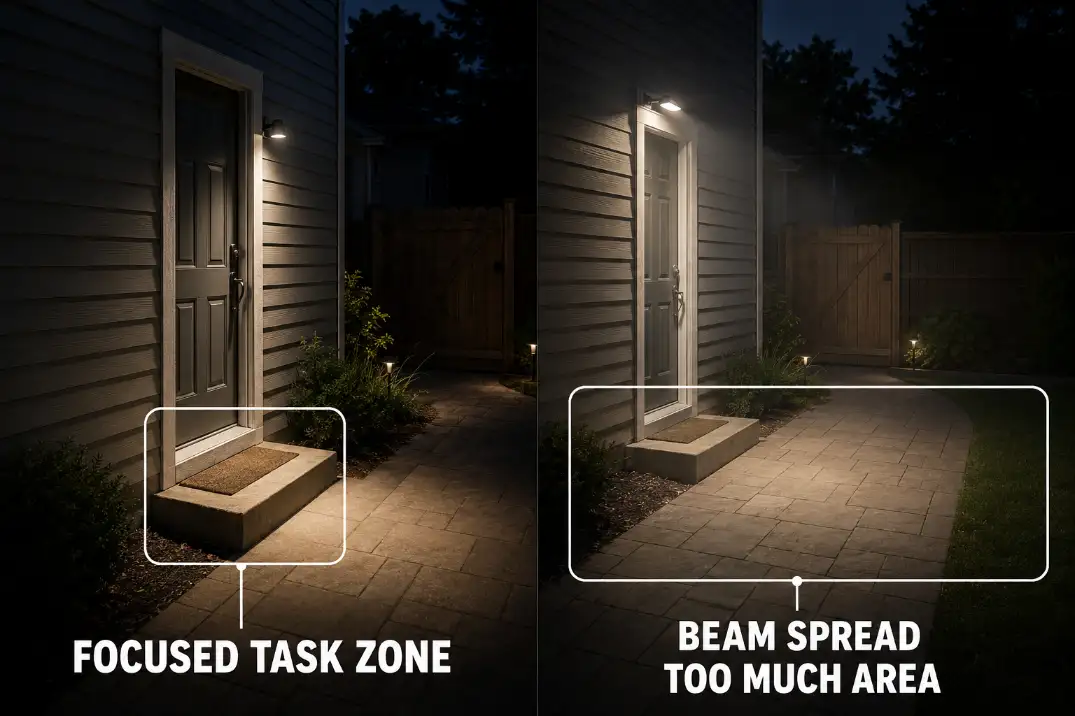
Coverage is where a capable battery light is most often overextended. Give it one visible job: reveal a door lock and threshold, define a short stair run, illuminate a gate latch, show grill controls during a quick check, or make a trash-bin handle easy to find.
These are bounded targets. The beam can place most of its useful output on a small surface instead of thinning across a patio, driveway, and side yard at once.
One fixture, one clear job
A door, nearby step, and gate may appear to belong to the same compact area during the day. At night, they can sit at different angles and distances from the fixture. A beam aimed well at the lock may pass above the step or stop before reaching the gate. Increasing the claimed brightness does not guarantee that all three become equally usable.
Beam shape matters alongside output. A controlled downward beam can outperform a broad, exposed source that sends much of its light outward. The test is whether the intended surface becomes readable—not whether the fixture itself looks bright from across the yard.
When the requirement extends to an entire patio or broad driveway, consider other no-wire outdoor lighting approaches or a properly designed powered setup. Stretching one compact fixture across several tasks usually produces a bright center, weak edges, and persistent dark gaps.
Editorial Note: A battery light becomes convincing by owning a defined target, not by carrying the largest headline specification.
Cold Weather Drop-Off
Cold weather does not automatically rule out battery lighting, but it reduces the margin available for optimistic runtime and coverage expectations. A fixture that works well during mild weather may fade sooner, need more frequent charging, or behave less predictably during a cold stretch.
The relevant condition is the exposure around the fixture, not merely the regional forecast. A light mounted on a detached garage, fence, or exposed north-facing wall can face a harsher environment than one sheltered beside the house. Best-case runtime claims should not be treated as winter guarantees.
This matters most when the light serves an important route. If it reveals a step or allows someone to operate a lock, plan for reduced winter performance rather than waiting for the beam to become inadequate. Battery access also matters more here: a fixture that requires an awkward ladder position or difficult disassembly becomes frustrating when attention is needed more frequently.
Avoid assuming that every battery chemistry responds identically. The practical test is simpler: confirm the fixture’s stated operating conditions, allow for a smaller cold-weather margin, and keep charging or replacement access realistic.

Mounting Height
Mounting height spends part of the light’s output budget. As the distance between the fixture and target increases, the beam generally spreads across more surface and can feel less intense where illumination is actually needed.
A compact battery fixture should therefore be positioned in relation to its task rather than copied from the location of a larger wired floodlight. Lower placement can tighten the relationship between the beam and target, but lower is not automatically better. The fixture still needs clearance, useful sensor exposure, protection from accidental contact, and an angle that does not send light into people’s eyes.
Aim toward the walking or working surface rather than outward across the property. The same principle used when aiming outdoor security lights toward useful surfaces applies here, but limited battery output makes every wasted direction more noticeable.
There is no universal mounting height that solves every doorway, gate, or stair condition. When the mount is removable, test it after dark from the real approach route before finalizing its position. Confirm that the sensor activates soon enough, the beam reaches the target, and the fixture itself is not the brightest object in view.
Buying Check
Start with the job, not the fixture specification. Once the target and operating pattern are clear, runtime and brightness claims become easier to interpret—and poor-fit applications become easier to reject.
Use this six-point check:
- Name one task. Identify the exact lock, step, threshold, gate latch, control surface, or short route the light must reveal.
- Choose brief or continuous operation. Battery motion lighting fits short activity better than stable evening illumination.
- Read runtime by mode. Confirm whether the stated runtime applies to the output setting you intend to use.
- Account for real activations. Frequent traffic and cold exposure can shorten the useful interval between charging or replacement.
- Check beam control. Make sure the beam shape, aiming range, and mounting position can concentrate light on the target.
- Keep the power source accessible. Batteries or the rechargeable fixture should be reachable without turning routine attention into a difficult maintenance job.
Reject the application—not automatically the light—when the expected area or operating time exceeds what battery power can reasonably support. A modest fixture can work well in a disciplined task zone. A more powerful model can still disappoint when mounted badly, triggered constantly, or assigned several separated areas.
The final test is fit: use battery lighting for short, clearly defined tasks where the beam can be controlled. Choose another approach when the area needs broad, continuous, or dependable all-evening coverage.
For technical background on low-temperature battery performance, see Argonne National Laboratory’s battery research overview.