
When one landscape cable run is bright and another is dim, the first useful comparison is where the difference begins. If the dim run’s first fixture is already weak, investigate its output and early connection. If both runs start similarly but one fades farther out, investigate what happens along that route.
Observe both runs at the same time, with their normal fixtures connected. A tap change or a reading taken with one run disconnected may make the symptom look different without explaining its cause.
Comparing Runs From the Same Transformer
Compare first fixture to first fixture before comparing the far ends. Use matching fixtures where possible: different LED models, lamps, lenses, and dirt levels can create a visible difference even when their electrical supply is suitable.
| What you see | What it suggests | Next comparison |
|---|---|---|
| One run is dim from its first matching fixture onward | The difference begins early | Check each run’s output and first connection |
| First fixtures look similar, but one run weakens farther out | Loss develops along that route | Compare its first and far fixtures |
| One fixture is dim while its neighbors look normal | The issue may be local | Check that fixture and its immediate connection |
These are directions for the next check, not fault verdicts. In particular, “one run is dim” does not yet tell you whether the difference starts at the transformer, at a splice, or along the cable.

If the first fixtures match and only the far end weakens, voltage drop along one run is the closer diagnostic path. Keep this two-run comparison focused on the first place their behavior diverges.
When the fixture types differ, appearance alone cannot settle that question. Compare each run’s own first and far fixtures, then use appropriate voltage readings under load if a closer electrical comparison is needed.
Cable Length vs Connection Loss
Uniform weakness from the first fixture points upstream of that fixture. Check the dim run’s selected output, the cable feeding its first light, and any connection between them before blaming the length of the entire route.
The cable may also travel farther than the yard suggests. It can bend around beds or cross a substantial distance before reaching its first fixture. That distance matters, but a poor early connection can produce a more abrupt difference than gradual loss along a long run.
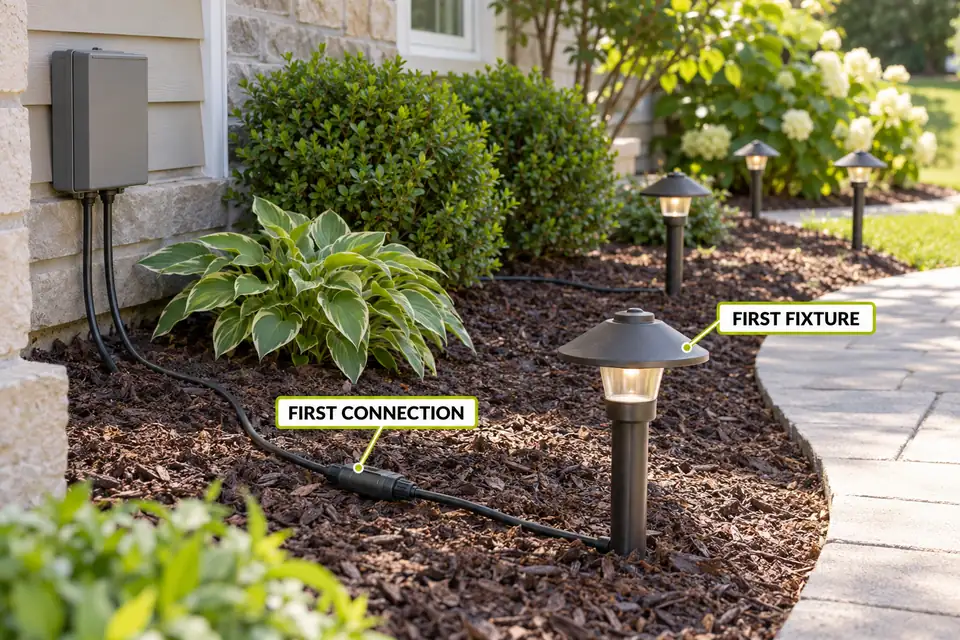
If every fixture beyond an accessible first connection is similarly weak, inspect that point with power off. Visible looseness, moisture, corrosion, or heat damage calls for proper assessment. Do not handle a damaged connection or open an unfamiliar transformer compartment to complete the check.
Where suitable low-voltage test points can be accessed safely, compare equivalent points with both runs carrying their normal loads. A transformer-output reading by itself does not show what reaches the first light. If readings are similar at the first fixtures but the gap grows farther along one route, cable gauge for that run length and load becomes a relevant next decision.
Load Difference Between the Runs
Compare watts before counting fixtures. A run with fewer high-output accent lights can impose more load than one with more small path lights. Record each run’s connected fixtures and stated wattages, including recent additions.
Load and route length act together. A longer, more heavily loaded run can perform differently from its bright neighbor even though both share a transformer. If the difference appeared after adding fixtures, that timing helps prioritize the load comparison.
Do not let the load explanation conceal an abrupt early loss. A run that became uniformly dim after its first splice was disturbed still warrants attention at that splice. The bright run shows that the transformer is operating; it says little about the condition of the other run’s connections.
Swapping Transformer Taps Without Hiding the Cause
Identify the existing tap assignments before changing either one. Some transformers offer multiple labeled outputs, but their arrangements and the fixtures’ permitted input ranges vary by model. The equipment instructions govern any comparison or adjustment.
A higher tap may brighten a weak run while leaving a poor connection in place. It can also raise voltage at near fixtures more than the far fixtures require. A meaningful result checks what comparable fixtures receive under normal load, not just whether the yard looks brighter immediately after a change.
If the evidence instead indicates a transformer tap that is not working, follow that separate diagnosis. Isolate power before any terminal work, and use a qualified professional when the transformer’s low-voltage and line-voltage areas cannot be confidently distinguished.
The End-to-End Night Comparison
After addressing the indicated cause, view both runs together with their usual loads. Compare matching first fixtures, then matching far fixtures, under similar evening conditions.
A sound correction improves the weak run without making its near fixtures unusually bright. If it remains dim from the start, return to its output and early connection. If it starts normally but fades farther out, follow that run’s cable path. If only one fixture differs, check it locally.
The aim is a fair match between comparable fixtures and a clear explanation for any remaining difference, not identical output from unlike lights.
For model-specific guidance on checking transformer and fixture voltage, see FX Luminaire’s voltage-checking instructions.