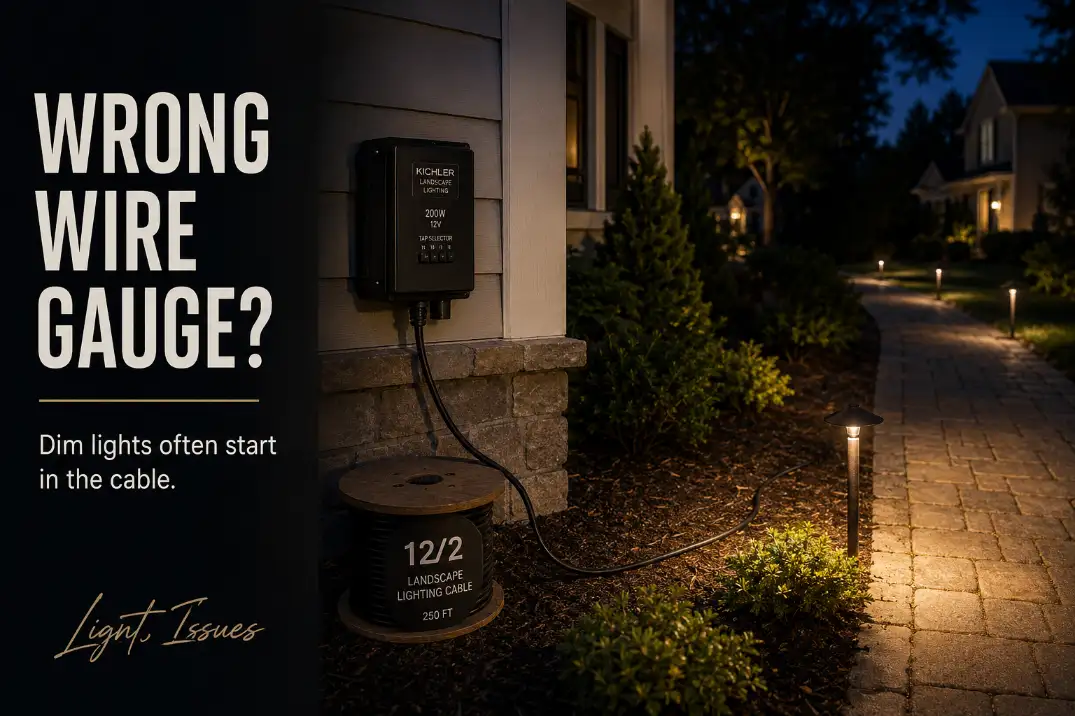
For most low voltage landscape lighting, 12-gauge wire is the best default choice. It gives typical residential LED systems enough capacity for normal path lights, bed lights, and accent fixtures without forcing every small project into oversized cable.
Use 14-gauge only for short, light LED runs, and move to 10-gauge when the run is long, heavily loaded, or feeding several fixtures near the far end.
The useful question is not just “How many feet is the run?” It is how far the power travels under load. On a 12-volt system, a 5% voltage drop is about 0.6 volts, while a 10% drop is about 1.2 volts.
If a typical 12-volt run is falling near 10.5–11 volts at the farthest fixture while the first fixture still looks strong, wire size, layout, or both deserve attention before you blame the bulbs.

Quick Wire Gauge Selection Chart
| Wire gauge | Best use | Be careful when | Better move |
|---|---|---|---|
| 16/2 | Very short, very light accent runs | It is being used as the main cable for a permanent system | Use 14/2 or 12/2 instead |
| 14/2 | Short LED runs near the transformer | The run pushes past about 50–75 feet or may expand later | Use 12/2 |
| 12/2 | Most residential LED landscape lighting | One long run feeds many fixtures or a far-end fixture group | Split the run or consider 10/2 |
| 10/2 | Long runs, higher loads, or far fixture clusters | The fixtures are small LEDs close to the transformer | 12/2 is usually cleaner |
| Split 12/2 runs | Larger yards, separate walkway or bed zones | One cable is trying to serve the whole yard | Use multiple shorter runs |
These are practical residential starting points, not a substitute for fixture manufacturer limits, transformer instructions, or local code requirements.
For a normal front yard walkway with low-watt LED path lights, 12/2 is usually the right balance.
For a small bed with four or five nearby fixtures, 14/2 may be enough. For a long driveway, deep backyard, or run that reaches 100 feet or more, the decision should include both heavier cable and a better layout.
What Actually Decides Wire Gauge
Distance matters twice
A common mistake is measuring only the one-way distance from the transformer to the last fixture. Electrically, the circuit has to travel out and back. A 75-foot one-way run behaves more like 150 feet of conductor path.
That is why a cable route can look reasonable in the yard but still perform poorly at night. A run that snakes around a walkway, crosses a planting bed, and continues to a far tree is often longer than the straight-line distance suggests.
Wattage changes the stress on the cable
Voltage drop gets worse as current rises. On a 12-volt system, a 60-watt load draws about 5 amps. A 120-watt load draws about 10 amps. The same wire gauge can behave very differently under those two loads.
This is where LED fixtures help, but they do not make wire gauge irrelevant. Ten 4-watt LED fixtures are only 40 watts. Ten older 20-watt halogen fixtures are 200 watts. A cable that works well for the LED version may be undersized for the halogen version.
If the system already shows weak far-end output, Voltage Drop in Outdoor Lighting Systems is the better diagnostic companion because the visible symptom is usually voltage loss, not a bad bulb.
Cable type still matters
Use outdoor-rated, direct-burial low-voltage landscape lighting cable where the cable will be buried. Do not treat indoor speaker wire, lamp cord, or leftover household wire as a permanent outdoor lighting cable.
This is not just about durability. Outdoor lighting cable deals with wet soil, seasonal freeze-thaw movement in northern states, irrigation cycles, and accidental contact from edging or planting work.
The wrong cable type may work for a while, then become the hidden weak point after months of exposure.
Wire Gauge Fixes Resistance; Layout Fixes Distance
A bigger wire does not shorten the run
Heavier wire reduces resistance. It does not change the fact that every fixture on a long daisy chain is farther from the transformer than the one before it.
If the first lights are bright and the last lights are weak, the wire may be too small, but the layout may also be asking too much from one cable.
Replacing 14/2 with 12/2 can help a borderline run. Replacing 12/2 with 10/2 may help a longer or heavier run. But when one cable is feeding an entire yard in a single line, splitting the run can outperform simply buying thicker wire.
Daisy-chain runs fade first at the end
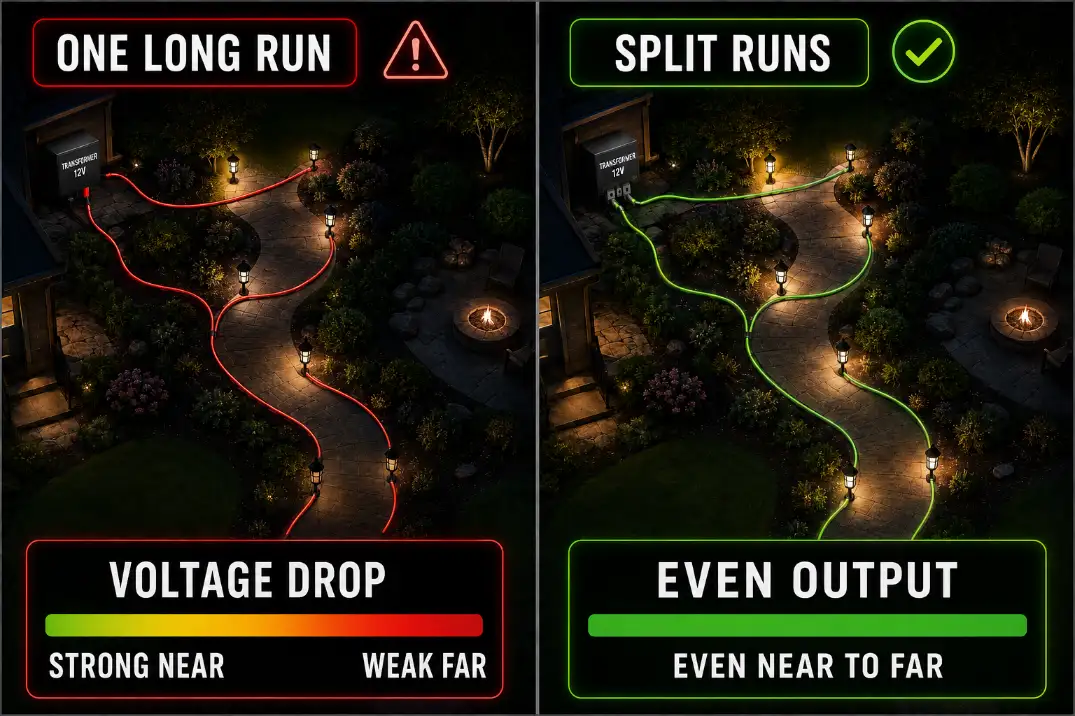
A daisy-chain layout puts fixtures in sequence along one cable path. The farthest lights receive power after the cable has already carried the load for the earlier lights. The result is often predictable: good output near the transformer, weaker output at the end.
A hub or split-run layout sends shorter cable paths to fixture groups. That can keep voltage more even without turning the whole project into a 10-gauge installation.
If your system is one long line, Daisy Chain vs Hub Landscape Lighting is worth comparing before you decide the wire alone is the problem.

A Practical Way to Choose the Right Gauge
Start with the farthest fixture
The first fixture usually gives a false sense of security. It is closest to the transformer and sees the least voltage loss. The farthest fixture tells you whether the cable and layout are holding up.
Measure the actual cable route, not the straight distance across the lawn. Then add the wattage of the fixtures on that run. If the cable branches, judge each branch separately instead of averaging the whole system into one vague number.
A run with six 5-watt LED fixtures is only 30 watts, and 12/2 usually has room. A run with eight 7-watt fixtures plus two 15-watt uplights is 86 watts, and layout becomes much more important.
Test voltage under real load
Do not test only when the system first turns on. Let the lights run for 10–15 minutes, then check voltage at the transformer and at the farthest fixture. The far fixture should stay within the fixture manufacturer’s input range; on many 12-volt landscape systems, that usually means staying near 11–12 volts, not sagging deep into the low 10s.
Pro Tip: If the transformer has 12V, 13V, 14V, or 15V taps, adjust only after measuring the near and far fixtures. A higher tap can help the far end, but it can also overfeed fixtures close to the transformer.
Do not use a higher tap to hide a bad run
A multi-tap transformer is useful for fine-tuning. It is not a cure for a poor splice, corroded connector, damaged cable, or overloaded run.
If a section flickers, cuts out after rain, or changes behavior after yard work, the issue is more likely a connection or cable fault than the original gauge.
A gauge problem usually looks orderly: the run fades as distance increases. A connection problem often looks erratic: one group fails, flickers, or comes back after the cable is moved.
If only the final lights are weak, Outdoor Lights Losing Power at the End of the Line is the stronger diagnostic path.
When 12-Gauge Stops Being the Right Answer
The transformer is too far from the lighting area
Sometimes the smartest fix is not thicker wire. If the transformer sits on a garage wall and the first real lighting zone starts 90–120 feet away, a single long run is already starting at a disadvantage.
In that case, a closer transformer location, a separate run, or a hub-style layout may reduce voltage drop more cleanly than forcing every fixture through one long main cable.
The system has grown beyond its original design
Many landscape lighting systems do not fail all at once. They outgrow their original wiring. Two path lights become six. A tree uplight gets added. Then driveway lights join the same run.
This is where people often overestimate transformer wattage and underestimate cable layout. A transformer may have enough total capacity while one cable run is still carrying too much load over too much distance.
If you are deciding how many fixtures belong on one route, How Many Landscape Lights Can You Put on One Cable Run? gives that decision more structure.
One long run should become two shorter runs
Once a run carries many fixtures across a long yard, splitting it often beats upsizing it. Two shorter 12/2 runs can perform better than one long overloaded 10/2 run, especially when fixtures naturally group by walkway, driveway, patio, or planting bed.
That is the point where routine “use 12-gauge” advice stops being enough. Gauge reduces resistance. Layout decides how much distance each fixture has to fight through.
Common Wire Gauge Mistakes
Buying 16-gauge because the lights are LED
LEDs reduce load, but they do not make the cable irrelevant. 16-gauge wire is best kept for very short, light-duty use, not as the main cable for a permanent landscape lighting system.
Treating wire gauge as a brightness control
Wire gauge should protect performance, not act as a dimmer. If the lights are too harsh near the transformer and weak at the end, the system is unbalanced. That is a distribution problem, not a styling choice.
If brightness problems also involve spacing, aiming, glare, or uneven pools of light, Low Voltage Landscape Lighting Problems can help separate power issues from placement issues.
Replacing wire before checking connections
This is one of the easiest ways to waste time. If the problem appeared suddenly after rain, digging, mulch work, irrigation repair, or fixture replacement, inspect splices and cable damage before trenching new wire.
Pro Tip: A predictable end-of-run fade points toward voltage drop. Random flicker, sudden outages, or rain-triggered failure points more toward connections, cable damage, or moisture.
Questions People Usually Ask
Is 12-gauge wire enough for low voltage landscape lighting?
Yes, 12-gauge wire is enough for many residential LED systems, especially when runs are moderate and fixture wattage is low. It becomes less reliable as the run gets longer, the fixture count rises, or several higher-wattage lights sit near the far end.
Is 10-gauge always better than 12-gauge?
No. 10-gauge reduces resistance, but it costs more and is harder to work with. It is worth using when distance and load justify it. For a short LED bed near the transformer, 12-gauge is usually the cleaner choice.
Can I mix wire gauges in one landscape lighting system?
Yes, but do it intentionally. A thicker main cable with shorter lighter branches can work well. Randomly mixing gauges because you ran out of cable makes troubleshooting harder later.
For broader safety and listing context, see UL Solutions’ landscape and outdoor lighting guidance.