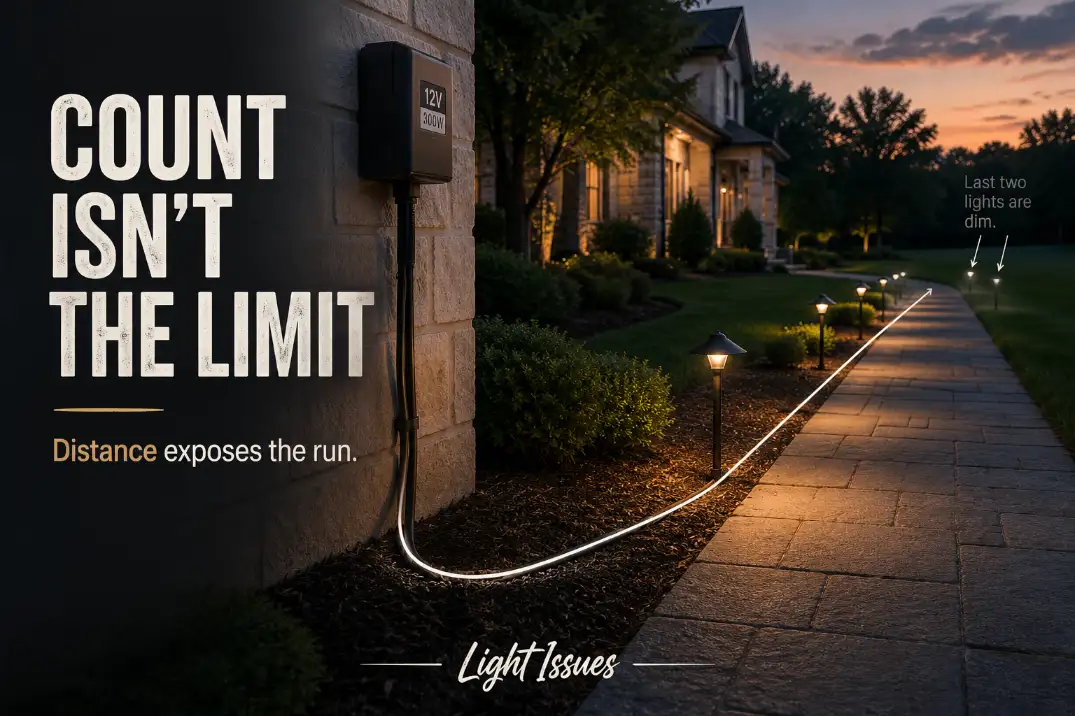
A low-voltage landscape lighting cable run does not have one universal fixture limit. The run starts failing when the last fixture no longer receives usable voltage.
As a practical planning range, many short LED path-light runs can handle about 8–12 low-watt fixtures, while a long 100–150 ft run may be safer with 4–8 fixtures, depending on wattage, wire gauge, and layout.
The first checks are simple: add the fixture watts, measure the real cable path, and compare the first light to the last light after the system has been on for 20–30 minutes.
If the first lights look normal but the last 2–3 lights look weaker, the issue is usually voltage drop or cable layout, not the fixture count alone. That is different from a transformer problem, where several runs or the whole system may struggle at once.
The Useful Answer: Count Fixtures Last
Start with watts, not fixtures
Ten landscape lights can be too many, or they can be perfectly fine. The difference is wattage. Ten 3-watt path lights use about 30 watts. Six 8-watt uplights use 48 watts. The second run has fewer fixtures but asks more from the cable and transformer.
A good planning rule is to keep the connected lighting load under about 80% of the transformer’s rated capacity. On a 100-watt transformer, that means planning around 80 watts of lighting load instead of filling the transformer to the label limit.
If the whole transformer is already close to its limit, read Too Many Landscape Lights on One Transformer? before blaming one cable run.
Measure the cable route, not the yard
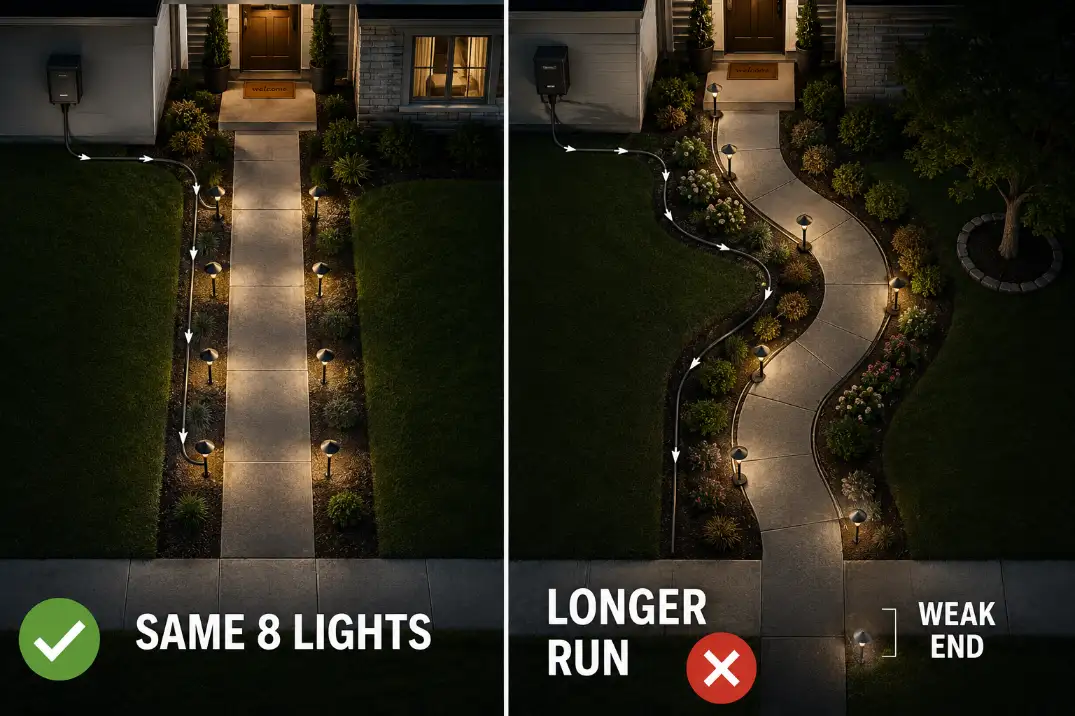
A 60 ft walkway rarely means exactly 60 ft of cable. The wire may curve around planting beds, loop behind fixtures, cross under mulch, and include slack near splice points. That real routed distance is what affects voltage drop.
This is where many homeowners overestimate fixture count and underestimate distance. A short 40–60 ft run with low-watt LEDs is forgiving. A 120–150 ft run along a driveway edge or deep planting bed is not. The same number of lights can behave very differently once the cable gets long enough for the far end to suffer.
Quick Planning Ranges for One Cable Run
These ranges are not a final electrical calculation, but they help you avoid the most common bad layout before the cable is buried.
| Your run looks like this | Safer fixture range | Main risk | Better move |
|---|---|---|---|
| 40–75 ft path run with 2–3W LEDs | 8–12 lights | Usually transformer load | Keep the run simple |
| 75–100 ft path run with 3–4W LEDs | 6–10 lights | Early voltage drop | Use 12-gauge cable and check the far end |
| 100–150 ft long bed or driveway edge | 4–8 lights | Weak last fixtures | Split the run before adding more lights |
| 100 ft+ mixed path lights and uplights | 4–6 higher-output fixtures | Uneven demand | Separate fixture types by run |
| Future expansion likely | Leave room for 2–4 lights | No layout buffer | Split early instead of maxing one run |
The real warning sign
The useful warning sign is not “I have eight lights.” It is “the last lights do not look like the first lights.”
Matching fixtures on the same run should look reasonably consistent. If the last fixture is visibly weaker, warmer, or slower to stabilize, the run is probably near its practical limit.
If a multimeter shows roughly a 1-volt difference or more between the first and last fixture, and the visual output also changes, treat the run as suspect rather than assuming the last fixture is bad.
What People Usually Misread First
They count lights before watts
Fixture count feels easy because you can see it. Wattage matters more because the cable and transformer respond to load, not just quantity. Twelve small LED path lights may be easier to support than five heavy accent lights.
This is also why adding “just one more” fixture at the end can change the whole run. The extra light is not only another object. It is another load placed at the weakest part of the cable.
They blame the transformer too early
A weak far-end fixture does not automatically mean the transformer is bad. If every run connected to the transformer is dim, flickering, or shutting down, the transformer deserves attention. If one long run fades toward the end, the cable path deserves attention first.
For a deeper look at the end-of-run pattern, Outdoor Lights Losing Power at the End of the Line fits that symptom more closely than a general fixture failure diagnosis.
They treat a bigger transformer as a layout fix
A bigger transformer helps when the total system load is too high. It does not shorten a cable, reduce resistance along a long daisy-chain, or make a poor layout balanced.
That is the fix that often wastes time. A 200-watt transformer can still feed a weak far end if the cable run is too long, too thin, or too unevenly loaded. The transformer may have more capacity while the last fixture still receives poor voltage.
Why Daisy-Chaining Fails First on Long Runs
The last fixture gets the worst deal
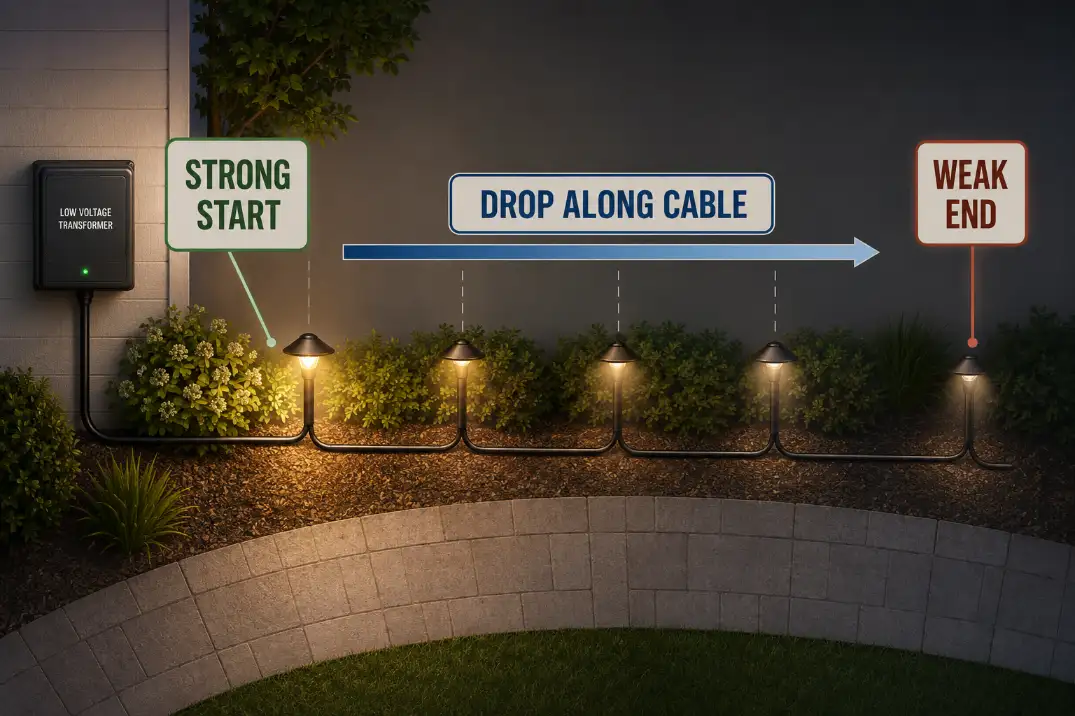
In a simple daisy-chain layout, power leaves the transformer, reaches the first fixture, then continues down the same cable to the next fixture and the next. That can work well on short runs.
On long runs, each foot of cable and each connection adds resistance, so the last fixture often gets the weakest conditions.
The clue is usually not the number of fixtures on paper. It is the brightness pattern from the transformer outward.
This is why “how many lights can one run handle?” is really two questions: how much load is on the run, and how is the run wired?
A hub-style layout or split run can make the same fixture count behave better because groups of lights sit closer to a stable feed. If the system has broader dimming, flickering, or uneven-zone behavior, Low-Voltage Landscape Lighting Problems gives a wider diagnostic path.
Voltage drop is the mechanism, dim light is the symptom
A dim last light is not the mechanism. It is the visible symptom. The mechanism may be voltage drop, a weak splice, a damaged underground cable, undersized wire, or too many higher-watt fixtures placed too far from the transformer.
That distinction matters because swapping the last fixture is rarely the best first move when several far-end lights are weak. Three fixtures usually do not fail the same way at the same time. A shared upstream problem is more likely.
Better Ways to Add More Lights
Split the run before the far end suffers
The cleanest fix is often not brighter fixtures or a larger transformer. It is a better cable layout. Instead of putting 12 fixtures on one long cable, split them into two shorter runs from the transformer or feed the lighting zones more evenly.
Turning one 140 ft run into two 70 ft runs usually does more for consistency than trying to rescue the far end later. This matters around long driveways, side yards, deep front beds, and large backyard edges where the cable naturally wants to stretch.
Match fixture type to the run
Path lights and uplights should not automatically share one cable run. A 3-watt path light and a 9-watt uplight create different demand. If the higher-output fixtures sit near the far end of a long run, they can expose voltage drop faster than small path lights.
A more reliable layout groups similar fixtures together. Path lights can stay on one balanced run. Uplights or wall-wash fixtures can use a separate run with their own load calculation. This makes troubleshooting easier too, because a future problem is tied to a zone instead of one overloaded cable carrying every job.
Leave room for expansion
A system designed at the edge of its capacity has no patience for future changes. If you may add 2–4 lights next season, do not build today’s run as if it will never change.
The same idea applies to the transformer and the cable layout. Leaving 20% transformer capacity is useful, but it is not enough if the only available cable run is already too long. A little layout buffer now can prevent a full rewire later.
When the Standard Fix Stops Working
Higher voltage taps have a boundary
Some low-voltage transformers include 12V, 13V, 14V, or 15V taps. A higher tap can help a long run when the fixtures are measured and the voltage remains within the manufacturer’s allowed range. It becomes a poor fix when it is used blindly to overpower a weak layout.
If the first fixtures become too bright while the last fixtures barely improve, the run is not asking for more force. It is asking for a better layout.
Pro Tip: Measure voltage at the fixture connection, not only at the transformer terminals, after the lights have been running for 20–30 minutes. A quick cold test can miss a marginal splice or transformer behavior that only shows up under normal operating time.
Moisture can imitate a capacity problem
Rain does not usually change how many fixtures one cable can support, but it can expose weak splices, damaged insulation, and buried connections. If the run works in dry weather and becomes unreliable 24–48 hours after heavy rain or irrigation, the fixture count may not be the main issue.
That pattern is common in sprinkler-heavy yards, coastal areas with salt moisture, clay-heavy Midwest soils, and northern states where freeze-thaw movement can disturb shallow wiring. When weather changes the behavior, inspect connections before redesigning the whole run.
Transformer symptoms are broader
If every fixture on every run is weak, flickering, or shutting down, then the transformer, timer, photocell, or input power may be involved. If only the far end of one run is weak, start with voltage drop, cable length, and splices.
That prioritization saves time. A transformer problem usually creates a system-wide pattern. A run problem usually creates a distance pattern.
For transformer-specific symptoms, Transformer Problems in Low-Voltage Systems is the better next step.
Questions People Usually Ask
Can I put 15 LED landscape lights on one cable run?
Sometimes, but only if they are low-watt fixtures, the run is short, the cable is properly sized, and the transformer has enough unused capacity. Fifteen 2-watt path lights on a compact run is very different from fifteen 6-watt fixtures stretched across 150 ft.
Is 12-gauge wire enough for landscape lighting?
For many residential LED landscape lighting runs, 12-gauge cable is a strong default. It is not automatically enough for every long run. Distance, total wattage, fixture spacing, and wiring method still decide whether the far end receives usable voltage.
Should every light on the run be equally bright?
Matching fixtures on the same run should look close in brightness. Different fixture types do not need to match perfectly. The warning sign is when identical lights become weaker as they get farther from the transformer.
What is the best rule of thumb?
Keep the run short enough that the last fixture still performs like the first, keep transformer load under about 80%, and split the run before the far end becomes a correction project.
The right number is the number that still looks balanced after 20–30 minutes of normal operation.
For broader electrical safety guidance on listed low-voltage outdoor lighting systems, see the National Electrical Code.