
Too many landscape lights on one transformer rarely fail all at once. The more useful warning is a pattern: the first fixtures look normal, the far end weakens, and the transformer starts behaving worse after it has been running for 10–30 minutes.
The first checks are total connected load, voltage at the last fixture, and whether one cable run causes the system to trip.
This is different from a single bad bulb or one corroded splice. A bad fixture usually creates a local problem. An overloaded or poorly balanced low-voltage system creates a system pattern: dimming across a run, repeat shutoff, transformer heat, or unstable LEDs.
A practical line is simple: do not treat a 150-watt transformer like a full 150-watt lighting budget. A healthier working target is closer to 120 watts, leaving about 20% headroom for heat, voltage drop, aging connections, and future fixture changes.
The Warning Signs That Matter Most
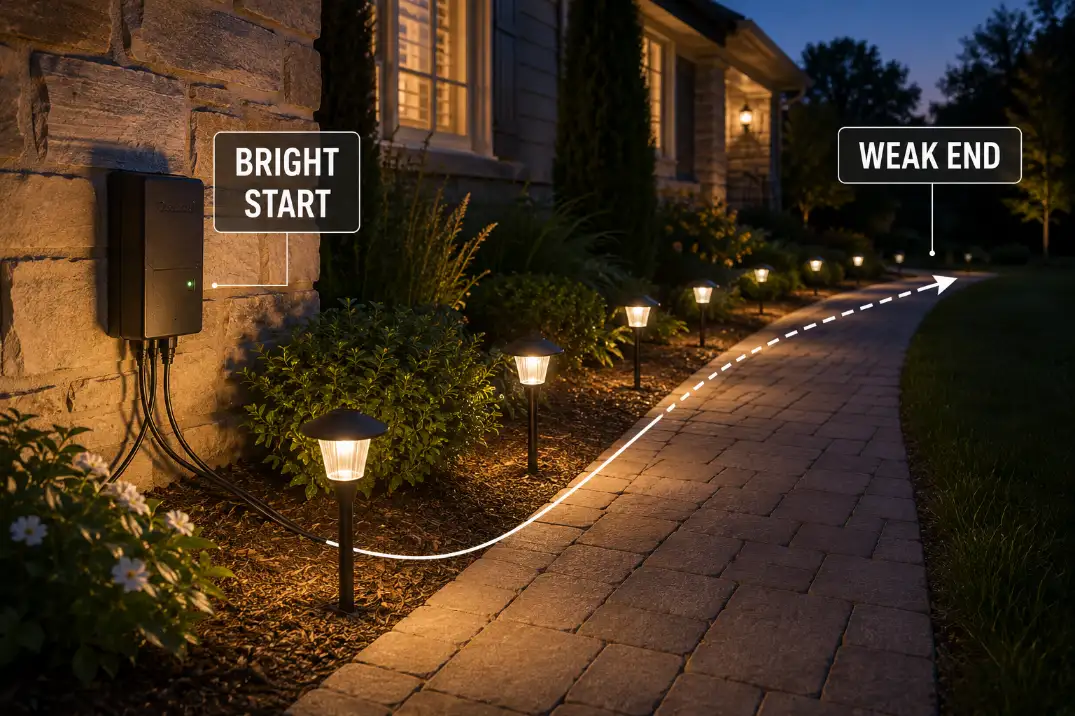
The first lights look fine, but the far end looks weak
The most common sign is not dramatic. Path lights closest to the transformer look normal, while the last two or three fixtures look dull, yellowish, delayed, or unstable.
When that same yard also shows transformer heat, flicker, or repeat shutoff, it belongs with broader low-voltage landscape lighting problems rather than a simple lamp replacement.
That does not automatically prove the transformer is too small. It often means the transformer load, cable length, wire size, and fixture placement are working against each other.
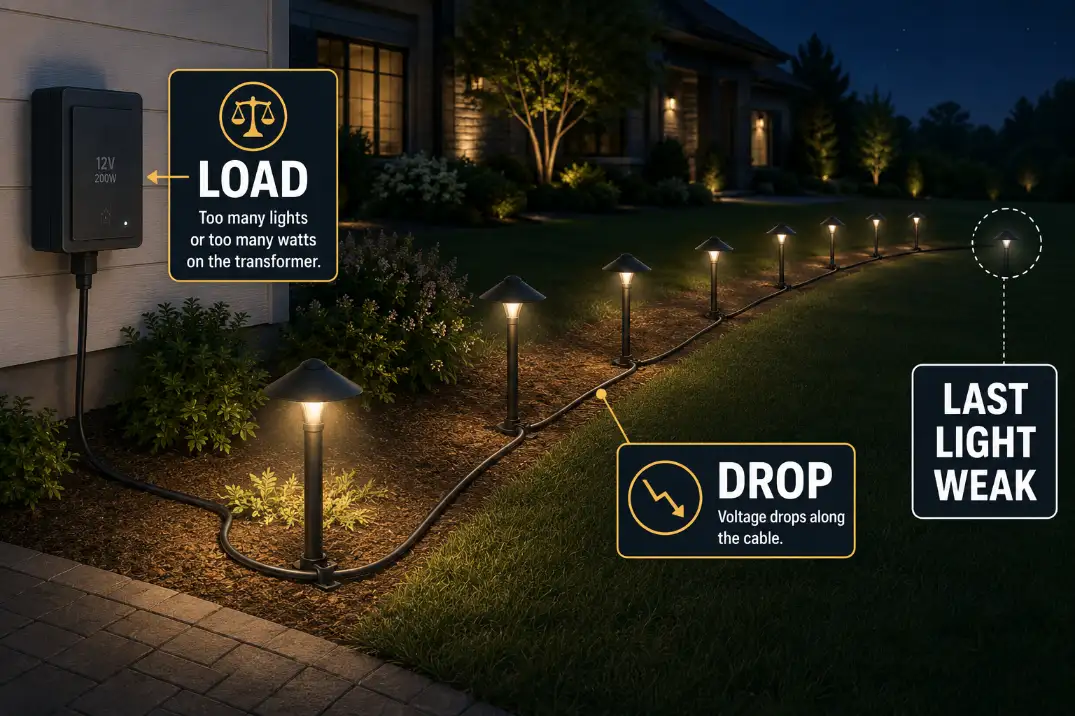
A 12-volt landscape lighting run may start near 12 volts and fall to 10 volts or less by the final fixture if the run is long and heavily loaded.
Many LED fixtures can tolerate some variation, but once the far end drops below about 10 volts under real load, weak output and flicker become much more likely.
Some LED fixtures tolerate low voltage better than others, so use the manufacturer’s listed input range when it is available.
The system shuts off after it warms up
A system that turns on normally and then shuts off after 15, 20, or 30 minutes deserves more attention than a system that never turns on.
That delay often points to heat buildup, overload protection, a marginal transformer, or a connection that gets worse as current flows.
A shutdown that happens only once during a storm is different. A repeatable warm-up failure on dry nights is more useful diagnostically. If the transformer resets after 15–60 minutes and repeats the cycle, do not start by replacing timers, photocells, or random fixtures. The load side needs to be checked first.
The transformer gets hotter than normal
Landscape lighting transformers often run warm. Warm is not automatically a defect. The warning sign is a transformer housing that becomes too hot to comfortably keep your hand on for more than a couple of seconds, especially when the system is near the listed capacity.
This is where people overestimate the value of the label rating. A 300-watt transformer is not a clean 300-watt invitation if it sits in direct afternoon sun, feeds one long cable run, or carries several high-output spotlights at the end of the line. Heat is not just a cosmetic clue. It is a margin warning.
Is It Overload, Voltage Drop, or a Short?
If everything dims together
If every fixture drops in brightness at the same time, the transformer may be undersized, overloaded, failing, or feeding too much total load. This is especially likely when the connected fixture load is near the transformer’s rating and the transformer becomes hot during normal runtime.
This is the classic “too many lights on one transformer” case, but it should still be confirmed with a load calculation before buying a larger transformer.
If only the far end is weak
If the first lights are strong and the last fixtures are weak, voltage drop is more likely than pure transformer overload. In many voltage drop i: outdoor lighting systems cases, the transformer has enough capacity on paper, but the electricity is not arriving cleanly at the end of the cable.
That distinction matters because the fix changes. A bigger transformer may not solve a poor run layout. A split run, shorter cable path, heavier wire, or correct voltage tap may matter more.
The giveaway is distance: the farther fixtures fail first while the early fixtures still look acceptable.
If one run trips the system instantly
If the transformer trips as soon as one specific cable run is connected, too many lights may not be the main issue. A shorted fixture, water-filled splice, damaged underground cable, or reversed connection can make a properly sized transformer act overloaded.
Timing is the useful separator. Instant trip points more toward a fault. Delayed trip after 10–30 minutes points more toward heat, load, or a marginal component. Failure after rain points more toward moisture intrusion or a wet connection.
Quick Diagnostic Checklist
- Is the connected load above about 80% of the transformer rating?
- Does the final fixture measure below about 10 volts while the system is on?
- Does the system shut off instantly or after 10–30 minutes?
- Does disconnecting one cable run make the transformer behave normally?
- Is the transformer too hot to comfortably touch after 20 minutes?
- Did the problem begin after adding new path lights, uplights, or spotlights?
How to Check the Load Without Guessing
Use fixture watts as the starting point
Find the transformer rating first. It may say watts, VA, or both. Then add the listed wattage of every connected fixture. Twelve 7-watt LED fixtures equal 84 watts. On a 100-watt transformer, that may run, but it leaves only 16 watts of margin. On a long run in a hot location, that is not generous.
If the label gives VA instead of watts, use VA for the safer calculation. For simple homeowner troubleshooting, watts are usually enough to reveal an obvious overload.
But when fixture labels provide VA, driver load, or manufacturer-specific transformer guidance, use that information rather than forcing every fixture into a rough wattage estimate.
A good working rule is to keep connected load around 80% of transformer capacity.
| Transformer rating | Better working load | Risk zone | What it usually means |
|---|---|---|---|
| 100 watts | Up to 80 watts | 85–100 watts | Small path or accent system only |
| 150 watts | Up to 120 watts | 125–150 watts | Common limit for mixed path and accent lighting |
| 300 watts | Up to 240 watts | 250–300 watts | Needs careful run balance |
| 600 watts | Up to 480 watts | 500–600 watts | Often better divided into zones |
The risk zone is not automatically unsafe, but it is not where a landscape lighting system feels forgiving. Heat, long wire runs, wet beds, and aging splices all matter more when the transformer has no margin left.
Measure voltage while the lights are on
Voltage readings are most useful under real load. Measure while all lights are connected and running. Check the transformer output, then the first fixture, then the last fixture on the same run.
A small drop is normal. A large gap between the first and last fixture is the clue. If the first fixture is near 12 volts and the last fixture is near 9.5 volts, the far-end problem is not just brightness preference. The electrical path is losing too much voltage before the last fixture gets usable power.
Two systems with the same transformer wattage can behave very differently if one uses a long thin cable run and the other uses shorter balanced runs. The label on the transformer tells you capacity; the voltage at the last fixture tells you delivery.
Pro Tip: Do not measure only at the transformer and assume the whole yard is fine. The last fixture tells you what the run is actually delivering.
Isolate cable runs before replacing the transformer
If multiple cables leave the transformer, turn power off and test one run at a time. A transformer that behaves normally with two runs but trips when the third run is connected is giving you a direction.
That third run may fit a broader outdoor lighting power supply issues pattern, especially if the trouble appears after rain, irrigation, or yard work.
This is where visible symptoms can mislead. The transformer is the part you can see, but the actual fault may be 50–80 feet away in mulch, under a walkway, near irrigation spray, or at a buried splice. Do not replace the visible box before the hidden run has been ruled out.
When the Usual Fix Stops Making Sense
Adding a bigger transformer is not always the first move
A bigger transformer helps when the connected load is truly too close to the rating and the wiring layout is otherwise reasonable. It does not fix a shorted fixture, a wet splice, a damaged cable, or one long run that drops voltage before the last lights.
This is the fix that often wastes time: replacing the transformer before separating the runs. If one bad run is causing the shutdown, a larger transformer may only make the system look improved briefly while the underlying fault remains.
A higher voltage tap is not an overload cure
Some low-voltage transformers include 12V, 13V, 14V, or 15V taps. These can be useful when a long run has voltage drop and the fixture manufacturer allows that setup. But a higher tap is not a cure for too many fixtures.
Use the higher tap to correct delivery to the far end, not to excuse a transformer that is already overloaded. If the load calculation is already too high, raising the tap is solving the wrong problem. It may make the far lights look better while increasing stress elsewhere.
More fixtures at the beginning can make the end worse
Adding two more lights near the transformer may look harmless because the first part of the run still appears bright. But those fixtures add load before electricity reaches the end.
If the final lights are already weak, the same pattern often appears when outdoor lights lose power at the end of the line: the end fixture looks like the problem, but the run design is doing the damage.
This is the point where a routine fixture swap stops making sense. If the final fixtures keep fading, flickering, or dropping out, the end light is the symptom. The mechanism is usually load placement, cable length, or voltage drop.
Stop when the problem moves beyond low-voltage checks
Homeowner troubleshooting should stay on the low-voltage side of the system. If the transformer smells burned, has melted terminals, trips the house breaker, or requires work on the 120-volt side, stop troubleshooting at the fixture level and have the system checked by a qualified electrician.
That boundary matters because an overloaded low-voltage run and a damaged power-side component can both look like “the transformer keeps shutting off” from the yard. The repair risk is not the same.
What Usually Fixes the Problem
Reduce load where brightness is not doing much work
The fastest useful fix is sometimes subtraction. If several decorative lights are not improving safety, visibility, or the main nighttime view, reduce their wattage or remove the least important fixtures first.
Changing ten 6-watt path lights to ten 3-watt fixtures cuts 30 watts from the transformer load. On a 150-watt transformer, that can move the system from stressed to comfortable without touching the box.
Split one long run into balanced runs
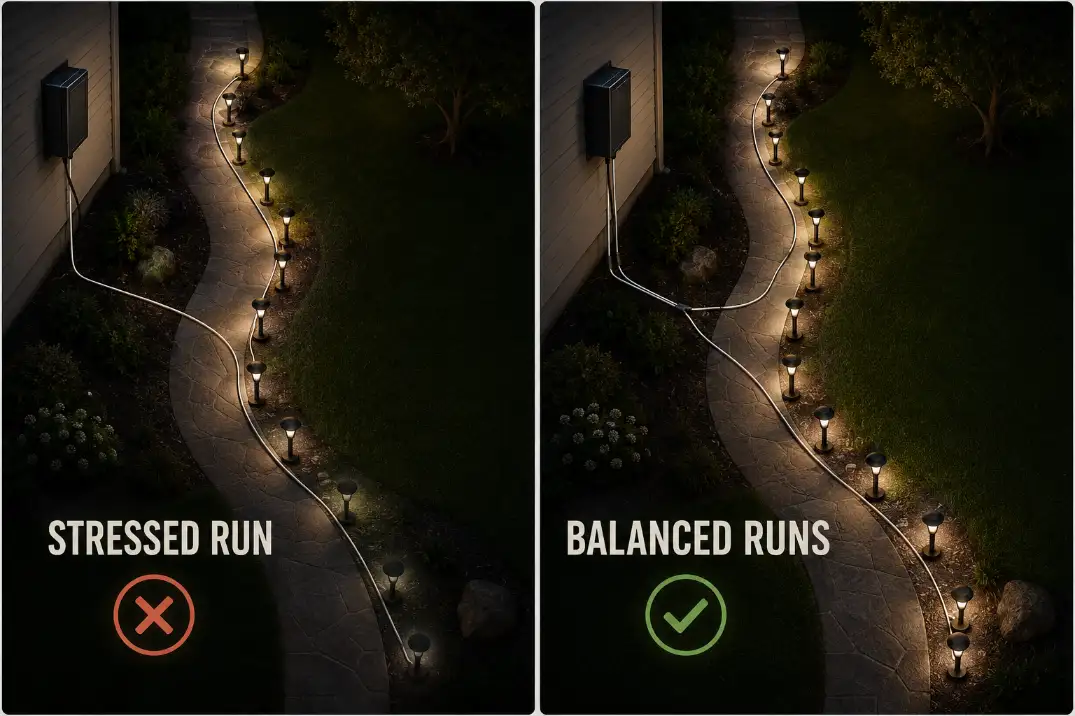
If the transformer has enough capacity but the far end is weak, split the layout. A front walkway, distant planting bed, and far tree uplights should not always be chained on one cable just because the wire was easy to continue.
Shorter, balanced runs usually outperform one long overloaded run. Runs over about 75–100 feet deserve closer voltage checks, especially if several fixtures sit near the end. Heavier cable can help, but layout still matters.
Replace the transformer when the evidence points there
Transformer replacement makes sense when the connected load is too high, the system is properly divided, and the transformer still overheats, hums loudly, trips with normal loads, or has damaged terminals.
When you are separating a bad cable run from true transformer problems in low-voltage systems, the key question is whether the transformer still misbehaves after the suspicious runs are removed.
But replacement should not be the first answer to every dim light. If the transformer trips with one specific run, fix that run. If the far end voltage is low, improve delivery. If the transformer fails even with no load connected, then the box itself becomes the stronger suspect.
Questions People Usually Ask
Can I use every watt listed on the transformer?
Technically, some systems will turn on near the full listed rating. Practically, that is not a good target. Keeping the connected load around 80% of capacity gives the transformer room for heat, voltage drop, fixture variation, and future changes.
Is a bigger transformer safer?
Not automatically. A larger transformer can help when the load is truly too high, but it does not repair a damaged cable, bad splice, water-filled fixture, or poor run layout. The safer fix is the one that matches the failure pattern.
Why do the lights work at first and fail later?
Delayed failure usually points to heat, load, or a connection that worsens under current. A system that fails after 20 minutes is giving a different clue than one that trips instantly or only fails after rain.
Should I add a second transformer?
A second transformer makes sense when the yard has separate lighting zones, the existing transformer is near its working limit, or long runs are causing far-end voltage problems. Two smaller, cleaner zones often perform better than one oversized transformer feeding a messy layout.
For a concise university troubleshooting note on low-voltage landscape lights that turn on and then shut off, see Iowa State University Extension and Outreach.