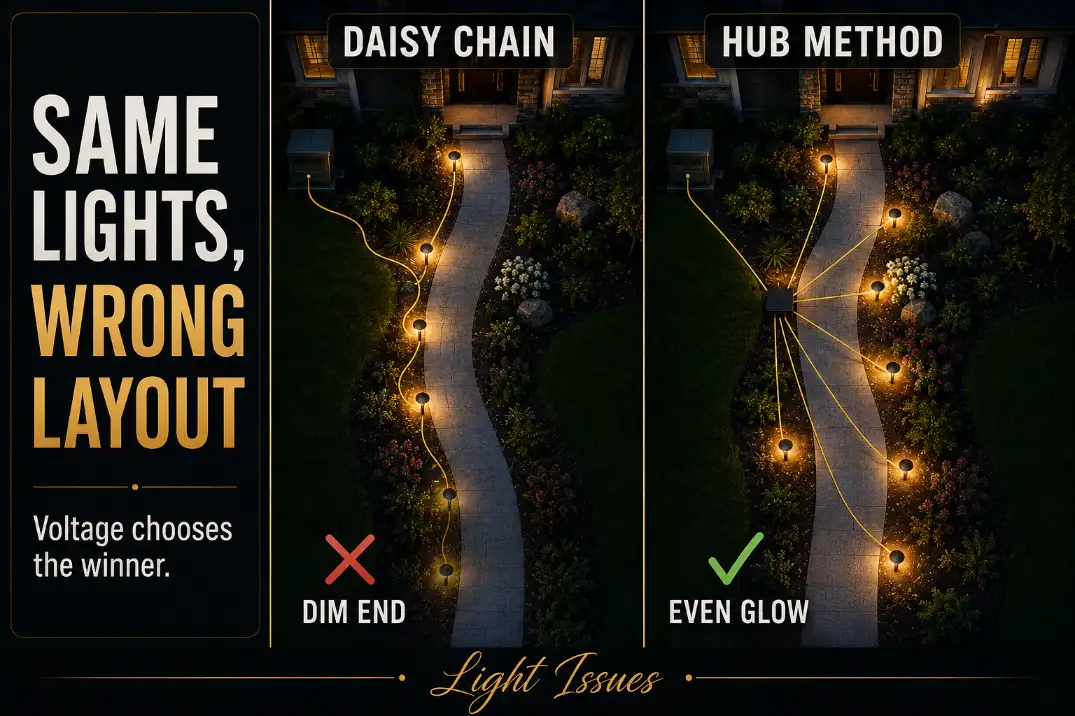
Low-voltage landscape lighting usually shows wiring problems as uneven brightness before it shows a complete failure. The last path lights look weaker, one side of the yard never matches the other, or a few fixtures flicker after 20–60 minutes of runtime.
That does not automatically mean the transformer is too small or the fixtures are bad. The wiring layout may be forcing the farthest lights to work with less voltage.
A daisy chain runs fixtures one after another on a single cable path. A hub method sends fixture leads or short branches back to a central connection point so the cable distance is more balanced. For a short 35–50 foot walkway with 4–6 low-watt LED fixtures, daisy chaining can work perfectly well.
Once the first fixture is near 12 volts and the last fixture is 1.5–2 volts lower, layout matters more than fixture count. The best answer is not always “use a hub.” Sometimes the better fix is a split run, a T-method layout, or a cleaner main cable route.
Daisy Chain vs Hub: The Real Difference
The daisy chain is the simplest layout: transformer, main cable, first fixture, second fixture, third fixture, and so on. It follows the visual line of the landscape, which is why it works well for straight walkways, short bed edges, and small borders.
The hub method changes the logic. Instead of making each fixture depend on every foot of cable before it, several fixtures connect back to a central hub or junction. The goal is not to make the installation look more advanced. The goal is to reduce the voltage spread between fixtures.
The symptom is brightness; the mechanism is voltage
Uneven brightness is the symptom. Voltage drop is the mechanism.
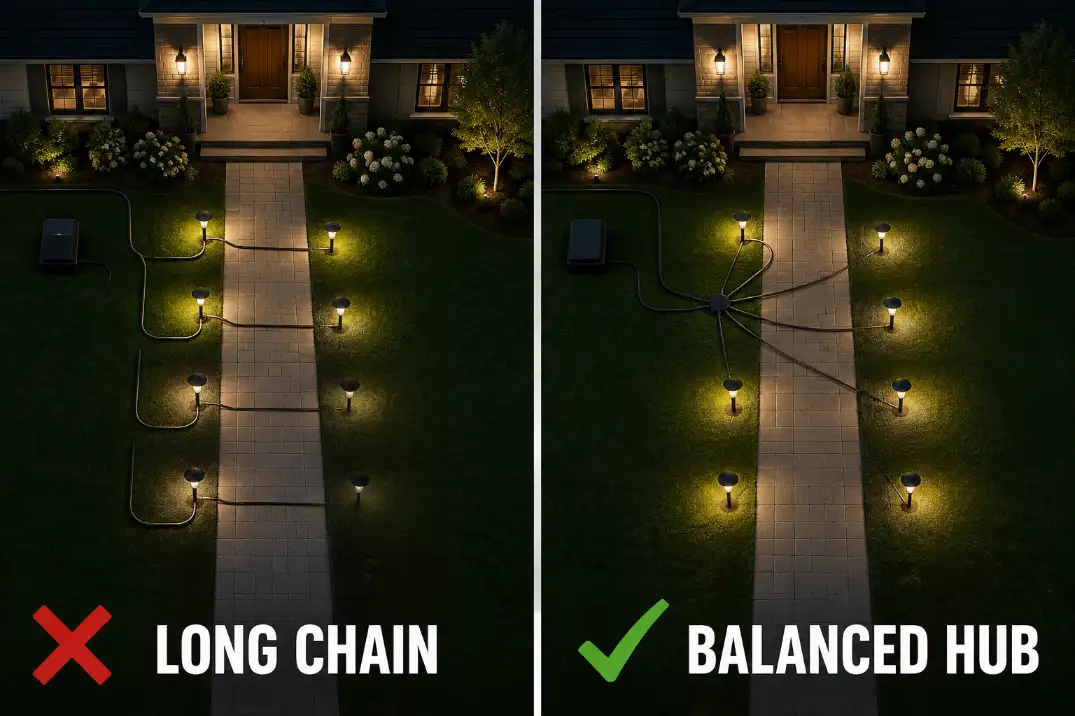
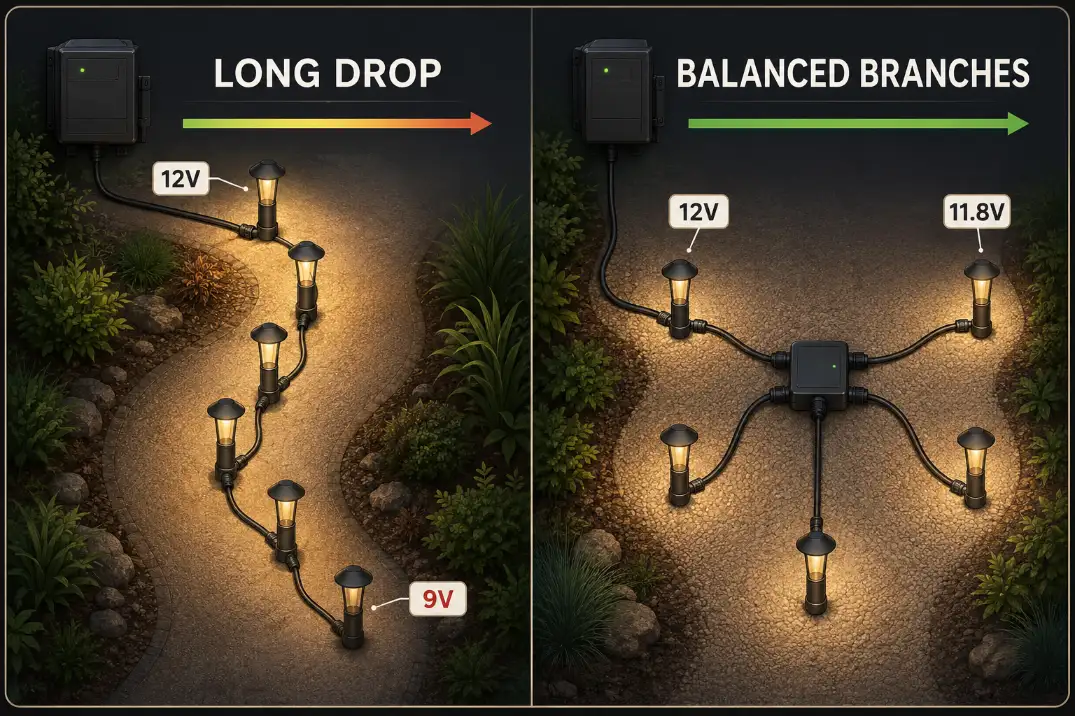
In a 12-volt system, the first fixture might receive about 11.8–12.2 volts while the last fixture on a long daisy chain receives closer to 9.8–10.5 volts.
Some LED landscape fixtures can still turn on across a wider voltage range, but “it lights up” is not the same as “it is balanced, efficient, and being fed well.” The visible problem is often not a dead light. It is a weaker light that keeps being mistaken for a fixture problem.
If your first question is how many fixtures one run can support, the deeper limit is explained in How Many Landscape Lights Can You Put on One Cable Run?. Count matters, but distance, wire size, and fixture grouping often decide the result first.
Daisy chain is not automatically wrong
A daisy chain gets blamed too quickly. For a straight run with five 3-watt LED path lights across 35 feet, a hub may add extra splices without solving anything. A simple run with clean connections and stable voltage is often the better installation.
Where daisy chaining starts to disappoint is when the layout keeps growing. A few lights down the walkway become two more near the driveway, then another pair around a tree, then one more near the steps.
The system may still turn on, but the last lights now live at the weakest electrical point in the layout.
Quick Layout Check Before You Rewire Anything
Use this check before buying more cable, replacing fixtures, or upgrading the transformer.
| What you see | More likely issue | Better next step |
|---|---|---|
| Last 1–3 lights are dimmer | Voltage drop along one cable path | Measure voltage at first and last fixture |
| Whole system looks weak | Transformer setting, load, or supply issue | Check total watts and transformer tap |
| One branch fails after rain | Wet splice or hub connection | Inspect the junction before redesigning |
| Near lights look harsh but far lights look weak | Layout imbalance | Split the run or rebalance cable distances |
| Flicker appears after 20–60 minutes | Low-voltage stress, heat, or driver behavior | Test voltage after the system warms up |
A small difference between the first and last fixture, around 0.3–0.7 volts, is usually not worth rebuilding the layout over. A spread of 1 volt is a warning sign. A spread close to 2 volts usually means the wiring path is shaping the performance, not just the fixture choice.
What people usually misread first
The weakest fixture gets blamed first because that is what the eye sees. But when the last two or three fixtures fade in sequence, replacing one fixture is usually a waste of time. The fixture is showing the problem; it is not necessarily causing it.
The second misread is assuming the transformer is too small. A larger transformer may help if the system is truly overloaded, but it will not make one long cable path electrically equal.
If the first lights are bright and the last lights are weak, the problem is usually distribution, not total power.
For broader troubleshooting across transformer taps, moisture, cables, and fixture behavior, Low Voltage Landscape Lighting Problems is the better diagnostic companion.
When Daisy Chain Wiring Makes Sense
Daisy chaining is strongest when the landscape itself is linear. A straight path, short garden edge, or compact patio border does not need a more complex wiring plan just to look professional.
Good daisy-chain conditions
A daisy chain usually makes sense when the total cable run is under about 50 feet, the fixture wattage is low, and the lights are spaced in one predictable direction. Six LED path lights at 2–4 watts each along a short walkway are not demanding enough to justify a hub in many yards.
The important check is not only total wattage. It is whether the final fixture still receives enough voltage to perform like the first one. Many installers aim for a tight fixture-to-fixture spread rather than chasing one perfect number at the transformer.
A 12-volt system with all fixtures staying visually even is healthier than one where the first light is strong and the last light is barely acceptable.
Where daisy chain starts to disappoint
A daisy chain becomes weak when the cable route is longer than the yard makes it appear. This happens around curved beds, wide driveways, retaining walls, and houses where the transformer sits on only one side.
A 70-foot lighting zone can easily become a 100-foot cable path once the wire follows safe burial routes and avoids hardscape. That extra distance is what homeowners often underestimate. They see “only eight lights,” but the cable sees distance, wattage, wire gauge, and every connection along the way.
Pro Tip: If several end fixtures are dim, measure voltage before changing bulbs. A brightness pattern is useful, but a voltage reading tells you whether the layout is actually the problem.
When the Hub Method Works Better
The hub method is better when equal brightness matters more than the simplest cable path. It is especially useful for grouped accent lights, symmetrical front-yard scenes, tree uplights, and layouts where several fixtures need to look even from the same viewing point.
The hub reduces imbalance
With a hub, each fixture or small group of fixtures branches from a central point. Instead of fixture six depending on every foot of wire and every connection before it, each fixture has a more comparable electrical path.
The hub does not erase voltage drop. It manages it. A 20-foot branch and a 25-foot branch will usually behave more evenly than one 90-foot chain with taps along the way.
This also makes troubleshooting cleaner. In a daisy chain, a weak connection near the beginning can affect everything after it. In a hub layout, one failed branch is easier to isolate.
That distinction matters when a row of lights fades at the end of a run, a failure pattern covered more directly in Outdoor Lights Losing Power at the End of the Line.
The hub can become the weak point
The hub method is not automatically superior. It can create more splices, more connection density, and one important junction that must stay dry and accessible.
A hub buried in wet mulch, low clay soil, or an irrigation splash zone can become the failure point of the whole system. In humid Florida yards or Midwest beds that stay wet after spring rain, the hub location matters almost as much as the wiring method.
If the hub is hard to find later, the “professional” layout becomes harder to service than a simple cable run.
The better version is an accessible junction, waterproof-rated connectors, and a location that does not sit in water for hours after rain.
If the issue is clearly connection corrosion rather than layout balance, Corroded Wire Splices Outdoors is the more relevant repair path.
The Middle Option: T-Method, Split Run, or Loop
The choice is not always daisy chain or hub. Many real yards need an in-between layout.
T-method wiring can balance a straight run
A T-method, sometimes called a center-feed layout, brings the feed into the middle of a run and sends power in two directions. Instead of one long chain with the farthest fixture at the very end, the run is divided into two shorter sides.
This can work well for a long walkway, driveway edge, or bed line where a full hub would use more wire than necessary. The T-method can reduce the worst end-of-line drop by shortening each direction, but it does not remove voltage drop from either side.
The limit is simple: if both branches become long or heavily loaded, the T-method only delays the problem. It is a balancing tool, not a cure for an oversized run.
Split runs are cleaner than overbuilt hubs
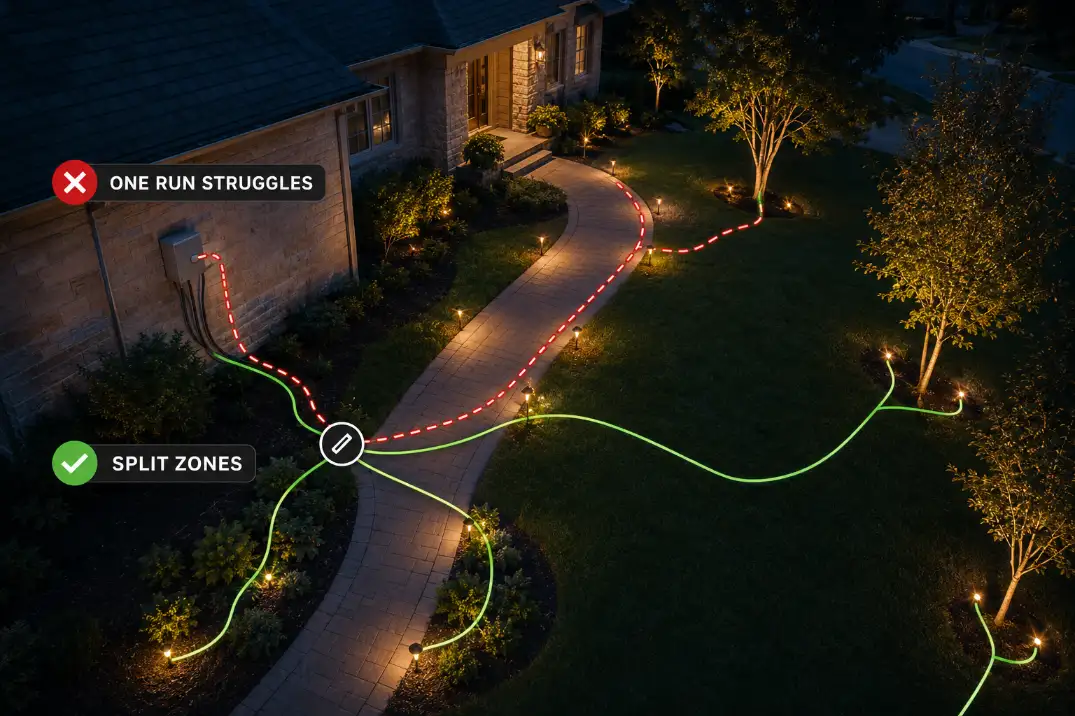
A split run is often the best answer when one transformer feeds two different yard zones. For example, one run can serve the walkway while another serves tree uplights or a driveway edge. This keeps each cable path doing one job.
That matters because one overloaded layout can be hard to diagnose. If path lights, tree lights, and foundation lights all sit on one wandering cable, you may not know whether the issue is distance, load, connector quality, or fixture grouping.
Loop wiring is not a casual shortcut
Loop wiring can reduce voltage imbalance in some layouts, but it needs disciplined polarity and connection work. It is not the first DIY fix for a dim end fixture. A poorly executed loop can make troubleshooting more confusing, especially if connectors are buried or undocumented.
For most residential low-voltage systems, a cleaner split run or hub is easier to understand, measure, and service later.
Wire Size Can Change the Answer
Wire gauge does not get enough attention because it is less visible than fixture layout. But cable size can decide whether a daisy chain remains acceptable or becomes weak at the end.
Main cable is not the same as fixture lead wire
A 12/2 main cable is usually a better choice for longer or more demanding runs than thin wire. A 14/2 cable can be fine for shorter LED runs with modest load. Fixture lead wire, often much smaller, should not be treated like a long main cable extension.
The mistake is using thin wire to “save” a layout that already has distance working against it. Use heavier cable to support a sound layout, not to rescue a bad route.
Better cable does not fix bad routing
If the cable path is 110 feet because it wanders around the yard, upgrading wire size may improve the numbers without fixing the design. The stronger move may be to shorten the route, split the load, or move the feed point.
This is where a routine fix stops making sense. If your first fixture is already receiving solid voltage and the far end is still weak, chasing a bigger transformer or slightly heavier cable may be less effective than changing how power is distributed.
Daisy Chain vs Hub Landscape Lighting Comparison
| Wiring method | Best use | Weak point | Decision rule |
|---|---|---|---|
| Daisy chain | Short straight runs | End fixtures receive the lowest voltage | Use when the run is short and brightness stays even |
| Hub method | Clusters and balanced scenes | More splices in one location | Use when fixture distances need to be equalized |
| T-method | Long straight runs | Each side can still become too long | Use when center-feeding shortens both directions |
| Split runs | Two or more yard zones | Requires more planning at the transformer | Use when one cable is doing unrelated jobs |
| Higher transformer tap | Mild voltage correction | Can overfeed close fixtures | Use only after measuring fixture voltage |
The main judgment is this: choose the wiring method by the shape of the load, not by habit. A straight run wants simplicity. A grouped or wide layout wants balance. A yard with separate zones usually wants separate runs.
The Fixes That Often Waste Time
The most common wasted fix is upgrading the transformer before checking voltage at the fixtures. If the system only uses 60 watts and the transformer is rated for 150 or 300 watts, size may not be the issue.
A bigger transformer helps when the total load is too high, the unit is failing, or the system needs more circuits. It does not fix a long cable path where the first fixtures are already bright and the last ones are weak. In that case, distribution is the problem.
A higher voltage tap can help when the layout is basically sound and the drop is moderate. It becomes risky when nearby fixtures are already receiving enough voltage. Raising the tap to help the last light may overfeed the first lights, making them too bright or shortening component life.
Replacing the last fixture is another common dead end. If one isolated fixture fails, replacement may make sense. If the final three fixtures all fade in order, the last fixture is not the cause. It is the messenger.
If the transformer itself is humming, overheating, shutting down, or behaving inconsistently, Transformer Problems in Low Voltage Systems is a more direct next step than redesigning the cable layout.
How to Choose the Better Layout for Your Yard
Start with the shape of the lighting plan, then confirm with voltage readings.
Use daisy chain for simple lines
Choose a daisy chain when the fixtures naturally follow a short line and the cable path does not need to wander. Walkways, short borders, and small planting beds are the best fit.
Keep the run disciplined. Once the cable starts wrapping around corners, crossing under hardscape, or feeding lights in different directions, the simplicity advantage fades.
Use hub wiring for grouped scenes
Choose a hub when several fixtures need to look equal from one viewing angle. Uplights on two trees near an entry, path lights around a courtyard, or accent lights around a front foundation often look better when the distances are balanced.
The hub also helps future maintenance if it is accessible. That matters after freeze-thaw cycles in northern states, repeated irrigation exposure in dry western yards, or coastal moisture in California and the Southeast.
Use split runs when one cable is doing too much
Sometimes neither a pure daisy chain nor a single hub is the cleanest answer. A split-run layout may be better when one transformer feeds two separate directions: one run for the walkway, another for the garden or driveway edge.
A practical boundary is 10–12 fixtures spread across two different yard zones. At that point, forcing everything into one daisy chain or one hub can make the system harder to balance than it needs to be.
For a deeper look at why far-end fixtures fade even when the transformer still has capacity, Voltage Drop in Outdoor Lighting Systems explains why distance can matter as much as wattage.
Practical Decision Checklist
- Use daisy chain if the run is short, straight, and under about 50 feet.
- Consider hub wiring if several fixtures must match brightness from one viewing angle.
- Use a T-method when a long straight run can be fed from the middle.
- Measure first and last fixture voltage before changing transformers.
- Treat a 1-volt fixture-to-fixture spread as a warning sign.
- Split the run if one cable is feeding two different yard zones.
- Fix wet or corroded splices before blaming the wiring method.
Final Takeaway
Daisy chain wiring is not amateur, and hub wiring is not automatically better. The right layout depends on distance, fixture grouping, wire size, voltage balance, and whether the system can be serviced later.
For a short straight walkway, daisy chaining is usually clean and efficient. For grouped accent lights, wide layouts, or systems where the far end keeps fading, the hub method gives better control.
For long straight runs, a T-method may be the smarter middle ground. For separate yard zones, split runs usually beat forcing one cable to do everything.
The best landscape lighting wiring layout is not the one with the most cable or the most technical name. It is the one where the electrical path matches the way the yard is actually lit.
For broader product safety and certification context, see UL Solutions landscape and outdoor lighting guidance.