
A mechanical timer’s dial can keep advancing while its switching action fails. The useful distinction is whether the dial reaches the scheduled event without triggering the switch, or the switch is operated but the lights still do not respond. Replacing parts before separating those conditions can leave the fault untouched.
Start by identifying the missing transition: ON, OFF, or both. Inspect the corresponding trippers, then compare automatic behavior with the timer’s own manual control. Lights that never start and lights that never shut off point to different events, even when the same clock drives both.
Clock Movement vs Switching Action
Confirm actual dial movement against the fixed time pointer before treating the clock drive as operational. A faint motor sound does not establish movement, and movement alone does not establish accurate timekeeping. Check the current time, including AM and PM where marked.
The clock drive advances the dial. Trippers initiate switching at selected positions, while electrical contacts carry or interrupt the controlled load. A working clock therefore leaves the event-triggering and load-switching functions unproven.
If you have not established which device controls automatic operation, start with the broader manual-versus-schedule diagnosis. A transformer’s manual setting and a separate timer’s lever may control different parts of the installation.
Watch what happens when the relevant tripper reaches its operating point during normal operation. A dial that continues past without a lighting change presents different evidence from one that stalls there. The latter has not demonstrated that its drive can carry the mechanism through the switching event. Record which behavior occurs before adjusting anything.
Missing or Misplaced Trippers
Check the tripper assigned to the failed transition first. A missing ON tripper can leave the lights off while the dial keeps time; a missing OFF tripper can leave them running after manual activation. If only one transition fails, preserve that clue rather than moving both trippers immediately.
On removable-tripper designs, these small dial-mounted parts provide the physical switching commands. Other mechanical timers use captive tabs, so identify your design before applying fitting instructions.
Fix Boundary: Use only normal user-accessible controls. Disconnect supply before handling or replacing removable components, following the manufacturer’s instructions. Do not remove protective barriers or expose terminals. Low-voltage landscape fixtures do not mean the timer operates at low voltage. If access requires opening a wiring compartment or altering fixed wiring, use qualified service.
Check that both required trippers are present, correctly seated, and intended for that timer. Identify ON and OFF from the model’s markings or instructions; colors are not universal. A loose, distorted, or incompatible tripper may pass the operating point without engaging properly.
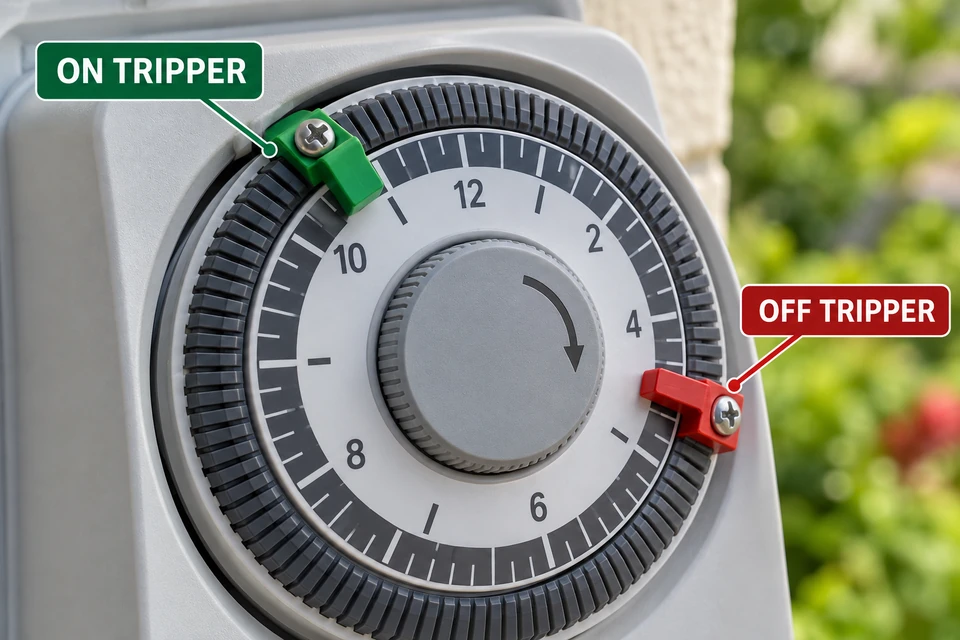
A misplaced tripper may switch the lights successfully while you are not watching. Distinguish “never switches” from “switches at an unexpected hour.” Where a separate operating selector exists, confirm it permits automatic operation.
Fit or tighten parts only as directed. Do not bend a tripper to increase its reach or force the dial through resistance.
After correction, observe a fresh ON event and an OFF event using supported timing increments. Hand-turning the dial is not a universal substitute: some designs disengage their drive during time adjustment, and a hand-assisted transition does not prove normal motor-driven operation.
What the Manual Lever Proves
Use the timer’s own normal manual control with the same landscape lights connected. Record which control you used; “manual works” is incomplete evidence if it refers to a separate switch on the transformer.
When the Timer’s Own Lever Switches the Lights
On a design where the lever operates the same load switch used by the trippers, successful manual ON and OFF shows that the switch can operate the connected lights under those conditions. If automatic operation still fails, attention shifts toward tripper engagement and the automatic actuation mechanism.
That result does not certify every internal part. A mechanism may respond to the stronger or differently applied action of its manual lever while failing to respond to a passing tripper. Intermittent switching trouble also remains possible.
When the Lever Moves but the Lights Do Not Respond
A click confirms mechanical movement, not electrical continuity. No lighting response leaves several possibilities: the timer may not deliver switched power, another control may block operation, or the transformer or downstream circuit may be unable to operate the lights.
Where output is present but the lights remain dark, continue with that separate diagnosis instead of treating lever movement as proof that the timer contacts have failed.
If a photocell or another control must also permit operation, use the documented normal conditions for the test. Do not improvise a bypass. Interpret the results this way:
- Lever switches both ways; automatic event fails. Manual switching works in this test. Recheck tripper engagement and automatic actuation.
- Only one automatic transition fails. Inspect the corresponding ON or OFF tripper before condemning the complete timer.
- Lever moves or clicks; lights do not change. Electrical switching remains unproven. The timer and remaining power path need model-specific isolation.
- Transformer manual mode works; timer-lever response is unknown. The lights operated through that transformer mode. Establish whether it bypasses the timer before drawing conclusions.
Return the timer to its intended automatic state according to its instructions. Some manual actions last until the next tripper event; other designs have a separate override selector.
A Worn Switching Mechanism
Suspect internal actuation wear only after compatible, correctly seated trippers fail to produce a fresh scheduled transition with automatic operation enabled. A repeated failure under those verified conditions carries more diagnostic weight than a missed evening, but it still does not identify one failed internal part.
If the timer’s own lever operates the lights reliably while the trippers do not, the mechanism that transfers tripper movement to the switch becomes a stronger suspect. Successful manual switching does not clear that automatic linkage.
Contact deterioration can also prevent load switching while the clock continues moving. However, a lever that produces no lighting response does not independently prove burned or welded contacts. The rest of the power path remains relevant.
Stop forcing a lever that feels unusually stiff, hesitant, or unable to complete its normal travel. A dial that stalls at a tripper likewise needs assessment of its drive and actuation, rather than an assumption that the contacts alone have failed.
These observations justify model-specific assessment or approved replacement. They do not justify opening the mechanism to file contacts, bend internal parts, or apply lubricant.
Replacing the Timer Without Rebuilding the Lighting System
Establish whether the timer is separately replaceable before committing to a transformer replacement. Some landscape transformers accept a mechanical timer accessory; others use integrated controls or a hardwired timer assembly. The exact model’s instructions or parts list sets that repair boundary.
Where the manufacturer permits user replacement, match the approved timer part and its electrical requirements, switching rating, connector arrangement, physical fit, and enclosure provisions. A plug that fits does not establish compatibility. The replacement must be suitable for switching that transformer, not merely have a familiar-looking dial.
Disconnect supply before a permitted module change. If replacement requires protected internal access or fixed-wiring changes, review when control replacement requires an electrician. Do not convert a hardwired assembly into an improvised plug-in arrangement or leave the timer bypassed.
A failure isolated to the timer gives no reason by itself to replace functioning fixtures, cable runs, or the transformer. If no user-replaceable module exists, follow the manufacturer’s service route rather than expanding the repair by guesswork.
The repair is complete when the normal lighting load starts and stops automatically at the intended events. Restore the time, trippers, and automatic operating state, then observe both transitions. A corrected tripper that restores both needs no further replacement; continued failure under verified conditions warrants approved timer replacement or service. Manual ON alone cannot close that decision.
For manufacturer guidance on distinguishing dial movement, manual response, and tripper condition, see Intermatic’s mechanical-timer troubleshooting instructions.