
Your new LED landscape fixture flickers while the lights already connected to the older transformer appear normal. Those working lights do not settle whether the new fixture is defective: the transformer may operate the existing fixtures correctly while supplying an input the new LED does not support.
Before replacing anything, compare the fixture’s input requirements with the transformer’s output and control arrangement. Then use a valid short-run comparison to separate the installed cable path from the fixture–supply combination. A poor new connection remains possible, but “the other lights work” is not enough to diagnose it.
Why the Old Fixtures Can Still Work Normally
Treat the existing lights as evidence about their own operating conditions. Their steady appearance does not certify the supply for a different LED driver.
If the old lamps are halogen, their electrical behavior differs from the input electronics inside an LED fixture. If they are already LEDs, their drivers may still accept different voltage ranges, supply types, or control methods. A new fixture can expose a mismatch that the existing lights do not reveal.
Separate an addition from a replacement. Replacing a higher-wattage lamp can reduce total demand; adding an LED while leaving the previous lights connected does not create that same reduction.
Also confirm that the symptom remains local. If several lights now become unstable and the transformer output drops when the lights are connected, the investigation belongs with the shared supply and connected demand.
When only the new fixture flickers, retain three possibilities: incompatible input power, trouble along its connection path, or a defective fixture. Normal neighboring lights cannot choose among them.
Transformer Output Type and LED Driver Compatibility
Compare the correct specifications
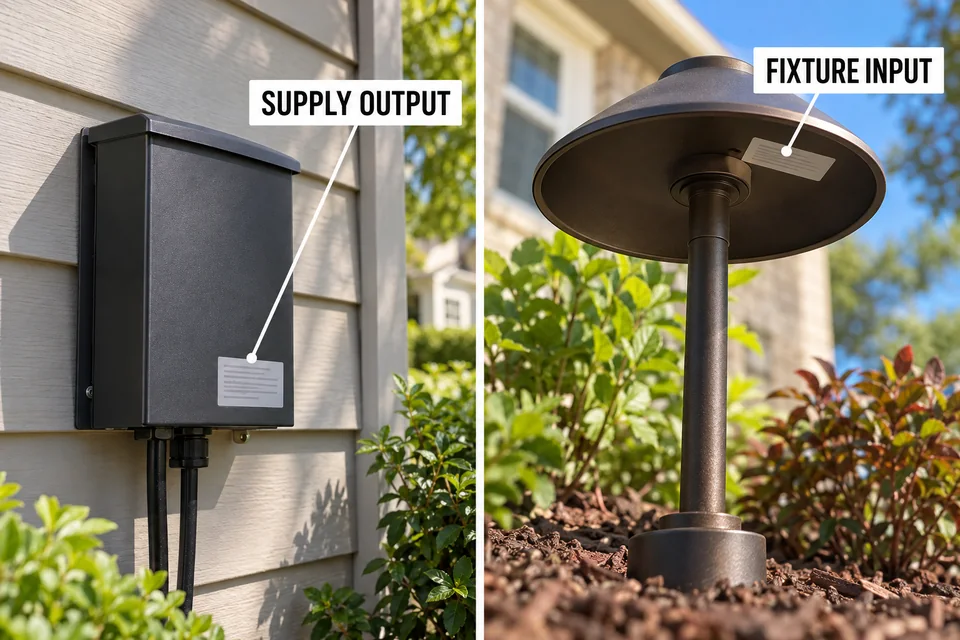
Match the transformer’s output rating to the complete fixture’s input rating before planning a powered test. The transformer’s household-power input and an internal LED board’s driver-output label describe different parts of the system.
A DC-only fixture should not be connected directly to an AC output. An AC/DC fixture accepts both only within its documented conditions. Check the permitted voltage range and, for DC connections, any polarity requirement.
| Specification | What must agree | What does not establish compatibility |
|---|---|---|
| Voltage and AC/DC type | Supply output must meet the fixture’s input requirements | Both products being described as “12-volt” |
| Frequency, waveform, or supply type | Fixture documentation must support the source being used | An AC/DC label without further specifications |
| Operating load | Connected demand must meet applicable minimum, maximum, and output limits | A large transformer wattage rating alone |
| Controls | Supply, fixture, and control must support the operating method | A dimmer being set to full brightness |
Identify the supply beyond its age
A traditional magnetic landscape transformer commonly supplies line-frequency low-voltage AC. An electronic supply may produce a different output, including high-frequency AC or regulated DC, depending on its design. “Electronic” does not automatically mean unsuitable for LEDs, and “magnetic” does not guarantee compatibility.
The fixture’s electronics must support the actual output. An AC/DC marking alone does not establish compatibility with every electronic transformer or modified waveform.
An ordinary meter reading cannot settle that question. A plausible voltage reading does not certify frequency, waveform, or control compatibility; some outputs also require instruments suited to their characteristics.
If the label is incomplete, use the model number to obtain the instructions or ask the manufacturer. A documented mismatch ends the test before power is applied. Missing documentation leaves compatibility unresolved.
Testing One New Fixture on a Short Run
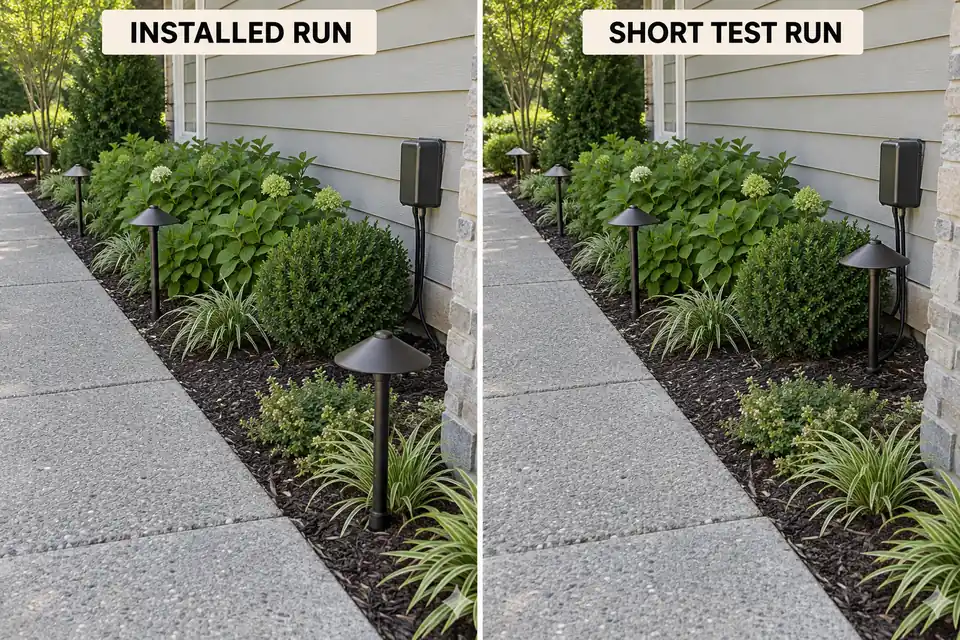
Use the short-run comparison only when it preserves a supported operating arrangement. Its purpose is to remove most of the installed cable path from the comparison without introducing a new electrical mismatch.
One fixture under test does not necessarily mean the only fixture connected. Removing the existing lights may take an electronic supply below its minimum load. A higher-voltage tap used for the installed run may also be inappropriate for a short connection. If the short-run arrangement requires a different tap or load, a simple before-and-after comparison becomes less conclusive.
Keep the controls and other relevant conditions unchanged for the first comparison. Shortening the path reduces cable-related uncertainty, but it does not eliminate a defective connector or establish that the transformer suits the LED.
Fix Boundary: Disconnect supply power before every connection change. Work only at manufacturer-permitted, user-serviceable low-voltage connections. Unknown ratings, exposed mains parts, hardwired alterations, damage, or protective trips require professional assessment. Secure connections and restore covers before operation; do not repeatedly provoke flicker or a shutdown.
- Record the starting arrangement. Note the fixture input, transformer output, connected lights, controls, and whether the LED was added or replaced another lamp.
- Check the proposed configuration. Confirm compatible output, permissible loading, and a manufacturer-supported short connection. If these cannot be established, stop.
- Arrange the comparison with power disconnected. Use suitable cable and connections, preserve required existing loads, and restore protective covers.
- Observe the fixture on the original source. Compare its behavior through the short connection with its behavior at the installed position. Stop at abnormal operation.
- Use a compatible reference supply if needed. This must independently match the fixture’s documented requirements and operate correctly under the test load. Disconnect the fixture from the original supply before substitution; never join two supply outputs. Have a technician perform the comparison if the arrangement is uncertain.
Interpret what actually changed
If the fixture becomes steady on the original source through the short connection, the installed route or its connections become stronger suspects. That result does not certify the whole installation or identify a particular bad splice.
If it flickers on the old source but operates steadily on a documented compatible reference supply, attention shifts toward the original supply/control combination. The next question is whether that combination is unsupported or malfunctioning; the comparison alone does not establish which.
If it flickers on both supplies, the fixture or its attached lead and connection become more likely—provided both test arrangements were valid.
A comparison that takes the load below an operating minimum is inconclusive. Likewise, an arbitrary adapter with the right voltage number is not a known-good reference. The reference must be suitable for this fixture and known to operate correctly under the proposed conditions.
Minimum Load and Electronic Controls
Give minimum load priority when the change actually reduced demand and the equipment specifies a minimum. Transformer age alone does not make this the explanation.
Replacing a higher-wattage lamp with an LED may move the connected load below a supply’s operating minimum. Disconnecting the remaining lights during testing can do the same. Simply adding one LED to an otherwise unchanged working installation does not reduce total load, so minimum-load loss is then a weaker explanation for the original symptom.
Use the manufacturer’s loading instructions. Actual fixture wattage is more useful than its “halogen equivalent,” but wattage alone may not describe the permitted combination. Documentation may specify volt-amperes, supported lamp counts, or other limits.
Controls need the same scrutiny. Determine whether a dimmer or electronic switching device is actually present. An ordinary timer that switches the supply on and off is not automatically changing the output waveform.
Setting a dimmer to maximum does not necessarily remove its electronics from the power path. Use manufacturer-supported operating modes when comparing behavior. Any test requiring electrical bypass or rewiring belongs with a qualified person.
A change in flicker when a control setting changes is a clue about the combination, not proof that the control alone has failed. Check whether the fixture, supply, and control are documented to operate together before selecting a replacement.
Adapter, Driver, or Transformer Replacement
Replace the component the evidence identifies. A healthy existing transformer may be worth retaining when the new fixture is the unsupported part. A compatible replacement fixture can resolve that mismatch without disturbing the rest of the installation.
If valid comparisons point toward the fixture, returning a defective new unit may be simpler than opening it. For a serviceable design, assessing a possible LED driver failure helps establish whether driver-only replacement is appropriate.
A replacement driver must match the required input, output behavior, current or voltage specification, controls, and environmental conditions. Physical fit and sufficient wattage do not establish suitability. A sealed, nonserviceable fixture should not become an improvised driver-conversion project.
An adapter also needs a defined job. A connector adapter does not automatically convert AC to DC, regulate voltage, or correct waveform compatibility. Use an interface or conversion device only when its manufacturer explicitly supports the electrical combination and installation environment.
Replace the transformer when it cannot support the intended fixtures and controls, or when testing establishes a source fault. Before changing a shared supply, verify the requirements of every retained fixture. Solving the new LED’s problem must not create a mismatch elsewhere.
Where broader deterioration or incompatible components justify renewal, a matched landscape-lighting replacement system becomes a reasonable next decision. One flickering addition alone does not establish that need.
The repair boundary should follow the smallest supported conclusion. If the new LED works on a compatible reference supply, resolve the original supply/control question before replacing the fixture. If the comparison was invalid, correct the test conditions before spending money. Keep the confirmed component specifications for the next addition.
LEDVANCE’s compatibility guidance recommends verifying an MR16 lamp–transformer–dimmer combination with a sample before completing installation. www.ledvance.com