
You replace several halogen landscape lamps with LEDs, and the yard stops looking consistent. Some fixtures appear brighter or whiter. Others flicker at startup, or the remaining halogens change brightness even though you never touched them.
Decide whether the difference stays steady or changes as the system operates. A consistent difference in color or beam shape calls for comparing light output. Flicker, dropout, or brightness that changes with the connected load calls for checking operating conditions before replacing more lamps.
Record which lamps changed and their actual wattages. Include the untouched fixtures in your observations: their response can reveal how the conversion affected the shared supply. LED and halogen lights can work together, but reduced wattage alone does not establish compatibility.
Different Loads on the Same Run
An untouched halogen that brightens after nearby lamps are converted is a useful clue: the conversion has changed its supply conditions. Landscape fixtures normally connect across a shared low-voltage supply, and replacing a load changes current through the cable sections feeding it.
Consider six 20-watt halogens: their nominal lamp load totals 120 watts. Replacing three with 4-watt LEDs reduces that total to 72 watts. This is useful bookkeeping, but it does not establish transformer compatibility, apparent-power loading, or equal light output.
Lower current generally reduces cable voltage drop. That can leave more voltage available at fixtures that previously operated with greater losses. The remaining halogens may therefore brighten even though their lamps and positions are unchanged.
Distance still matters, especially where substantial halogen loading remains. Understanding how cable gauge affects voltage drop helps explain why replacing a few lamps may improve a run without eliminating its delivery problem.
A higher transformer tap previously selected to compensate for cable losses also deserves reassessment after conversion. Do not assume the old setting remains appropriate, and do not raise the tap simply to make mismatched lights look equally bright.
Use actual input watts when recording the new load. A “20-watt halogen replacement” LED does not necessarily consume 20 watts. Its driver characteristics also matter, so adding nameplate watts is an inventory step, not a complete compatibility check.
| Observation | What it suggests | Next decision |
|---|---|---|
| Steady color or beam difference | Different light-output characteristics | Compare lamp specifications and illumination on the same surface |
| Gradual brightness variation along the run | Possible voltage-delivery differences | Assess the cable path and operating voltage against equipment requirements |
| Flicker, dropout, or inconsistent startup after conversion | Possible supply, control, connection, or driver incompatibility | Confirm the documented equipment combination before converting further |
Use the pattern to choose the next check. Appearance alone cannot identify which component is responsible.
Why Halogen Can Mask Voltage Problems
A Glowing Filament Is Not a Voltage Check
Working halogens do not confirm that the supply suits the new LEDs. A halogen lamp can remain visibly lit while receiving unsuitable voltage. Its brightness and color generally change progressively, so a weak, warm-looking lamp may be accepted as normal.
A regulated LED can behave differently. It may maintain relatively consistent output across part of its specified input range, then flicker, cycle, or stop outside that range. Other LED designs respond more gradually. Neither technology provides a reliable voltage reading through appearance alone.
The halogen filament also stays hot between rapid electrical fluctuations, making some supply variations less visible. An LED’s response depends on its driver and how effectively that circuitry handles the incoming power.
If the problem is concentrated in newly installed LEDs, the narrower investigation into LED compatibility with an older transformer can help separate lamp requirements from the behavior of the existing supply.
A matching “12V” label is only a starting point. The lamp must support the actual AC or DC output, operating range, and relevant supply characteristics.
The Remaining Halogens May Be Supporting the Load
Some electronic supplies and controls need a minimum load or a tested lamp combination to operate correctly. Remaining halogens may keep the installation within that operating condition. Removing another one can expose instability that was absent during the previous conversion stage.
That does not mean every older landscape transformer needs halogen lamps. A conventional magnetic transformer must not automatically be assigned the minimum-load behavior of an electronic halogen supply. Identify the equipment and check its documentation.
If operation depends on retaining a particular halogen, investigate that dependence before proceeding. Keeping an unnecessary lamp installed indefinitely as a stabilizing load leaves the underlying compatibility question unresolved.
Color and Dimming Differences After Partial Conversion
Judge visual matching only after the lights operate steadily. Similar nominal color temperatures can still produce different tint, color rendering, beam shape, and apparent brightness. A concentrated beam may look brighter than a broader beam even when their total light output is similar.
Compare illumination on the same paving, wall, or planting surface. Looking directly into the lamps makes glare and optical differences harder to separate. A stable mismatch, without flicker or changing output, does not establish a voltage fault.
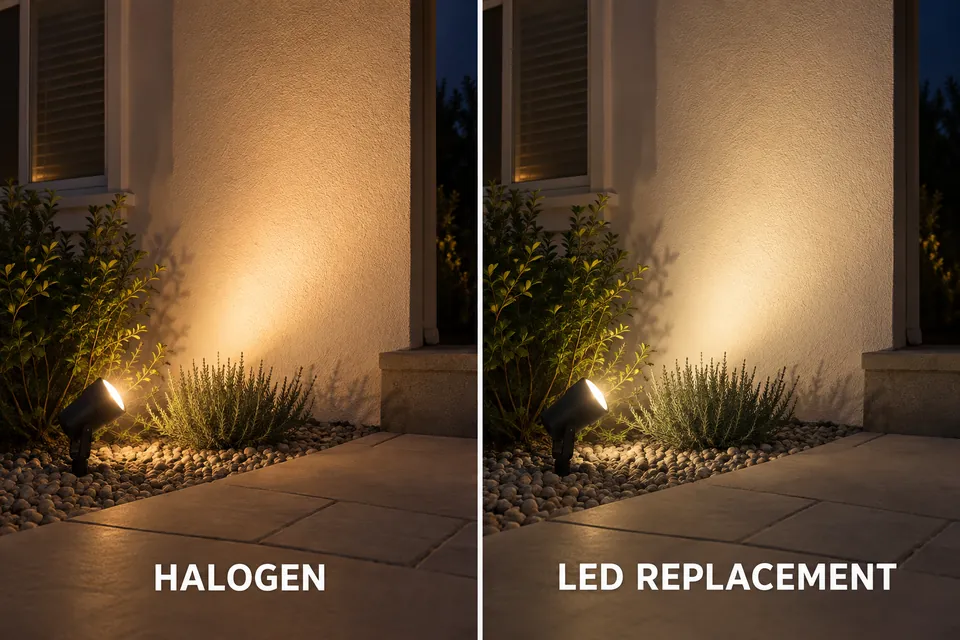
Dimming can widen the visible difference. Halogens generally become warmer-looking as they dim. Ordinary dimmable LEDs may reduce brightness without following the same color shift; dim-to-warm lamps are a specific exception.
Where a dimmer is installed, the lamp, transformer, and control must support the combination. “Dimmable LED” does not mean compatible with every existing dimming arrangement. A timer or photocell that only switches power on and off is not a dimmer.
If the mismatch appears only when dimmed, check the supported dimming combination before choosing another lamp color. Changing color temperature will not correct an unstable dimming response.
Converting One Run at a Time
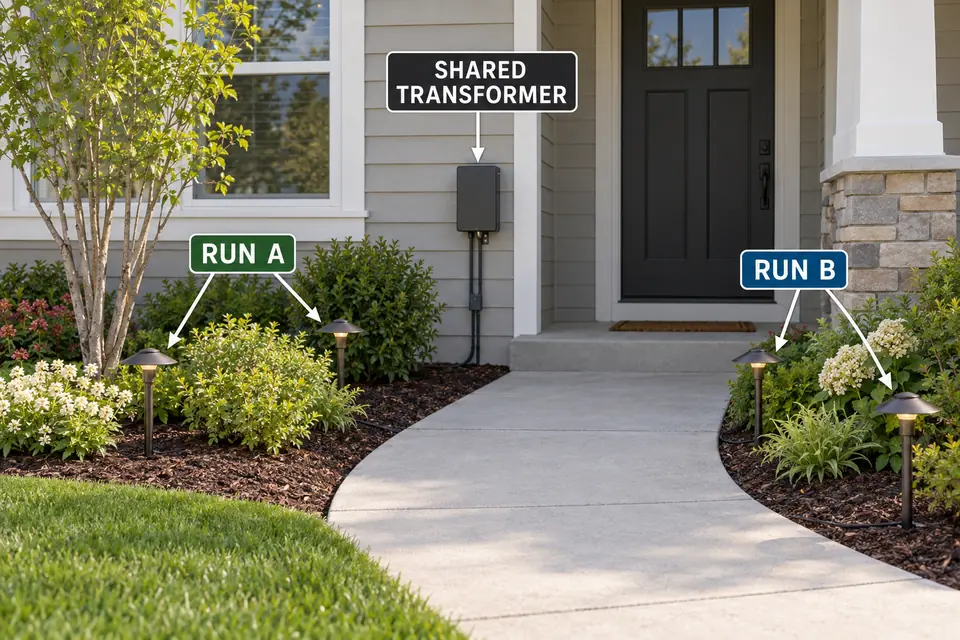
Use one run as the next controlled change, then assess every run sharing its supply. Converting a branch separately makes the results easier to interpret, but it does not make that branch electrically independent.
Use a controlled sequence:
- Record the existing configuration. Note lamp types, actual input wattages, which fixtures belong to each run, the supply model, and any controls. Record which symptoms existed before the next change.
- Confirm the proposed combination. Check compatibility for both the next conversion stage and the intended final load. Include lamp input requirements and any documented loading or dimming restrictions.
- Change one run with power disconnected. Make only replacements permitted by the fixture instructions. Keep other variables unchanged rather than simultaneously adjusting taps, changing controls, and replacing connectors.
- Reassess the whole installation. Observe startup, established operation, visual consistency, and the unconverted runs. Pause if the new stage introduces instability elsewhere.
The final halogen deserves the same planning as the first replacement. A successful LED run may still be sharing a supply whose operating load includes halogens on another branch. Their later removal creates a different condition.
A brief successful startup is not the entire assessment. Check whether behavior remains consistent during normal operation and through the controls normally used.
If confirming suitability requires live measurements or uncertain terminal access, use a qualified professional. Readings must be interpreted against the actual equipment specifications; a generic acceptable-voltage range cannot certify every LED and halogen combination.
When a Mixed System Is No Longer Stable
Pause further conversion when flicker, dropout, resets, or inconsistent startup recur after load changes. Adding more LEDs at that point introduces another variable before the current problem is understood.
Where evidence points toward transformer output falling under load, distinguish that behavior from a lamp-level compatibility problem before replacing more fixtures.
A deteriorated connector, damaged cable, or disturbed socket can also explain trouble appearing during conversion. The timing makes the conversion relevant, but it does not prove that mixing technologies caused the fault.
Voltage outside a lamp’s specified range requires correction. Visible damage, a burning odor, or repeated protective trips warrants stopping operation. Dependence on particular halogens remaining connected likewise calls for establishing compatibility before another conversion stage.
When compatibility cannot be established—or widespread deterioration makes individual changes impractical—planning a coordinated landscape-lighting replacement becomes a reasonable next decision. Replacement should address the identified limitations rather than merely remove the remaining halogens.
Keep a supported mixed system if it operates steadily and its appearance suits the yard. Proceed with the next conversion stage only when the proposed load is supported and the previous stage remains stable. A steadier, compatible installation is the useful endpoint; replacing the last halogen is not proof that you have reached it.
For the technical background on lamp, transformer, and control interactions, see Lutron’s explanation of LED loads on low-voltage transformers.