
Your landscape lights were quiet before the LED conversion. Now a fixture whines, a housing rattles, or the transformer buzzes while the lights still illuminate. Locate the sound before choosing a replacement: a noisy transformer may be responding to the new lamps, while a rattling fixture may have a disturbed cover.
The useful diagnosis connects three observations: where the sound occurs, which conversion step introduced it, and what changes during one supported lamp substitution. Keep the remaining installation consistent so the comparison answers the original question.
Locating the Buzz at Fixture or Transformer
Start with the conversion step that introduced the noise. Replacing halogen bulbs inside existing fixtures changes the lamp electronics and may disturb a cover. Replacing complete fixtures also changes their housings and connections. Note whether buzzing began with the first LED, after several replacements, or when the last halogen was removed.
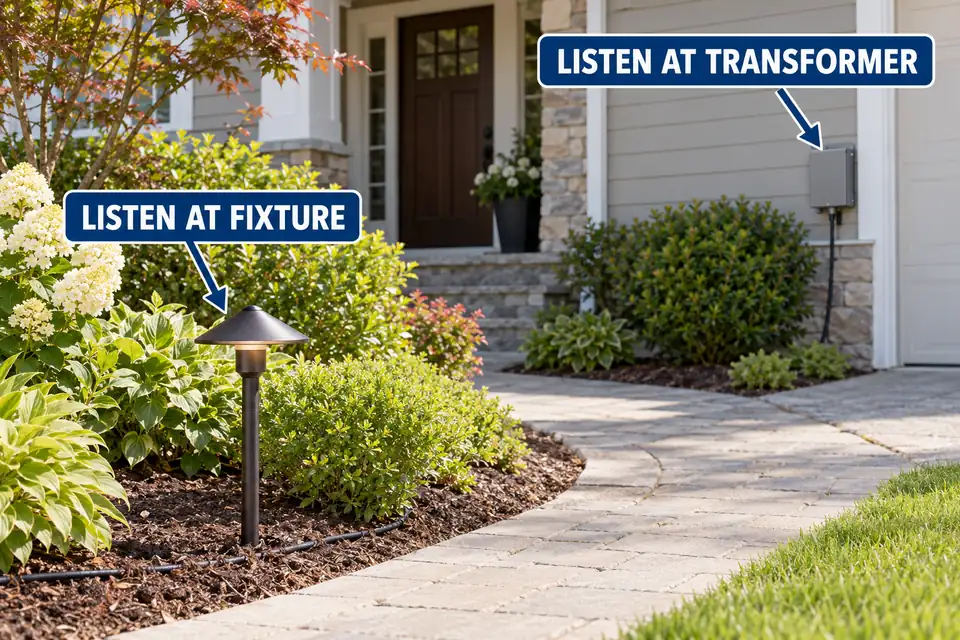
Listen separately near the converted fixtures and the closed transformer from accessible positions. One noisy lamp among otherwise quiet fixtures gives you a local starting point. Similar noise at several converted fixtures raises a shared compatibility question. Noise concentrated at the transformer suggests the supply is reacting, but does not establish that it is defective.
Compare under similar background conditions. Traffic, irrigation, or an air-conditioning unit can conceal a sound. Keep a similar listening distance rather than comparing one fixture from inches away with another across the yard.
If the hum predates the conversion, the broader investigation for transformer hum that has become louder is more appropriate. Here, the useful clue is the relationship between the replacement work and the new sound.
Sound can travel through mounting surfaces, so the loudest location is a starting point rather than a complete diagnosis. With no warning signs present, normal operation of the system’s user control can help establish whether the sound coincides with lighting operation. Burning odor, smoke, visible damage, or repeated protective trips means stop; disconnect power from a safe location and arrange assessment.
Driver Noise vs Mechanical Vibration
Check what was physically disturbed before blaming the electronics. A removable cap, trim ring, or lamp cover handled during conversion may now amplify vibration that was previously unobtrusive.
An LED replacement contains input electronics that behave differently from a halogen filament. Electrical operation can excite physical vibration in components, producing a buzz or whine. “Driver noise” and “mechanical vibration” therefore overlap: the useful distinction is between the component producing vibration and an exterior part making it louder.
With supply power disconnected and the fixture cool, visually check accessible exterior parts that the manufacturer allows you to service. Correct only a clearly identified assembly issue within those instructions. A cover that no longer seats correctly deserves attention; an unexplained whine does not justify opening the driver.
Do not press on energized equipment to see whether it quiets down. Avoid opening sealed electronics, tightening internal transformer parts, or inserting material behind an enclosure.
If permitted reassembly removes a rattle, that supports an exterior explanation. If the sound remains without an observable assembly problem, review the lamp–supply–control combination. Sound pitch alone cannot identify a failed internal component.
Why Dimming Controls Matter
Identify the actual control before interpreting a change in sound. An ordinary timer or photocell that switches power on and off is not automatically a dimmer. A wall dimmer, electronic controller, or proprietary landscape-lighting control needs to be identified by model and operating method.
The lamp, transformer, and control must support the combination. “Dimmable LED” does not mean compatible with every dimmer, and some landscape transformers prohibit dimming their incoming supply. Follow the installed equipment’s instructions before changing settings or planning a comparison.
Where dimming is explicitly supported, note whether the noise changes across normal settings. That implicates the operating combination without proving the control has failed. Maximum brightness does not necessarily remove dimmer electronics from the power path.
Conversion can also reduce connected demand. Use actual input ratings rather than “halogen-equivalent” wattage, and check any documented LED loading requirements. If halogens remain connected, the behavior of a mixed LED and halogen system helps explain why removing another lamp can change operation.
Do not assign every transformer a minimum-load problem. Check the specific supply, including its output type and the LED’s permitted input. A matching voltage number alone does not establish compatibility with AC, DC, or every electronic supply waveform. A quiet dimming setting cannot override an unsupported combination.
Testing a Single Converted Fixture
Keep the Comparison Valid
Keep the other lights connected during a single-fixture comparison. Removing them changes the load and may create a different operating problem, especially where the supply has a documented minimum.
Leave the selected fixture in its original position, with the same cable route and control setting. For a replaceable-lamp fixture, use a documented compatible, known-good reference LED with comparable input demand. A same-model reference is particularly useful for comparing individual lamps; a different compatible model tests a different lamp–system combination. Neither result alone proves an internal fault.
An integrated fixture requires a manufacturer-approved replacement method. If substitution involves uncertain connections or opening sealed components, have an installer perform it. Do not introduce an arbitrary adapter or connect two power-supply outputs together.
Fix Boundary: Disconnect supply power before every lamp or connection change; a dimmer’s off setting is not a work disconnect. Allow lamps to cool. Work only on documented user-serviceable parts and restore covers before operation. Unknown compatibility, damage, protective trips, or required mains work means stop and obtain qualified help.
- Record the baseline. Note where the sound is audible, the lamp and transformer models, the controls, and which other lights remain connected.
- Confirm the reference arrangement. Check that replacement is permitted and that the proposed lamp meets the fixture, supply, control, and loading requirements.
- Substitute with power disconnected. Change only the selected lamp or approved serviceable fixture, then restore its protective parts.
- Observe under matching conditions. Listen at both the selected fixture and the transformer using the same control setting and similar background conditions.
- Record the result and stop. Note what changed without repeatedly cycling unstable equipment or reproducing a protective trip.
Interpret What Changed
If the reference LED is quiet in the same position, the original lamp or its interaction with the system becomes the stronger suspect. A substantially different reference wattage weakens that conclusion because the substitution also changes loading.
If both LEDs buzz, the comparison has not cleared the shared supply or controls. Fixture resonance and the reference lamp’s suitability also remain open questions. Two noisy lamps are not proof that both drivers have failed.
If transformer noise changes after the substitution, the changed load influences the sound. It does not automatically mean the original configuration exceeded capacity.
Restoring an approved original halogen can provide another observation, but it changes both the lamp electronics and electrical demand. A quieter result cannot isolate which change mattered. Do not retain an unnecessary halogen or add a resistor as an improvised permanent stabilizing load.
A comparison that creates unsupported loading or compatibility conditions is inconclusive. Resolve those conditions before using its result to choose a replacement.
When Audible Noise Means Incompatibility
Treat a documented mismatch as decisive; treat sound changes as clues. A transformer that prohibits supply-side dimming should not remain on that arrangement simply because one setting sounds quieter.
Without a documented mismatch, repeatable changes help direct the investigation. A quiet compatible reference makes the original lamp worth reviewing. Noise that changes with an approved control setting points toward interaction. A corrected exterior rattle supports a mechanical explanation.
When buzzing accompanies flicker, the investigation for a new LED fixture flickering on an older transformer can help separate compatibility from other supply-path problems. Curing the audible symptom does not necessarily resolve unstable operation.
Persistent new noise with no established explanation calls for manufacturer or installer assessment. Audible noise alone does not prove imminent failure, and silence does not certify safe operation. Keep the equipment off if damage, odor, smoke, or repeated protective shutdown accompanies it.
Pause further conversion until the next change has a clear purpose. Provide the lamp, transformer, and control models, identify which replacement introduced the sound, and describe the valid comparison. Replace the component that the evidence identifies; the location of the loudest buzz is not enough to choose it.
For technical background, Lutron’s guidance on low-voltage LED dimming explains lamp, transformer, control, and loading compatibility.