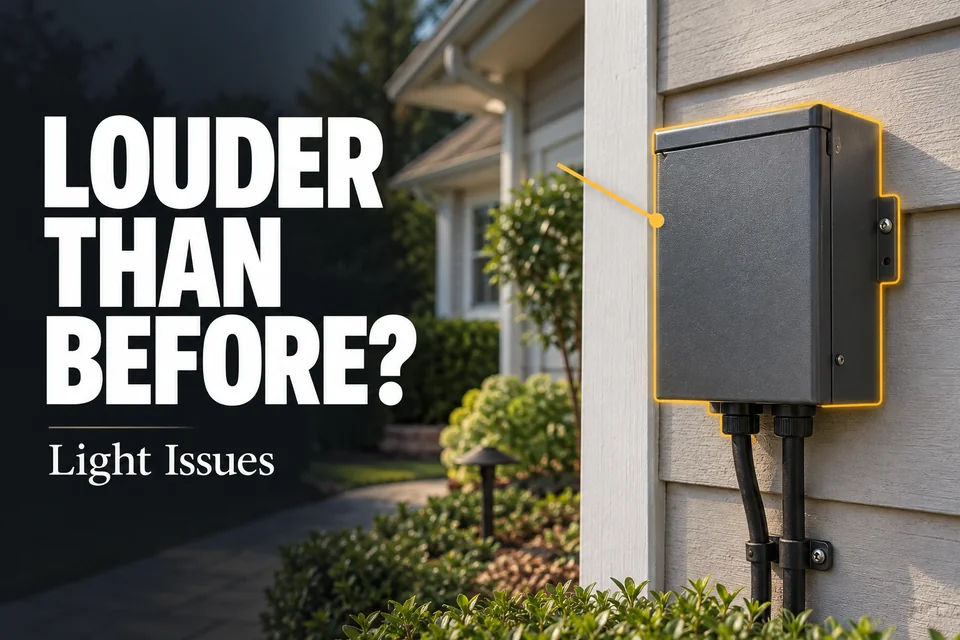
The landscape transformer used to disappear into the background. Now you hear it from the patio, beside the garage, or through the wall—even though the lights still come on.
The first decision is whether the louder hum follows an identifiable change or remains unexplained. Added lights, replacement lamps, or a loosened mounting point give you something specific to investigate. Continued illumination alone does not tell you whether the transformer is operating normally.
Start with when the sound changed and compare it with this transformer’s previous behavior under similar conditions.
Warning Sign: Burning odor, smoke, visible heat damage, or repeated protective shutdown means stop using the transformer and disconnect its supply from a safe location. Do not restart it to gather more evidence.
Normal Transformer Sound vs a New Mechanical Hum
Judge the change against this unit’s familiar sound. A magnetic transformer can produce a steady hum because its magnetic core vibrates, but normal operating sound does not explain a new increase by itself.
Listen from your usual position with roughly similar background noise. A quiet evening after the air conditioner stops can reveal a sound that was already present. Hearing the transformer from a place where it previously could not be heard, under comparable conditions, is a more useful sign of change.
Also separate increased volume from a different sound. A steady hum, a metallic rattle layered over it, and an intermittent chatter are different observations. Note whether the change starts immediately or develops later during ordinary operation; do not prolong operation if warning signs appear.
A short recording can help explain the change to an installer. Phone microphones and automatic recording levels make recordings unsuitable for deciding whether equipment is electrically safe.
Check the equipment identification, too. An electronic landscape-lighting power supply may behave differently from a conventional magnetic transformer. “Transformers always hum” is not a sufficient explanation for either type becoming much louder.
Load Changes and Loose Mounting
What Changed in the Connected Lighting?
Match the sound change to the installation history before choosing a fix. Extra path lights, higher-input lamps, or a schedule that runs more fixtures together can change the operating load. A newly installed control may also introduce a compatibility question.
Use actual electrical input ratings when reviewing the connected lighting. A lamp’s “50-watt equivalent” brightness claim does not mean it draws 50 watts. Follow the transformer manufacturer’s total-load and individual-output limits rather than applying one universal loading percentage.
If the hum increased after an expansion, checking the load after adding landscape lights is a useful next step. Include changed lamps and operating combinations, not just the number of fixtures.
That timing narrows the investigation without proving overload. A changed load can affect sound without exceeding capacity. Conversely, staying within the rated total does not rule out an incompatible component or a downstream fault.
What Changed at the Mounting Surface?
A mounting surface can amplify vibration that was previously less noticeable. A loosened exterior bracket, deteriorated mounting board, or nearby panel contacting the housing may make the installation louder without identifying an internal transformer fault.
With the supply disconnected and the unit cool, visually inspect accessible exterior mounting points. Look for a backed-out fastener, a bracket separating at its attachment, or damaged material around an anchor. Do not lift the transformer or open its cover.
A uniform gap behind the housing may be a designed stand-off. Look for separation where the bracket should be secured, rather than treating all daylight behind the enclosure as looseness.
Limit any correction to exterior fastening work the manufacturer permits. Damaged anchors, uncertain support, or work requiring the unit to be removed belong with an installer. Do not press against an energized housing to see whether it quiets down, or wedge material behind it to suppress the sound.
Heat, Vibration, and Enclosure Clues
Let accompanying symptoms determine whether further observation is appropriate. A new rattle with a visible mounting defect suggests a different next step from louder humming accompanied by flickering and repeated shutdown.
Some operating warmth may be expected. Direct sunlight, outdoor temperature, and operating duration also affect enclosure temperature. Do not use your hand as a temperature test or assume a single surface-temperature limit applies to every model.
Fresh scorching, melted material, a burning smell, visible enclosure damage, or repeated protective shutdown require leaving the unit off for assessment. Visible moisture-related damage also warrants service; opening the enclosure to investigate is outside this check.
Keep the manufacturer’s required clearances unobstructed. Where the design has ventilation openings, inspect them externally for accumulated debris. A sealed enclosure may have no visible vents—do not modify it to add any.
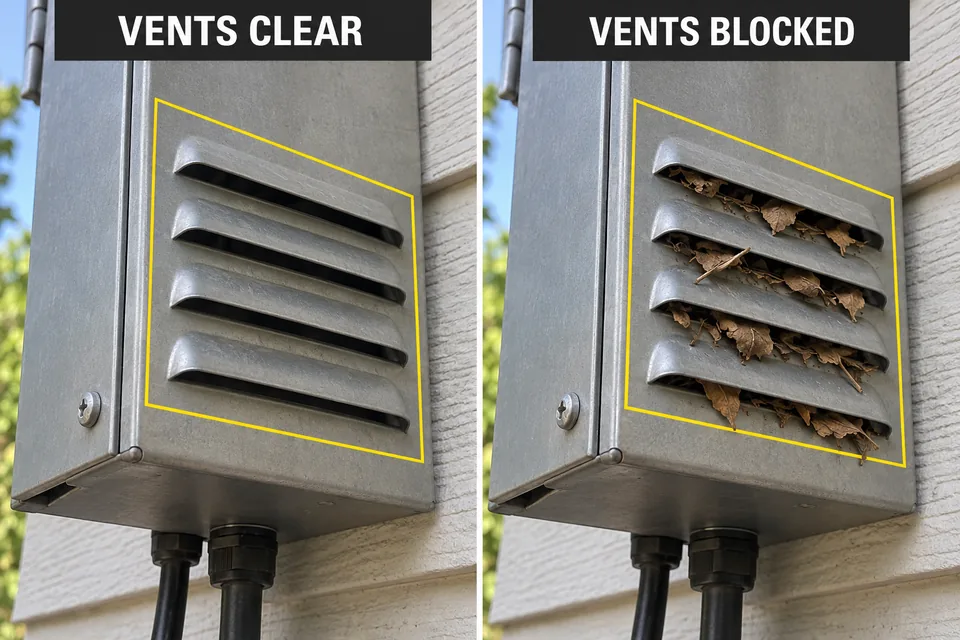
An obstruction is a reason to restore the specified clearance safely, not proof that it caused overheating. Disconnect power before permitted exterior cleaning, and do not insert anything through openings. Clearing debris does not erase a history of scorching or repeated shutdown.
If the plug, receptacle, or enclosure is wet, hot, or damaged, do not handle it. Use a safe upstream disconnect if accessible and arrange qualified help. Repeatedly resetting protection can keep reenergizing an unresolved fault.
Comparing No-Load and Normal Operation Safely
A no-load comparison is useful only when the equipment permits it and the two operating states are correctly identified. True no-load operation means the transformer remains energized while the lighting load is electrically disconnected. Unplugging the transformer produces a power-off condition.
Dark lights do not establish no-load operation either. A timer, app command, or lighting controller may turn off illumination while leaving equipment electrically connected.
For a homeowner, this comparison is appropriate only when the exact manufacturer instructions permit unloaded operation and provide a designated, externally accessible, user-disconnectable load connection. It must require neither enclosure access nor handling exposed conductors. Any permitted connection change must occur with the supply disconnected.
If it requires opening a compartment, removing wires from terminals, working on a hardwired installation, or guessing about minimum-load requirements, leave it to a qualified technician. An unclear manual is not permission to improvise.
Even a correctly performed comparison has limits. A magnetic transformer may still hum without a lighting load. If the sound decreases, that suggests the load contributes to the noise; it does not establish that the transformer was overloaded. If the sound remains, that alone does not prove internal failure.
The comparison can narrow the investigation, but it cannot clear the unit for continued use. Existing warning signs take priority over any change in sound.
When Noise Means Service or Replacement
Choose the next action from the strongest evidence available. A visible support defect gives an installer a mounting problem to correct. A documented lighting change gives them a load or compatibility question to assess. A persistent increase with neither explanation needs further investigation, even while the lights still work.
| Observed pattern | What it suggests | Next action |
|---|---|---|
| Visible exterior attachment problem | Support may be amplifying vibration | Arrange a permitted exterior correction or installer repair |
| Noise began after lighting changes | Load or compatibility may contribute | Review equipment ratings and recent changes |
| Noise remains unexplained or keeps increasing | The cause is unresolved | Arrange manufacturer or qualified-service assessment |
| Odor, heat damage, smoke, or repeated shutdown | A potentially unsafe operating condition | Keep power off and arrange service |
If the system also develops loss of output or other operating failures, those belong within broader transformer troubleshooting. Have a technician handle any testing that requires terminal access or energized measurements.
Before contacting service, gather the model, approximate age, when the sound changed, recent fixture changes, exterior mounting photographs, and any shutdown history. These details are more useful than describing the unit as simply “noisy.”
Replacement is appropriate when assessment identifies a failed or unsuitable unit. The replacement must match the lighting system’s output type, voltage, capacity, controls, and outdoor installation requirements. Transformer noise alone does not justify replacing the entire landscape-lighting system.
A return to the familiar sound after a permitted mounting correction supports that explanation; it is not a complete electrical safety certification. Keep required clearances open and record future lighting changes. If the hum stays louder without an established cause, arrange assessment. If warning signs accompany it, leave the transformer off.
For the underlying sound mechanism, Siemens explains how magnetic-core vibration can produce transformer noise.