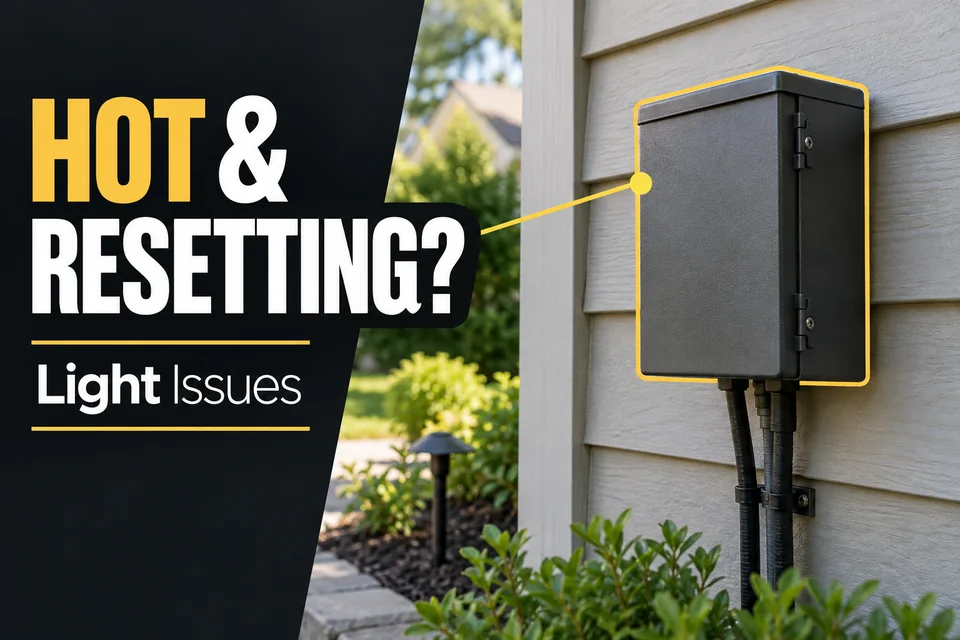
Your landscape lights come on, the transformer warms up, and the entire system shuts down. Later, the lights return without anyone changing the controls. That recovery can mean a protective device has reset while the condition that triggered it remains.
The useful decision is whether to correct connected load or installation conditions, investigate a particular run, or stop operation for assessment.
Start with the transformer’s model documentation: how its protection works, what load it permits, and how it must be installed. Cooling recovery supports a temperature-related diagnosis, but does not establish the cause.
Thermal Reset vs Random Power Loss
Check whether your model actually has automatic thermal reset before interpreting the cycle. That protection can interrupt operation at an internal temperature limit and allow operation again after cooling. Other units require a manual reset or use different protective arrangements.
Use the sequence you have already observed. Did the lights return without a reset button being pressed? Did a timer command coincide with either event? Does the manual explain an accessible indicator that identifies a protection event?
If the interruption follows a schedule or lacks a consistent warming-and-recovery relationship, consider other reasons outdoor lights shut off after a few minutes before attributing it to transformer temperature.
Elapsed time is not a diagnostic threshold. A shutdown after several minutes can involve other components, and a warm housing alone does not establish overheating. Do not use your hand as a temperature test or deliberately reproduce repeated trips.
Fix Boundary: Lights being off does not mean power is isolated; an automatic-reset unit may restart. Disconnect the supply before permitted low-voltage changes. Do not access internal or line-voltage parts. Stop for burning odor, melted material, damaged supply equipment, water intrusion, or repeated protective operation.
Load, Ventilation, and Direct-Sun Factors
Build the Load Inventory
Reconstruct the load as it exists today. A transformer that previously operated reliably may now be serving additional fixtures, higher-input replacement lamps, or LEDs with different electrical requirements.
Collect five facts before deciding that the transformer needs replacing:
- Transformer identification: Model, output type, total rating, and any separate output-circuit limits.
- Connected fixtures: Quantity and actual input rating for each fixture or lamp.
- Loading instructions: Any manufacturer-specific VA, LED compatibility, or capacity requirements.
- Recent changes: Added lights, replacement lamps, changed controls, or altered cable connections.
- Installation conditions: Required clearances, existing openings, surrounding obstructions, and environmental limits.
Use actual input watts, not an LED package’s “equivalent wattage.” When the documentation specifies volt-amperes, or VA, follow that method rather than treating watts and VA as interchangeable.
If additions have pushed the installation toward its documented limits, review the connected transformer load before choosing a correction. A count of fixtures alone cannot establish whether the load is acceptable.
Check both total capacity and any individual circuit limits. There is no universal percentage that overrides the manufacturer’s loading instructions, and an apparently modest total does not rule out a downstream fault.
Check How the Enclosure Sheds Heat
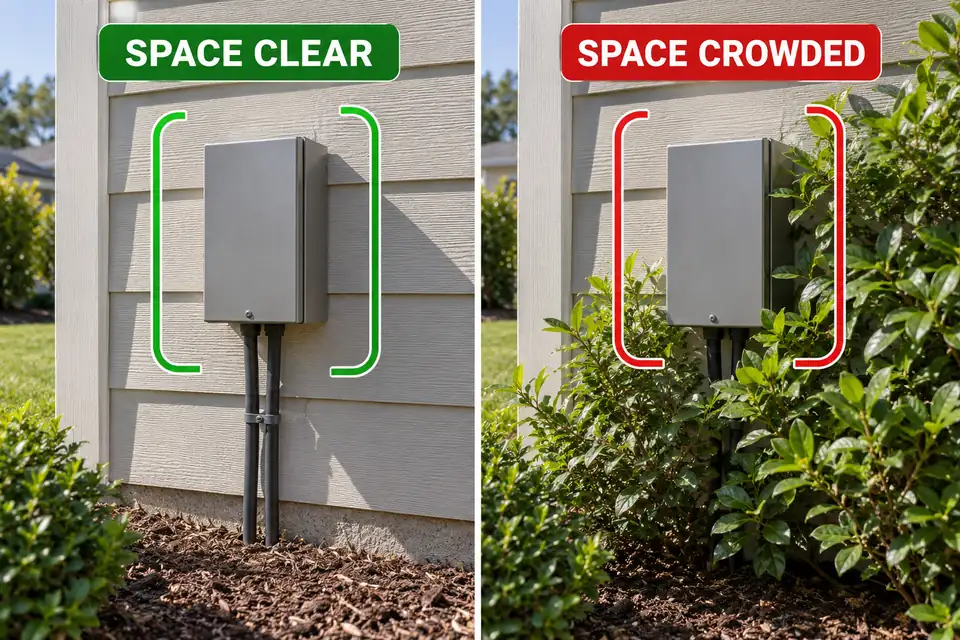
An unchanged lighting load can still develop a problem if the space around the transformer changes. Look for shrubs growing against it, debris collecting near designed openings, or a decorative screen added to hide the box.
Follow the specified clearances and mounting conditions. If the enclosure has ventilation openings, keep those existing openings unobstructed using the manufacturer’s maintenance instructions. A sealed enclosure must remain sealed; do not drill holes or operate it with the cover open.
Direct afternoon sun and high ambient temperatures can contribute to heat stress, but they do not independently explain repeated shutdowns. Moving the unit into shade without checking load, faults, and installation requirements can leave the underlying problem unresolved.
One Faulted Run That Heats the Transformer
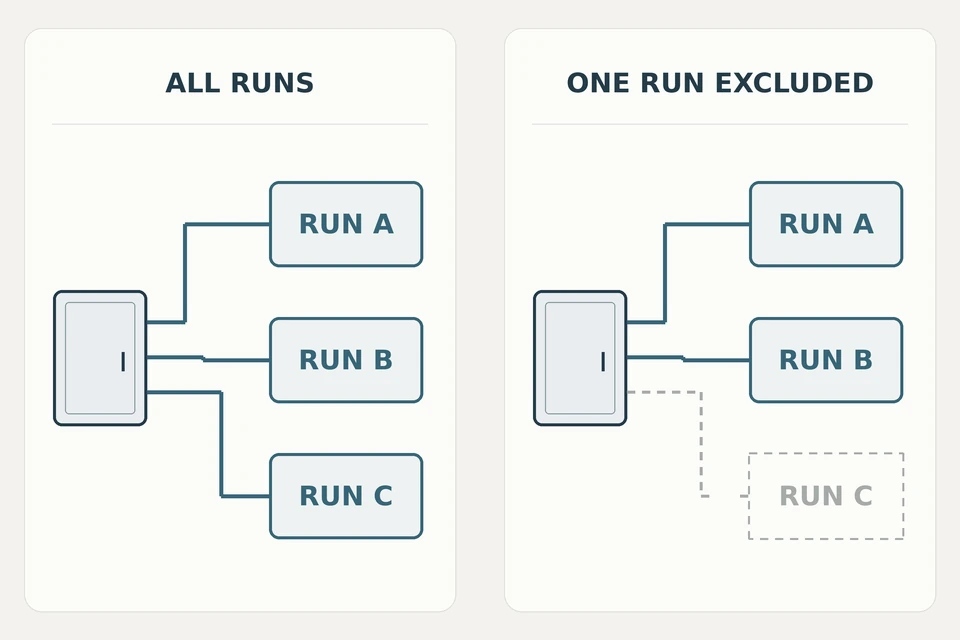
Treat improvement after removing a run as a clue that needs interpretation. A downstream short or abnormal load can trigger transformer protection, but removing a healthy run can also relieve excessive total demand.
Branch isolation changes two things at once: which equipment is connected and how much load remains. If the remaining lights stay on, that result alone cannot distinguish a defective run from an overloaded transformer.
Removing the run with the most fixtures illustrates the problem: the transformer may stop shutting down simply because demand dropped substantially. Suspicion of a run becomes stronger with supporting evidence, such as visible cable damage, a connection affected by irrigation, or a qualified technician finding abnormal current.
Timing does not settle the distinction either. A fault can emerge as equipment warms. An immediate trip and a delayed trip are useful observations, not absolute labels for “short” and “overload.”
Any homeowner isolation must be limited to low-voltage connections the manufacturer explicitly identifies as user-accessible. Disconnect the supply first. If reaching those connections exposes line-voltage parts, or the instructions are unclear, leave the work to a qualified electrician.
Do not reconnect visibly damaged wiring for comparison. Where the manufacturer permits an operational check, secure the enclosure before restoring power and end the check at the first recurrence. Do not cycle through repeated shutdowns to build a stronger diagnosis.
A long cable or loose splice also deserves appropriate investigation, but neither automatically explains transformer overheating. Keep the conclusion proportional to the evidence: isolation identifies a direction for further assessment, not necessarily a failed component.
Cooling Down Is Not the Final Fix
Choose the permanent correction from the evidence collected while the system is out of service. Another successful restart does not establish that the installation can sustain normal operation.
| Evidence | Permanent response | What remains unproven |
|---|---|---|
| Documented loading limit exceeded | Permanently reduce demand or redesign the supply arrangement within documented limits | Whether any component also has damage |
| Installation or ventilation requirement not met | Restore the specified installation conditions | Whether restricted heat dissipation was the only cause |
| Supporting evidence points toward one run | Keep that run out of service pending assessment and repair | Whether the transformer is also affected |
| Cycling continues despite apparently suitable conditions | Stop operation and arrange qualified assessment | Whether the fault is internal, downstream, or supply-related |
Permanent load reduction means bringing a serviceable installation within its requirements. It does not mean finding a lower load at which damaged equipment happens to keep running. Moving cables between terminals on the same transformer also does not reduce its total connected load.
Correcting exposure may be part of the solution, but shade alone is not a sufficient conclusion. Do not add a shelter or enclosure that restricts heat dissipation.
If assessment supports transformer replacement, match the output type, fixture compatibility, loading requirements, environmental suitability, and circuit limits. Greater capacity does not repair a damaged run.
Only when fixtures and supporting components also have independent deterioration should you consider replacement options for an aging landscape-lighting system. A transformer shutdown alone does not justify discarding healthy lights and cable.
The correction should address an identified loading, installation, or equipment problem. If the cause remains uncertain, keep that uncertainty in the decision instead of treating temporary stability as clearance to resume normal use.
When Repeated Thermal Cycling Ends the Test
Once repeated shutdown and recovery are established, stop leaving the system operating unattended. Another evening of cycling adds little useful evidence and leaves the unresolved condition in service.
If a manufacturer-permitted check produces another shutdown, end the test. Burning odor, melting, damaged supply equipment, or water intrusion means stopping without further operational trials. Disconnect the supply if it is safe to do so and arrange assessment.
Give the technician the transformer model, connected-load inventory, affected runs, recent changes, and the sequence already observed. Those details are more useful than repeated resets. Do not open the transformer to inspect windings or replace protective components.
Keep the system off until the identified cause is corrected within its documented operating limits or qualified assessment establishes the appropriate repair or replacement. Cooling recovery is the clue that starts this decision; it is not the condition for returning the lights to service.
Iowa State University Extension’s landscape-lighting troubleshooting guidance identifies overload and shorts as possible causes of lights starting and then shutting off.