A landscape transformer that still trips after all external low-voltage runs have been disconnected has reached a different diagnostic boundary. The lighting loads are no longer connected, but the transformer assembly and its input supply remain part of the problem.
First, make sure the description matches what actually happened: removing bulbs or disconnecting fixtures out in the yard does not necessarily isolate the cables feeding them. Also identify which protection operated—the transformer’s own resettable protector, the outlet GFCI, or the breaker in the electrical panel.
Those distinctions determine what the observation means. They do not require another reset attempt, and they do not automatically prove that the transformer needs replacement.
What Disconnecting the Low-Voltage Loads Rules Out
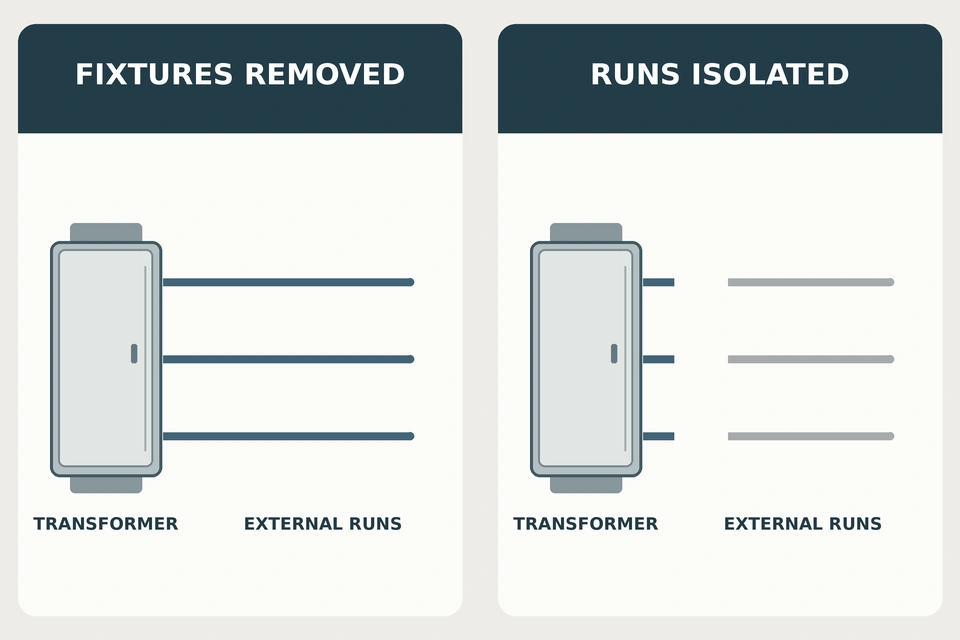
“All fixtures disconnected” can describe two electrically different situations. In one, the fixtures have been removed but the outdoor cables remain connected to the transformer. In the other, every external low-voltage run has been isolated from the transformer output.
Only the second situation removes those external cables, their splices, and their fixtures from the connected output circuit. A damaged cable can remain relevant when its lamps are gone. Once that cable is properly isolated, however, it cannot continue acting as a connected load.
This distinction separates the present condition from broader transformer failure patterns, where overload, one damaged branch, or loss along a cable may still explain the symptom. Here, the useful question is what remains electrically involved after the external runs are excluded.
The transformer itself is still an electrical load on the household supply. Its internal connections, integral controls, and protection have not disappeared simply because the landscape cables are disconnected. Neither has any problem affecting its input cord or supply circuit.
Treat the isolation result as useful evidence, not a universal pass-or-fail test. The model’s documentation must establish whether unloaded operation is appropriate and what its protector monitors. If the isolation condition is uncertain, report that uncertainty to support rather than assuming the yard wiring has been ruled out.
Input-Side vs Internal Transformer Fault
The word “reset” does not identify the device that interrupted power. A button on the transformer, a GFCI reset at the receptacle, and a breaker handle in the panel belong to different protective arrangements.
Start with the location and accessible labeling of the device that actually operated. A dark transformer display or dead lights alone cannot tell you which protection opened. Use existing observations and the model manual; do not open an enclosure to trace the circuit.
| Protective device | What continued tripping narrows | What it does not prove |
|---|---|---|
| Transformer-mounted resettable protector | Attention shifts to the protected parts of the transformer assembly and the model’s operating requirements | That a particular winding, control, or protector has failed |
| Outlet or upstream GFCI | A ground-fault concern may remain in connected equipment or the protected supply arrangement | That the receptacle itself is defective |
| Electrical-panel breaker | The supply circuit, connected equipment, and breaker function need assessment | That the landscape transformer alone caused the event |
If the observation is a breaker trip rather than a GFCI trip, preserve that distinction when describing the problem. Some panel devices provide additional protective functions, so the device’s labeling matters as well as its location.
A transformer-mounted protector that continues to operate after verified output isolation warrants model-specific support or service assessment. It makes the transformer assembly a more relevant suspect, but the protector’s placement within the design determines what that evidence can establish.
Conversely, an upstream GFCI can respond to leakage associated with a connected transformer. Calling this an “input-side trip” describes where protection operated, not necessarily where the defect is located. Replacing the outlet on that observation alone skips the unresolved question.
The practical boundary is therefore between identifying the device and diagnosing its circuit. A homeowner can report the former from accessible information. Establishing the latter may require qualified testing.
Moisture and Burn Marks Outside the Enclosure
Exterior evidence can change the next step without revealing the exact internal fault. Look only at areas already visible: the closed housing, its seams, the cord entry, exposed portions of the insulated power cord, and the surrounding receptacle cover.
A water trail across the enclosure suggests exposure. It does not prove that water reached an internal electrical connection. Likewise, staining around a seam may be dirt or weathering rather than heat damage.
Deformed plastic, melted insulation, an obviously scorched patch, or a damaged cord entry carries a different implication. Those observations support keeping the equipment out of service and arranging assessment. They are not reasons to energize it again to see whether the same mark gets worse.
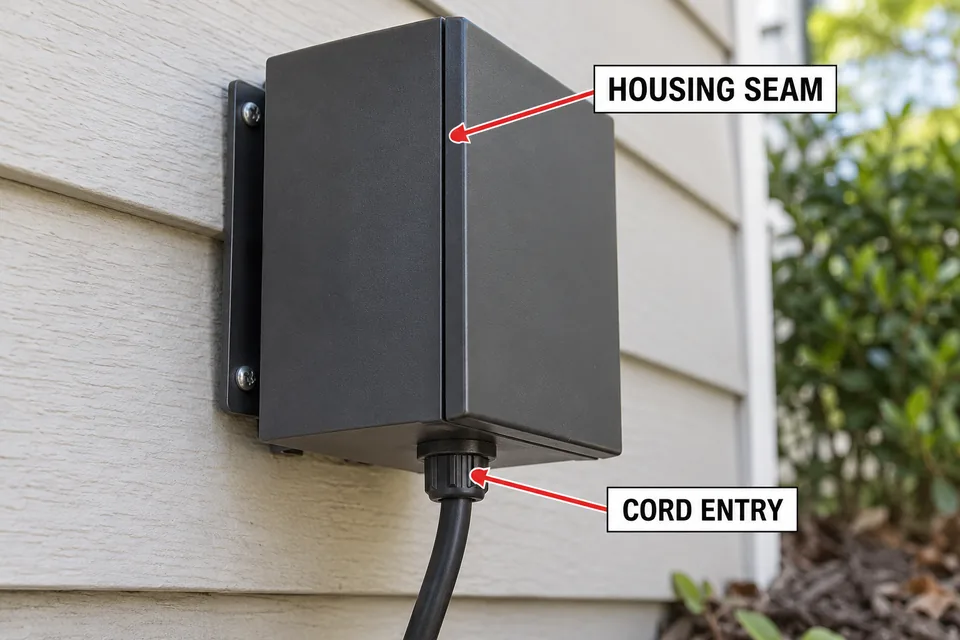
Photographs can help support distinguish a housing issue from damage around the power connection. Take them only from an accessible position without touching damaged equipment, moving cords, or opening covers.
A clean exterior does not clear the transformer. Concealed insulation, connections, or controls can fail without leaving an obvious mark outside. Conversely, exterior moisture does not establish that the entire unit is beyond repair. The observation sets the service priority; it does not replace an assessment.
Why Repeated Resetting Adds Risk
A reset restores the possibility of energizing the circuit. It does not remove the condition that caused protection to operate. When a fault remains, another reset may expose the affected equipment to further electrical or thermal stress.
A brief period of operation after resetting is particularly easy to misread. It shows only that the device stayed on for that interval. It does not establish that damaged insulation, a failing connection, or another unresolved condition has recovered.
If the original symptom was a transformer that shuts down hot and returns after cooling, that timing belongs to a separate thermal-cycle diagnosis. It should not become a reason to keep cycling an already isolated unit.
There is no useful universal instruction to “try three times” or “wait ten minutes” here. Keep the equipment out of service and retain the timing already observed. Whether the previous trip was immediate or delayed can help support interpret the report without requiring you to recreate it.
The Electrician-or-Replacement Boundary
An electrician is the appropriate route when the unresolved problem involves a hardwired transformer, damaged input wiring, the receptacle, upstream protection, or uncertain supply conditions. Replacing the transformer cannot correct a defective supply connection.
Manufacturer support is useful when the question concerns the transformer’s own protection and the model’s intended behavior. The model number allows support to identify the correct manual, determine whether the reported unloaded condition is meaningful, and explain warranty or approved service options.
A report of a GFCI that will not reset with the equipment unplugged describes another boundary altogether. Disconnecting the transformer’s input removes equipment that remains connected during low-voltage output isolation. If that condition has already been established, include it in the report; this is not a request to perform another test.
Before contacting support or an electrician, gather what is already available:
- The transformer’s model number and an accessible identification-label photo.
- The location and labeling of the protective device that operated.
- Whether all external runs were isolated or only fixtures were removed.
- Previously observed trip timing and any rain or irrigation association.
- Exterior photographs or notes describing visible damage.
Replacement becomes a supported decision when assessment identifies a failed unit that is not serviceable, or when the manufacturer directs replacement. Age alone, an unexplained trip, or a clean-looking housing does not settle that decision.
The useful outcome is a clear handoff: the external runs have been excluded, the protective device has been identified, and the remaining transformer or supply uncertainty needs assessment. That is enough to stop chasing fixtures without pretending the failed component has already been found.
For household electrical warning signs, including frequent breaker trips and discolored outlets, see ESFI’s home electrical safety guidance.