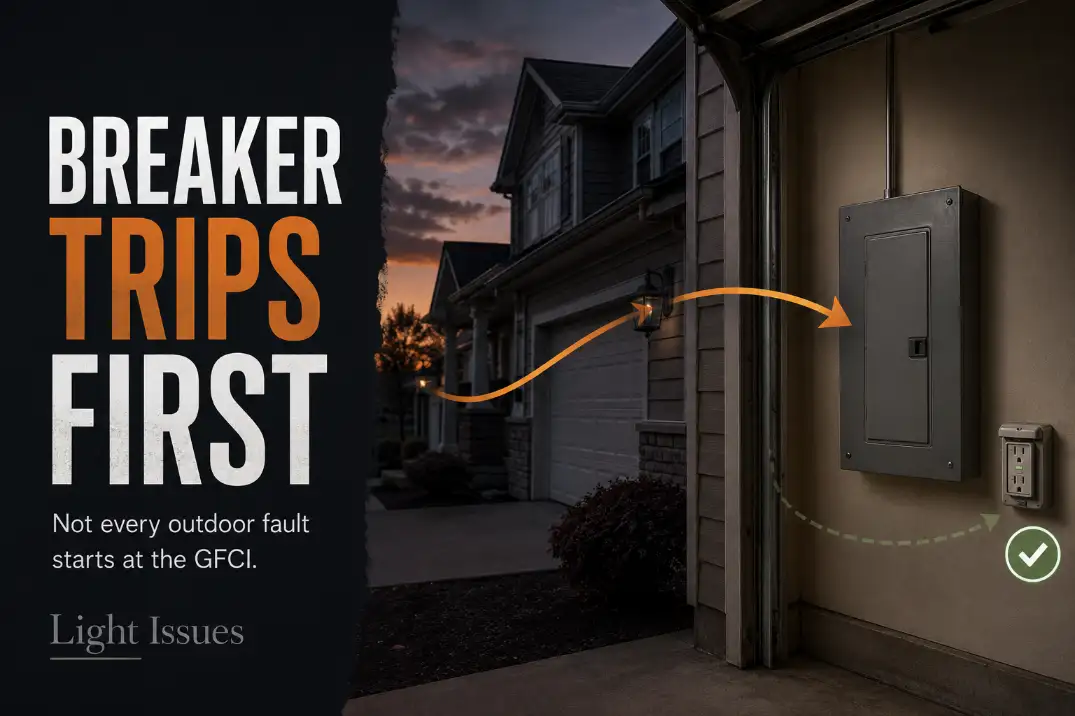
Outdoor lights that trip the breaker but not the GFCI should not be diagnosed as a simple “bad GFCI” problem. The useful clue is which device reacted first.
A breaker usually trips because the circuit is seeing too much current, a short, damaged equipment, or a fault that has become heavy enough to protect the wiring. A GFCI trips for a different reason: current leaking where it should not. Those problems can overlap, but they are not the same signal.
So the first diagnosis is not “reset it and try again.” It is pattern reading: when the breaker trips, what else is running, whether rain changed the behavior, whether one fixture or zone causes it, and whether a transformer is part of the circuit.
Breaker vs GFCI
Start by separating protection types, not by guessing which device is broken.
A circuit breaker protects the wiring from overcurrent conditions, including overloads and short circuits. A GFCI watches for a difference between outgoing and returning current, which suggests current may be leaking through an unintended path.
That means a GFCI staying set does not prove the outdoor lighting is safe, dry, or correctly wired. It only means the GFCI did not see the kind of imbalance that makes it trip before the breaker reacted.
| Device | What It Reacts To | What It Does Not Prove | Outdoor Lighting Clue |
|---|---|---|---|
| Standard breaker | Overload or short-circuit current | That the connection is dry or safe | Breaker trips when lights or a zone turn on |
| GFCI outlet or breaker | Ground-fault current imbalance | That no overload or short exists | GFCI may stay set while breaker trips |
| AFCI or dual-function breaker | Arc-fault patterns and/or other protection types | That the outdoor fixture itself is healthy | Trips may feel less predictable |
| Transformer reset/protection | Low-voltage lighting load or fault behavior | That the house breaker is the first problem | Transformer may shut down before the panel breaker |
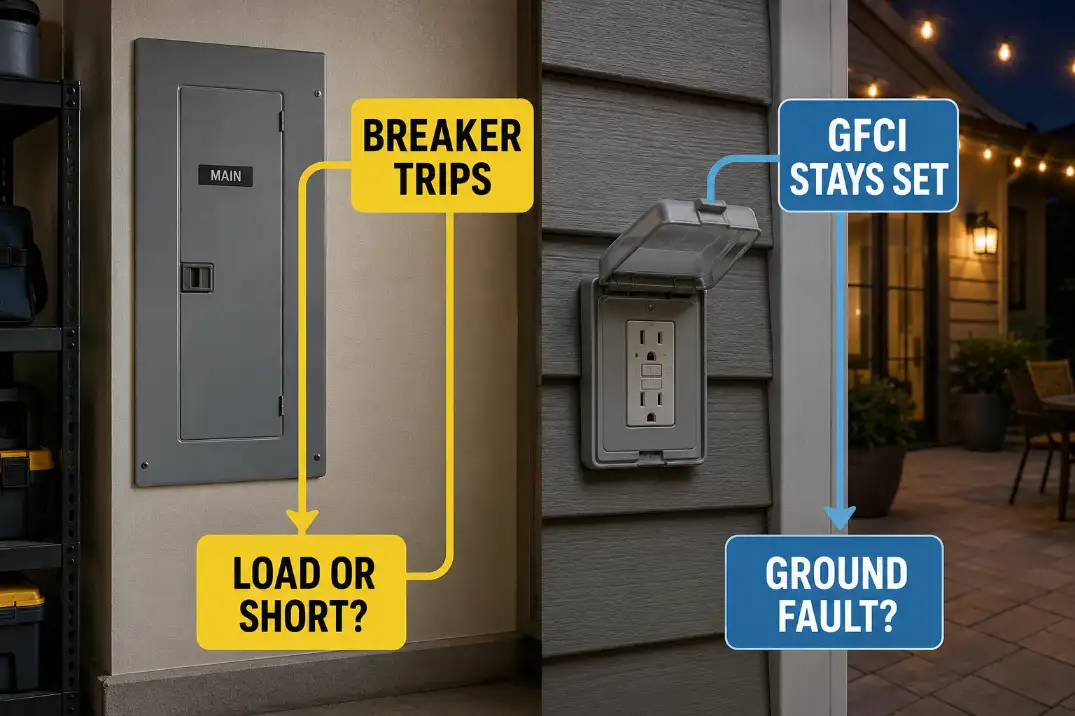
Important distinction: This is not about deciding that the breaker is “right” and the GFCI is “wrong.” It is about knowing which device saw the problem first. A breaker-only trip usually moves the diagnosis toward load, short, damaged equipment, or a fault that became strong enough to trip the circuit before the GFCI acted.
A broader GFCI problem can still exist elsewhere, especially if the outlet is old, miswired, or not protecting the circuit you think it protects. But if your issue is the opposite pattern, this separate guide on outdoor lights tripping GFCI outlets is the cleaner route.
Overloaded Circuit
Overload moves higher on the list when the breaker trips only after the circuit carries more than the lights alone.
The outdoor lighting circuit may also feed garage outlets, a patio receptacle, holiday lights, a pond pump, a sprinkler controller, a plug-in transformer, or other exterior equipment. The lights may seem fine by themselves, then fail when several loads run together.
The clue is timing. If the breaker trips only when everything is on together, overload is more likely. If one small fixture causes an immediate trip by itself, overload becomes less likely and a short or equipment fault moves higher.
Older high-wattage floodlights can add pressure. So can adding new lights to an existing run without noticing what else is already on that breaker. A typical household lighting or receptacle circuit may be 15 or 20 amps, but the useful homeowner test is not a full load calculation. It is whether the failure appears only when the circuit is carrying more than usual.
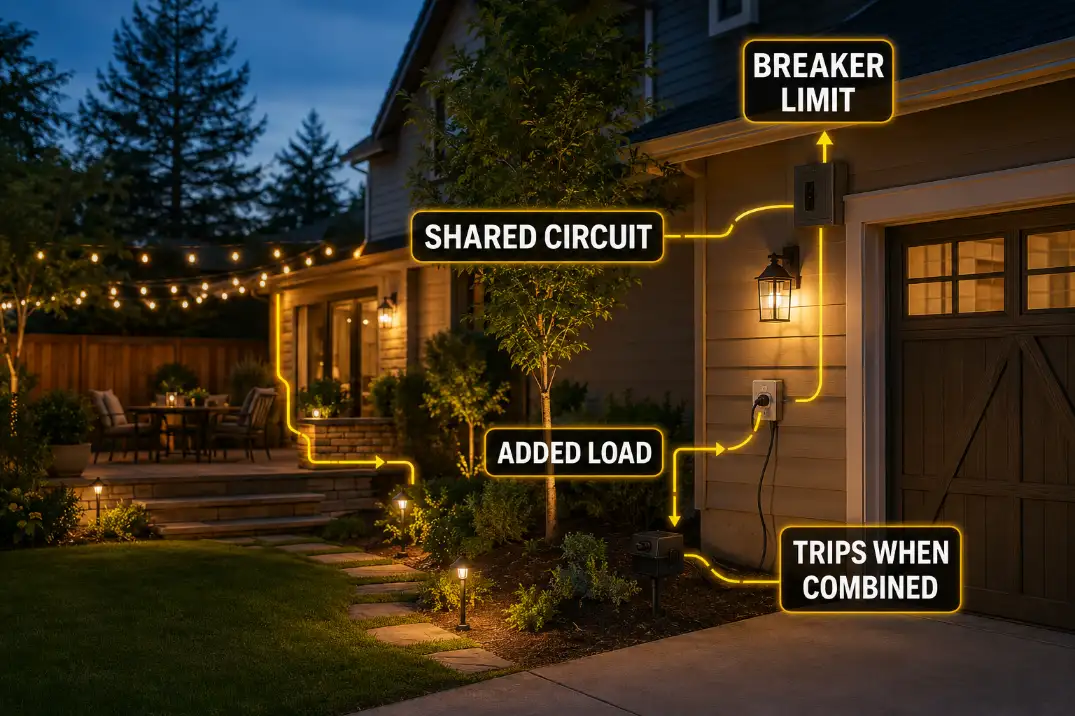
A load problem usually leaves an observable pattern without touching wiring. The breaker may hold when only the porch lights are on, then trip when landscape lights, garage outlets, or extra exterior devices run at the same time.
That is different from a shorted fixture, where the breaker often trips fast even with very little else running.
Field Check: Repeatedly resetting a breaker is not a diagnostic method. If the breaker trips again, treat that as useful information and stop forcing the circuit back on. Note what was running, which switch or zone was used, and whether the trip was immediate or delayed.
Shorted Fixture
A fast trip points away from load pressure and toward a fault at one fixture, control, or wiring point.
You flip one switch, one zone energizes, or one fixture tries to start, and the breaker trips almost immediately. The rest of the system may have seemed fine before that moment.
A short can come from a damaged socket, burned internal wiring, a crushed cable entering the fixture, water damage inside the fixture body, a failed photocell, or a timer/control part that has failed in a way that affects the circuit. In outdoor fixtures, the fault is often hidden behind a lens, gasket, base plate, post cap, or buried connection point.
The safe homeowner-level observation is correlation. Does the breaker trip only when one wall light is switched on? Only when one post light comes on? Only when the landscape lighting transformer is plugged in? That narrows the suspect area without turning the homeowner into the repair person.
If the fixture recently stopped working after replacement, repair, yard work, impact, or water exposure, the problem may be tied to that event. A related diagnostic path is covered in outdoor lights not working after replacing a fixture, but a breaker trip is a stronger safety signal than a simple no-power symptom.
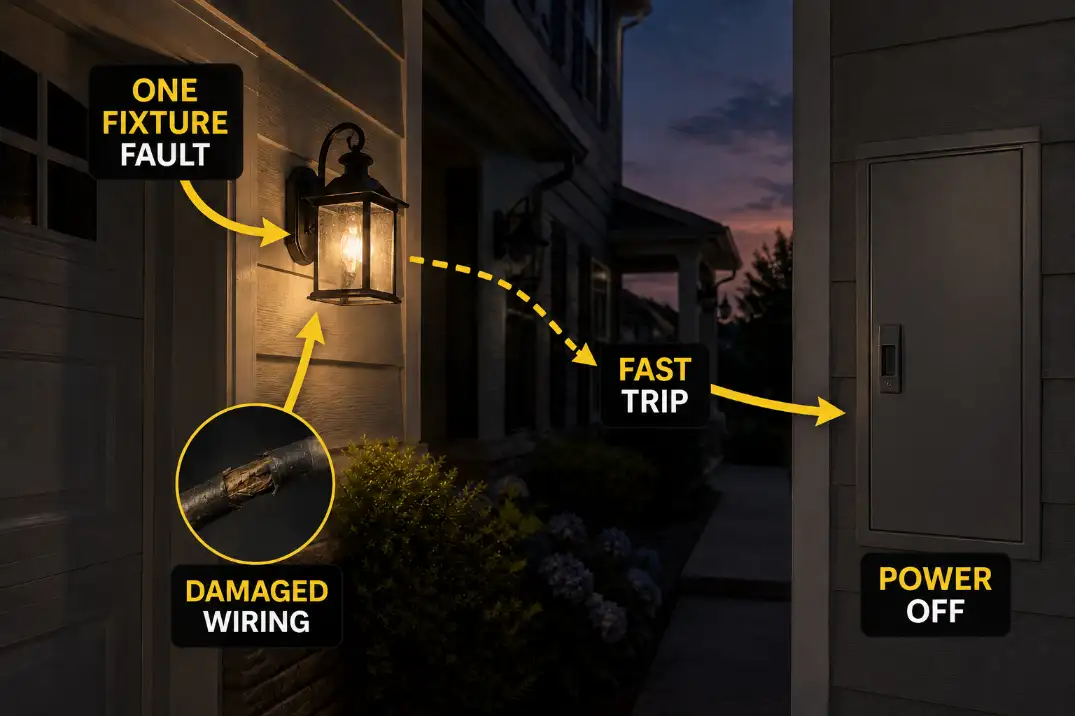
Do not treat a fast breaker trip as a bulb problem. A burned-out bulb normally does not keep tripping the breaker by itself. When the breaker trips immediately, the diagnosis has moved deeper than “replace the lamp and try again.”
Wet Splice
A GFCI that stays set does not clear water from suspicion.
A wet splice, cracked junction box, buried landscape-lighting connection, damaged cable entry, or loose outdoor cover can create several different fault behaviors. Sometimes it creates a ground-fault pattern. Sometimes corrosion, arcing, or a more direct current path develops and the breaker reacts first.
The timing matters. If the breaker only trips after rain, irrigation, snowmelt, or a damp morning, water exposure moves high on the list. If the problem is worse after a storm but disappears during dry weather, the circuit may be telling you where the weakness is: not at the switch, but at the outdoor connection point that gets wet.
This can happen at wall lights, deck lights, post lights, low-voltage landscape connections, cable entry points, and boxes near soil or mulch. A splice that was “fine for years” can still become a fault after a gasket dries out, a cover loosens, a fixture tilts, soil rises around a junction, or irrigation spray starts hitting the connection.
The important question is not “Did the GFCI trip?” The better question is “Where could water reach a connection and change the circuit behavior?”
A rain-specific version of this problem is covered in why outdoor lights fail after rain, but breaker-only tripping deserves a stricter boundary. Drying the area and turning the breaker back on may make the symptom disappear for a while, but it does not prove the connection is safe or properly sealed.
Wet outdoor electrical problems also tend to return. Once corrosion starts inside a splice, socket, box, or cable entry, the failure can become less predictable. A connection may work on one damp night and trip the breaker the next.
Transformer Fault
With low-voltage landscape lighting, the first question is whether the house breaker is tripping or the transformer is shutting itself down.
Sometimes the transformer resets, cycles, or shuts down because the low-voltage side is overloaded or faulted. In that case, the house breaker may not trip at all. Other times, the house breaker trips when the transformer is plugged in, when a lighting zone is connected, or when a damaged transformer has an internal problem.
The split matters. A low-voltage cable nicked by edging, a fixture full of water, too many lights on one transformer, or a poor connection on the lighting run may cause transformer-side shutdown behavior. But if the branch-circuit breaker trips as soon as the transformer is energized, the problem may be on the primary side, inside the transformer, or in how that equipment is connected.
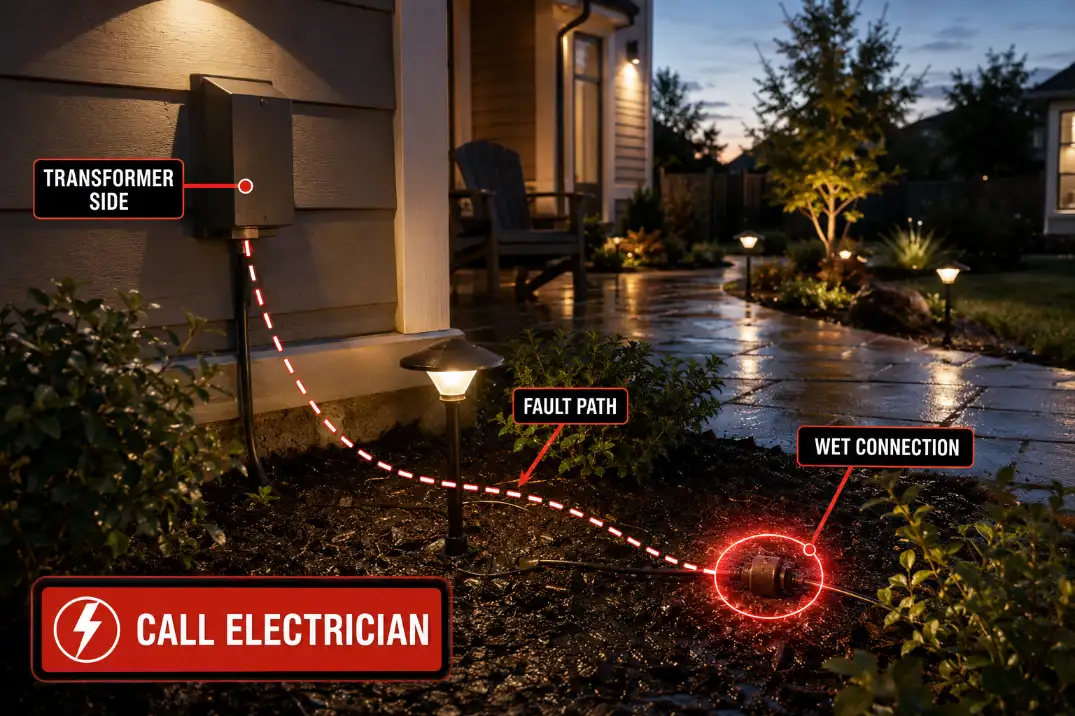
The useful observation is where the trip happens. If the breaker holds until the transformer is plugged in, the transformer or its supply side becomes suspect. If the transformer stays powered but shuts down when one lighting run is connected, the low-voltage run or fixture group becomes more suspicious.
For a deeper transformer-specific path, use transformer problems in low-voltage systems rather than turning this breaker article into a full landscape-lighting repair guide.
The same boundary still applies: do not open the transformer, panel, junction box, or buried connection to test live parts unless you are qualified. The diagnostic value here is the pattern, not a DIY bench test.
Electrician Boundary
The stop point is not when every possible cause has been tested. It is when the breaker is showing a repeatable fault pattern.
Call an electrician when the breaker trips again after reset, trips immediately when the lights are turned on, or trips when a transformer is connected and you cannot clearly isolate a harmless load issue.
Also stop if you notice burning smell, buzzing, heat, melted parts, visible wire damage, water inside boxes, a damaged fixture body, or uncertainty about which circuit feeds the lights.
Do not open the panel to investigate. Do not dig into buried splices. Do not remove fixture wiring to “try one more thing” if the breaker is actively tripping. The useful homeowner role is to observe timing, weather, affected zone, recent changes, and whether the failure is immediate or delayed.
Breaker-only tripping points to a different diagnostic path than a GFCI trip. It may be overload, a shorted fixture, a wet splice that has become a stronger fault, or a transformer-side problem.
The safest next step is not more resetting; it is narrowing the pattern and knowing when the circuit has crossed into professional diagnosis.
For general outdoor electrical safety guidance, see the NFPA’s Outdoor Electrical Safety Tip Sheet.