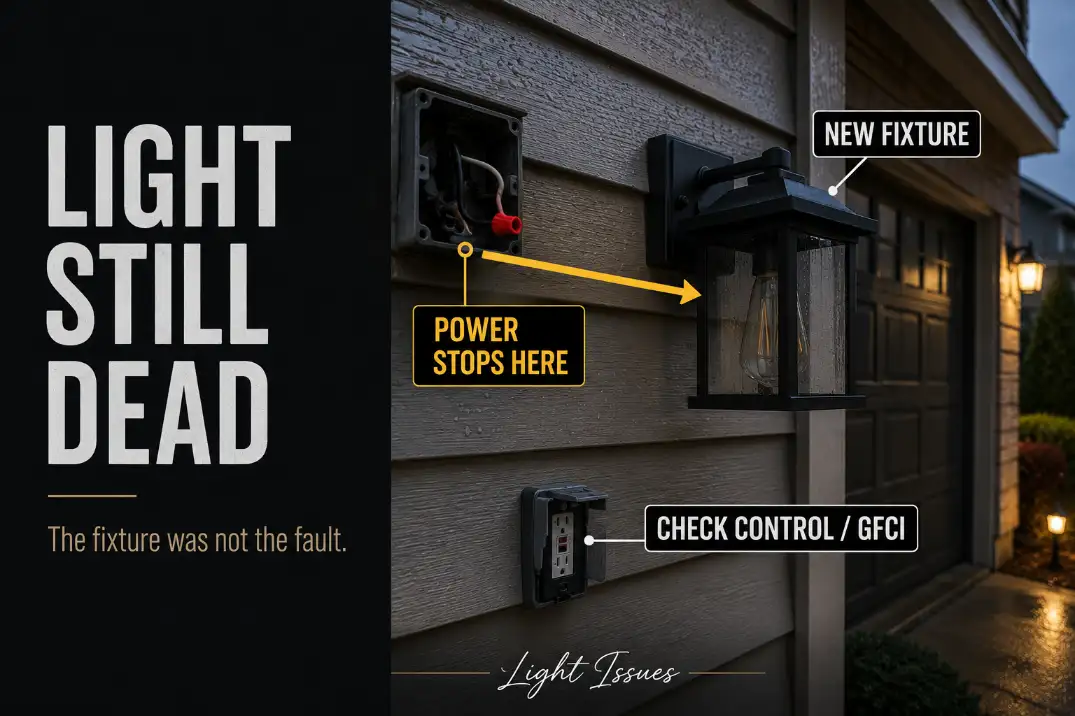
If an outdoor light still does not work after replacing the fixture, the fixture is usually not the first thing to blame.
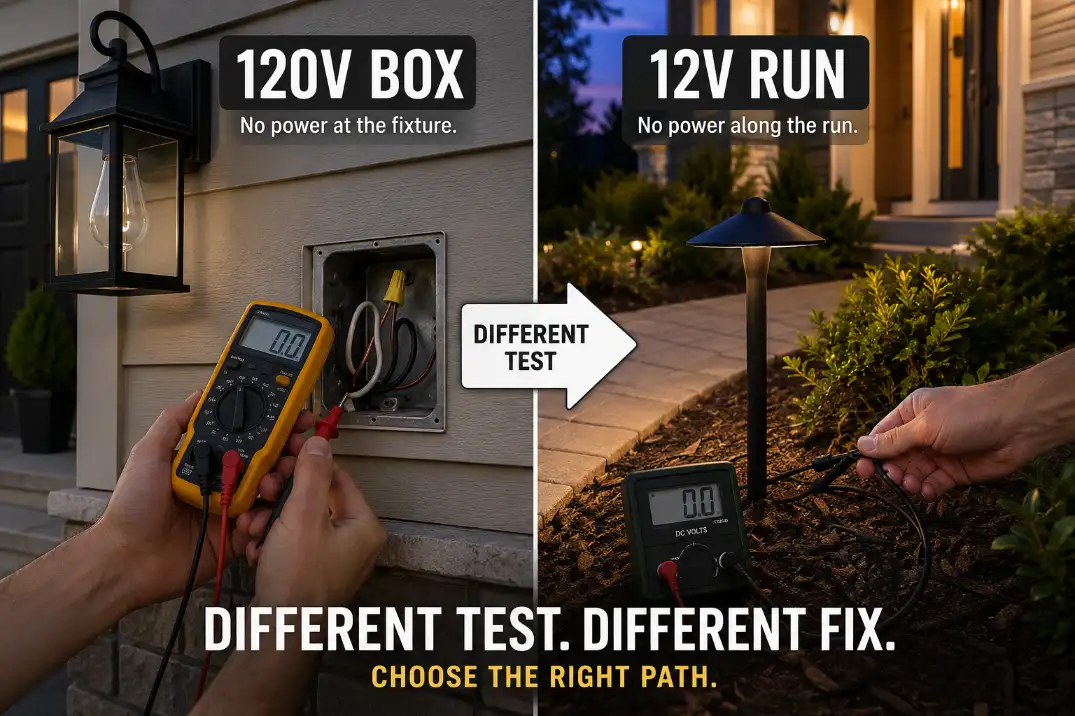
The useful first decision is whether this is a dead feed, a bad connection, a blocked control, or a safety trip. A hardwired porch, wall, or post light should have usable line voltage at the fixture box when the switch or control is calling for light.
A low-voltage landscape fixture should usually receive close to the transformer’s output, often around 12 volts, not a weak far-end reading that collapses under load.
Quick answer: If an outdoor light still does not work after replacing the fixture, the most likely causes are no power at the box, a loose or shifted connection, a blocked timer, photocell, or motion control, a tripped GFCI, or moisture inside the outdoor box.
The pattern matters more than the new fixture itself. If the light never turns on, check power and connections first. If it works for 5–30 minutes and then shuts off, suspect heat, a weak connection, a control issue, or an LED driver problem.
If it fails within 6–24 hours after rain or irrigation, moisture is a stronger clue than the fixture model. And if the GFCI trips, stop treating the problem as a normal fixture swap.
First Decide What Kind of Replacement This Was
A replacement fixture can mean several different systems. The mistake is diagnosing all of them the same way.
Hardwired wall, porch, or post fixture
A hardwired outdoor fixture depends on the breaker, switch, control, wiring inside the box, grounding path, and the fixture connection.
If the old fixture and the new fixture both stay dark, the odds shift away from “bad fixture” and toward “power is not reaching the fixture correctly.”
Do not test live line-voltage wiring unless you are qualified to do it safely. For most homeowners, the useful decision is not to prove every conductor personally; it is to recognize when the same failure pattern points beyond the fixture.
That is especially true when the old fixture failed intermittently before replacement. A light that flickered, worked after tapping the housing, or failed after wet weather was already showing a wiring or moisture clue.
The new fixture simply made the same upstream problem more obvious. If the fixture is mounted on a wall or porch, the related diagnosis in Outdoor Wall Light Not Working can help separate fixture failure from feed, box, or switch problems.
Low-voltage landscape fixture
A low-voltage path or landscape light is different. The replacement head may be fine, but the transformer, cable run, pierce connector, splice, or far-end voltage may be weak.
If the fixture works near the transformer but not at the installed location, the fixture is not the main suspect.
In a healthy 12V landscape system, the reading at the far end should stay usable when the light is connected.
If voltage drops sharply under load, or the farthest fixtures are dim while the first fixtures are bright, the failure lives in the run.
For that system-level pattern, Low Voltage Landscape Lighting Problems is the better troubleshooting path.
Motion, photocell, or timer-controlled fixture
A control can make a good new fixture look dead. A photocell may not energize the light in daylight. A timer may have lost its schedule. A motion fixture may be in test mode, dusk-only mode, or a short-duration setting.
Before returning the fixture, make sure the control is actually sending power when the light is expected to turn on. A fixture cannot solve a control that is not calling for light.
What the Repeat Failure Usually Means
A second dead fixture is no longer a fixture-shopping problem. The repeat pattern is the diagnostic clue.
Same failure, same location
If the old and new fixture fail in exactly the same way, the replacement did not change the part of the system that matters.
The most likely causes are no power at the box, a loose or disturbed connection, a control that is not passing power, a tripped GFCI, or moisture inside the outdoor box.
This is where many homeowners lose time. They tighten the mounting screws, change the bulb, or buy a different fixture style while the open neutral, bad splice, or dead feed remains untouched.
Works before mounting, fails after mounting
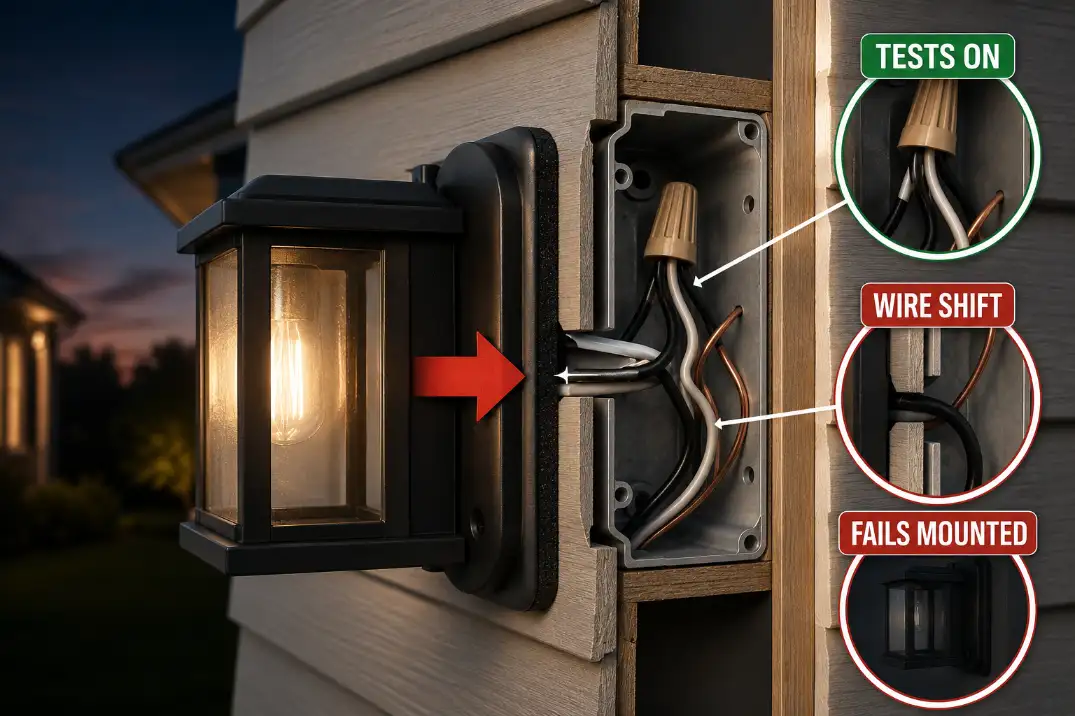
This is one of the strongest clues after fixture replacement. A light may work while the wires are hanging free, then fail after the fixture is tucked into the box and mounted.
That usually means the wire connection shifted, a conductor was not fully captured, insulation was nicked, or the bracket compressed the wiring.
A fixture can look professionally mounted while the electrical path behind it is barely holding. If the connection quality is questionable, the guide on Loose Outdoor Wiring Connections fits the actual mechanism better than another fixture replacement.
Trips GFCI after replacement
A GFCI trip is not proof that the outlet is too sensitive. It is a safety signal. The new fixture may have exposed leakage, moisture, damaged insulation, a pinched wire, or a wiring mistake.
Immediate trips point more strongly to a wiring or leakage problem. Trips after rain point more strongly to water reaching a connection or fixture cavity.
Do not repeatedly reset a GFCI to “test” the light. If it trips again within seconds, or only holds until the fixture is connected, the problem needs isolation rather than another reset.
The Replacement Mistakes That Matter Most
Not every installation mistake deserves equal worry. A slightly crooked fixture plate is cosmetic. A poor connection, wrong control assumption, or wet box changes whether the light can work safely.
Wire pairing and loose neutrals
The common repair-ending problem is not usually the decorative fixture itself. It is the final wire connection. A loose neutral can leave the fixture dark even when the hot conductor appears active. A poor connection can also open only after the fixture is pushed into place.
Do not guess at wire pairing in an old outdoor box. Older homes may have switch loops, multiple cables, shared boxes, or wiring colors that do not match modern expectations.
If the box does not clearly match the fixture instructions, the safe move is to stop and verify the circuit.
Line/load confusion near a GFCI
If the fixture is connected through or near a GFCI-protected circuit, line/load confusion can cause strange results.
The fixture may not receive power, downstream devices may stop working, or the GFCI may not behave as expected. This is not a brightness or bulb issue; it is a wiring-path issue.
Old seals disturbed during replacement
Outdoor fixture replacement breaks the old seal. If the new gasket does not sit flat, the siding is uneven, the cable entry is exposed, or the fixture backplate traps water, the first dry test can pass and the first wet night can fail.
Moisture is often underestimated because the fixture may look clean from the outside. A small amount of water inside a junction area can create corrosion, leakage, or intermittent failure.
If the light fails after rain, sprinkler spray, or damp overnight conditions, Moisture Damage in Outdoor Lighting is a more useful lens than assuming the new fixture is defective.
Quick Failure Pattern Guide
Use the pattern to decide where to look next. The fixture is only one possible cause.
| Failure pattern | Most likely direction | What not to waste time on |
|---|---|---|
| Old and new fixture both stay dark | No power, bad connection, blocked control | Buying another fixture first |
| Light works before mounting, then fails | Shifted splice, loose neutral, pinched conductor | Only tightening the fixture screws |
| GFCI trips immediately | Leakage, miswire, damaged insulation, pinched wire | Repeated reset attempts |
| Fails after rain or irrigation | Moisture path into box, gasket, cable entry, or fixture | Blaming the LED module first |
| Low-voltage fixture works near transformer only | Cable run, connector, voltage drop, transformer load | Replacing the fixture head again |
| Turns on briefly, then shuts off | Heat, driver issue, weak connection, control setting | Assuming the switch is the only cause |
Pro Tip: If the same failure follows two different fixtures at the same location, diagnose the feed and connection before replacing any more parts.
When the Standard Fix Stops Working
Replacing the fixture is a reasonable repair when the old fixture is visibly cracked, rusted through, water-filled, or internally failed, and the circuit feeding it still works correctly. It stops being reasonable when the replacement repeats the original failure.
Stop when the fault points inside the circuit
Hardwired outdoor lighting involves more risk than swapping a low-voltage landscape head.
Stop DIY if the box has burned insulation, damaged conductors, unknown wiring, water inside the electrical box, no clear grounding path, or repeated GFCI trips. Those are not styling or fixture-choice problems.
If the outdoor lights trip protection after replacement, the more specific safety path is Outdoor Lights Tripping GFCI Outlets. The key distinction is that a GFCI trip is not a failed-light symptom; it is the system refusing to keep the circuit energized.
Stop when the test requires guessing
If you cannot tell which conductor is feed, switched hot, neutral, ground, or load, guessing can make the problem worse. The fixture instructions only help when the box wiring is already understood.
When the wiring is unclear, when a breaker trips repeatedly, or when the fixture box has signs of heat or moisture damage, When to Call an Electrician for Outdoor Lighting Problems is the more practical decision than continuing the swap.
Pro Tip: A routine fixture replacement becomes an electrical diagnosis the moment the new light repeats the old failure.
The Bottom Line
When outdoor lights are not working after replacing the fixture, the strongest clue is not the new light. It is the way the failure repeats. A brand-new fixture can be defective, but that is not the first bet when the old and new fixtures fail the same way.
Start by separating the problem into four paths: no power, bad connection, blocked control, or safety trip. Then match the pattern.
A light that never turns on points upstream. A light that works before mounting but fails afterward points to the box connection.
A light that fails after rain points to moisture. A GFCI that trips points to leakage or wiring trouble, not a normal reset problem.
The fixture is the visible part. The failure often lives in the power path feeding it.
For outdoor circuits where moisture and GFCI protection change the safety risk, see the Electrical Safety Foundation International.