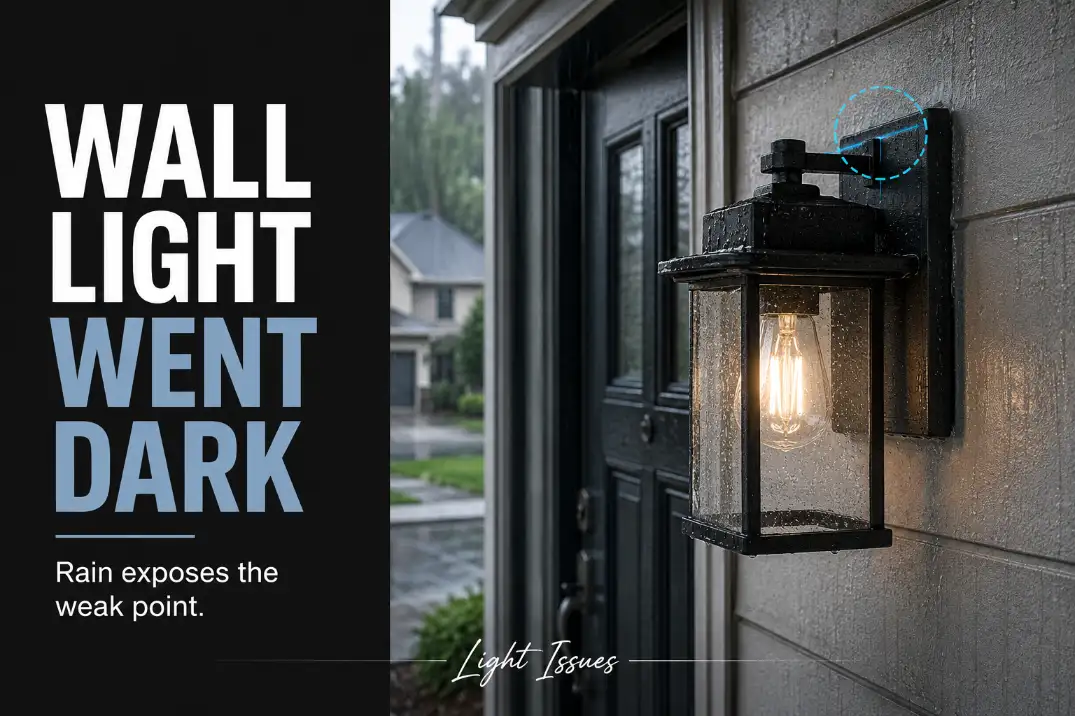
An outdoor wall light that stops working is not automatically a bad bulb. The bulb is the fastest check, not the most reliable diagnosis.
A better first split is timing: did the light fail right after rain, trip a GFCI, flicker for several nights, or stay dead even with a known-good bulb? If it works again after 12–24 hours of dry weather, moisture is more likely than the lamp itself.
Start with three checks: confirm the switch and breaker, test a known-good bulb, then look for water, corrosion, or looseness around the backplate and socket.
A wall light differs from a path light or flood light because the weak point may be behind the fixture, inside the wall box.
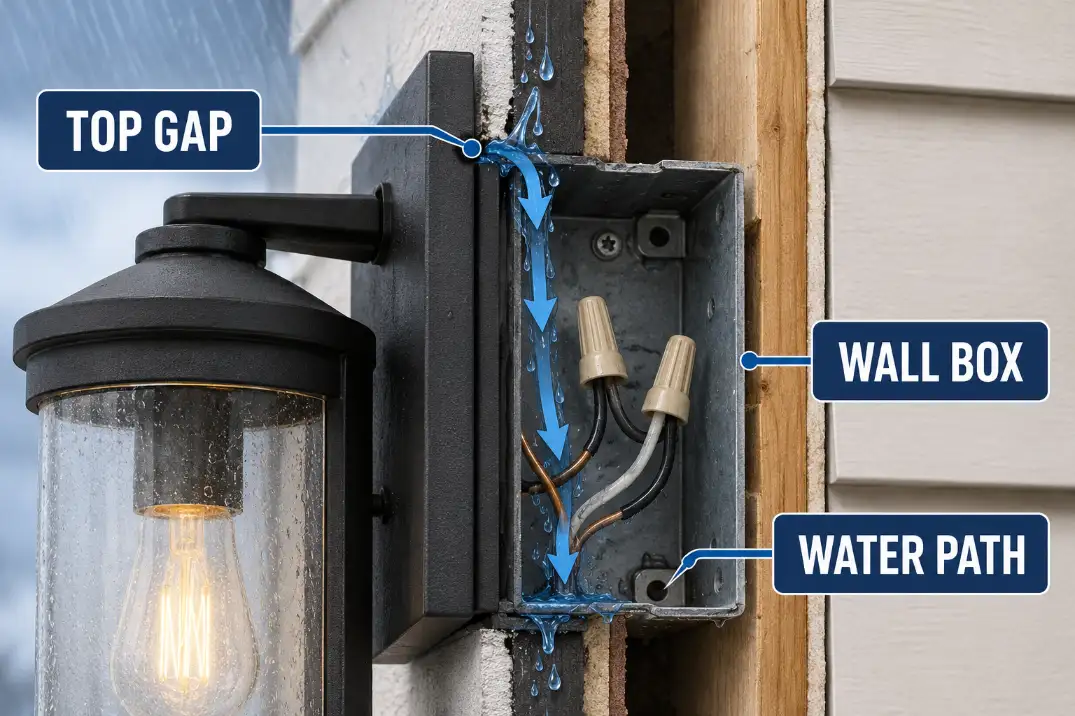
Rain running down siding can enter through a tiny top seam, reach the connections, and make a simple-looking fixture failure behave like a wiring problem.
Quick Diagnostic: What Failed First?
If it failed right after rain
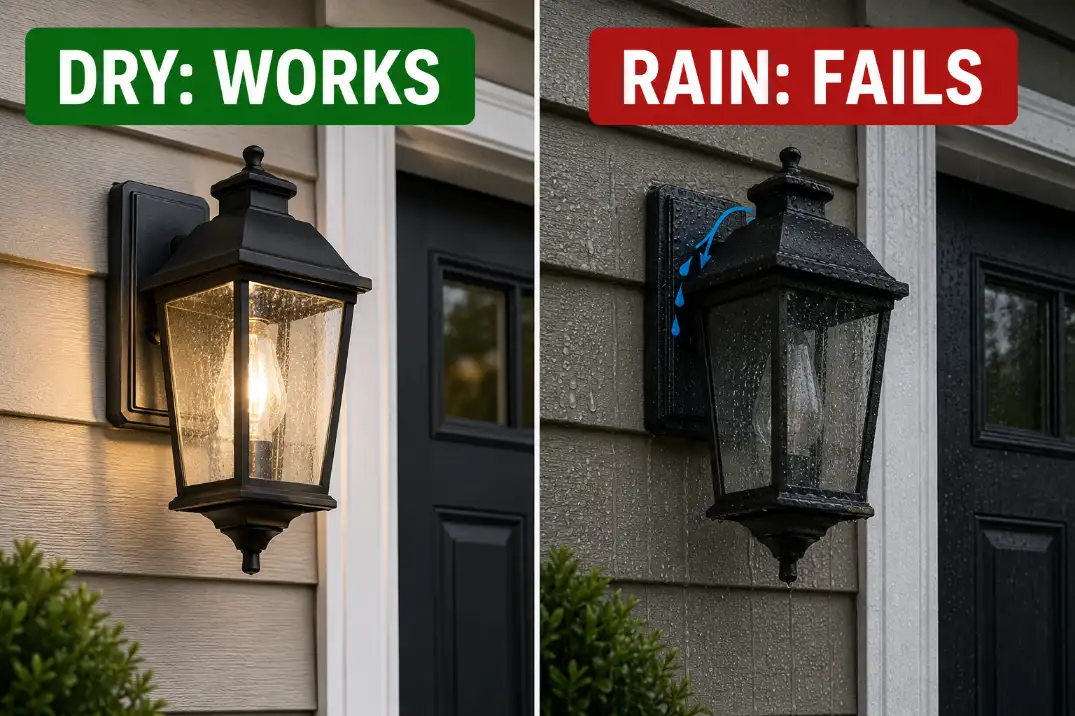
Rain-related failure points to water intrusion, a damp socket, a compromised gasket, or a ground fault. If the light returns after a dry day, the fixture is giving you a pattern, not a coincidence.
That is similar to what happens when an outdoor light works fine until it rains, but wall lights add one more common entry point: water slipping behind the mounting plate.
If it never comes on
A wall light that never responds is more likely to involve power, a switch, a tripped breaker, a failed photocell, or a loose connection. The bulb is still worth checking, but it should not become a guessing game.
If two known-good bulbs fail in the same fixture, stop treating the bulb as the diagnosis.
If it works sometimes
Intermittent operation usually means the connection is marginal. Door vibration, heat expansion, humidity, and small amounts of corrosion can make the light work one night and fail the next.
The flicker is the symptom; unstable contact is the mechanism.
Why Wall Lights Fail Differently Than Yard Lights
The wall becomes part of the water path
A freestanding landscape fixture mostly deals with water from above, soil, irrigation, or cable splices. A wall light also has to deal with water running down a vertical surface.
On vinyl siding, brick, stucco, or trim, the fixture backplate may not sit perfectly flat. Even a small 1/16-inch gap above the plate can let wind-driven rain get behind the fixture.
This is why the fixture can look fine from the front while the actual failure begins at the wall interface.
The box can hide the evidence
Water does not have to pool inside the glass to cause trouble. It can reach the wall box, wire connectors, socket base, or mounting screws first. By the time the lamp goes dark, the visible lens may still look mostly dry.
That hidden path is why water inside outdoor light fixtures is not always a cracked-glass problem. Sometimes the water is entering from behind, not through the front.
Door vibration can expose weak connections
Entry lights live next to doors, trim, siding movement, and seasonal expansion. If the light flickers when the door closes or when the fixture is gently touched with the power off, suspect a loose socket, splice, or terminal. A healthy fixture should not react to vibration.
Rain, Wiring, Bulb, or Fixture?
| Suspect | Strong signal | Avoid this misread | Best next move |
|---|---|---|---|
| Bulb | One lamp fails, replacement works normally | Buying multiple new bulbs | Replace with correct outdoor-rated bulb |
| Rain intrusion | Fails after storms, recovers after 12–24 dry hours | Resetting or swapping bulbs repeatedly | Inspect seam, gasket, socket, and wall box |
| Loose wiring | Flickers with movement or door vibration | Wiggling a live fixture | Turn power off and have connections checked |
| Bad fixture | Corroded socket, cracked body, brittle gasket | Adding more caulk to damaged parts | Replace the fixture |
| Circuit issue | GFCI or breaker trips repeatedly | Treating reset as the repair | Stop using the light and diagnose safely |
The Checks That Actually Narrow It Down
Check the bulb, then move on
A burned-out bulb is still the easiest fix. Check that the bulb is seated firmly, has the correct base, and stays within the fixture’s wattage rating. If it is an LED lamp, test with a known-good compatible bulb.
But do not let the bulb become the whole diagnosis. If the socket is corroded, wet, loose, or discolored, a new bulb may work briefly and fail again. That does not mean the second bulb was bad.
Reset the GFCI only once
Many exterior circuits are protected by a GFCI outlet or breaker. If the GFCI has tripped, reset it once after visible moisture is gone. If it trips again immediately, or trips when the wall light is switched on, stop.
A one-time trip after heavy rain may point to temporary moisture. A repeat trip after at least 24 hours of dry weather points more strongly to a fixture, wiring, or circuit fault. This is where routine homeowner troubleshooting should end.
Inspect the backplate seal
Look at the top and sides of the fixture backplate. Missing caulk, hardened sealant, loose screws, uneven siding, and water stains below the fixture all matter.
In humid Florida conditions or coastal California air, corrosion can develop faster because moisture lingers around metal parts longer.
Pro Tip: Seal the top and sides of the wall light backplate, but leave the bottom edge able to drain. Sealing all four sides can trap water inside.
When Wiring Becomes More Likely Than the Fixture
Flicker points to contact, not brightness
If the wall light flickers, cuts out when the door closes, or changes when the fixture is touched with the power off, the issue is probably connection stability. That can happen at the socket, wire splice, switch, or wall box.
This is closer to loose outdoor wiring connections than to a normal bulb failure. A stable connection should not respond to tiny movement.
Corrosion changes the repair decision
Light residue on an old bulb base is one thing. Pitted socket metal, green or white buildup, rusted screws, blackened terminals, or brittle insulation are different. Once the contact surface is damaged, drying the fixture does not restore the connection.
This is where a routine fix stops making sense. Replacing bulbs, adding caulk, or cleaning the same socket again may only delay the next failure.
Repeat trips are not nuisance behavior
A GFCI trip is not the problem; it is the warning. If the light trips protection every time it is switched on, especially after dry weather, the fixture should not stay in use. Do not use repeated resets as a test method.
Reseal, Repair, or Replace?
Reseal when the fixture is still healthy
Resealing makes sense when the fixture body is solid, the socket is clean, the gasket still compresses, and the only obvious weakness is the backplate seam. This is a maintenance repair, not a rescue repair.
Replace when the fixture body has failed
Replacement is usually the better call when the socket is pitted, the housing is cracked, the gasket is brittle, the lens no longer seals, or the same fixture burns through more than one bulb within a few weeks.
If the fixture is older than 8–10 years and has visible corrosion inside, replacement is often cleaner than another temporary patch.
Choose a wet-location-rated fixture if the wall light is directly exposed to rain. Damp-location fixtures belong under protection, not on open walls.
Call an electrician when protection devices react
Call an electrician if the breaker or GFCI trips repeatedly, the wall plate feels warm, the fixture smells burnt, wires look damaged, or terminals appear blackened. Also call if the wall box is loose or the fixture is mounted on damaged siding.
A wall light is not worth risky trial and error. Once the issue moves from lamp replacement to wiring, moisture intrusion, or circuit protection, the repair has to be safe before it is cosmetic.
For broader official guidance on outdoor electrical protection, see the Electrical Safety Foundation International.