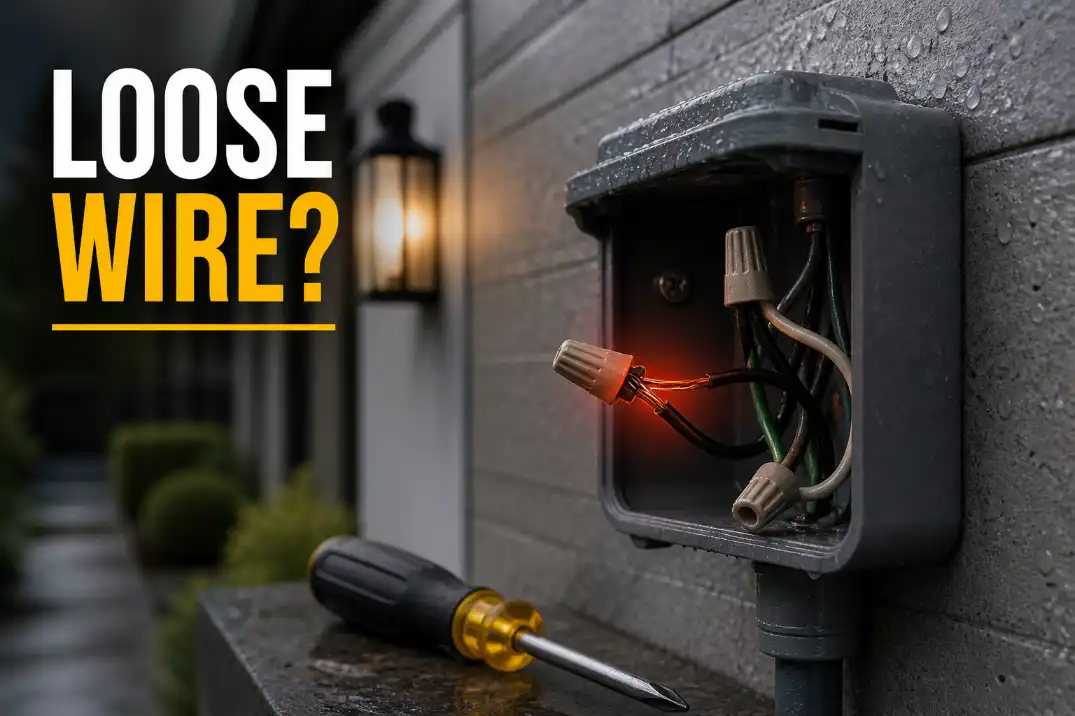
Loose outdoor wiring connections usually show up as flickering, intermittent power, a light that works after being tapped, or a fixture that fails after rain. The safe fix starts with one distinction: is this a 120-volt outdoor fixture or a low-voltage landscape lighting splice?
A porch light, garage light, wall sconce, or post light is usually line voltage and carries real shock and fire risk. A 12-volt landscape light is safer to handle, but a bad splice can still overheat, corrode, dim the run, or fail again within weeks.
If the light fails only after rain, the loose connection may be the weak point, but moisture is usually the trigger.
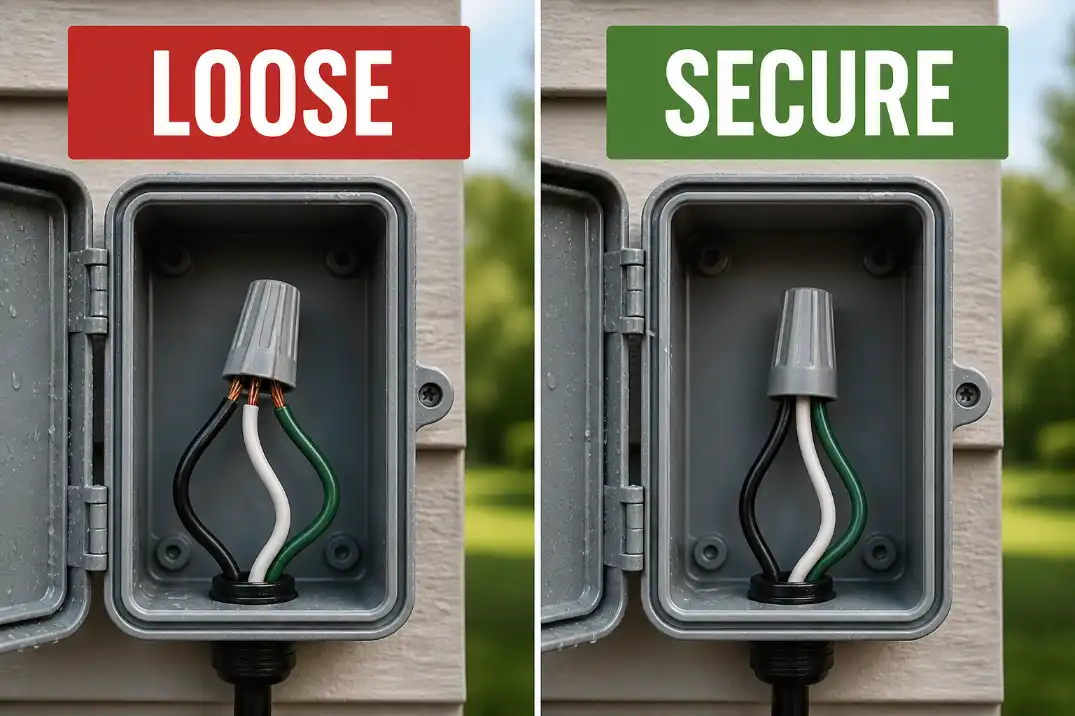
The first meaningful checks are simple: turn power off at the breaker or transformer, verify it is off, look for a connector that spins or slips, and check whether more than about 1/8 inch of bare copper is visible below the connector.
Flickering is only the symptom. The real problem is weak metal-to-metal contact, rising resistance, and sometimes heat at the splice.
Start With the Safety Split: 120V or Low Voltage?
Outdoor wiring problems get misdiagnosed because people treat all exterior lights the same. A loose connector in a 12-volt landscape run and a loose hot conductor in a 120-volt wall fixture are not the same repair.
120V outdoor fixtures are not “just a loose wire”
If the light is connected to household wiring, treat it as 120 volts unless you know otherwise. That includes porch lights, garage sconces, floodlights, many post lights, and exterior ceiling fixtures. Shut off the breaker, not just the wall switch. A switch may not remove power from every conductor inside the box.
Do not keep working if you see melted insulation, blackened copper, buzzing, heat, a burning smell, aluminum wiring, a wet junction box, or a breaker/GFCI that trips immediately. Those are not routine loose-connection signs; they suggest heat damage, a ground fault, water intrusion, or unsafe wiring conditions.
Low-voltage landscape wiring still needs sealed connections
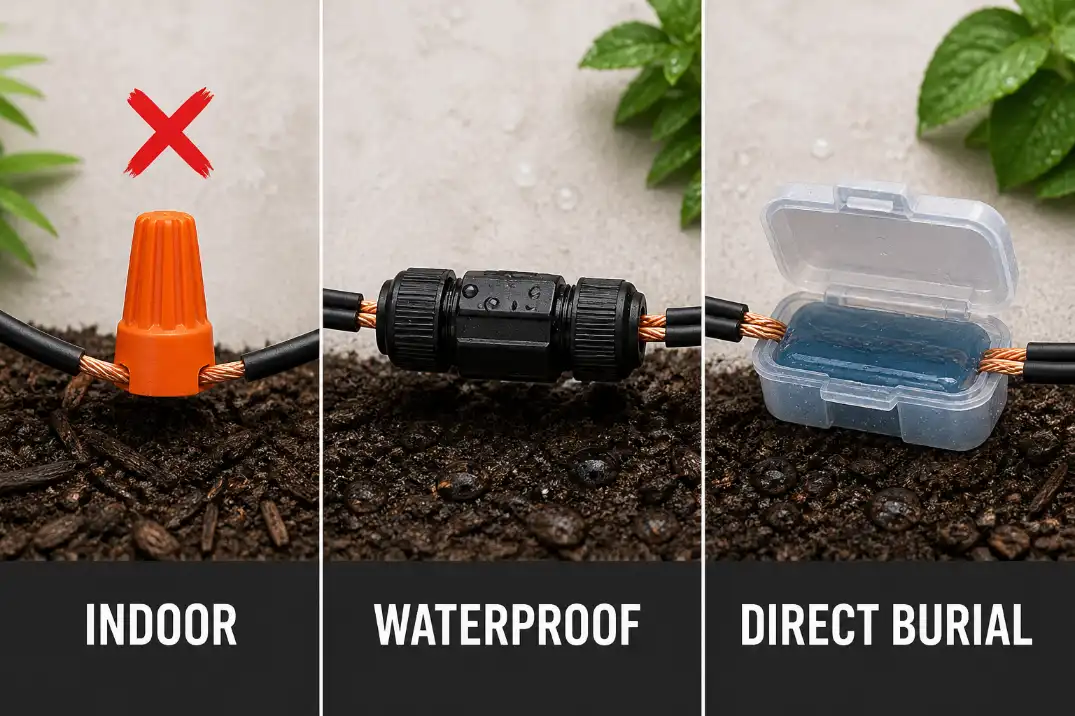
Low-voltage landscape lighting is commonly 12 volts, but that does not make the connections disposable. A weak splice can cause one fixture to flicker, several downstream lights to dim, or an entire zone to drop out after irrigation. In mulch beds, near sprinklers, or in soil, a basic indoor wire nut is the wrong repair even if the light turns on briefly.
If the issue appears only when the cable moves, start with the splice. If several fixtures brighten and dim together, the problem may be broader than one loose connector, especially in a long run. That pattern is covered more fully in Outdoor Lights Working Intermittently.
What a Loose Outdoor Connection Usually Looks Like
A loose outdoor connection rarely announces itself cleanly. It often imitates a bad bulb, weak transformer, failing photocell, or timer problem. The useful clue is whether the symptom changes with movement, moisture, or load.
A connection is suspicious when the fixture flickers as you touch the housing, a post light cuts in and out when the post moves, or a landscape light works again after the cable is nudged. That does not prove the fixture is bad. It usually means the electrical path is unstable somewhere near the light, splice, socket, or terminal.
Quick diagnostic checklist
- Light flickers when the fixture, post, or cable moves.
- The connector twists freely or pulls off with light hand pressure.
- More than 1/8 inch of bare copper is visible below the connector.
- The light fails within 10–60 minutes after rain or irrigation.
- The fixture works after tapping, then fails again.
- Copper looks green, black, powdery, dull, or pitted.
- One fixture cuts out while nearby lights on the same run stay steady.
- GFCI trips only when the fixture or splice area is damp.
Why Tightening the Wire Nut Often Fails
The most common wasted fix is twisting the connector tighter and closing the box. Sometimes that restores power for a day. It does not always restore a safe, durable connection.
The copper is already damaged
Copper needs clean contact. If it is green, blackened, powdery, or deeply dull, tightening the connector only presses damaged surfaces together. That can leave resistance inside the splice, which creates heat and another failure point.
Cut the conductor back until the copper is bright and solid. If corrosion has traveled under the insulation, the damaged section may be longer than it first appears. This is where loose wiring overlaps with Corrosion in Outdoor Light Connections, because the visible color change is usually a sign of poor contact, not just a cosmetic stain.
The connector was never rated for the location
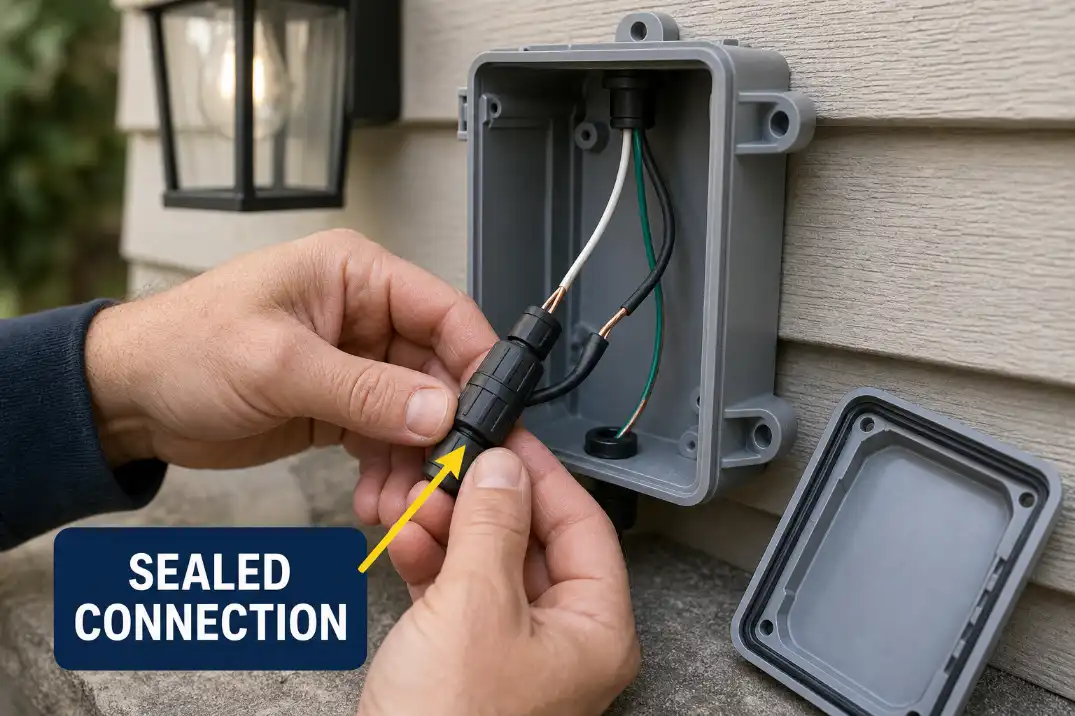
Indoor wire connectors are not permanent outdoor waterproofing. Wrapping one in electrical tape does not turn it into a wet-location splice. Tape can loosen, trap moisture, and hide corrosion until the next failure.
The connector has to match the environment. A damp exterior box, a wet fixture cavity, and a buried landscape splice are different conditions. The farther the connection moves toward soil, mulch, irrigation spray, or standing moisture, the more important a sealed outdoor-rated or direct-burial-rated connector becomes.
The cable is still moving
Even a good splice can loosen if the cable is carrying mechanical stress. Outdoor fixtures move in wind, posts shift in freeze-thaw cycles, and landscape cables get pulled by soil movement, edging, rodents, or planting work. If the wire is tight when the fixture is reinstalled, the connector may be forced loose as soon as the housing is screwed back into place.
Pro Tip: Do not judge the repair only with the fixture hanging open. Recheck that the splice is not being crushed, pulled, or twisted after the fixture is mounted back in its final position.
The Permanent Fix, Step by Step
This process applies only when the wiring is dry, accessible, not burned, and not part of a pool, spa, fountain, or other high-risk installation. If you are unsure whether the circuit is 120 volts, stop and call an electrician.
1. Turn off power and verify
For line-voltage fixtures, turn off the breaker. For low-voltage systems, unplug or switch off the transformer. Use a non-contact voltage tester first, and use a meter if you know how to verify the circuit properly. Do not rely on the light being off as proof that the wires are dead.
2. Open the box without yanking the wires
Remove the fixture, cover, or splice housing carefully. Before disconnecting anything, look at how the wires sit. If the box is crowded or the wires are under tension, that may be part of the failure. A splice that has to be forced back into the box is more likely to fail again.
3. Cut back to clean copper
Remove damaged ends instead of trying to polish them in place. Strip only the length required by the connector, commonly about 3/8 to 5/8 inch depending on the product. Long exposed copper is not better. If more than about 1/8 inch of bare copper remains visible below the connector after assembly, remake the splice.
4. Use the correct outdoor-rated connector
Match the connector to the wire size, wire type, number of conductors, and exposure level. For many low-voltage landscape splices, gel-filled or silicone-filled connectors are a better choice than basic twist caps. For household-voltage exterior fixtures, use connectors and boxes suitable for the wiring method and location.
5. Tug test every conductor
After making the connection, gently pull each conductor. Nothing should slide out, rotate independently, or feel loose inside the connector. For stranded low-voltage cable, make sure all strands enter the connector. Stray strands reduce contact area and can create small failure points.
6. Repack the box without stressing the splice
Fold wires back gently. Do not crush the connector behind a fixture plate. Do not let the splice carry the fixture’s weight. Replace damaged gaskets, tighten covers evenly, and make sure water is not being directed toward the cable entry.
If water appears to be following the cable into the box rather than entering through the lens or cover, the failure may be closer to Why Water Gets In Through Cable Entry Points than a simple loose wire.
Which Connector Should You Use Outdoors?
The right connector depends less on the light type and more on exposure. A covered wall box and a buried splice in wet mulch do not need the same repair.
| Location | Better connector choice | Avoid | Why it matters |
|---|---|---|---|
| Covered exterior fixture box | Outdoor-rated connector matched to wire size | Loose indoor cap | Damp air still affects copper |
| Wet or gasketed fixture box | Waterproof connector | Tape-only repair | Tape can trap moisture |
| Mulch or garden bed splice | Gel-filled outdoor connector | Standard wire nut | Mulch holds water for hours or days |
| Buried low-voltage splice | Direct-burial gel connector | Exposed twist splice | Soil pressure and moisture attack the joint |
| Heat-damaged fixture lead | Replace damaged lead or fixture | Retwisting burned copper | Heat-damaged metal may not conduct reliably |
The connector must also match the wire gauge and conductor count; an outdoor-rated connector can still fail if it is overfilled or too large to grip the wires. This is the point where many repairs go wrong. The connector that makes a light turn on during a dry afternoon may not survive a week of irrigation, a Florida summer, or a northern freeze-thaw cycle.
When the Problem Is Bigger Than One Loose Connection
A loose splice is a common cause, but it is not the only cause. The repair stops making sense when the symptoms point to the circuit, cable route, or moisture path instead of one connector.
It fails again within 30 days
A repaired connection that fails again within 30 days usually means the original cause was missed. Look for cable strain, corrosion beyond the stripped end, the wrong connector type, a wet box, or insulation damage. Repeating the same repair is unlikely to change the outcome.
The GFCI trips after rain
A damp loose connection can trip a GFCI, but repeated wet-weather trips deserve more caution. The problem may be water inside a fixture, a damaged cable, a wet splice, or leakage to ground. If the outlet or breaker trips immediately after reset, stop resetting it and inspect the circuit. The decision path is different from a simple flicker, which is why Outdoor Lights Tripping GFCI Outlets is the better next read for that pattern.
Several lights dim together
If multiple lights dim, especially near the end of a landscape lighting run, one loose connection may not be the main cause. Long cable runs, undersized wire, overloaded transformers, or poor layout can create voltage drop. A healthy low-voltage light near the transformer may receive close to expected output, while far-end lights may run noticeably dimmer. That belongs in a different diagnostic bucket than one loose fixture connection, and Voltage Drop in Outdoor Lighting Systems explains that comparison more directly.
Outdoor Conditions That Make Loose Wiring Return
The same splice that survives in a covered entry can fail quickly in mulch, salt air, or freeze-thaw movement. Outdoor wiring is not failing in a clean indoor environment, so the surroundings often decide whether a repair lasts.
Humid and coastal homes
In humid regions and coastal areas, moisture and salt air speed up corrosion. A barely sealed connector may last one dry season and then fail when humidity rises. Clean copper and sealed connectors matter more in these environments because even small air gaps can become oxidation points.
Freezing winters
In northern states, freeze-thaw movement can shift posts, fixture bases, and shallow landscape cables. A splice that was marginal in October may open by spring. If a deck, patio, or post light fails after winter, consider movement and cable strain before blaming the bulb.
Irrigated beds and mulch
Mulch can stay damp long after the surface looks dry. Sprinkler overspray also pushes moisture into weak boxes and low-voltage connectors. Any splice sitting in a bed that gets watered several times a week should be treated as a wet-location or direct-burial exposure, not a protected indoor-style connection.
When to Call an Electrician
Call a licensed electrician if the wiring is 120 volts and you are not fully comfortable verifying power, identifying conductors, and remaking the connection correctly. Also call if you find burn marks, melted insulation, buzzing, heat, a burning smell, repeated breaker trips, immediate GFCI trips, a wet junction box, aluminum wiring, missing grounds, or old wiring that does not match modern color expectations.
Pool, spa, fountain, and dock lighting deserve extra caution. Water, grounding, and bonding requirements make those installations less forgiving than a simple landscape path light.
The Fix That Lasts Is More Exact Than It Looks
Loose outdoor wiring is tempting to treat as a quick twist-and-close repair. That is why the same lights often fail again after the next rain, freeze, or cable movement. A permanent fix is more precise: identify the system voltage, shut power off, verify it is safe, cut back to clean copper, use the correct outdoor-rated connector, tug test the splice, control cable movement, and correct the water path.
The visible flicker is not the whole problem. The connection failed because contact pressure, copper condition, connector choice, moisture control, or strain relief was wrong. Fix that cause, and the repair has a much better chance of lasting beyond the next storm.
For broader official guidance on shock protection around home electrical systems, see the U.S. Consumer Product Safety Commission GFCI Fact Sheet.