An outdoor photocell light that flickers at dusk is usually not failing in the same way as a light that flickers all night. The first decision is not which part to replace. It is whether the photocell becomes stable once the sky is fully dark.
That timing matters because dusk is the sensor’s weakest moment. The light level is changing quickly, and the photocell may be caught between “off” and “on.” If the fixture turns on, sees its own reflected light, and shuts back off, the problem can look like an electrical failure even when the real issue is sensor feedback.
Start by watching the light from late daylight until full dark. If the flicker settles after the sky darkens, focus on threshold, reflection, weather, or nearby light interference. If it keeps flickering after full dark, move away from dusk diagnosis and look at contact, moisture, driver, or wiring clues. For broader flicker patterns that are not limited to sunset, compare this with flickering outdoor lights and their common causes.
Dusk Threshold
The useful test is whether the light can make one clean decision as daylight fades. If it cannot, the photocell may be hovering around its switching threshold.
A photocell does not read “evening” the way a homeowner does. It reads light level. Around dusk, the sensor is moving through the most unstable part of its day: not bright enough to stay clearly off, but not dark enough to stay confidently on.
That is why dusk-only flicker matters. A light that blinks for a few minutes during sunset is giving a different clue than a light that flickers randomly at 11 p.m. The first points toward sensor threshold behavior. The second points more toward power, contact, moisture, driver, or fixture trouble.
| Flicker pattern | More likely cause | First safe check |
|---|---|---|
| Flickers only as the sky fades | Dusk threshold instability | Watch until full dark |
| Turns on, then immediately shuts off repeatedly | Light feedback loop | Look for reflected light hitting the sensor |
| Flickers only after another light turns on | Nearby fixture interference | Turn nearby lights off one at a time |
| Flickers after full dark | Contact, moisture, driver, or wiring issue | Stop treating it as a dusk-only sensor problem |
The timing tells you how aggressive the fix should be. A short unstable period at dusk may need sensor shielding or fixture adjustment. A light that keeps flickering after the sky is fully dark needs a different diagnosis.
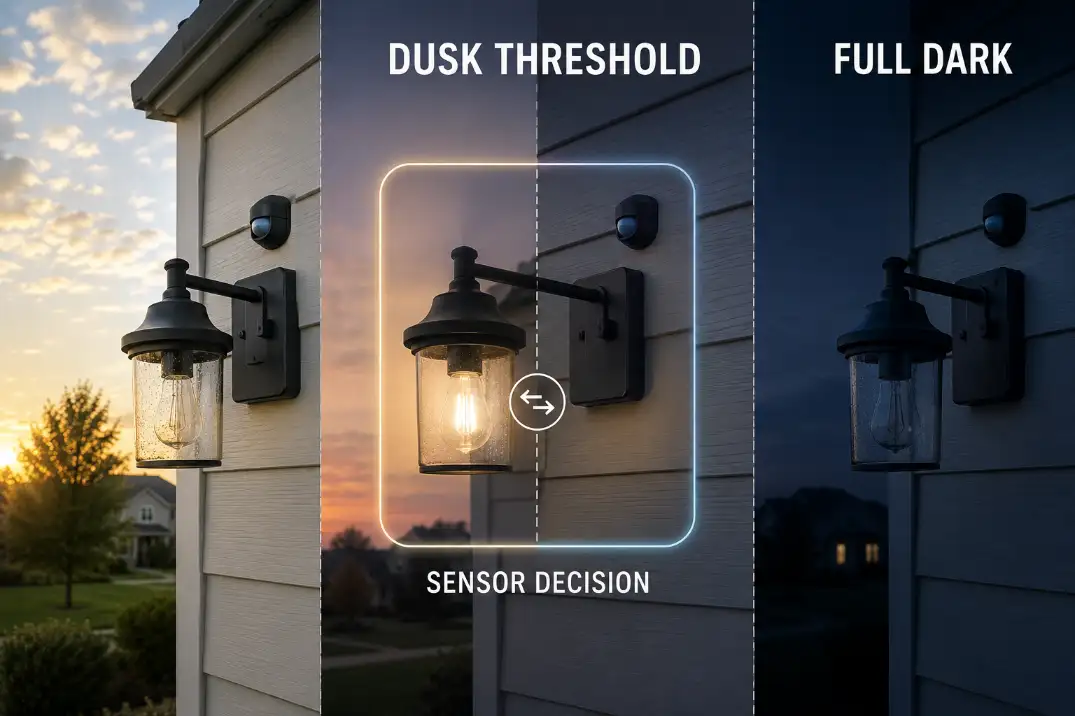
A photocell placement problem can make this threshold worse. A sensor tucked under a deep porch roof, turned toward a bright wall, or aimed toward a reflective surface may receive a confused light reading even when the yard feels dark. If this sounds like your setup, the placement issue may be similar to photocell placement mistakes that make lights turn on too early, but this page should stay focused on flicker rather than early switching.
Light Feedback Loop
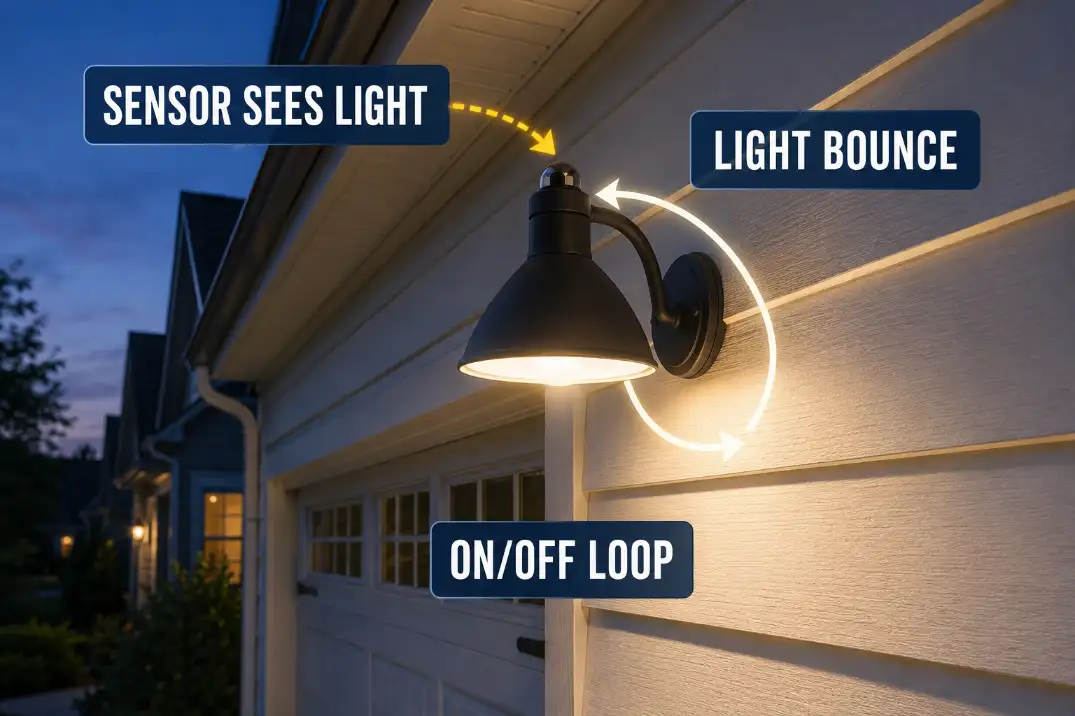
If the light turns on and then immediately makes itself turn off, suspect a feedback loop before blaming the bulb.
The fixture turns on. Its own light hits the wall, glass, trim, soffit, siding, or nearby surface. That reflected light reaches the photocell. The sensor thinks daylight has returned, so it turns the fixture off. Once the light shuts off, the sensor sees darkness again and turns the fixture back on.
That loop can repeat until the surrounding sky gets dark enough that the sensor finally settles.
The clue is rhythm. Feedback cycling often looks more like on-off-on-off behavior than a random electrical shimmer. It may begin immediately after the light first activates. It may also be worse on light-colored siding, glossy paint, white trim, glass doors, or fixtures mounted close to corners where light bounces back toward the sensor.
A safe test is to observe the sensor from the side. Do not open the fixture. Look for the path between the fixture’s beam and the photocell. If the sensor is on the same face of the fixture that receives its own glow, or if the wall around the sensor lights up brightly when the fixture turns on, feedback is a strong suspect.
The fix should break the light path, not just replace the part. Aim adjustable heads away from the sensor, reduce bounce off a nearby surface, use an approved sensor shield if the fixture design allows it, or move the photocell-controlled fixture out of its own reflected-light path.
The common mistake is replacing the bulb or photocell before checking whether the fixture is confusing itself. A new photocell can still cycle if it is placed in the same reflected-light path.
Nearby Fixture Interference
When flicker starts only after another outdoor light comes on, the photocell may be reacting to the lighting layout around it.
A porch light, garage sconce, landscape uplight, motion light, or bright fixture across a narrow side yard can hit the photocell during dusk. The timing can be tricky because the problem may not begin until that second light turns on.
This creates a different diagnosis from self-feedback. In a feedback loop, the problem starts when the controlled fixture turns itself on. With nearby fixture interference, the photocell may behave normally until another light source enters the scene.
The cleanest test is to turn nearby lights off one at a time during dusk. Do not change several things at once. Start with the closest porch, garage, or landscape fixture that has a direct line toward the photocell. Then watch whether the flicker stops.
Pay close attention to reflective paths, not just direct beams. A garage light may not shine straight into the sensor, but it can brighten a white column, window glass, or glossy siding panel near the photocell. That bounce may be enough to make the sensor hesitate.
This is also where motion lights can confuse the diagnosis. A motion fixture that activates during the dusk transition may briefly flood the area with light, then shut off, then allow the photocell light to activate again. If the nearby light is motion-controlled and keeps triggering too often, it may belong to a separate problem like driveway motion lights that trigger too often.
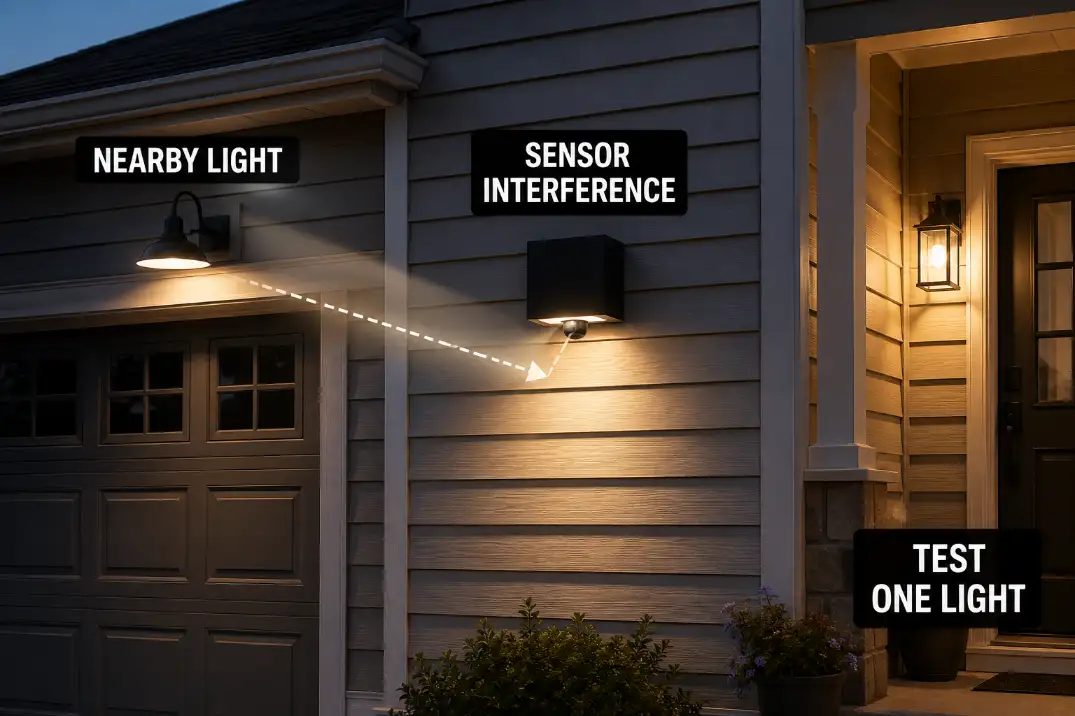
If the flicker stops when one nearby fixture is off, the fix is usually placement or aiming, not a mystery electrical failure. Aim the interfering light away from the photocell, reduce wall bounce, change which light turns on first if controls allow it, or move the photocell-controlled fixture out of the interference path.
Loose Sensor Contact
A loose contact becomes more likely when the flicker ignores the dusk window.
Instead of a clean on-off-on-off cycle at sunset, the light may blink sharply, shimmer irregularly, or keep acting up after full dark. It may react when wind shakes the fixture, when a door slams nearby, or after rain has worked into an already weak connection. A screw-in photocell adapter can also create poor contact if it is not seated firmly, corroded, or paired with an aged fixture socket.
Stay conservative here. Homeowners can safely observe patterns and check only accessible, non-invasive items after power is off. That might include confirming a bulb is seated, checking a screw-in adapter, or looking for obvious damage, water inside a lens, corrosion, or a loose external sensor cap.
Do not open a hardwired fixture or start moving wires around unless you are qualified to do that work. If the fixture keeps flickering after full dark, trips a breaker or GFCI, smells hot, shows melted plastic, has visible water inside, or reacts when touched, stop treating it as a simple dusk sensor issue.
Loose or intermittent outdoor connections have their own risk path. When the symptom looks less like dusk cycling and more like unstable power, the safer next read is outdoor lights working intermittently, especially if the problem appears outside the dusk window.
Cloudy Weather Cycling
Cloudy-weather cycling is only meaningful if it changes the pattern. A fixture that flickers once during a stormy sunset is not giving the same warning as one that flickers every clear evening.
Heavy clouds near sunset can drop the light level quickly. Then a break in the clouds can brighten the area again. Storm edges, fast-moving clouds, shaded walls, covered porches, and north-facing placements can all make the sensor cross back and forth through its switching point.
The key question is repeatability. If the light cycles only during stormy or fast-changing evening skies, and then behaves normally on a clear evening, the sensor may simply be sitting at the edge of its threshold. That does not mean the setup is perfect, but it is different from a fixture that flickers every night under stable conditions.
A covered porch can make this confusing. To your eye, the porch may already look dark, while the photocell still sees enough scattered sky light or reflected brightness to hesitate. Or the opposite may happen: the sensor sits in deep shade and turns on early, then a nearby light or sky reflection pushes it back off.
A practical way to separate weather from failure is to test on two evenings: one cloudy or stormy, one clear. If the flicker appears only when the sky brightness is changing fast, avoid replacing parts immediately. If the flicker repeats on clear evenings at the same dusk point, look harder at sensor placement, reflected light, or nearby fixture interference.
Dusk Stability Test
The dusk stability test should leave you with one next move, not a longer list of guesses.
Do this from late daylight through full dark. Stand where you can see both the fixture and the sensor area without blocking the sensor yourself.
- Watch when the first flicker starts: before the fixture turns on, right after it turns on, or only after another light activates.
- Note whether the flicker stops once the sky is fully dark.
- Turn nearby porch, garage, landscape, or motion lights off one at a time.
- Look for light bounce from siding, trim, glass, soffits, or walls back into the photocell.
- Repeat on a clearer evening if the first test happened under heavy clouds.
- Stop and call a qualified electrician if flicker continues after full dark with heat, smell, water inside the fixture, visible damage, breaker trips, or hardwired contact concerns.
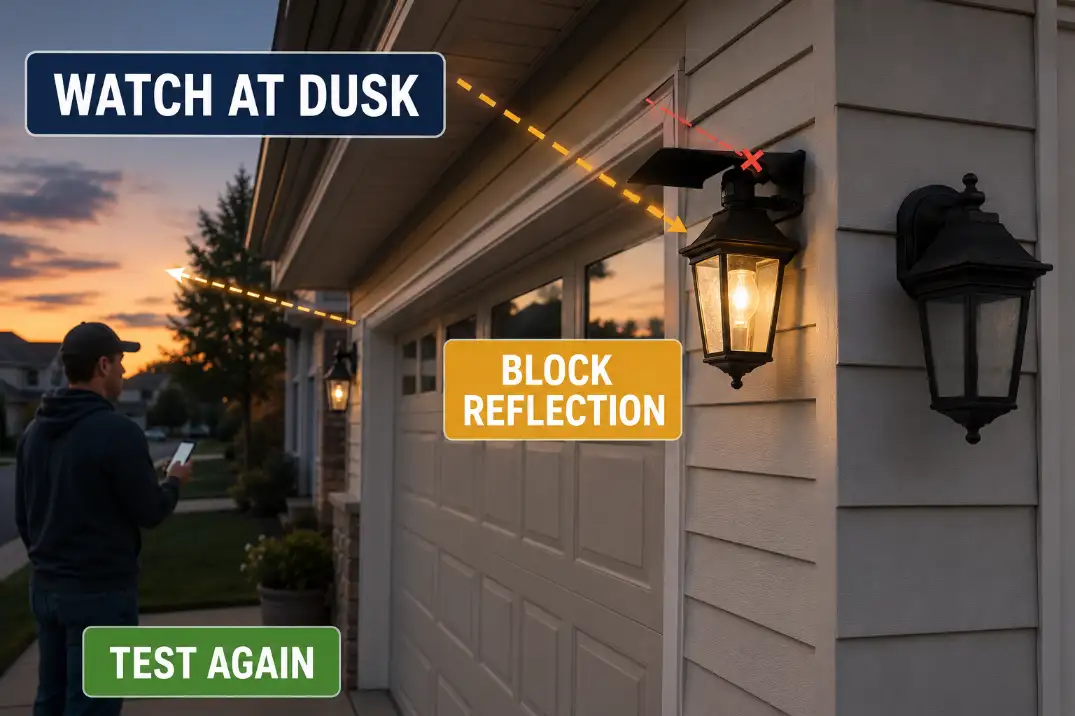
Read the result by timing, not frustration.
If the light flickers only briefly at dusk and then settles, the issue is probably threshold sensitivity or weather. If it cycles right after it turns on, look for self-feedback. If it starts only after another fixture activates, look for nearby interference. If it continues after full dark, stop blaming the sunset and move toward contact, moisture, driver, or wiring diagnosis.
A photocell light that flickers at dusk is not automatically a bad fixture. The stronger repair path is to find out what the sensor is seeing, remove that false signal if possible, and only then decide whether the sensor, adapter, fixture, or wiring needs attention.
For a manufacturer example of reflected light causing photocell cycling, see this outdoor light use and care guide.