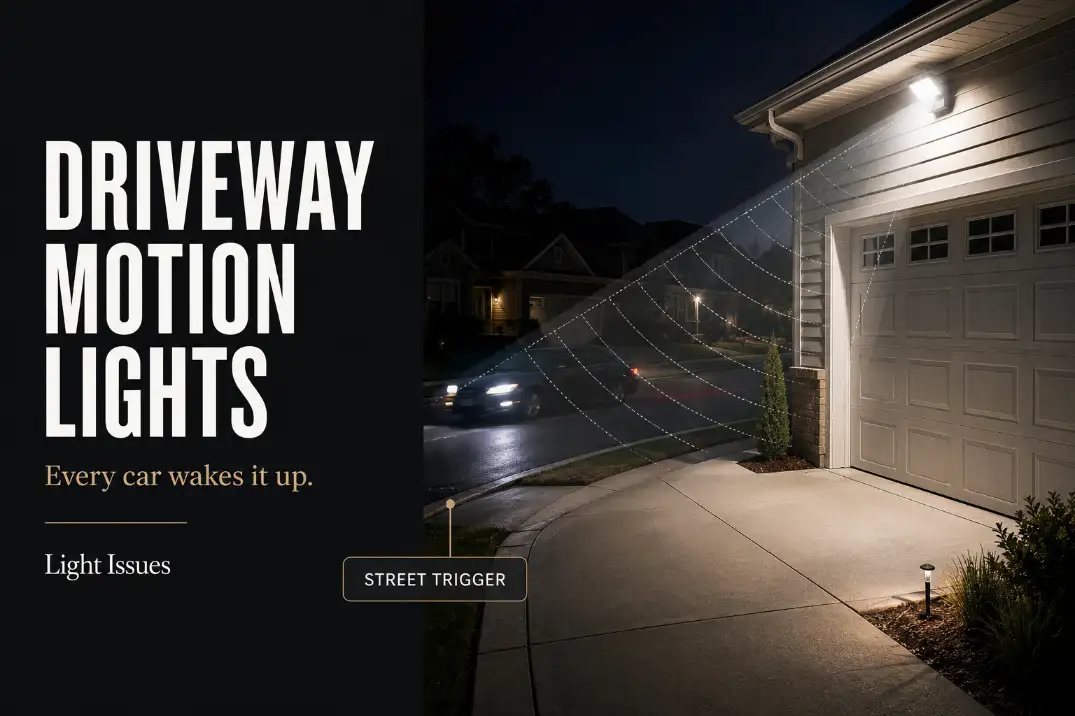
A driveway motion light that triggers too often is usually watching the wrong scene.
The fixture may be mounted on your garage, but the sensor may be reading passing cars, sidewalk movement, moving branches, wet pavement glare, or headlights reflecting across the driveway.
Start with the pattern, not the bulb. A normal driveway light may turn on once or twice during a windy night.
A problem light may trigger 10–20 times per hour, turn on with nearly every passing car, or restart before the previous 30–90 second cycle feels finished. That points to a detection-zone problem, not a need for more brightness.
The first checks are simple: watch whether traffic activates the light, see if the sensor reaches past the curb, and test whether a person walking up the driveway triggers the fixture at the right moment.
A light that turns on too often is different from a light that cycles because of a failing component. One is usually a scene-control issue. The other may be electrical, moisture-related, or fixture failure.
Passing Cars
The sensor is reading sideways motion
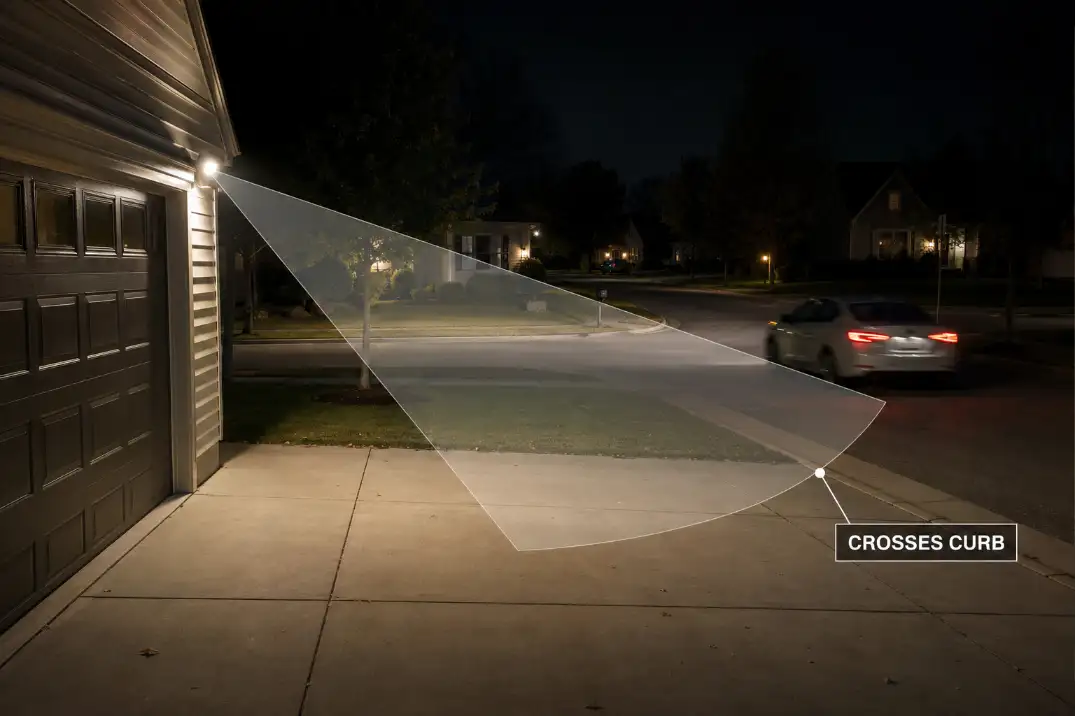
Passing cars are the most likely cause when the light turns on in a repeatable rhythm. Many motion sensors react more strongly when movement crosses their field from side to side than when it moves straight toward the fixture.
A car moving across the front of the property can create a stronger trigger than a person walking directly up the driveway.
That is why the light may seem “too sensitive” even though the real issue is where the sensor is looking.
If the detection fan reaches the road, the fixture starts treating public traffic as driveway movement. The light is not making a judgment about risk. It is simply reacting to motion inside its view.
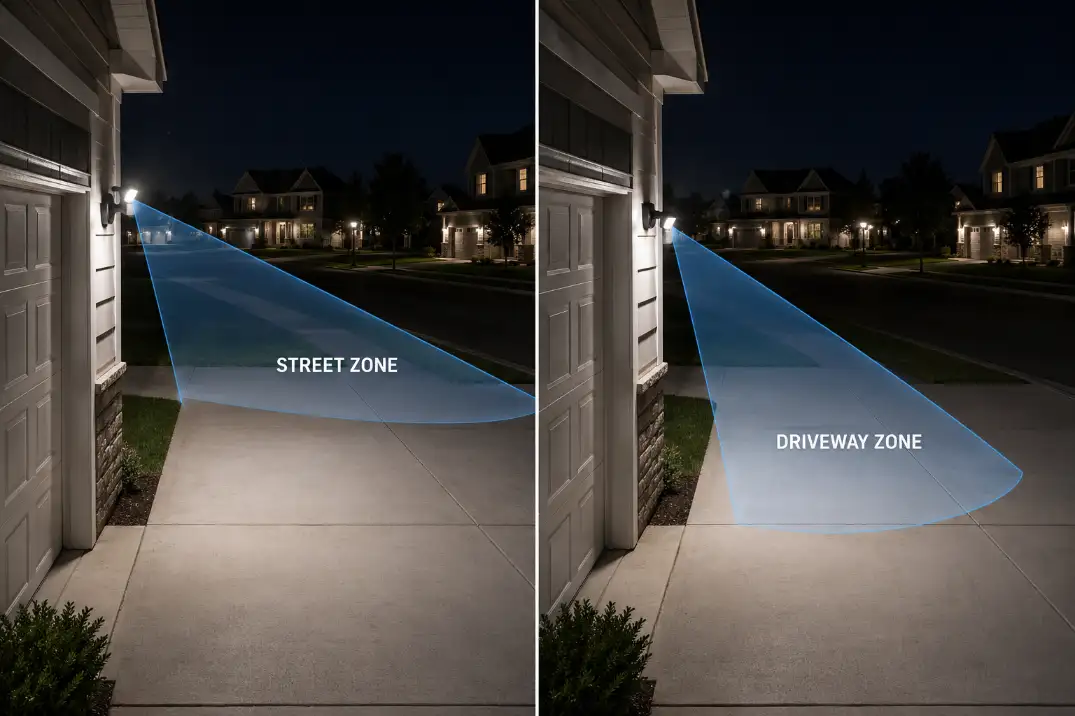
A useful driveway zone normally covers the garage approach, parking pad, side-door route, or the first part of the driveway someone actually uses.
It should not need to watch the opposite curb, the neighbor’s parked car, or traffic moving across the street.
This is the same kind of zone mistake that shows up in broader sensor problems such as Outdoor Motion Sensor Light Too Sensitive, but driveways make it more obvious because vehicles create large moving targets.
Brightness makes false triggers worse
One common wasted fix is replacing the bulb or fixture with something brighter. That does not make the sensor more selective. It only makes every false trigger more visible.
A driveway floodlight that turns on for traffic every few minutes is annoying at modest brightness.
At higher output, it can become harsh, distracting, and more likely to spill into neighboring windows. Brightness should be adjusted after the detection zone is corrected, not before.
Street Movement
Sidewalk motion is not driveway motion
A sidewalk near the driveway can fool the setup even when cars are not the main trigger.
Dog walkers, joggers, delivery workers, and kids on bikes may all pass through the outer edge of the detection zone.
The important distinction is whether that movement enters the property or only passes beside it.
For many suburban driveways, the useful detection distance is closer to 15–35 feet than the maximum range printed on the box.
A 60- or 70-foot range can sound better when shopping, but it often becomes a liability when the sidewalk, curb, or neighbor’s driveway sits inside that distance.
The common mistake is assuming the light should cover everything visible from the garage. In practice, a shorter zone is usually safer and calmer.
It should catch someone entering the driveway early enough to be useful, but not so early that the fixture reacts to every public movement beyond the curb.
False triggers can become a neighbor problem
A motion light that turns on too often creates two problems at once: it trains you to ignore the light, and it may send repeated bursts of glare toward someone else’s house.
If the light stays on for 60 seconds each time and triggers 20 times in one evening hour, that is 20 minutes of unnecessary light.
If it points toward a bedroom window, parked car, shared driveway, or nearby porch, the sensor problem becomes a spill-light problem too.
The same aiming logic behind Driveway Floodlights Shining Into Neighbor Windows matters here because false triggers are worse when the beam has nowhere polite to land.
When neighbor conflict is already part of the issue, fixture choice matters. A shielded, lower-glare motion light with adjustable heads and a controllable sensor is a better direction than a wide-open floodlight.
If replacement becomes necessary, Best Neighbor-Friendly Outdoor Lights is the more useful buying path than simply choosing the brightest security fixture.
Tree Shadows
The shadow is not usually the trigger
Tree shadows get blamed quickly, but the sensor is not usually reacting to darkness moving across the driveway.
It is reacting to movement, heat change, or sudden contrast inside its detection field. Branches, leaves, shrubs, tall grasses, and hanging planters can all create false activity if they move within the sensor zone.
The most useful clue is timing. If the light behaves normally on calm nights but triggers repeatedly during 10–15 mph gusts, the landscape is part of the problem.
If the light triggers every time a car passes, traffic is more likely than the tree. Those two symptoms can look similar from inside the house, but they need different fixes.
Do not start with aggressive pruning unless branches move directly in front of the sensor or sit within a few feet of it.
First reduce the detection range and lower the sensor slightly. Trimming is useful when foliage sits inside the zone you actually need. It is wasted work when the sensor is simply aimed too far outward.
Headlights and reflections can imitate motion
Some driveway triggers come from changing light, not physical entry. Headlights sweeping across wet concrete, glossy garage doors, snow cover, or a light-colored parked vehicle can create sudden contrast changes.
This is especially noticeable on short winter evenings in northern states, after rain on smooth concrete, or on driveways with bright garage doors facing the street.
This does not automatically mean the fixture is defective. It means the setup has very little margin. A well-aimed sensor should still behave reasonably when the driveway is wet or reflective.
If normal weather turns the fixture into a repeated false-trigger machine, the detection zone is too wide or too exposed.
Sensor Angle
Angle usually beats sensitivity
The lamp head and the sensor should not always point in the same direction. The lamp head may need to illuminate the driveway, but the sensor should watch the approach zone.
When both are aimed outward toward the street, the light sees movement before it becomes relevant.
Lower the sensor in small steps so the active zone ends near the driveway entry, garage approach, or parked-car path.
Avoid big angle changes all at once. If you aim the sensor too low, the light may stop seeing people until they are already close to the garage.
Pro Tip: After each adjustment, let the fixture complete a full off-cycle before testing again. Instant retesting can be misleading on lights with delay or test-mode behavior.
Sensitivity is secondary. Reducing sensitivity may quiet some false triggers, but if the sensor still faces traffic, cars can still activate it.
Angle changes what the sensor is allowed to watch. Sensitivity only changes how easily it reacts.
Mounting height changes the scene
Garage-mounted motion lights often work best when the sensor sits in a practical residential range around 6–10 feet above the ground.
Too high, and the sensor may look over the driveway and catch the street. Too low, and parked vehicles, shrubs, trash bins, or snow piles may block the zone you actually need.
Height is not always easy to change after installation, but it explains why some fixtures are hard to tune.
A light mounted high on a garage peak with a wide sensor pattern may see more public movement than driveway movement.
A lower wall-mounted fixture near the garage door may be easier to control, but only if the beam does not glare into drivers’ eyes or neighboring windows.
This is why How to Aim Outdoor Security Lights is often more relevant than a general brightness fix. The important decision is not only where the light shines. It is what the sensor sees before the light ever turns on.
Shorter Zones
Maximum range is usually the wrong goal
The best driveway motion light is not the one that detects the farthest movement. It is the one that detects the right movement soon enough.
A healthy setup might trigger when someone enters the driveway or reaches the lower walking path, then stay on for 60–120 seconds.
A failing setup may trigger from traffic beyond the driveway, hold for 2–5 minutes, and restart repeatedly before the front of the house ever settles back into darkness.
| Trigger pattern | More likely cause | Better first fix |
|---|---|---|
| Turns on with every passing car | Sensor reaches street | Lower angle or shorten range |
| Fires mostly on windy nights | Moving branches in zone | Re-aim before trimming heavily |
| Reacts to headlights but not people | Reflective scene or bad aim | Narrow zone and retest walking path |
| Turns on when neighbors move outside | Side-facing detection | Aim away from property line |
| Stays active through busy evenings | Long timer plus false triggers | Shorten zone before shortening timer |
| Misses people near garage after adjustment | Sensor aimed too low | Raise slightly and retest |
Timer settings come after zone control
Timer settings matter, but they are not the first lever. If the sensor is badly aimed, shortening the timer from 3 minutes to 30 seconds only makes the light cycle more often.
The pattern may become more irritating because the on-off rhythm is easier to notice.
Use timer changes after the detection zone is reasonable. A 60-second hold time is often enough for a simple driveway walk-through.
A 3-minute hold time can make sense near a garage work area, trash-bin route, or side entry. Longer times stop making sense when the light is being activated by cars, branches, or sidewalk movement.
Some fixtures do not give enough control
Adjustment stops being practical when the fixture has no independent sensor angle, no range control, no shielding, and a wide detection pattern that keeps reaching public movement.
At that point, the problem is not only setup. It is the product’s limited control.
Replacement becomes reasonable when three things are true: the sensor still reaches the street after adjustment, the light creates glare when it activates, and the timer cannot prevent repeated cycling.
In that case, a lower-glare fixture with adjustable detection and controlled beam spread is a better choice than another oversized floodlight.
Best Low Glare Outdoor Security Lights fits this decision point because the replacement goal is control, not raw brightness.
Trigger Test
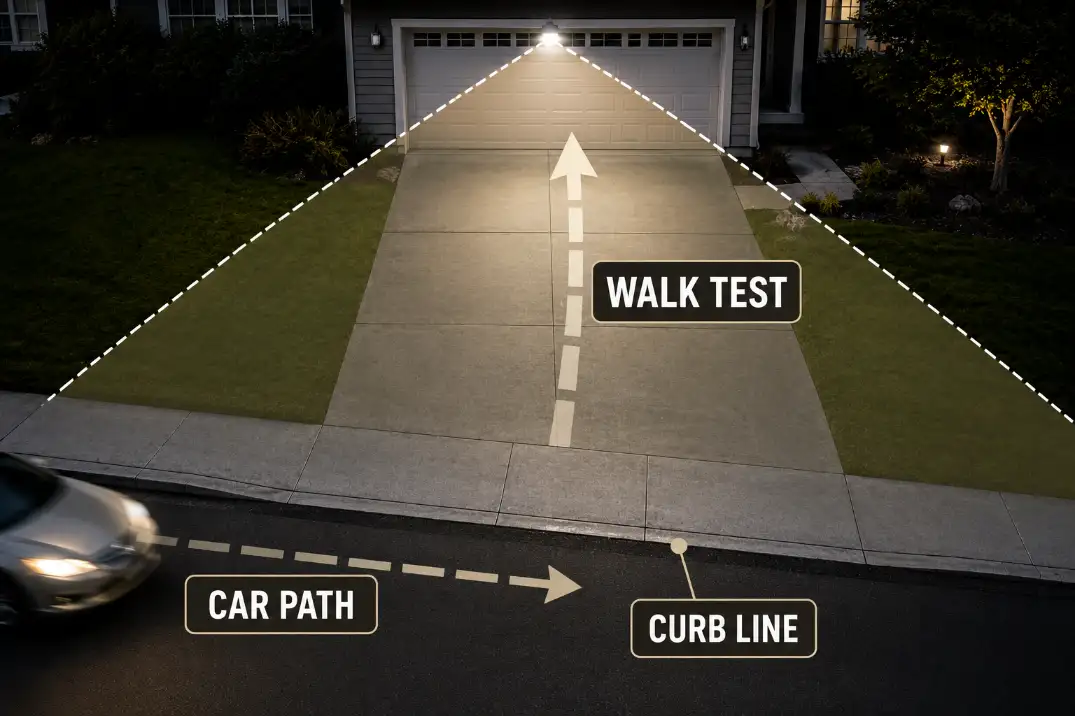
Test the street first
A useful driveway test takes less than 15 minutes after dark. Start by standing where you can see both the driveway and the street.
Watch several cars pass. If the light turns on while vehicles stay fully outside the driveway, the sensor zone is too long, too wide, or aimed too high.
Do not change three settings at once. Lower the sensor slightly, reduce range if the fixture allows it, then test again.
If you adjust angle, range, timer, and lamp head together, you will not know which change fixed or worsened the pattern.
Test the walking path second
After the traffic test, walk the actual path you want the light to cover. That may be street-to-driveway, driveway-to-garage, car-to-side-door, or garage-to-trash-bin.
The light should activate before the person reaches the darkest decision point, not after they are already at the door.
If the fixture misses the walking path after you reduce false triggers, the sensor may now be too low or too narrow.
Raise it slightly and retest. The right setup ignores street movement but still sees a person entering the usable driveway zone.
Camera-light combinations need a little extra care. A PIR motion sensor mainly reacts to heat and movement.
A camera-based motion setting may react to pixel movement, headlights, rain streaks, insects near the lens, or changes in the image.
If your driveway light also records video, check whether the light trigger and camera trigger are controlled separately. Some false alerts are camera-zone problems, not floodlight sensor problems.
If the fixture cycles on and off while nothing enters the driveway, compare the behavior with Outdoor Motion Light Turning On and Off. Repeated cycling can come from poor aim, but it can also come from heat reflection, light feedback, failing electronics, or moisture inside the fixture.
A simple driveway trigger checklist
- The light should not activate for cars that stay on the street.
- The detection zone should end before the opposite curb or neighbor’s driveway.
- Branches and shrubs should not move within the closest 10–20 feet of the sensor.
- A person walking toward the garage should trigger the light before reaching the darkest step, door, or parking edge.
- The timer should usually hold long enough for normal movement, often 60–120 seconds.
- If every adjustment creates a new miss or false trigger, the fixture may lack usable zone control.
The goal is not to make the driveway light less sensitive everywhere. The goal is to make it selective.
A selective driveway motion light ignores passing cars, waits for movement that actually enters the property, and lights the path long enough to be useful without making the front of the house feel jumpy all night.
For broader official guidance on motion sensors and lighting controls, see the U.S. Department of Energy lighting controls.