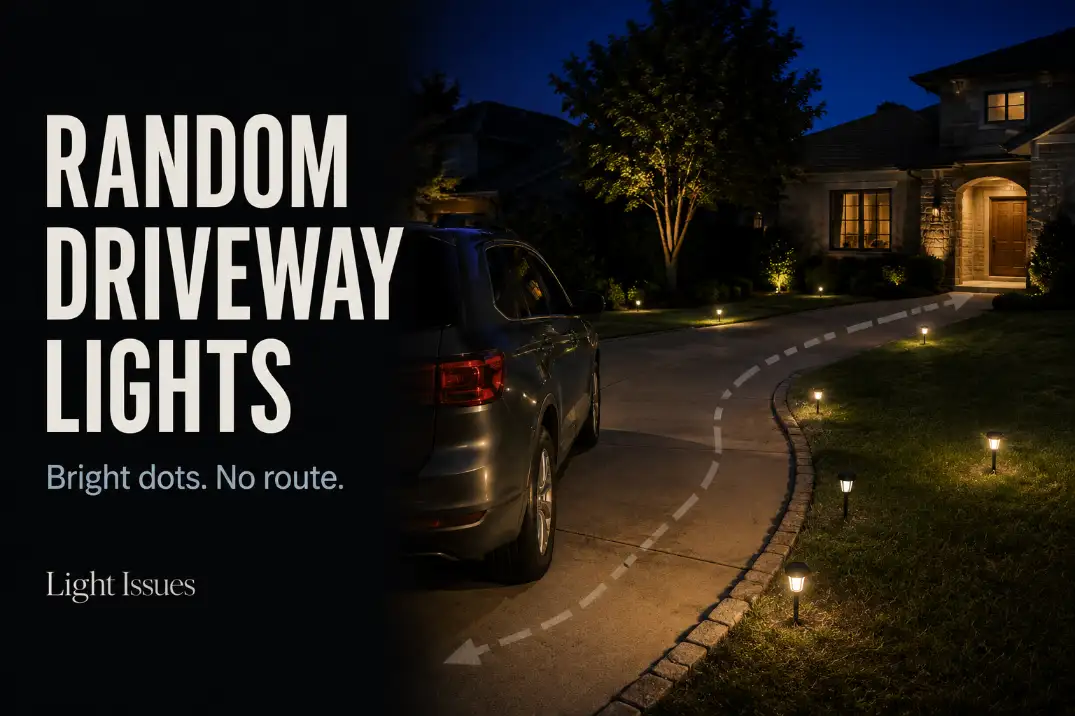
Driveway path lights usually look random because they are placed around the driveway shape instead of the walking route.
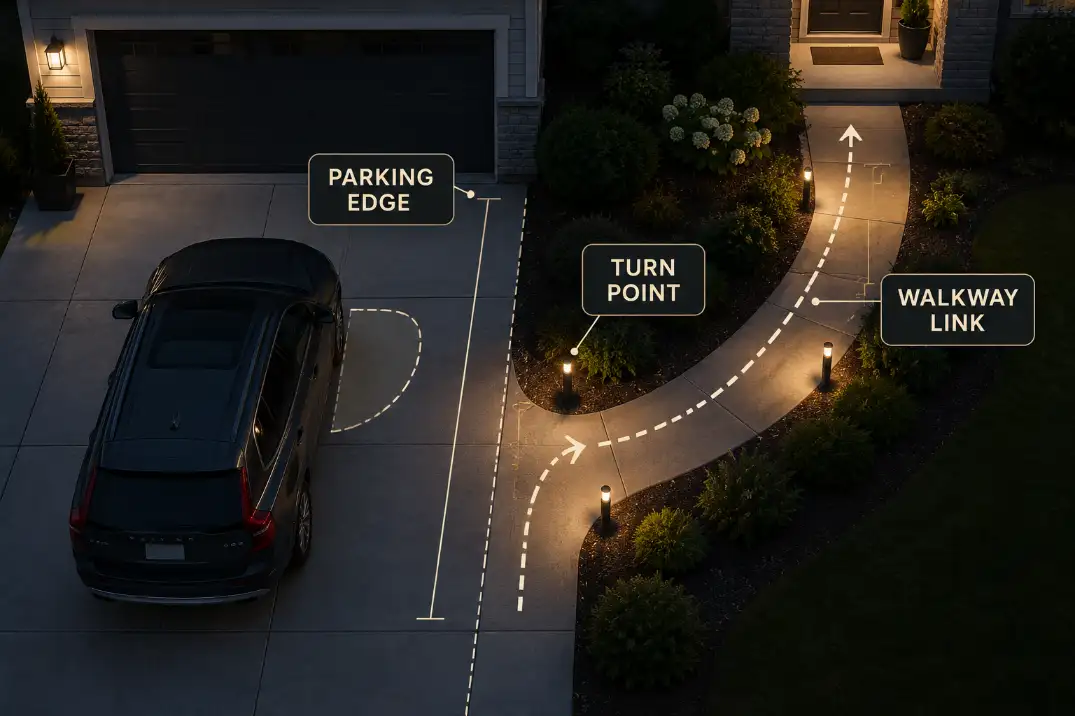
The quick fix is not to buy more fixtures first. Mark the car-door zone, the turn toward the walkway, and the first visible entry cue, then move lights to those anchor points before filling straight gaps.
The first checks are simple: whether turn points are lit, whether the parking edge has a readable walking strip, and whether the driveway connects cleanly to the front walkway.
If the brightest dots are 4 feet apart near one shrub bed but leave 10 to 14 feet of darkness near the car door or walkway turn, the issue is not “too few lights.” It is a broken route rhythm.
This differs from a driveway that is merely dim. A dim driveway still has a readable path, just with weak output.
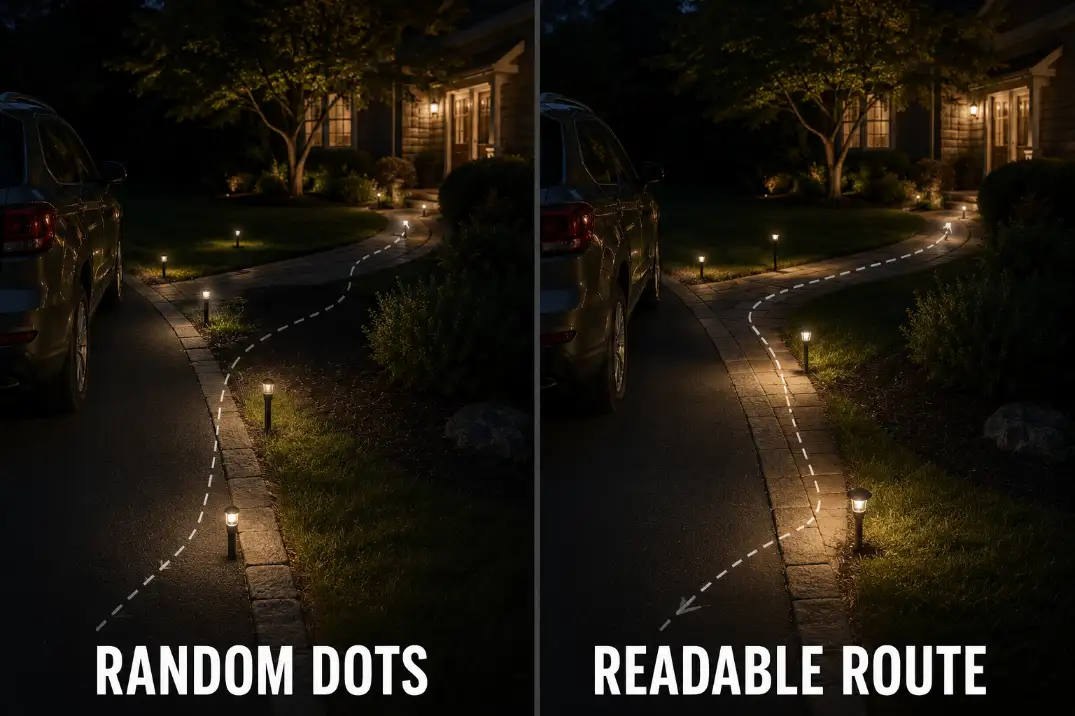
Random-looking lights create isolated bright spots with no sequence, so guests see fixtures before they understand where to walk.
If the route is visible but weak, the problem is output. If the fixtures are visible but the route is not, the problem is placement.
Random Dots
The symptom is brightness without sequence
Random dots are a symptom, not the real mechanism. The real problem is that the lights are not marking decisions.
They may be evenly spaced in a landscaping sense, but they do not tell the eye where the driveway starts, where the walking lane continues, or where the turn toward the door happens.
A healthy driveway route does not need every foot lit. It needs a visible cue before each change. On many residential driveways, that means a useful light cue every 6 to 8 feet along a narrow walking edge, or every 8 to 12 feet when the fixture has a broader beam.
The failing version is more uneven: tight clusters near decorative beds, then dark gaps at the exact points where someone has to step around a car, turn toward a walkway, or avoid the lawn edge.
This is why a driveway can still feel confusing even when the fixtures themselves are working.
If the whole driveway is hard to read after dark, the broader diagnosis may overlap with driveway lights that are hard to see, but random-looking path lights are usually a placement logic problem first.
Fixture style is rarely the first culprit
Homeowners often blame the fixture style first. Tall caps, modern bollards, solar stakes, and low-voltage path lights can all look random if they are placed as decoration rather than route markers. The layout decides whether the light feels intentional.
The second common misread is equal spacing. Equal spacing only works when the route is straight and simple. A curved driveway, wide parking pad, side-entry garage, or offset front walk needs hierarchy.
The first light should identify the arrival edge. The next should confirm direction. The most important light should mark the turn.
Missing Turn Points
Turns matter more than straight runs
The driveway turn point matters more than the middle of a straight edge. If someone exits a car, walks along the driveway, then turns toward a front walk, that turn deserves a cue before the straight stretch gets extra decoration.
A light placed 2 to 3 feet before the turn often reads better than one placed directly in the corner. The reason is simple: the person sees the direction change before reaching it. A light buried at the corner may brighten the edge, but it does not prepare the eye for the next move.
This is where adding lights between existing lights wastes time. If the missing point is a turn, filling the straight line may make the driveway brighter but still leave the same confusion. The route has to be anchored before it is filled.
Dark turns feel worse than straight dark gaps
A dark gap longer than about 8 feet at a decision point is usually more noticeable than a 12-foot gap along a straight border. Straight gaps look like dimness. Turn gaps look like uncertainty.
That distinction matters because people do not walk a driveway as a drawing. They slow down, drift toward the lawn, cut across the pavement, or step around the car in a slightly different line each time. A missed turn cue changes behavior. A dim straight run usually only changes comfort.
The 30-minute test
Check the layout 30 to 45 minutes after sunset, not during blue hour. Early dusk hides spacing mistakes because the pavement still reflects ambient sky light.
Once the driveway is truly dark, stand where a guest would arrive and look for the first three decisions: where to step out, where to walk, and where to turn.
If those three points are not obvious within about 5 seconds, the layout is not guiding the route. It is only showing where fixtures were installed.
Parking Edge
Empty-driveway spacing can fail once a car is parked
Many driveway path lights are laid out while the driveway is empty. That is why they look acceptable during installation and random during normal use.
Once a vehicle is parked, the car can block the fixture, hide the light pool, or push the walking route 18 to 30 inches farther from the edge.
A useful parking edge usually needs a readable walking strip about 24 to 36 inches wide beside the car. That strip should remain visible when the driver’s door opens, when a guest steps out, and when someone carries bags toward the front walk.
If the light only marks the decorative border but disappears behind the vehicle, it is not doing the driveway job.
The fixture should help someone see the stepping zone without shining directly into the driver’s eyes or across a neighbor’s window.
On wet concrete, misplaced bright dots can look harsher than they do on dry pavement, especially after summer storms, irrigation runoff, or coastal moisture.
The edge should be visible, not outlined
A driveway does not need to be traced like a runway. The edge needs enough visibility for someone to judge where pavement ends and planting, gravel, lawn, or a slope begins.
A low-output fixture that grazes the pavement edge is often better than a brighter fixture that sprays light outward with no control.
If fixtures sit too close to the hardscape edge, they can create a dotted line that looks neat from the street but feels harsh up close.
That problem is closely related to path lights placed too close to the walkway edge, where the fixture position creates glare and distraction instead of guidance.
The condition homeowners often overestimate is brightness. The condition they underestimate is beam direction.
A 100-lumen path light aimed poorly can look more chaotic than a softer fixture placed at the right threshold.
Walkway Link
The driveway and walkway must read as one night route
The most awkward layouts happen when the driveway lights and walkway lights are treated as separate projects. The driveway has one rhythm, the front walk has another, and the connection between them disappears. At night, that break makes the route feel accidental.
A better layout links the two systems visually. The last driveway cue should point toward the first walkway cue. They do not need to match perfectly, but they should agree on direction, height, and brightness.
If the driveway lights are warm and low while the walkway lights are bright and cool, the transition can feel like two unrelated zones.
When dark gaps appear between the driveway and the front walk, the issue may look like weak lighting, but the real problem is often route interruption.
That is also why pathway lights with dark gaps can feel worse at transitions than they do along straight walks.
| Route Area | Healthy Condition | Failing Condition | Better Fix |
|---|---|---|---|
| Driveway entry | First cue visible from arrival point | First light hidden behind car or shrub | Move cue closer to arrival angle |
| Parking edge | 24–36 inch walking strip is readable | Bright dots but no usable edge | Light the stepping zone, not just the border |
| Walkway turn | Direction change visible before arrival | Dark corner or late cue | Place light 2–3 feet before the turn |
| Straight run | Soft rhythm every 6–12 feet | Tight clusters and long gaps | Remove extras before adding more |
| Garage apron | Edge remains readable when car is parked | Car blocks the route cue | Shift cue outside door-swing zone |
Route Rhythm
Rhythm is not equal spacing
Route rhythm means the eye can predict the next safe step. Equal spacing is only one possible way to create that rhythm. On a driveway, it is often the wrong one because the walking route is interrupted by cars, turns, curb cuts, garage aprons, and planting beds.
A good rhythm starts with anchor points, then fills only where needed. The anchors are the arrival edge, the car-door zone, the walkway turn, and the entry walk. Once those are clear, the remaining lights can be spaced lightly. If the anchor points are missing, extra lights just create more dots.
This is the point where the standard fix stops making sense. If a driveway already has 8 to 10 fixtures and still looks random, more fixtures are probably not the answer. The better move is to remove or relocate the ones that visually compete with the route.
Pro Tip: Photograph the driveway from the street and from the parked-car position after full dark. If the photos show bright fixtures but not a clear direction, the spacing is failing.
Avoid the runway correction
Some homeowners respond to randomness by lining both sides of the driveway with identical lights. That can solve disorder, but it often creates a new problem: a runway effect. The route becomes rigid, overly bright, and more commercial than residential.
For a typical two-car driveway, lighting both sides evenly is rarely necessary unless both sides are active walking zones.
One readable edge with a few turn cues usually feels calmer. If the driveway already has that airport-like look, the issue is closer to path lights that look like a runway than a lack of organization.
Do not make path lights do every job
Path lights are good at marking edges, transitions, and walking rhythm. They are not always good at lighting a wide garage apron, a large parking pad, or a shared driveway entrance.
When the paved area is too wide, forcing path lights to cover everything can create scattered dots along the perimeter while the usable middle stays visually weak.
That does not mean the driveway needs more random fixtures. It means the lighting job has changed.
For a wide garage apron, the path lights should define the walking route, while another controlled fixture may handle the broader visibility zone. Mixing those jobs without a plan is one reason driveway lighting starts to feel patched together.
Better Spacing
Fix the sequence before buying more lights
Start by marking the actual route during the day. Walk from the curb or parking position to the door and identify the points where your direction changes. Those points should get priority before any decorative spacing is adjusted.
Then test the lights at night for at least 10 minutes. Your eyes adapt during the first few minutes, and a layout that looks acceptable immediately after stepping outside may feel spotty after you have walked it twice.
Watch for three failures: a dark first step, a missing turn cue, or a bright fixture that pulls attention away from the route.
If all fixtures are working and the route still feels scattered, use this order:
- Move lights from decorative clusters to turn points first.
- Keep the main walking edge readable within a 24–36 inch stepping zone.
- Reduce tight spacing under 4 feet unless the fixture output is very low.
- Treat gaps over 10 feet near turns as higher priority than straight-run gaps.
- Avoid placing lights where parked cars block them for most of the evening.
- Recheck the layout 30–45 minutes after sunset, not at dusk.
For driveway layouts that share the same behavior as a walkway, the spacing patterns in fixing pathway lighting spacing problems are worth checking before replacing fixtures.
When replacement is actually justified
Replacement makes sense when the fixture beam is too narrow, the output is inconsistent, or the runtime is too short to hold the route through the evening.
If solar driveway lights fade after 3 to 4 hours while entry lights stay bright for 6 to 8 hours, the layout may look random simply because half the route disappears too early.
Fixture type also matters once the anchor points are correct. Omnidirectional solar stakes can create bright dots without much useful pavement guidance.
A shielded hat-style path light or a low-voltage fixture with a broader downward spread usually gives the edge a calmer read.
The healthier condition is not “more visible fixtures.” It is a route that stays readable after the fixtures stop calling attention to themselves.
Replacement is not justified just because the driveway looks uneven from the street. First decide whether the route fails from the walking position.
If the car-door zone, turn point, and walkway link are clear, small decorative irregularities may not be worth correcting. If those three points fail, even expensive new fixtures will look random unless they are placed around the route.
The best driveway path light layout is usually quieter than people expect. It marks decisions, protects the parking edge, and connects the driveway to the front walk without turning every foot of pavement into a display.
For broader outdoor lighting quality principles, see the Illuminating Engineering Society.