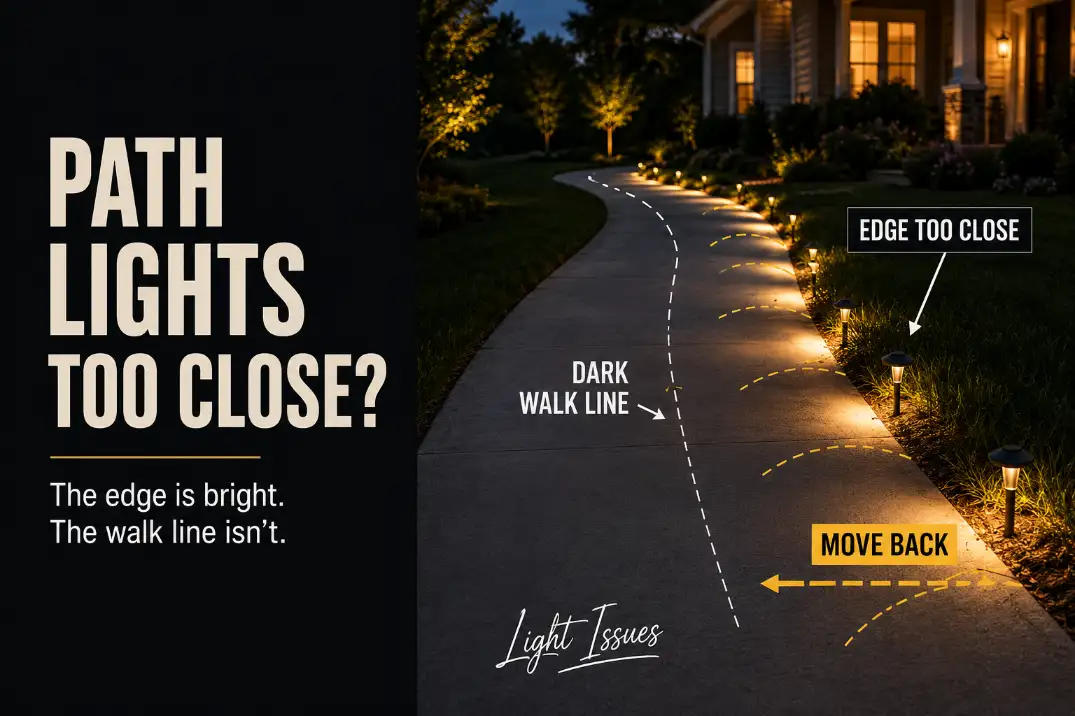
Path lights are usually too close to the walkway edge when the fixture sits within 2–3 inches of the hardscape and the brightest part of the beam lands on the border instead of the walking line.
A better first test is usually 6–12 inches back from the edge, then adjusted at night based on the actual beam spread.
Normal placement lights the walking line softly; problematic placement makes the border brighter than the route. This is not the same as a weak-bulb problem. A dim fixture reduces light everywhere.
A too-close fixture often creates plenty of brightness, but in the wrong place: mulch, grass, edging stone, or the first few inches of concrete.
If the edge looks bright while the center 12–18 inches of the walkway still feels dull, placement matters more than wattage. In higher-traffic areas, or where mowers and trimmers pass close to the path, a 12–18 inch setback may also reduce damage.
Quick Diagnostic Checklist
Check the layout after dark, not while the lights are being installed. Daytime alignment can look clean even when the nighttime beam misses the useful walking surface.
The bright strip sits beside the path
If the strongest light lands on grass, mulch, gravel, or edging, the fixture is probably too close or too low for that position. The fix is not automatically a brighter lamp. First, move one light back a few inches and watch where the beam falls.
The walking line stays darker
A path does not need to be evenly flooded from edge to edge. But the walking line should be easy to read. On a typical 30–36 inch walkway, the center area matters more than the outer border.
When the outer edge glows and the middle still feels uncertain, the light is not doing its real job.
The fixtures draw more attention than the route
When path lights are crowded against the hardscape, the eye often sees a row of glowing dots before it sees the path. That is a layout signal, not just a style issue.
If the row itself becomes the main visual feature, the same pattern can turn into the rigid effect explained in Why Path Lights Look Like a Runway.
The problem returns after yard work
If the lights look acceptable for a few days and then seem crowded again after mowing, edging, mulching, or irrigation work, the stakes may be shifting. A movement of only 2–4 inches can change where a small path-light beam lands.
Why the Walkway Edge Becomes the Wrong Reference Line
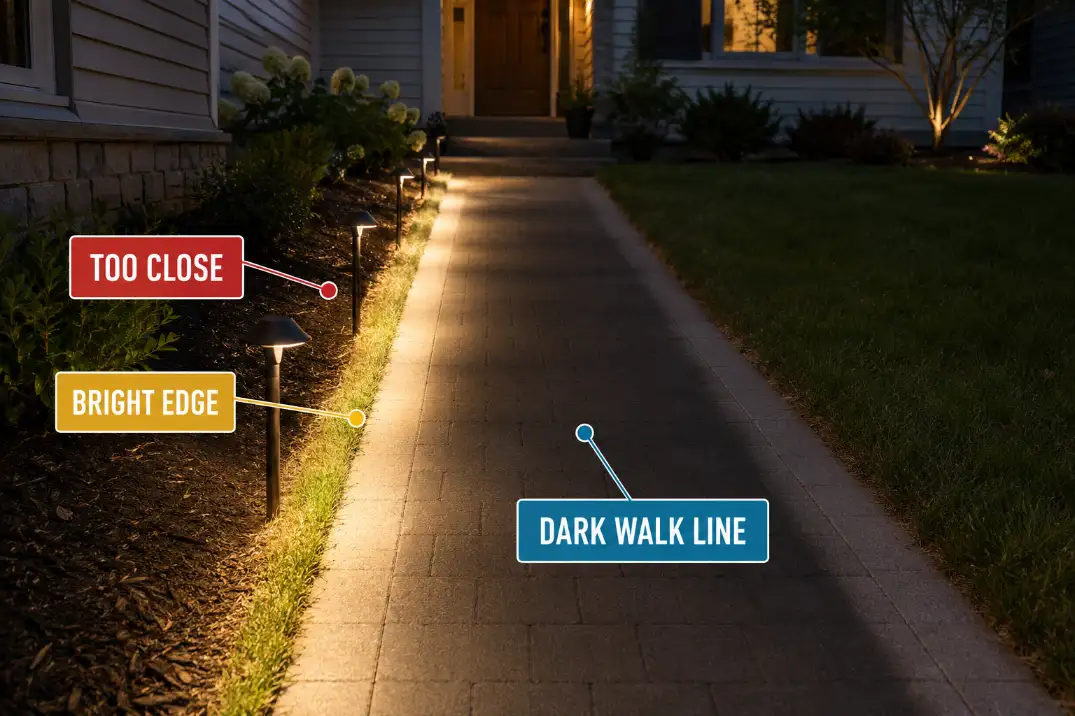
The fastest way to misplace path lights is to use the hardscape edge as the main guide. It feels logical in daylight because the row looks tidy, the stakes stay out of the walking surface, and the lights appear to follow the path.
At night, that same tidy line can send most of the useful light into the border.
Do not use the hardscape edge as the final alignment line until the beam has been checked at night.
Daytime alignment is not nighttime performance
A clean row does not guarantee a useful beam. The real test is where the light lands after dark. If the fixture is lined up with the walkway edge but the beam spreads outward or downward too soon, the border becomes bright while the walking surface stays uneven.
This is why straightening the row often disappoints. A perfectly aligned path-light row can still be wrong if the beam keeps missing the route.
When the broader issue is light landing outside the useful target area, the same placement logic shows up in Why Path Lights Shine Into Grass Instead of the Walkway.
Setback is not the same as spacing
Setback is the distance from the walkway edge to the fixture. Spacing is the distance from one fixture to the next. Many path-light problems get misread because people adjust spacing when the real issue is setback.
If each fixture is too close to the edge, widening the gap between fixtures may only create larger dark patches. If each fixture is correctly set back but the pools of light still feel choppy, then spacing becomes the next adjustment.
Treat setback first because it determines whether each beam reaches the walking line at all.
Short fixtures make edge placement less forgiving
Low mushroom-style or small hat-style path lights often have a modest spread. If the fixture head sits around 12–16 inches above grade and the stake is almost touching the walkway edge, the beam may not travel far enough across a 36-inch path.
A taller fixture, around 18–24 inches, may throw light farther, but height alone does not fix a bad edge position.
The common overestimate is brightness. People assume a higher-lumen lamp will push light across the path. The underestimated factor is beam geometry: where the light starts, how it spreads, and whether the source is shielded from the walker’s eye.
What Too-Close Path Lights Actually Do
The visible symptom is crowding. The underlying mechanism is uneven light distribution. Once those are separated, the repair choice becomes easier.
Edge stripe, dark center
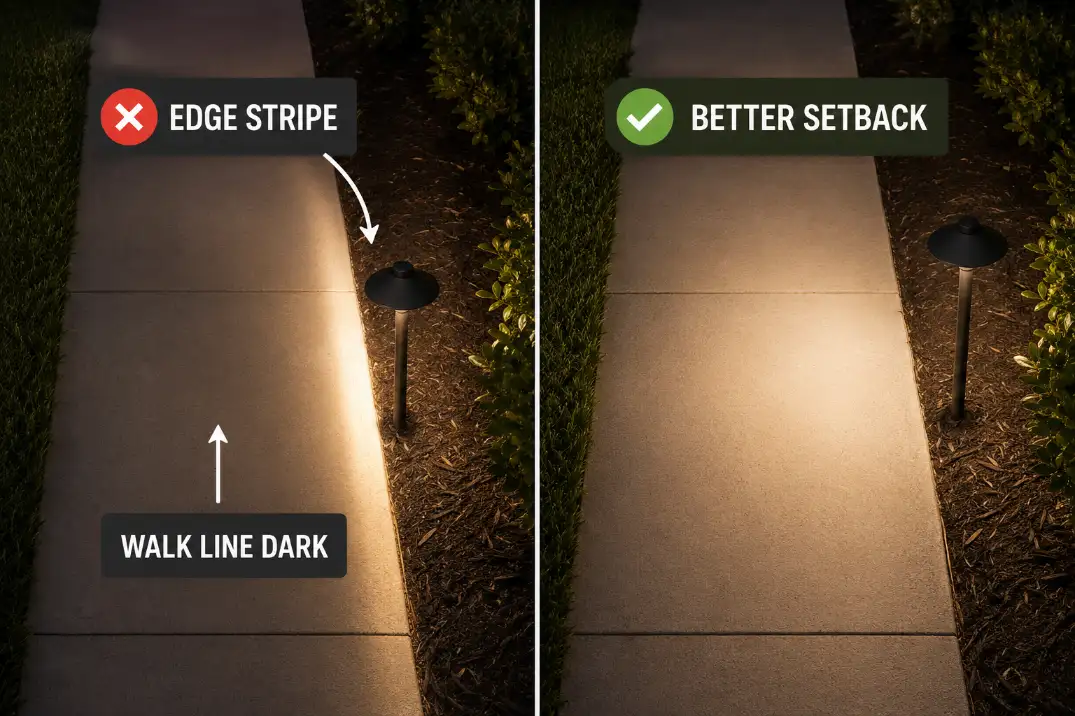
The clearest failure pattern is a bright outer stripe with a weaker center. On a 3-foot-wide walkway, the center line is where the eye and foot placement need the most guidance.
If the beam is strongest at the border and fades before it reaches the middle, the path can feel less safe even though the fixtures are working.
A better layout usually creates soft pools of light that touch the walking line without making the edge glow harder than the route. The goal is not to make the path look brighter from the curb. The goal is to make the next few steps readable.
Glare from the fixture head
When fixtures sit too close to the hardscape, people pass nearer to the source. That increases the chance that the visible lamp, lens, or hot spot enters the eye.
A path light can be low voltage and still feel harsh if the source is exposed from 2–4 feet away at walking height.
This is why a walkway can have enough fixtures and still feel uncomfortable. If the route is technically illuminated but glare makes walking less pleasant, the issue overlaps with the safety problem discussed in Why Path Lights Don’t Make Walkways Safer.
Maintenance damage and leaning stakes
Close-edge fixtures also live in the damage zone. Lawn edging, string trimmers, snow shoveling, mulch rakes, hoses, and foot traffic are more likely to hit stakes near the path. In northern states, freeze-thaw movement can loosen shallow stakes over a few winter cycles.
In dry Arizona yards, hard soil can keep a stake from seating deeply unless the hole is softened first.
A fixture that leans 10–15 degrees toward the walkway may suddenly look much closer than it did after installation. That is still a placement problem, but it is also a stability problem.
| Signal | What It Usually Means | Better First Fix |
|---|---|---|
| Bright strip at the path edge | Fixture is too close or beam is aimed too shallow | Move the stake back 6–12 inches and retest |
| Dark center of walkway | Light is not crossing the walking line | Adjust setback before increasing brightness |
| Visible lamp glare while walking | Source is too exposed from the path | Change angle, shield, or fixture style |
| Lights look too close together | Row rhythm is drawing attention to fixtures | Widen spacing before adding output |
| Fixtures shift after yard work | Stakes are too close to maintenance activity | Reset outside the edge damage zone |
| Path still feels unsafe | Light exists, but not where feet need it | Recheck beam landing and glare together |
How to Reset the Layout Without Rebuilding It
The fastest useful correction is to move one fixture, not the whole row. The goal is to find where the beam lands before changing bulbs, adding fixtures, or replacing the system.
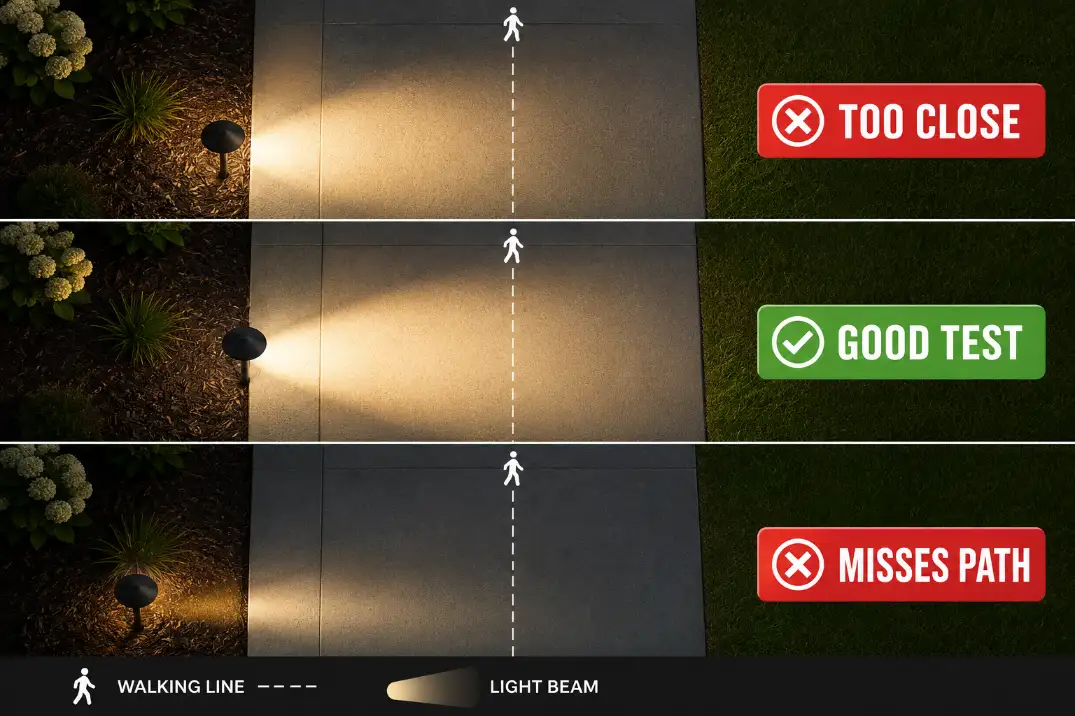
Test one light in three positions
Choose one problem fixture and pull it back from the edge in small steps. Start around 6 inches from the walkway edge, then test 9 inches and 12 inches if the planting bed allows it.
Walk the path from both directions after dark and watch the walking line, not just the fixture.
A good test takes about 10 minutes. Leave the temporary position in place for one full night if the soil is loose or damp. In humid Florida yards or irrigated beds, stakes can creep more easily after watering, so check again after 24 hours before resetting the full row.
Pro Tip: Test the fixture with the lens and cap fully assembled. Open or tilted heads can make the beam look wider than it will be during normal use.
Move back before adding brightness
A brighter lamp should come after placement is corrected, not before. If the fixture is too close, more output can sharpen the edge stripe and increase glare. Moving the light back 4–8 inches often changes more than swapping the lamp.
If the walkway still has uneven pools after the setback is corrected, then fixture spacing becomes the next issue. That is when Pathway Lights and Dark Gaps becomes more relevant than brightness alone.
Do not force a perfect straight line
A slightly irregular planting bed may need a slightly irregular light line. Curves, shrubs, and grade changes affect where the beam lands. A rigid row that follows the hardscape edge exactly can look neat in a product photo and still perform poorly in a real yard.
On curves, pull the fixture back more where the beam would otherwise skim the edge. On narrow side paths, keep the fixture far enough from the walking edge that shoes, hoses, and trash bins do not hit it.
On wider front walks, the useful setback may be larger because the beam must reach farther across the surface.
When Moving the Light Back Stops Working
Moving path lights back is the right first correction only when the fixture can still send light across the walkway. Sometimes the edge problem exposes a fixture mismatch, cable limitation, or path-width problem.
The fixture is too low or too shielded
If moving the stake back leaves the walkway even darker, the fixture may not have enough spread for the path width. A narrow decorative fixture can look attractive beside a path but fail to cover the surface.
In that case, the better fix is a different path-light style, not a brighter bulb in the same weak geometry.
A useful boundary is this: if a fixture moved 8–12 inches from the edge still cannot light the center of a 30–36 inch walkway without glare, the fixture type is probably part of the problem.
The cable route limits better placement
Low-voltage systems often have some cable slack near each fixture, but not always. If moving the stake back puts strain on the connector or pulls the cable toward the surface, stop. A stretched splice near a wet planting bed can become a future failure point.
If the light becomes dim or unreliable after you move it, the issue is no longer just placement. It may need the broader electrical diagnosis covered in Low Voltage Path Lights Not Working.
The path is too narrow for the chosen rhythm
On very narrow walks, especially 24–30 inch garden paths, every fixture may feel close if all lights sit on the same side at tight intervals.
Reducing the number of fixtures, alternating sides, or using softer low-output fixtures may create a calmer path than packing the edge with more lights.
This is the fix people often avoid because it feels less complete. But fewer better-placed lights usually beat a crowded row that keeps drawing attention to itself.
Questions People Usually Ask
How far should path lights be from the walkway edge?
A practical starting range is 6–12 inches from the hardscape edge, then adjust at night based on beam spread. In mower-heavy, high-traffic, or frequently edged areas, 12–18 inches may be more durable if the beam still reaches the walking line.
Should path lights be directly across from each other?
Usually no. Opposing pairs can make a residential path look stiff and runway-like. Staggered placement is often softer, especially when fixtures are spaced several feet apart or when the path curves.
Across-the-path pairs only make sense when the path is wide enough and both beams stay soft.
Is it better to move the lights or replace them?
Move one fixture first. If a new setback fixes the beam, keep the fixtures. If the light still cannot reach the walkway center after a reasonable 8–12 inch setback, or if it creates glare from every useful position, replacement makes more sense.
Can lights be too far from the walkway?
Yes. If the beam falls mostly into planting and leaves the first step off the path hard to read, the fixture has gone too far back. The right position is not the farthest distance from the edge.
It is the position where the beam crosses the walking surface cleanly.
Final Takeaway
Path lights look too close when the fixture line is designed around the walkway border instead of the walking line.
The most useful fix is to test one light at night, move it back in small increments, and judge where the beam lands before changing bulbs or buying new fixtures.
If the edge is bright, the center is dull, and the fixture row is more visible than the route, placement is the problem to solve first.
Because this problem is really about putting light only where it helps, DarkSky’s responsible outdoor lighting principles are a useful reference for glare and spill control.