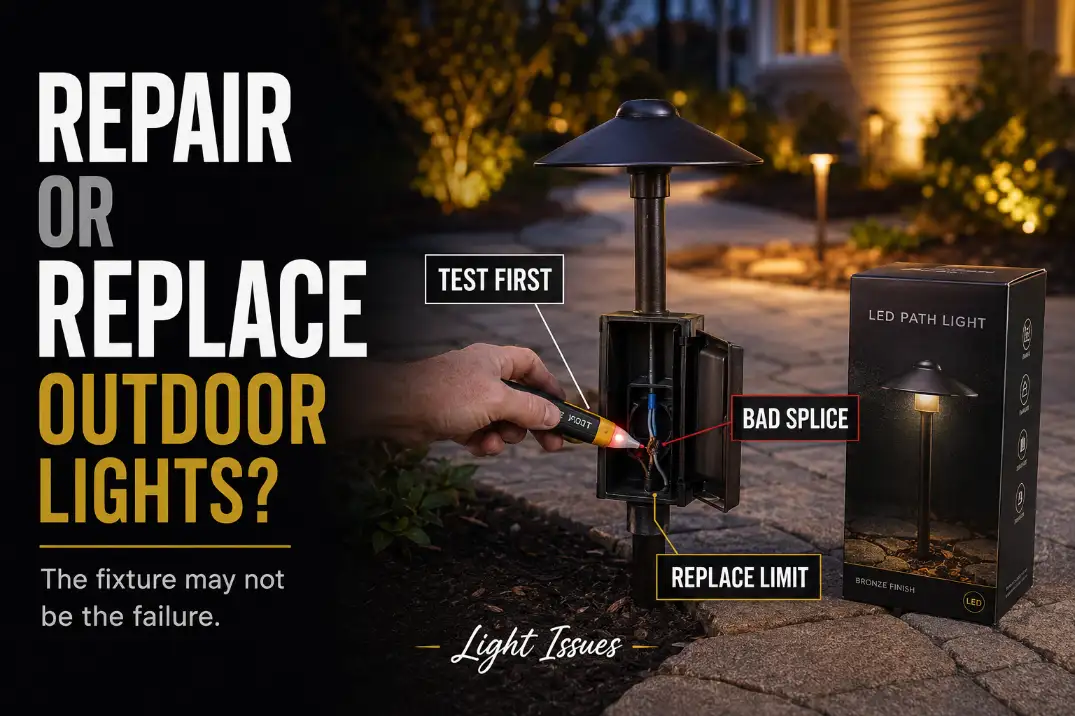
A stopped outdoor light is not automatically a bad fixture. The repair-or-replace decision depends on where the failure sits: upstream in the power source, beside the fixture at a splice or socket, or inside the fixture body itself.
Several lights failing together usually point to a system fault. One wet, cracked, overheated, or repeatedly failing fixture points more strongly toward replacement.
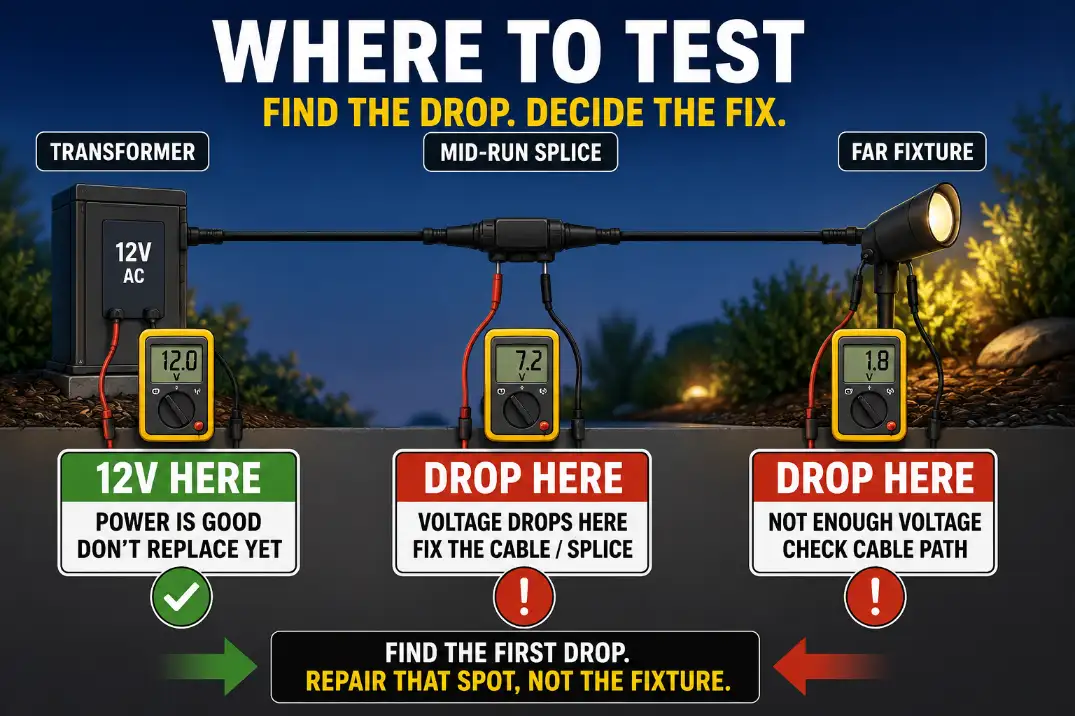
Start with three checks: whether nearby lights still work, whether the failure happens after rain, and whether the fixture receives usable voltage. In many 12-volt landscape systems, a fixture seeing about 11–12 volts is in a different category from one receiving 7–9 volts at the end of a long run.
A light that fails again within 24–48 hours after drying out is also sending a stronger replacement signal than one loose connection.
Decide by Failure Location, Not by the Visible Fixture
The visible fixture is where the problem shows up, but it is not always where the problem starts. This is the main reason outdoor lights get replaced too early.
Upstream faults usually deserve repair
If multiple outdoor lights fail at once, start with the shared parts of the system: outlet, GFCI, timer, photocell, transformer, cable run, or main splice. Three fixtures rarely fail at the same moment for separate reasons.
In low-voltage landscape lighting, a healthy fixture can look dead if the transformer is off, overloaded, mis-set, or feeding a weak cable run.
Before replacing anything, confirm that the system is actually sending power where it should. A broader look at low voltage landscape lighting problems can help separate transformer, cable, and fixture faults before money goes into the wrong part.
Local connection faults are often repairable
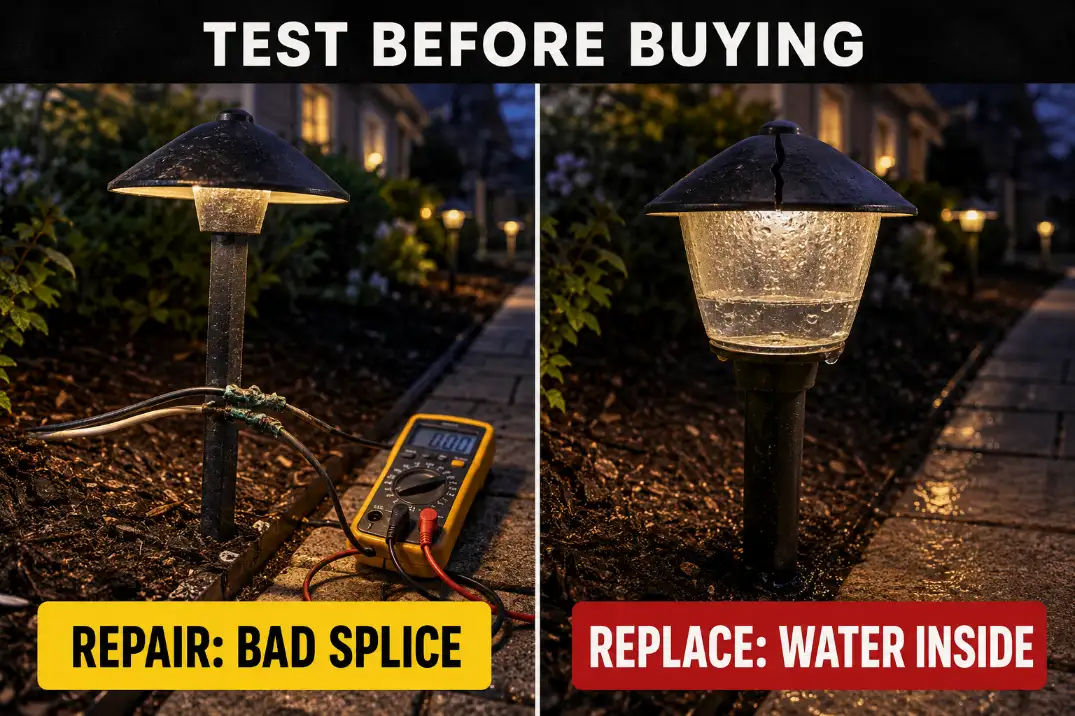
A single dead light with nearby lights still working often comes down to the immediate connection area. That may mean a loose splice, corroded connector, bad lamp contact, worn socket tab, or water around a cable entry point.
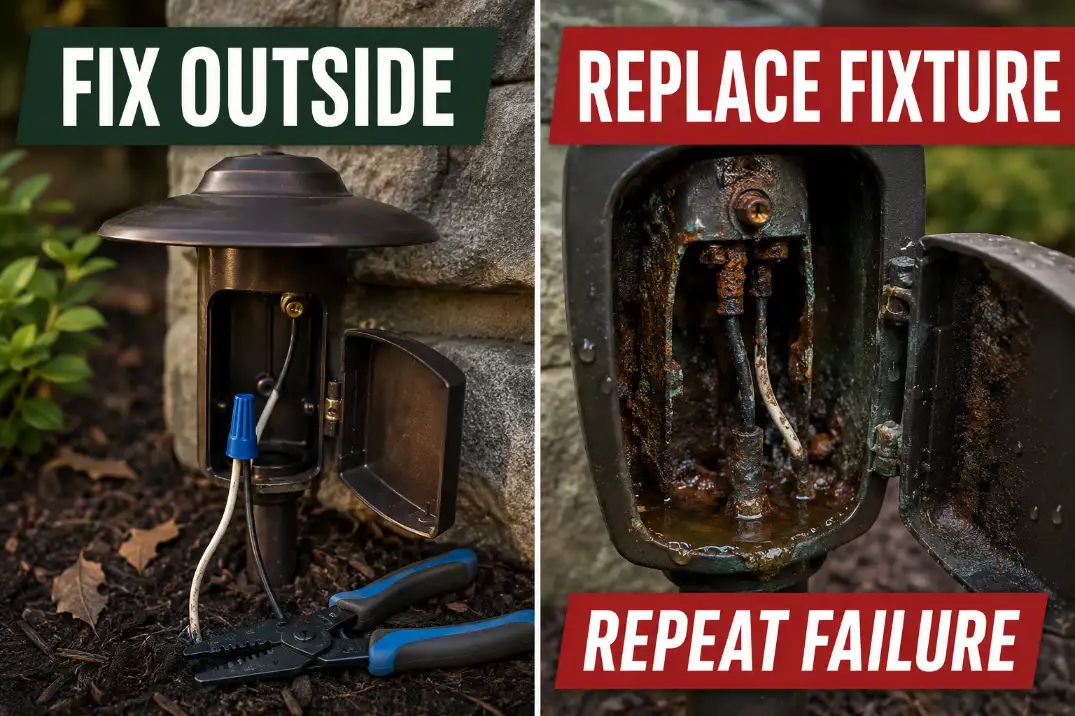
These are usually repair candidates if the fixture housing is still solid, the lens is intact, the gasket area is not brittle, and there is no visible heat damage. A small connector repair can sometimes restore a light that looked ready for replacement.
Internal fixture faults often justify replacement
Replacement becomes more logical when the failure is inside the fixture: standing water, internal corrosion, a failed sealed LED board, cracked housing, damaged socket, brittle gasket channel, or heat marks near wiring.
This distinction is important because an external repair can restore power, but it cannot rebuild a fixture that no longer keeps water, heat, or corrosion away from its working parts.
Replace an outdoor light when the fixture can no longer protect its own electrical components.
What People Usually Misread First
The most common mistake is treating “not working” as a fixture diagnosis. It is only a symptom. Outdoor lighting failures can look identical from the outside even when the causes are completely different.
A dead light is not the same as a dead fixture
A dead fixture can mean no power, low voltage, a failed sensor, a corroded connection, water inside the light, a bad LED driver, or a damaged socket. The symptom tells you where you noticed the failure. It does not tell you where the failure began.
A useful first split is single-light versus group failure. One dead light points more toward that fixture, its nearby splice, socket, or driver. Several dead lights in sequence point more toward a cable run, transformer load, timer, GFCI, or upstream connection.
Dimming is not always old age
Dimming is often blamed on aging LEDs, but low voltage and weak connections can create the same look. If lights farther from the transformer are noticeably weaker than lights near it, fixture age may not be the main issue.
In a healthier low-voltage run, brightness stays reasonably even from the first fixture to the last. In a failing or poorly loaded run, output drops as distance increases.
If voltage falls from about 12 volts near the transformer to below about 10.5 volts at the far fixture, that is a stronger system-design warning than a fixture-aging warning.
When added lights weaken the whole run, the issue may be load and layout rather than bad bulbs, as explained in why landscape lights get dimmer after adding fixtures.
Test These Before Buying New Lights
A good repair-or-replace decision usually needs a few focused checks, not a complete system rebuild. The goal is to find the failure boundary before you spend money.
Check power at the source
For plug-in or transformer-fed lights, confirm that the outlet, GFCI, timer, transformer, and photocell are actually working. If the power source is off, tripped, misprogrammed, or overloaded, a new fixture will fail the same way as the old one.
For line-voltage fixtures on a 120-volt circuit, do not open wiring boxes unless you are qualified and the circuit is safely shut off. If you are unsure where power is lost, the decision is not repair versus replacement yet. It is safe diagnosis first.
Test at the fixture, not only the transformer
A transformer can test fine while the far fixture is still starving. That is why testing only at the transformer can mislead you.
In a 12-volt landscape system, a fixture receiving around 11–12 volts is usually in a healthier range than one receiving 8–9 volts. The second case points toward voltage drop, undersized wire, poor splices, too many fixtures on a run, or a layout problem.
If voltage is good at the fixture and the light still does not work, the lamp, socket, driver, sealed LED module, or fixture body moves higher on the suspect list.
Watch what happens after rain
Rain timing is one of the best decision signals. A light that works in dry weather but fails during or shortly after rain usually has moisture reaching a connection, cable entry, socket, driver, or fixture cavity.
If the light recovers after 12–24 dry hours and then fails again after the next storm, the problem is not random. It is a water-triggered fault.
A guide to why outdoor lights work fine until it rains can help narrow whether the weak point is the fixture, splice, cable entry, or GFCI path.
Pro Tip: When a rain-related failure repeats twice, stop treating it as a one-time wet fixture. Repeated wet-dry recovery usually means water is still entering somewhere.
Know when testing should stop
Some signs move the decision out of normal DIY troubleshooting. Repeated GFCI trips, visible arcing, melted insulation, burning smell, heat marks, water inside a line-voltage fixture, or a breaker that trips again after reset should not be handled as a simple fixture swap.
If an outdoor circuit trips repeatedly after rain, the problem may be moisture reaching a fixture, box, cable, or connection point.
In that situation, replacing the most visible light may miss the actual fault. For that failure pattern, outdoor lights tripping GFCI outlets is a better diagnostic path than guessing at fixtures.
Repair or Replace: Practical Comparison
| Condition | More likely repair | More likely replacement | Why it matters |
|---|---|---|---|
| One fixture is out, others work | Bad lamp, socket contact, splice, or local connection | Failed sealed LED module or damaged fixture | The fault is local, so test before replacing |
| Several lights fail together | Transformer, timer, GFCI, cable run, or shared splice | Rarely all fixtures at once | Group failure usually points upstream |
| Far lights are dimmer | Redesign run, reduce load, improve wire path | Replace only if voltage is healthy | Low voltage can imitate weak fixtures |
| Light fails after rain | Rebuild wet splice or seal cable entry | Replace if water is inside the housing | Water location decides the repair |
| Same repair repeats in one season | Repair may no longer be worth it | Replacement becomes cleaner | Repeat failure means the weak point remains |
| Parts are sealed or unavailable | Limited repair options | Replace fixture | Many LED fixtures are not field-serviceable |
| GFCI trips repeatedly | Find moisture or wiring fault first | Replace only after fault is confirmed | Safety diagnosis comes before fixture buying |
When Repair Usually Wastes Time
Repair is worth trying when it changes the weak point. It becomes wasteful when it only resets the same failure for a few days or weeks.
Re-sealing a failed housing rarely restores it
Minor lens fogging is not always a reason to replace a fixture. Outdoor lights deal with temperature swings, and small amounts of condensation can appear when warm moist air cools at night.
Standing water is different. So is green corrosion, repeated bulb failure, moisture around the driver cavity, or water marks inside the fixture body.
Once water reaches internal electronics, drying the fixture may make it work briefly, but it does not restore the original weather barrier.
Adding sealant over a failed gasket or cracked cable entry often traps water instead of solving the entry path.
If the fixture has already let water reach the inside more than once, water inside outdoor light fixtures is usually a stronger replacement signal than a maintenance issue.
Replacing bulbs repeatedly hides socket or heat failure
If a replaceable bulb burns out once after years of use, that is normal maintenance. If bulbs fail every few weeks or every couple of months in the same outdoor fixture, the bulb may not be the real problem.
Heat buildup, a corroded socket, vibration, moisture, wrong bulb type, or a failing connection can all shorten lamp life. Replacing another bulb may make the light work again, but it does not fix the condition that is destroying bulbs.
Repair cost can cross the common-sense line
A repair does not need to be expensive to become wasteful. If the same fixture has to be opened twice in one season, or if a repair bill approaches about half the cost of a comparable new fixture, replacement deserves serious consideration.
That does not mean replacing a whole system because one light failed. It means the repeated-failure fixture has become the cost center.
The Fixture Type Changes the Decision
Different outdoor lights fail in different ways. The same symptom does not carry the same meaning across every fixture type.
Low-voltage path and landscape lights
For low-voltage path lights, repair is often the first move. These systems are vulnerable to loose splices, weak connectors, overloaded runs, voltage drop, yard-work damage, and transformer settings.
Replacement makes more sense when the individual fixture has a cracked body, damaged socket, water inside the housing, or a sealed LED module that has failed despite healthy voltage at the fixture.
Wall lights and post lights
Outdoor wall lights and post lights often sit on line-voltage circuits, so safety matters more. A bad bulb or corroded socket may be repairable, but heat marks, melted insulation, loose mounting boxes, or water inside the fixture should be treated seriously.
If the fixture body has lost its seal against rain, wind-driven moisture, or sprinkler spray, replacement is often cleaner than repeated patching.
Floodlights and security lights
Floodlights and security lights add another layer: sensors and drivers. A light that will not turn on may have a sensor issue rather than a bad fixture.
A light that flickers, buzzes, overheats, or fails repeatedly may have driver or heat-management trouble.
For sealed LED floodlights, internal repair is often impractical. If the sensor is separate, repair may be possible. If the driver, LED board, and housing are integrated, replacement is usually the realistic option.
For that specific failure pattern, see outdoor LED driver failure.
Solar outdoor lights
Solar lights deserve a different decision path. A dim or dead solar light may simply have a dirty panel, weak rechargeable battery, blocked sun exposure, or nearby artificial light confusing the sensor.
Replacement makes more sense when the panel is cloudy or cracked, the battery compartment is corroded, or the light still fails after a full sunny charging day with a known-good battery.
The Replacement Boundary
Sometimes replacement is simply the cleaner repair because the fixture has reached the point where small fixes no longer change the outcome.
Replace when the fixture can no longer keep water out
Outdoor fixtures are not just decorative shells. Their housings, gaskets, cable entries, drain paths, and lens seals protect electrical parts from water and debris. Once that protection fails repeatedly, the fixture becomes the weak point.
In humid Florida conditions, coastal California moisture, or freeze-thaw winters in northern states, a small opening can become a recurring failure path.
Water intrusion that freezes can widen cracks. Salt air can accelerate corrosion. Repeated sprinkler spray can attack the same gasket or cable entry several times a week.
A fixture that needs drying, cleaning, or re-sealing every season is usually past the practical repair line.
Replace when the fixture no longer fits the job
Sometimes the old fixture still works, but no longer solves the outdoor lighting problem. A dim path light may be technically functional while still missing the walkway.
A floodlight may still turn on but create glare, harsh shadows, or neighbor spill. A post light may work electrically but have a failing sensor or corroded socket that makes the fixture unreliable.
Repair keeps a suitable fixture alive. Replacement should solve a fixture that is wrong for the location, unsafe, internally damaged, or no longer worth maintaining.
Replace when sealed parts are unavailable
Many outdoor LED fixtures are not built like older bulb-and-socket fixtures. The LED board, driver, and housing may be integrated.
If the manufacturer does not sell the driver or LED module separately, the “repair” becomes a custom electronics project, not a normal fixture repair.
That does not mean every LED fixture should be discarded early. It means the decision should be honest. If the sealed part failed and replacement parts are unavailable, a new fixture is usually the practical repair.
A Simple Outdoor Light Decision Checklist
Use this checklist before buying anything:
- If several lights fail together, check the shared outlet, GFCI, timer, transformer, photocell, and cable run first.
- If one light fails but voltage at the fixture is healthy, inspect the lamp, socket, driver, sealed LED module, and fixture body.
- If the problem repeats within 24–48 hours after rain, look for water entry rather than random failure.
- If far-end low-voltage lights measure below about 10.5 volts, fix the run before replacing fixtures.
- If the fixture has standing water, cracked housing, internal corrosion, heat marks, or a damaged socket, replacement is usually smarter.
- If the same fixture needs the same repair twice in one season, stop treating it as routine maintenance.
- If a 120-volt fixture shows arcing, burning smell, melted insulation, or repeated breaker/GFCI trips, stop testing and get the wiring checked safely.
Questions People Usually Ask
Is it cheaper to repair or replace outdoor lights?
Repair is cheaper when the fault is a splice, timer, lamp, connector, sensor setting, or low-voltage layout issue.
Replacement is cheaper in the long run when a sealed LED module, corroded socket, cracked housing, or failed water barrier keeps causing repeat problems.
Should I replace all outdoor lights at once?
Not usually. Replace all fixtures only when they are the same age, same model, and showing the same physical decline, or when the system design no longer fits the yard.
If one light fails because of a local splice or water entry point, replacing every fixture is unnecessary.
How long should outdoor lights last before replacement?
There is no single reliable lifespan because moisture, heat, sun exposure, salt air, sprinkler spray, fixture quality, and installation quality all matter.
A fixture that works normally for years and needs one lamp or connector repair is not automatically old. A fixture that fails repeatedly in one season has crossed a more useful decision threshold than age alone.
Can I repair outdoor lights myself?
Low-voltage landscape lighting repairs are often homeowner-manageable when power is off and the work involves accessible fixtures, lamps, or splices.
Line-voltage outdoor fixtures, damaged wiring, tripping breakers, heat damage, or uncertain 120-volt wiring should be handled by a qualified electrician.
Final Decision
Repair the outdoor light when testing shows the fixture is still sound and the failure comes from power delivery, a connection, a lamp, a timer, a sensor setting, or a low-voltage layout issue.
Replace it when the fixture itself has become unreliable: water inside, cracked housing, failing sealed electronics, damaged socket, heat marks, or repeat failure after the same fix.
The biggest mistake is buying a new light before finding the failure boundary. A new fixture will not fix a weak cable run, a tripped GFCI, a poor splice, or a transformer overload.
But a careful repair will not rescue a fixture that can no longer keep water, heat, and corrosion away from its working parts.
For broader outdoor electrical safety guidance, see the Electrical Safety Foundation International.