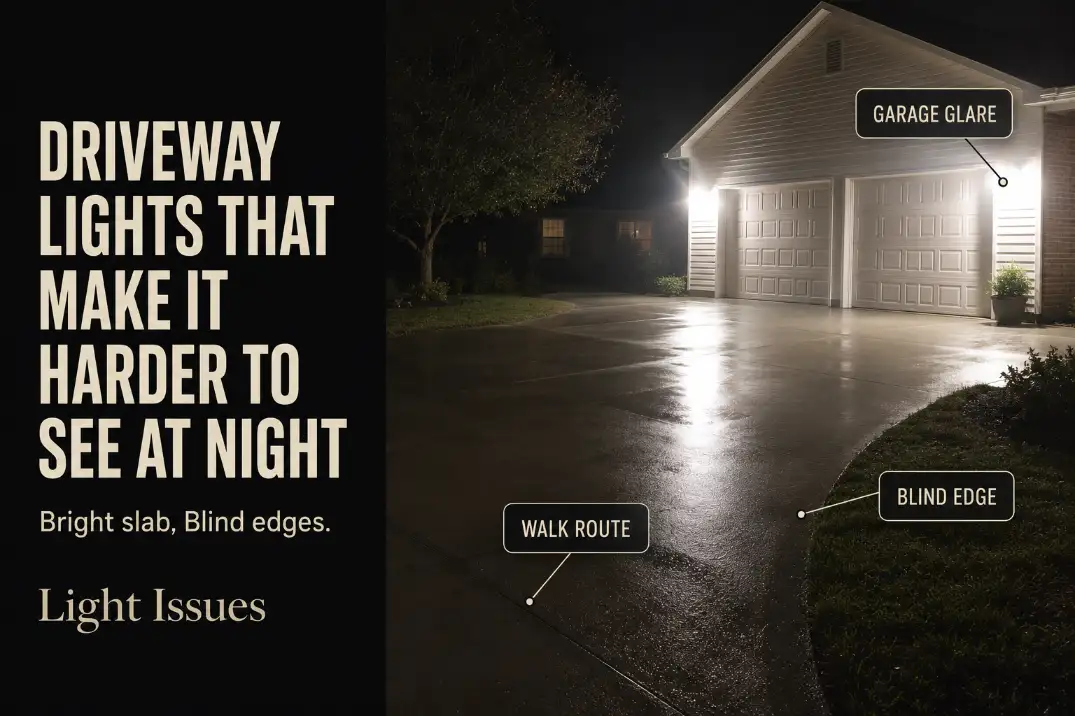
Driveway lights make it harder to see at night when they create contrast instead of usable visibility.
The usual problem is not that the driveway has too little light. It is that the brightest surface is the garage door, a wet concrete patch, or the fixture face itself, while the driveway edges and walking route stay weak.
The first fix is not a stronger bulb. It is checking what surface the light reaches first. From 25–40 feet away, you should be able to read both driveway edges, the car-to-door route, and the entry transition without staring into the fixture.
If your eyes need 3–5 seconds to recover after looking toward the garage, the light is already working against visibility. A good driveway setup makes the ground easier to read. A bad one makes the bright parts more obvious and the useful parts harder to trust.
Brightness Trap
A driveway can look brightly lit and still be harder to use. That is the brightness trap: the light makes the scene feel safer from a distance, but it does not help someone step out of a car, follow the edge of the slab, avoid a curb, or find the walkway turn.
Brightness is the symptom, not the answer
The center of a concrete driveway is often the easiest surface to light and the least important surface to over-light. If one garage floodlight creates a white patch in the middle of the slab, your eye adjusts to that patch first.
The side strip beside a parked car, the grass edge, the porch step, and the walkway corner can all look darker by comparison.
That is why some driveways feel worse after a fixture upgrade. The output increases, but the useful information does not.
This is the same failure pattern behind brighter outdoor lights creating worse visibility: more light lands in the scene, but not where the eye needs it.
The quick visibility test
Stand near the street or sidewalk and look toward the garage for 5 seconds. Then look at the driveway edges and the path someone would actually walk from a parked car to the house. If the fixture or garage face dominates your view, the driveway is not being lit in a balanced way.
A practical threshold: if you cannot identify both driveway edges within about 1 second after looking toward the house, the lighting is not just bright. It is uneven.
Garage Reflection
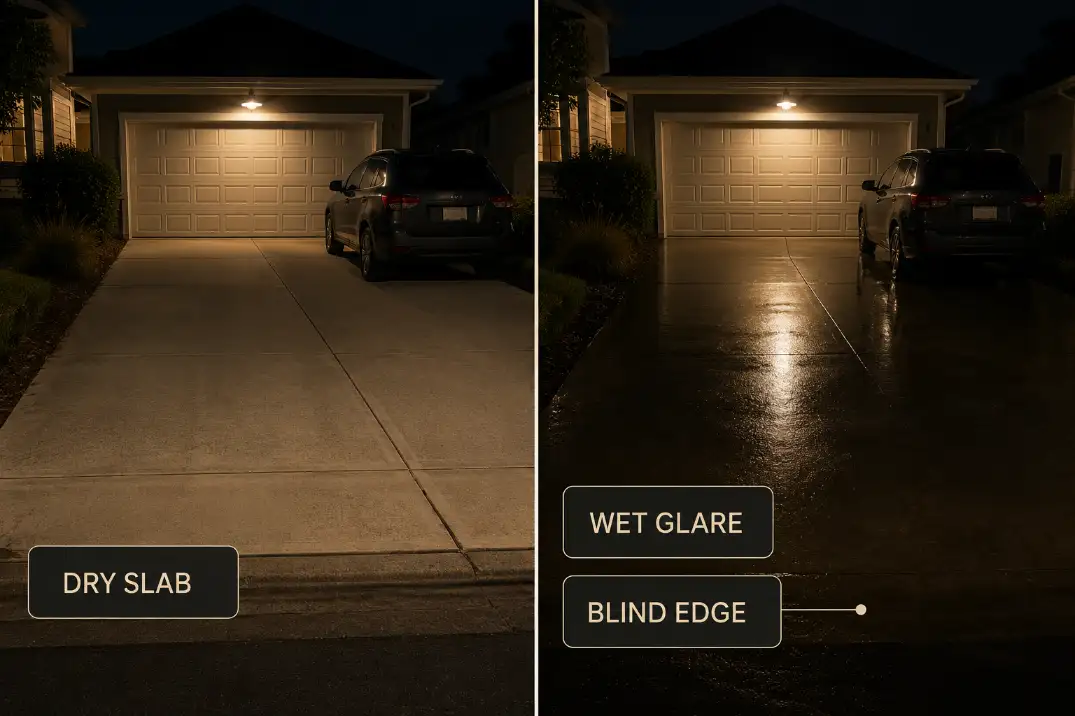
If the garage door is the brightest surface, the driveway light is no longer lighting the driveway first. It is lighting the garage face first, then forcing your eyes to adjust around that bright surface.
The garage door steals the scene
Pale garage doors, white trim, glossy paint, light stone, and smooth concrete can bounce light back toward the viewer. A fixture mounted high above the garage and aimed across the slab often hits these surfaces before it helps the walking route.
This is where many homeowners overestimate garage brightness. The garage door does not need to glow for the driveway to feel safe.
The higher priority is the 3–4 foot route from the driver-side door to the house, plus the edges where someone steps around a vehicle, planter, trash bin, or snow pile.
Wet concrete changes the result
A driveway that looks acceptable on a dry night can become harsh after 20 minutes of rain, sprinkler overspray, or heavy moisture. Damp concrete reflects more light back into the view, especially when the beam hits it at a shallow angle.
This matters because the fix is different. If the driveway only feels difficult after rain, the bulb may not be too dim. The beam angle may be wrong. Replacing the bulb with a brighter one often makes the wet-slab reflection more obvious, not less.
Aim Check: Test the driveway once dry and once after the surface is damp. If the wet version creates glare but the dry version does not, change angle or shielding before changing brightness.
Dark Edges
The edges of the driveway are more important than they look. They show where the slab ends, where a guest steps off the concrete, where tires track, and where the walking route narrows beside a parked vehicle.
Edge loss is a layout problem
Dark edges usually come from a light that is too high, too centered, or too focused on the middle of the slab. The driveway center may look clean and bright while the curb edge, grass line, side gate, or walkway turn disappears.
This is not a cosmetic issue. A driveway with strong center light and weak edge light creates the same kind of uneven reading problem found in outdoor lights with bright spots and dark gaps. The eye sees light, but the body still has to guess where the safe step is.
What counts as a problem edge
A driveway edge is underperforming when someone standing 10 feet from the garage can see the center slab clearly but cannot quickly identify where the concrete ends. The issue is stronger when the edge is next to gravel, lawn, mulch, a shallow curb, or a planting bed because those surfaces absorb light differently.
A healthier driveway does not make every surface equally bright. It gives the eye enough edge definition to understand the space quickly.
Walking Route
A driveway is not only a parking slab. At night, it becomes a walking route from the car, street, mailbox, trash cans, side gate, or front door. Many driveway lights fail because they aim at the driveway as a surface instead of the route people actually use.
Follow the real path
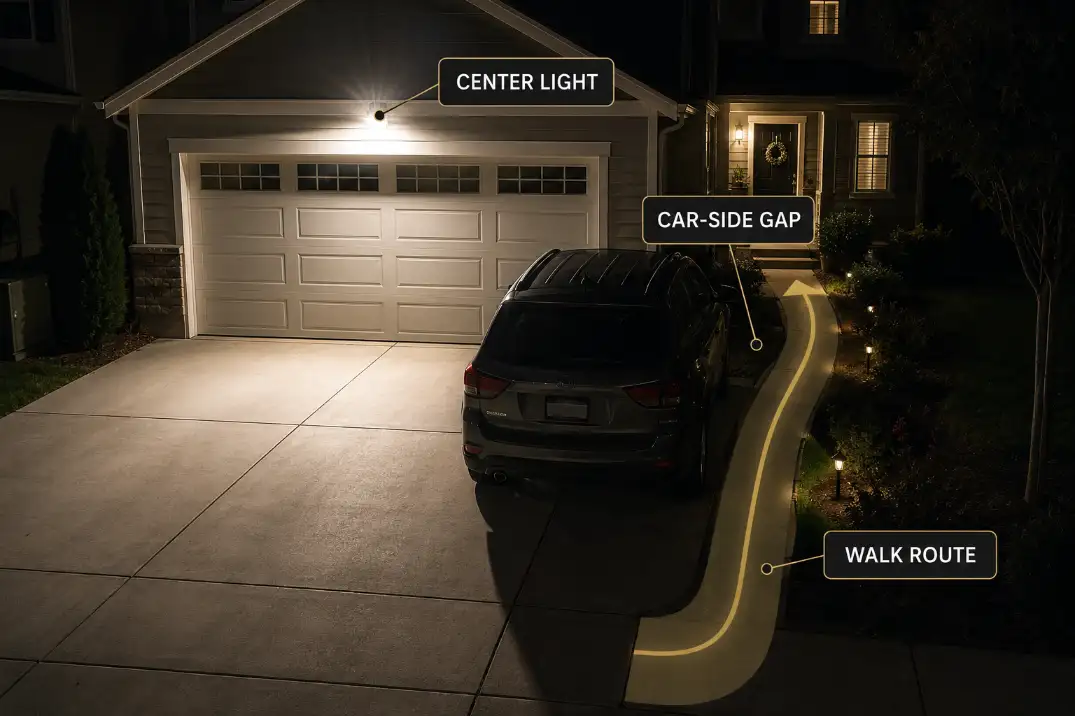
The official route may be the front walk. The real route may be diagonal from the driver-side door to the porch. If a car is parked close to one edge, the route may squeeze through a 24–36 inch gap between the vehicle and a planting bed. If someone parks at the curb, the route may start at the sidewalk instead of the garage.
Lighting the open middle of the driveway does not solve that. The useful zone is often beside the car, not in the empty center. This is where driveway lighting connects closely with motion lights that miss a walk path. Detection and visibility are not the same thing.
Park the car before judging the light
An empty driveway can make a bad lighting layout look better than it is. Park the car where it normally sits at night, then walk from the driver-side door to the entry. If the car blocks the light and creates a dark side gap, the fixture may be aimed at the wrong target.
A comfortable route is usually at least 36 inches wide, but even a narrower route can feel usable if the edge and entry transition are clear. The mistake is assuming the brightest part of the driveway is the safest part.
Beam Aim
Beam aim usually matters more than fixture power. A light that points into eyes, glass, garage panels, or wet concrete can reduce visibility even when the lumen rating looks strong. A light aimed lower and across the ground can feel calmer while showing more useful detail.
Keep the beam below the glare line
From the street or sidewalk, the fixture face should not be the first thing your eye notices. If the light feels harsh from 25–40 feet away, it is probably exposed enough to create glare. A small change in tilt, a shield, or a fixture with better cutoff can change the whole driveway without increasing output.
That is why aiming outdoor security lights should come before replacing bulbs. The same fixture can perform very differently after a small aim adjustment.
Do not chase maximum reach
Driveway lights do not need to reach far past the driveway. Lighting beyond the slab can create spill, neighbor conflict, and stronger contrast between the bright driveway center and darker side zones.
The more useful question is whether the first 10–15 feet of movement from the car and the last 6–8 feet near the entry are readable. If those areas are weak, a stronger bulb in the same exposed fixture is usually a wasted fix.
When adjustment stops making sense
If the fixture still shines into your eyes after aiming, or if it cannot light the walking route without blasting the garage door, the problem may be fixture design rather than setup.
At that point, a shielded, lower-glare fixture is a better decision than another brightness upgrade, and a guide to best low-glare outdoor security lights becomes more useful than comparing raw output numbers.
Better Driveway Zones
The best driveway lighting layouts do not treat the whole driveway as one target. They separate the driveway into useful zones: edge, walking route, entry transition, garage face, and vehicle area.
Prioritize the zones that guide movement
The highest priority is the walking route and driveway edge. The medium priority is the entry transition where someone moves from driveway to door, step, or side gate. The lowest priority is making the garage face look bright.
The garage face should be visible, but it should not be the visual anchor of the driveway. A softly readable edge does more for safe movement than a glowing garage door.
Use layers instead of one hard blast
A good driveway often works better with one moderate primary light and one softer support point than with one powerful garage-mounted floodlight.
The support light might be near the walkway, entry turn, side path, or low edge zone. It should fill the route, not compete with the main fixture.
| Driveway signal | What it usually means | Better first move |
|---|---|---|
| Garage door looks brighter than the ground | Reflection is controlling visibility | Lower aim or add shielding |
| Center slab is bright but edges disappear | Light is too concentrated | Add softer edge support |
| Wet nights feel worse than dry nights | Damp concrete reflection is part of the issue | Change beam angle before bulb power |
| Walking beside parked cars feels uncertain | Route is not being lit | Light the car-side path |
| Fixture feels harsh from the street | Glare source is exposed | Use shielded, lower-glare aim |
Keep the entry transition calm
The driveway should not end in a dark porch step, side gate, or garage entry. The transition needs enough light for foot placement and lock use, but not so much that it becomes another glare point.
If the entry light blinds the person approaching from the driveway, it creates a second brightness trap. The better result is a gradual move from driveway edge to walking route to entry, without one surface overpowering everything else.

Quick Diagnostic Checklist
Use this after dark with the driveway in its normal condition, not perfectly empty.
- Stand 25–40 feet away and check whether the fixture face feels harsh.
- Look for a garage door or concrete patch that appears brighter than the walking surface.
- Park the car normally before judging the route.
- Walk from the driver-side door to the entry and note any dark side gap.
- Repeat the test after rain or sprinkler spray if the driveway becomes reflective.
- Check whether both driveway edges are readable within about 1 second.
- Adjust aim before increasing bulb brightness.
What Usually Matters Most
The most likely cause is not that the driveway needs more light. It is that the brightest light is landing on the least useful surface. Garage doors, wet slabs, pale walls, and exposed fixtures can dominate the eye while the actual route stays weak.
The best fix is selective: reduce glare, lower the beam, soften the edge, and support the route people really walk. A driveway should not look dramatically bright from the street. It should feel easy to use when someone steps out of a car.
For broader official guidance on lighting quality and glare, see the Federal Highway Administration Lighting Handbook.