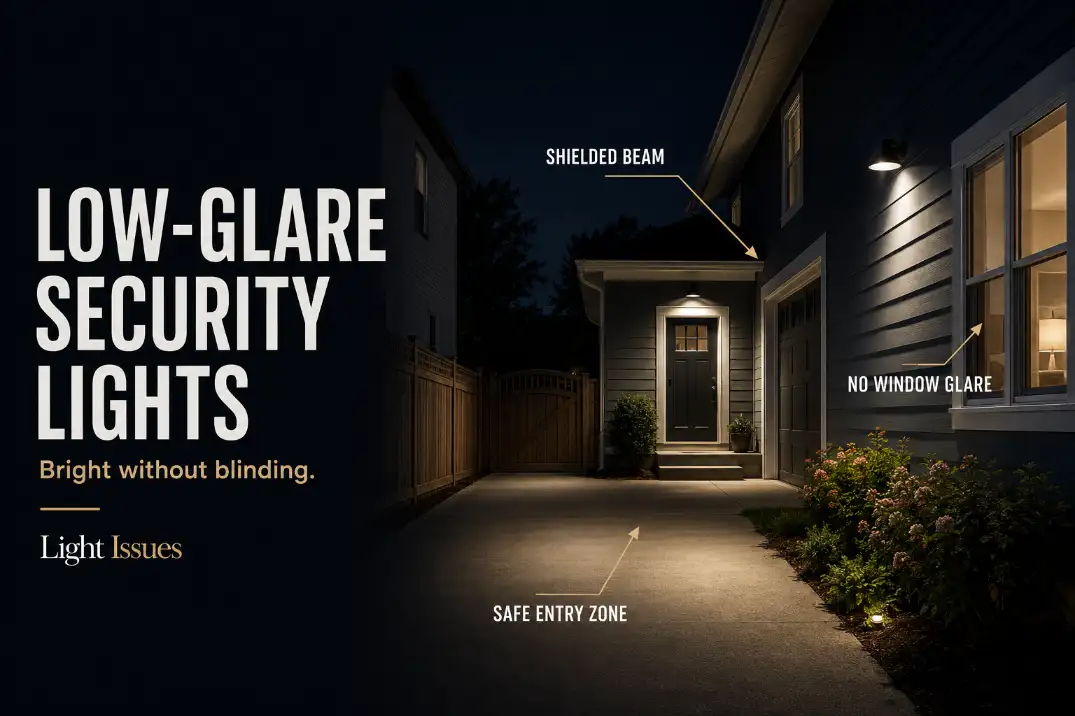
The best low-glare outdoor security lights do not simply throw more light across the yard.
They put enough light on the driveway, back door, garage corner, or side path while hiding the bright LED source from your eyes, your windows, and your neighbor’s property line.
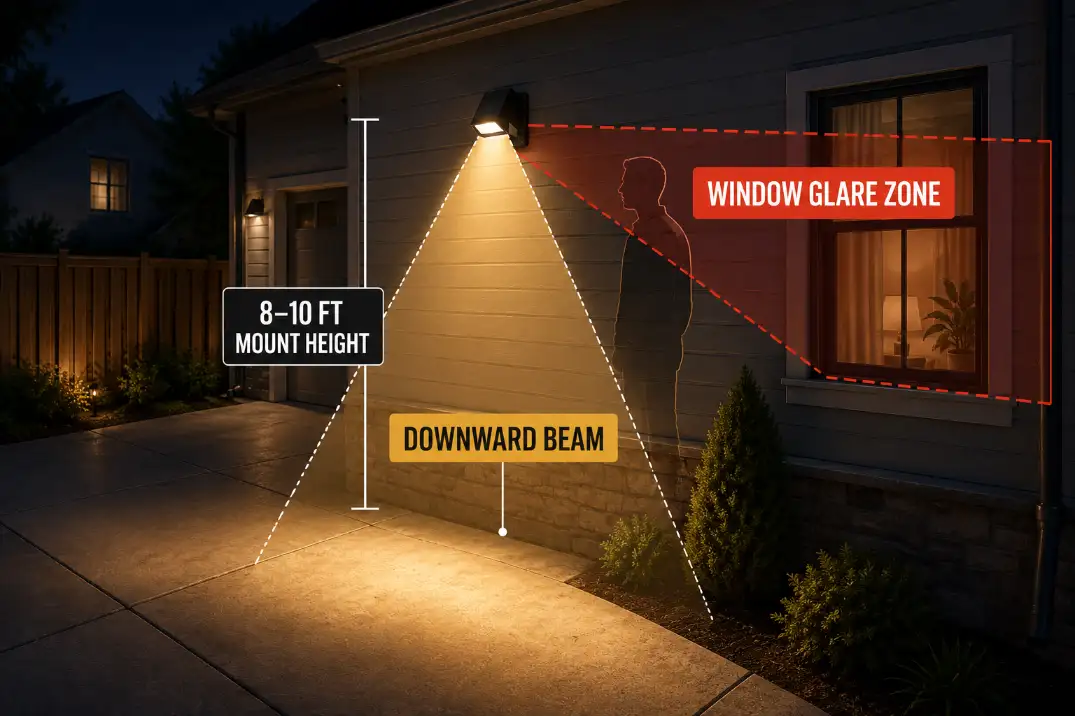
For most homes, that means a shielded fixture, warm white light around 2700K to 3000K, a motion timer in the 30- to 90-second range, and a beam aimed down from about 8 to 10 feet high.
The first mistake is buying a brighter floodlight to fix a visibility problem. If the bare LED is visible from 25 feet away, glare is already part of the problem.
A 700- to 1600-lumen controlled fixture often feels safer than a 3000-lumen unshielded flood because it lets your eyes read steps, door hardware, vehicle edges, and walking routes without forcing everything into a white glare field.
Quick Buying Decision: Match the Light to the Area
Best for driveways: shielded adjustable motion lights
Driveways need wider coverage than a back door, but the beam should still land on pavement, parked vehicles, and the walking route. A shielded dual-head motion light usually works better than a bare high-output flood because each head can be aimed separately.
Use one head for the car-door area and one for the walking path toward the garage or entry. Do not aim both heads straight outward just to cover more distance. That often lights the street, windows, or neighbor side before it improves the usable driveway zone.
Best for back doors: compact warm security lights
Back doors need predictable light, not maximum output. A small landing, step, lock, pet area, or trash-bin route often works well with 400 to 900 lumens if the light is close, shielded, and aimed downward.
This is where buyers often overestimate brightness. A harsh 2500-lumen light over a 6-foot landing can make the entry feel exposed without helping you see the lock, step edge, or handle more clearly.
Best for side yards: narrow low-glare fixtures
Side yards are the easiest place to create glare by accident. A 4- to 6-foot passage between a house and fence can bounce light off siding, windows, gates, and pale concrete. A wide flood often lights too much vertical surface and not enough walking path.
Choose a narrow shielded motion light, a small directional fixture, or a side-facing light that can skim the ground. The goal is not to illuminate the whole side wall. The goal is to make the route readable.
| Area | Best low-glare choice | Usually avoid |
|---|---|---|
| Driveway | Shielded adjustable motion light | Bare 3000+ lumen flood aimed outward |
| Back door | Warm compact security light | Cool white always-on flood |
| Side yard | Narrow downward beam | Wide flood with exposed LED panels |
| Garage corner | Adjustable heads with cutoff control | Fixed-angle fixture that cannot tilt down |
| Neighbor-facing wall | Shielded or semi-cutoff fixture | Light with visible LEDs from the property line |
What Actually Makes a Security Light Low-Glare
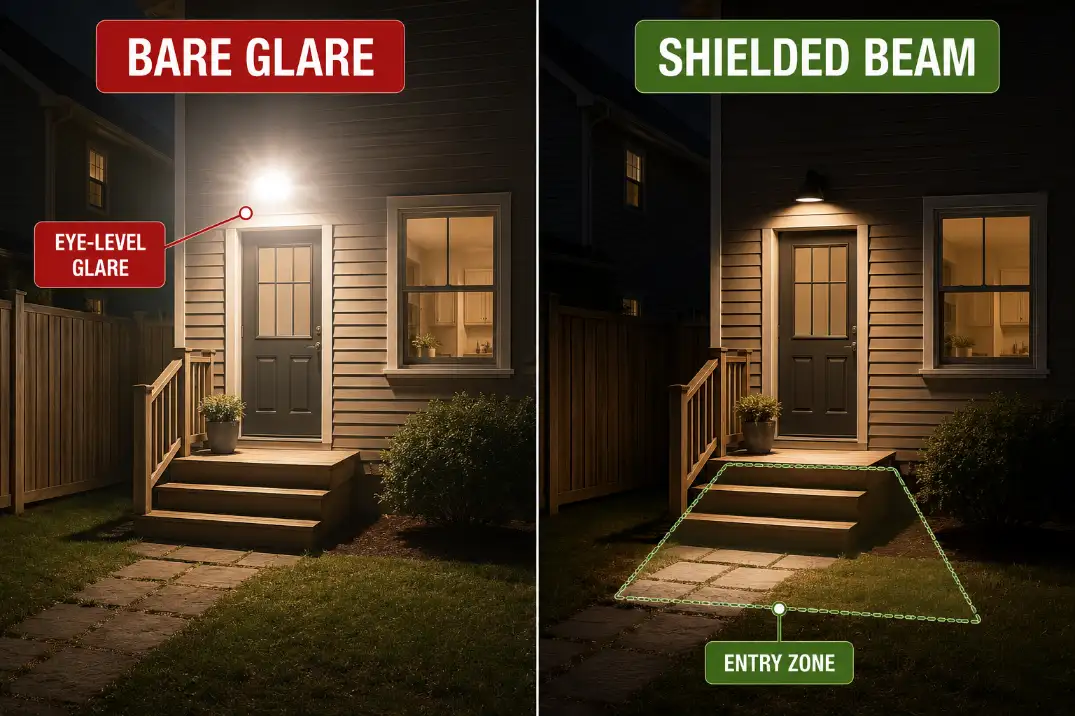
Glare near a window, door, sidewalk, or neighbor-facing wall is not a brightness problem first. Start with a shielded wall fixture, because this category controls the light source before it adds more output.
BEST FIRST FILTER
Shielded low-glare outdoor security lights
Choose this when the light is near windows, doors, sidewalks, or a neighbor-facing wall.
Look for a covered light source, downward aim, warm white output, and outdoor-rated construction.
🟦 SHOP motion sensor outdoor wall sconces
Shielding matters more than raw lumens
A security light can be too bright, but glare usually starts with exposure, not output. If the LED panel, bulb, or reflector is directly visible from normal standing height, the fixture can feel harsh even at moderate brightness.
A shielded fixture hides the brightest point and pushes light downward. That improves contrast because your eyes are not fighting the light source itself.
This is why a lower-output shielded light can make steps, trash bins, locks, and driveway edges easier to see than a stronger unshielded flood.
The symptom is glare. The mechanism is poor light control. Adding more lumens treats the symptom backward.
Warm white is usually the safer residential choice
For most residential security lighting, 2700K to 3000K is the safer buying range. Cool 5000K light can look crisp in product photos, but on white siding, pale concrete, wet pavers, snow, and windows, it often feels harsher than expected.
Warm light does not mean weak light. It simply reduces the sharp blue-white cast that makes outdoor fixtures look more aggressive than they need to be. This matters most near patios, bedroom windows, side gates, and neighbor-facing walls.
Motion settings should be adjustable
Motion security lights often fail because they trigger too broadly, stay on too long, or switch on at full brightness for minor movement. For many homes, a useful detection range is about 20 to 40 feet.
Longer detection can help on a deep driveway, but it can also catch passing cars, tree movement, pets, or sidewalk traffic.
A 30- to 90-second timer is usually enough for entries, bins, gates, and short driveway tasks. A light that stays on for 5 minutes after every small trigger can become more annoying than protective.
Aim Check: If you can stand at the property line and see the bright LED source directly, the fixture is not low-glare in practice, even if the product listing says “soft,” “warm,” or “eye-friendly.”
Check Outdoor Rating Before Brightness
Wet exposure changes the buying decision
Do not buy an outdoor security light on lumens alone. A fixture under a covered porch has a different exposure level than one mounted beside an uncovered driveway, fence gate, detached garage, or side wall.
For exposed areas, prioritize fixtures rated for wet locations or direct outdoor exposure. A protected porch may tolerate a less exposed fixture, but driveway corners, side yards, and uncovered back doors need a housing, lens, wiring compartment, and finish built for rain, wind-driven moisture, and repeated temperature swings.
Cheap bright fixtures often fail in the wrong place
A low-cost high-output light may look strong on the first night, but that does not make it the best security choice. If the housing traps moisture, the motion sensor becomes unreliable after a few storms, or the finish starts corroding in coastal air, the extra brightness did not solve the real problem.
This matters in humid parts of Florida, rainy Midwest seasons, coastal California areas, and northern states where freeze-thaw cycles and snow reflection can make outdoor fixtures work harder.
The best light is not only bright enough. It is built for the place where it will live.
When Solar or Battery Motion Lights Make Sense
Good for gates, sheds, and short routes
Solar and battery motion lights can be useful when wiring is inconvenient. They make the most sense on sheds, gates, fence-side paths, detached storage areas, and short side-yard routes where you need brief light rather than full driveway coverage.
They are not the first choice for the main driveway security zone unless the location gets reliable sun and the light has enough runtime for repeated nighttime triggers.
This is especially important in shaded side yards or winter conditions when solar charging time may drop.
Runtime matters more than peak brightness
A solar or battery light that is bright for the first few activations but weak by late evening may disappoint in real use. Look for a practical motion mode, replaceable batteries when possible, and a sensor zone that can be narrowed.
For side yards, a smaller controlled light that turns on reliably for 30 to 60 seconds is usually more useful than a larger fixture that fades, over-triggers, or lights the fence more than the path.
Short, hard-to-wire routes need a different buying filter. Solar or battery motion lights make sense for small task zones, but the main driveway security area still needs reliable sun, runtime, and repeated-trigger performance.
BEST FOR HARD-TO-WIRE SPOTS
Solar or battery low-glare motion lights
Choose this for gates, sheds, side paths, and detached corners where wiring is not practical.
Look for a shielded face, outdoor exposure rating, reliable runtime, and a narrow motion zone.
🟦 SHOP solar motion sensor security lights
🟦 SHOP battery powered motion sensor lights outdoor
What to Avoid Before You Buy
Bare LED panels facing outward
The most common bad purchase is the exposed-panel security light that looks powerful online and harsh on the wall. These fixtures can work in isolated utility areas, but near homes they often create the exact problem low-glare buyers are trying to avoid.
If the product photo shows LED panels facing straight forward with no hood, lip, lens control, or cutoff shape, assume glare control is limited.
Cool white lights near reflective surfaces
White siding, pale concrete, wet pavers, snow, and glossy garage doors all increase the harshness of outdoor lighting.
In northern states during winter, snow cover can make an already-bright fixture feel dramatically stronger. In humid or rainy areas, wet pavement can reflect glare back toward windows and drivers.
This is where buyers often underestimate reflection. The fixture is only one part of the result. The surface receiving the beam changes how harsh the light feels.
Always-on security floods
An always-on flood can make a yard feel exposed without making it safer. For many homes, motion-based lighting with a controlled beam is more useful because it draws attention when something changes. It also avoids hours of unnecessary spill.
The standard fix stops making sense when you keep increasing wattage or lumens but still cannot see comfortably. At that point, the issue is not lack of light. It is poor aiming, exposed brightness, bad color temperature, weak weather suitability, or the wrong fixture type.
Quick Questions Before Choosing
Are low-glare security lights less safe?
No. A low-glare fixture can be safer because it improves contrast. Security lighting should help you see faces, steps, edges, locks, and movement. If the light makes you squint or turns everything behind it dark, it is working against visibility.
Is 5000K better for security?
Usually not for residential areas. Cool white light can look intense, but intensity is not the same as useful visibility. Around 2700K to 3000K is often more comfortable near doors, windows, and patios while still giving enough light for security tasks.
Should I buy the brightest motion light available?
Only if the area is large enough and the fixture gives you control. A 3000- to 5000-lumen light with exposed heads can be the wrong choice for a short driveway, back door, or side yard.
Start with shielding, aim, motion settings, weather suitability, and beam placement; then choose output.
What is the simplest buying rule?
Buy the fixture that hides the light source and lights the surface you actually use. If you can see the bright LED more clearly than the ground, door, path, or driveway edge, it is not the right security light for a low-glare setup.
When a security light starts lighting the sky, windows, or neighbor side instead of the task area, compare the setup with DarkSky International’s Five Principles for Responsible Outdoor Lighting.