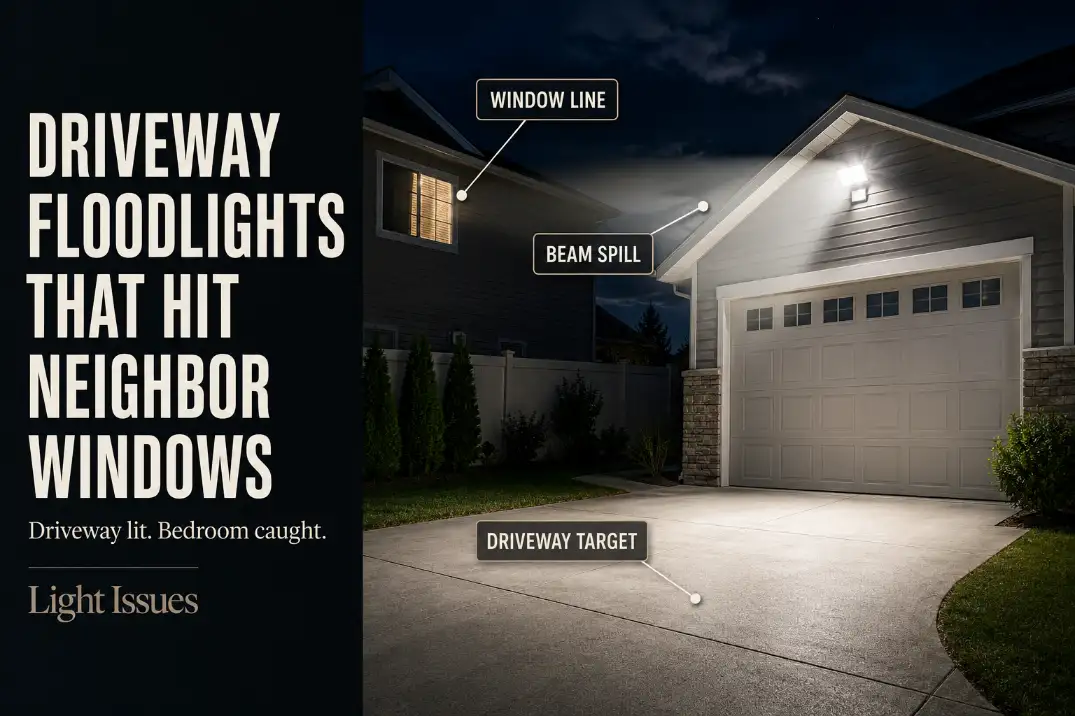
Driveway floodlights usually hit neighbor windows because the beam edge is too high, the fixture face is visible from the side, or the motion cycle keeps the light on too long.
This is usually not a simple “too many lumens” problem. A 1,200-lumen fixture aimed into glass can be more intrusive than a brighter fixture aimed cleanly down at pavement.
Start with three checks: where the upper beam edge lands, whether the lamp face is visible from the neighbor-side view line, and whether the light stays on longer than 30–90 seconds after motion.
If a bedroom window glows every time a car passes or someone walks up the drive, the problem is light trespass, not just normal driveway security lighting.
The fix is also more specific than “use a dimmer bulb.” Aim the light down first, control side spill second, shorten the runtime third, and replace the fixture only when it cannot keep the beam on the driveway.
Window Line
Start at the receiving side
The first useful test is not standing under the fixture and deciding whether it looks bright. From that position, almost every floodlight looks more controlled than it really is.
The better test is the view from the receiving side: the neighbor-facing property edge, shared driveway line, sidewalk, or curb angle that looks back toward the light.
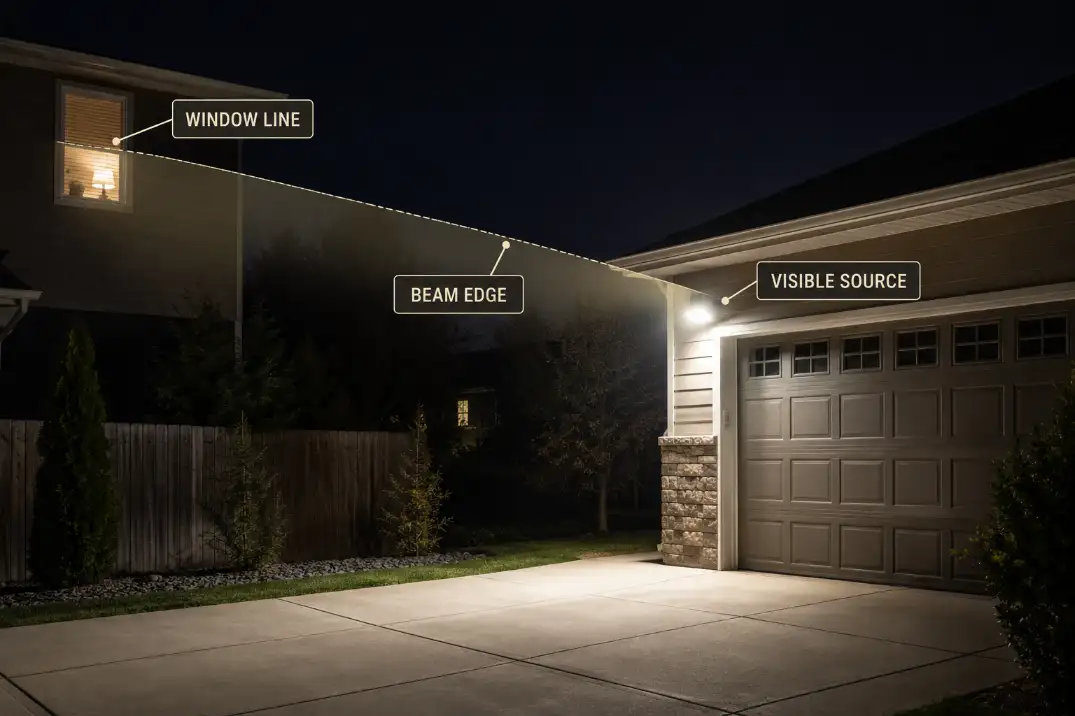
After full dark, stand on your side of the property and look toward the fixture from the neighbor-window direction. If the glass or curtain line catches a defined bright patch, the beam edge is too high.
If the wall around the window glows without one sharp patch, the beam may be too wide. If the fixture itself looks harsh from that angle, glare is part of the problem even before the beam pattern is corrected.
This is different from a driveway visibility problem. Your driveway can look bright while the light is still aimed badly.
When glare also makes your own pavement harder to read, the issue overlaps with Driveway Lights That Make It Harder to See at Night, but the neighbor-window version is more about where the upper beam travels.
Time changes the nuisance
A floodlight that turns on for 20 seconds is usually less disruptive than one that stays on for 10 minutes. The beam path may be the same, but the impact changes. For many residential driveways, a 30–90 second motion setting is enough for parking, unloading groceries, or walking to the garage entry.
A long timer is one of the most underestimated causes of neighbor complaints. The light may only trigger a few times, but each trigger becomes a long room-lighting event. Before replacing the fixture, reduce the on-time and test one full motion cycle from the neighbor-side view line.
Beam Angle
The upper edge is the real boundary
A driveway floodlight should not be judged only by where the brightest center lands. The upper edge of the beam is what usually reaches the neighbor window.
If the center looks acceptable but the upper spill crosses a fence, garage side wall, or second-story window line, the fixture is still aimed too high.
A small adjustment can matter. With a garage-mounted light, lowering the head by 5–10 degrees can move the hot zone several feet lower by the time the beam reaches the side property line.
That is why aiming should happen at night, with the light on, not by guessing from daytime fixture position.
The practical target is simple: the strongest light should land on the driveway surface, walking path, or garage entry zone. If it lands on siding, glass, a fence top, or the neighbor’s upper wall, the beam is doing more than driveway work.
For a broader aiming method, How to Aim Outdoor Security Lights Without Glare fits this step better than another brightness adjustment.
| Night signal | More likely mechanism | First fix |
|---|---|---|
| Bright patch on neighbor glass | Beam edge too high | Re-aim fixture downward |
| Whole wall softly glowing | Beam too wide | Add side shielding or narrower beam |
| Lamp face visible from side | Source glare | Use shielded fixture or visor |
| Light stays on after motion ends | Timer too long | Reduce runtime to 30–90 seconds |
| Driveway goes dark after re-aiming | Wrong fixture pattern | Use better-controlled coverage |
The dimmer-bulb fix often disappoints
Lower output can reduce the intensity of the complaint, but it does not move the beam. If the floodlight is still aimed into the same window line, the neighbor may still see the same repeated glow, just slightly weaker.
That is the routine fix that often wastes time. Brightness is the symptom people notice. Direction is the mechanism that usually needs correction.
Mounting Height
Higher is not automatically better
Many garage floodlights are easiest to control when mounted around 8–10 feet above the driveway.
That height is usually high enough to cover the parking area and walking route, but still low enough that the beam can be aimed down without overshooting the property.
At 12 feet or higher, the margin gets tighter. A fixture mounted high on a garage face or near a second-story wall can throw light farther than expected, especially on narrow suburban lots where the neighboring house may sit only 10–20 feet away.
A tiny upward angle can send the upper beam into a bedroom window instead of onto the driveway.
People commonly overestimate mounting height because higher lights look more “security focused.” But a high, bare floodlight can become a shallow-angle light cannon. The better rule is controlled direction first, coverage second, brightness third.
When lowering the aim creates dark gaps
If lowering the head fixes the neighbor window but leaves your own driveway edges dark, do not immediately tilt the beam back up.
That usually recreates the same conflict. The better answer may be a fixture with a narrower beam, a shielded head, or a second lower-output light aimed only at the missing walking route.
This is where the standard fix starts to reach its limit. A poorly located floodlight cannot always be saved by aiming alone.
Wide Spill
Side spill is the hidden conflict
A driveway can look properly lit from the garage while the side edge of the beam still crosses the property line. This is common with twin-head floodlights, wide LED panels, and fixtures turned slightly across a shared driveway.
Wide spill is easy to underestimate because it may not create a dramatic bright patch on glass. Instead, it softly fills the neighbor’s wall, blinds, or room every time the light turns on. From your side, that can look harmless. From the receiving side, it can feel like a repeated indoor light.
Motion settings make this worse. If the sensor is aimed toward the street, a tree branch, or the shared driveway approach, the floodlight may trigger far more often than actual driveway use requires.
When the trigger pattern is part of the conflict, Motion Sensor Lights That Surprise Neighbors at Night is the closer companion issue.
Direct hit and wide spill need different fixes
A direct window hit usually needs a lower aim. Wide spill usually needs side control. Those are not the same repair.
If the beam center is too high, aim the head down. If the side edge keeps leaking, add a shield or use a fixture with better cut-off.
If the sensor is triggering too often, shorten the range or narrow the detection area before changing the light head.
Pro Tip: Make the final adjustment with someone standing near the neighbor-side view line. The person at the fixture can turn the head; the person at the receiving angle can tell when the beam actually leaves the window.
Shielded Fix
Fix the path before replacing the light
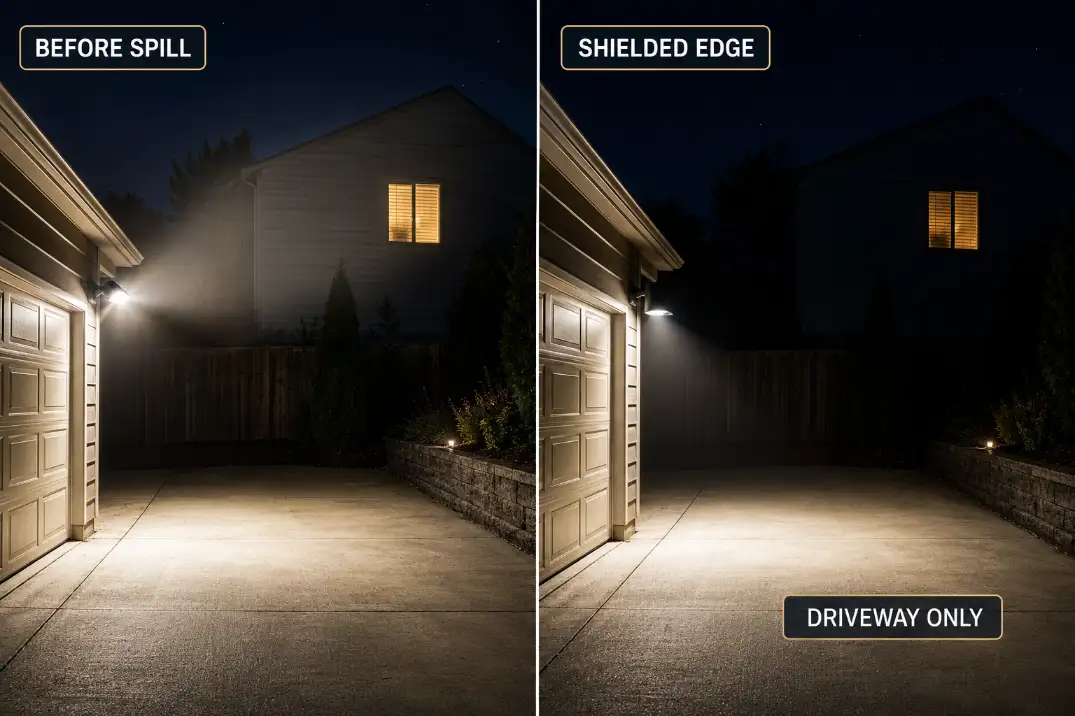
The clean repair order is aim, shield, timer, then replacement. Replacing the fixture first can work, but it is not always necessary. Many driveway floodlights stop bothering a neighbor once the upper edge is lowered and the side spill is blocked.
Start by aiming the brightest part of the beam onto pavement. Then check whether the neighbor-facing edge still leaks sideways. If it does, a proper side shield, hood, or cut-off fixture can block that edge while keeping useful light on the driveway.
Avoid temporary materials on the fixture face. Tape, cardboard, painted lenses, or improvised covers often fail outdoors and can create heat or weather problems.
If the fixture needs a crude homemade patch to behave, it is usually the wrong fixture for that driveway.
Replace when the fixture cannot control the source
Replacement starts making sense when three things are true: the beam still reaches the neighbor after careful aiming, the fixture still shows a harsh face from the side, and shielding would block the driveway area you actually need.
That is usually a fixture-control problem, not a homeowner effort problem. A shielded, downward-facing security light or a better cut-off fixture can keep the driveway readable without throwing light into the room next door.
If the existing fixture is a bare wide floodlight, a more controlled option from Best Low-Glare Outdoor Security Lights is a more useful next step than chasing slightly lower lumen numbers.
The goal is not to make the driveway dim. It is to make the light stop at the job.
Neighbor View Test
Test the result from the conflict angle
After adjusting the light, repeat the same receiving-side test. Stand near the property edge or shared driveway line after full dark. Watch one full motion cycle.
The driveway should remain readable, but the neighbor window should no longer catch the beam edge, the fixture face, or a bright wall glow.
A good result has four signs: the lamp source is not directly harsh from the side, the hot spot lands on pavement, the motion cycle ends within a practical window, and the driveway walking route still has enough light to use safely.
If the property line is tight, do not judge success from your garage door. Tight lots and shared drives change the view angle.
In those cases, Shared Driveway Lights and Neighbor Conflict is worth using as a layout check, because the light may be technically on your property while still aimed into someone else’s living space.
Quick diagnostic checklist
- The neighbor window shows a bright patch, not just a faint distant glow.
- The floodlight face is visible from the neighbor-side view line.
- The beam center lands on siding, fencing, or glass instead of pavement.
- The light stays on longer than 90 seconds after normal motion.
- The fixture is mounted high enough that small aim changes send light across the property line.
- Lowering the aim fixes the window but creates dark driveway gaps.
- A side shield helps, but the fixture source still looks harsh from the side.
A driveway floodlight that hits neighbor windows is usually not a sign that security lighting is wrong. It is a sign that the light is leaving its target area.
Aim the beam edge below the window line, block side spill, shorten the motion cycle, and only replace the fixture when it cannot control the source.
For broader responsible outdoor lighting guidance, see DarkSky International’s Five Principles for Responsible Outdoor Lighting.