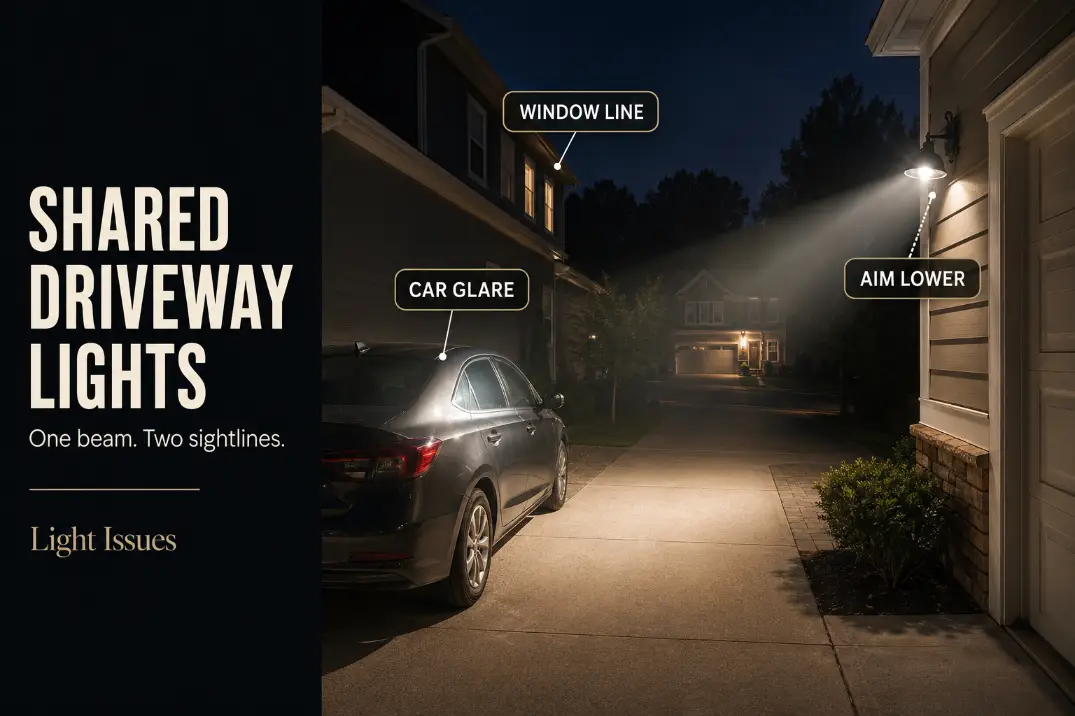
Shared driveway light conflict is usually a sightline problem before it is a brightness problem.
The fixture may light your side of the pavement, but if the source is visible from a driver’s seat, the beam rises into a neighbor’s window line, or the motion sensor watches the shared lane, the light starts controlling space that is not fully yours.
The first checks should happen from real use positions: sit in a parked car, stand near the nearest neighbor-facing window line, and walk the shared edge after full dark.
If the light source is visible from about 36–48 inches above the driveway, or the fixture stays on for 5–10 minutes after ordinary shared-lane movement, the setup is probably too exposed.
The goal is not a darker driveway. The goal is useful light that stays low, timed, and aimed at the task area.
Car Glare
Start where a driver actually sees the light
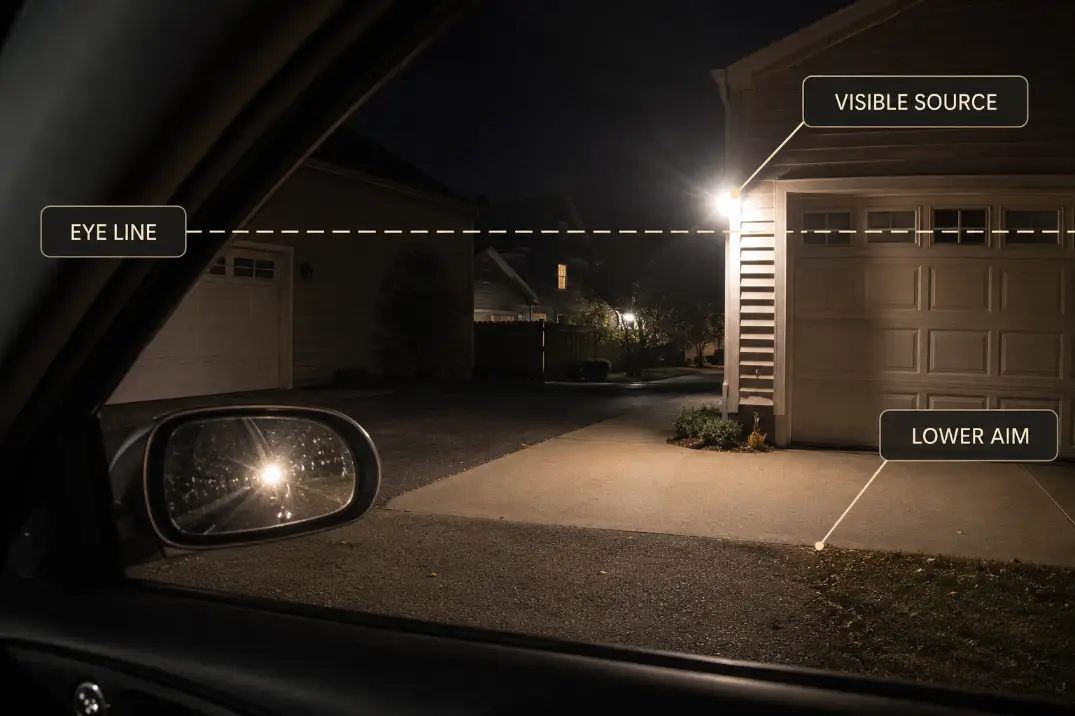
Driver-seat glare is the first shared-driveway test because it proves whether the fixture is lighting pavement or aiming into people.
A garage wall light can look harmless from the front door and still hit directly into a windshield, side mirror, or rearview mirror when a car turns into the shared apron.
Park in the normal stopping position and look toward the fixture from the driver’s seat. If the bare LED, bulb, or bright lens is visible without moving your head, the light is acting like a point source. That matters more than the stated wattage on the bulb.
A lower-output bulb may make the driveway dimmer, but it does not remove the glare path if the source remains exposed. This is where many fixes waste time: people reduce brightness first when they should be changing shield, aim, or fixture style first.
Shielding beats simple dimming
The cleaner fix is to hide the source from the seated eye line. A deeper hood, downward aim, frosted controlled lens, or fixture with a real cutoff usually changes the experience more than another bulb swap.
For tighter security-light situations where visibility gets worse because the source is too exposed, the same principle applies in Outdoor Security Lights Without Glare: useful light should land on the task area, not in the viewer’s eyes.
Window Lines
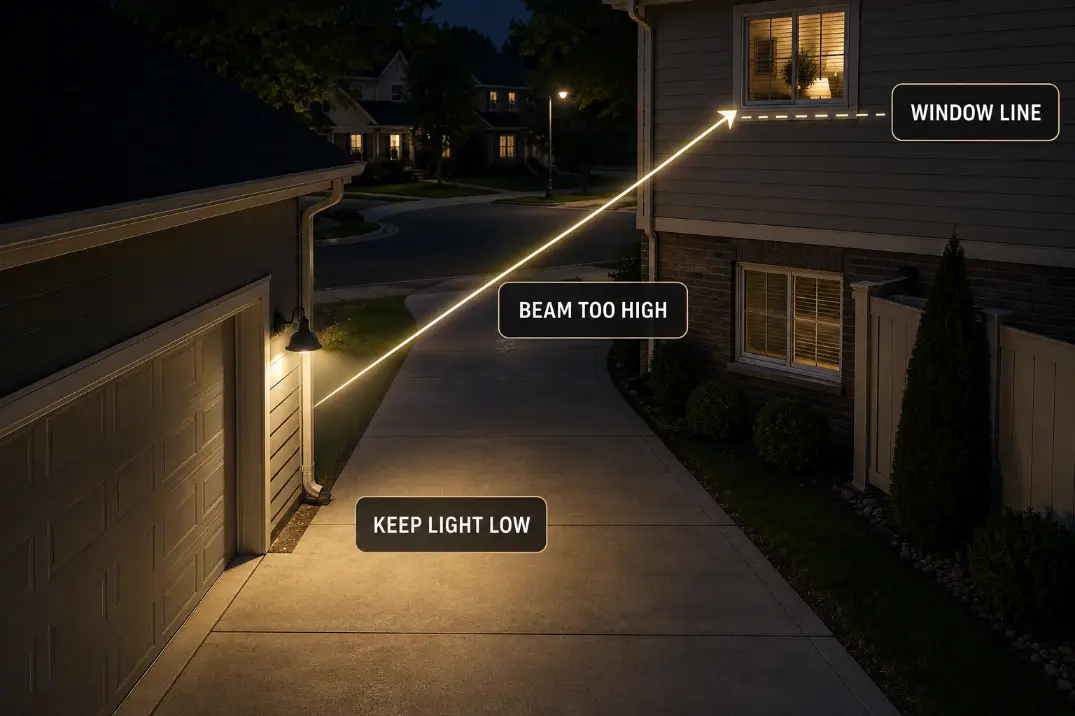
A window can catch the beam before the driveway looks overlit
Window-line conflict is slower than car glare, but it creates more friction. A driver may see the source for a few seconds. A bedroom, living-room, or upstairs side window may catch the same spill for hours.
The fixture does not need to point directly at the window to become a problem. A clear lens, pale siding, glossy garage trim, wet pavement, or a white garage door can lift light into the lower window area.
That is why “but the light points down” is not enough. The real question is where the bright part of the beam is still visible near the shared edge.
As a practical test, stand near the property line and look across the beam height. If the bright spill remains strong around 4–5 feet above the driveway, it is probably too high for a shared driveway.
A calmer setup keeps the brightest part of the beam below window level and lets only soft reflected light reach higher surfaces.
Move the beam, not just the fixture
Moving a fixture a few feet sideways often disappoints because the beam still opens outward. Lower aim, a better shield, or a fixture with a deeper top cap usually changes the outcome more than a small location shift.
The important distinction is between a light that reaches the driveway and a light that crosses a sightline. If the driveway is usable but the neighbor’s lower window area still glows, the problem is not lack of light. It is uncontrolled beam height.
This is where the logic in Stop Outdoor Lights From Shining Into Neighbor Windows fits the shared-driveway case better than a general “use a dimmer bulb” fix.
Motion Timing
Sensor direction usually matters before sensitivity
Motion timing conflict often gets blamed on sensitivity, but the detection direction is usually the earlier problem.
A sensor aimed across the shared travel lane will keep reacting to cars, deliveries, pedestrians, and normal neighbor use even if the fixture is not extremely bright.
A better detection zone is usually the final 6–10 feet near your own garage, side door, or walkway connection. That zone catches the moment when the light is actually useful.
Watching the full shared apron turns every normal movement into an event.
Sensitivity can help after the sensor points at the right area. It should not be the first adjustment if the sensor is still looking across the shared centerline.
Shorter hold times reduce repeated irritation
For a shared driveway, a 30–90 second hold time is usually enough for parking, stepping out, unlocking a door, or carrying a bag inside.
A 5-minute hold time may feel normal on a private rear entry, but in a shared driveway it can make one brief trigger feel like the whole space has been taken over.
The light should not restart constantly from activity that is not connected to your entry. If the fixture turns on every time the neighbor backs out, the trigger zone is too broad. If it stays on long after the movement is gone, the timing is too generous.
For more detail on why motion lights feel more disruptive when they surprise nearby houses, see Motion Sensor Lights That Surprise Neighbors.
Garage Spill
The garage may be the real floodlight
Not every shared-driveway complaint comes from the outdoor fixture. Sometimes the open garage becomes the brightest light in the scene.
A bright interior shop light, white garage ceiling, pale concrete floor, and open overhead door can throw more light across the shared apron than the exterior fixture does.
If the driveway only feels usable while the garage door is open, the exterior lighting plan is borrowing brightness from the wrong source.
This is easy to miss because the garage light feels temporary to the homeowner. To the neighbor, a door left open for 20–30 minutes after dark can read like a wide, unshielded floodlight.
The driveway may look safer from inside the garage, but the spill is uncontrolled from the outside.
A short burst of garage light while unloading is normal. The problem starts when the open garage becomes the background lighting for the whole shared drive.
Do not add more exterior light to balance spill
The wrong response is adding another outdoor fixture to “even out” the driveway. That usually increases the total glare field and makes the shared area feel brighter from more directions.
Fix garage spill first. Use warmer interior bulbs where practical, avoid bare high-output shop lights near the open door, and close the garage when active work is done.
If the outdoor fixture only seems weak when the garage is open, the driveway may not need more exterior light at all.
This is a common condition people underestimate because garage spill feels accidental. But in a narrow shared driveway, reflected interior light can be just as visible as a wall-mounted fixture.
Low Boundary Light
Mark the edge instead of lighting the whole apron
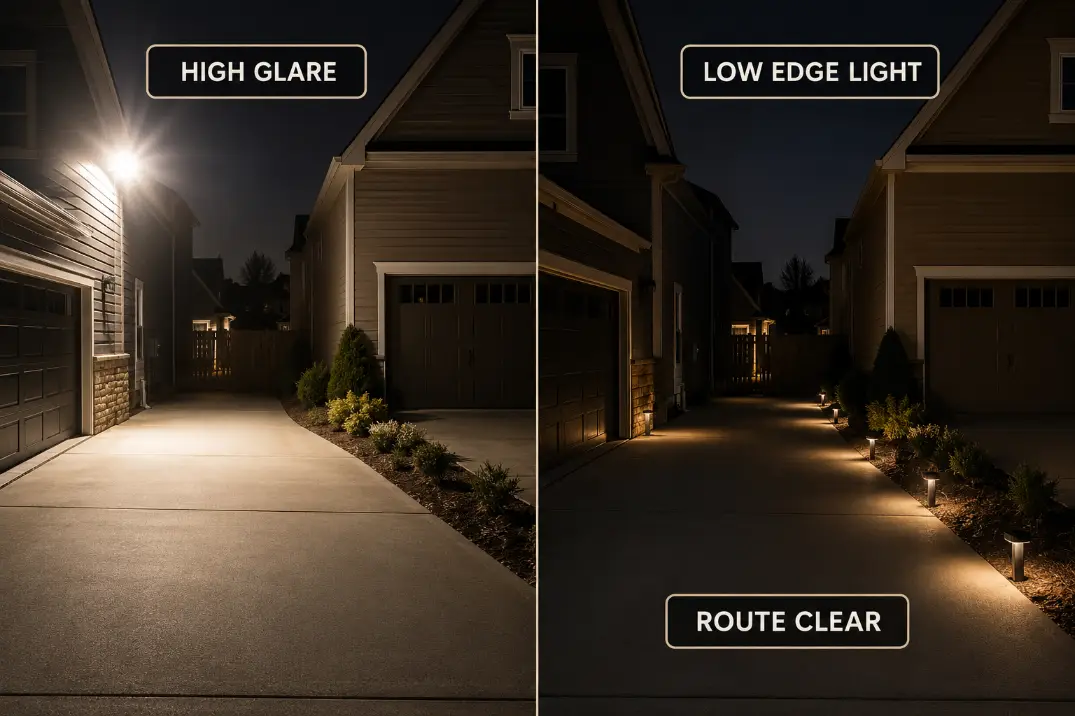
Low boundary light often solves shared-driveway conflict better than a brighter wall fixture because it changes the job. Instead of trying to light every square foot, it marks the edge, turn point, curb, planting strip, or walking side so people understand where the safe route is.
Short shielded fixtures around 12–24 inches high can feel calmer than a wall fixture mounted 6–8 feet high because the beam starts closer to the pavement.
The light does not have to travel through the shared eye line before it reaches the task area.
Spacing matters too. A few controlled points about 6–10 feet apart usually read better than a continuous bright line. Too many low fixtures can create a runway effect, especially on a narrow straight driveway.
Warm, shielded, and low is the safer product direction
A warm 2700K to 3000K light usually feels less harsh than cool white light in tight shared spaces. But warm color is not a cure for bad aim. If the source is still visible from a windshield or window, warmer light only makes the mistake softer.
The strongest product direction is low, shielded, and downward. For a broader category-level match, Best Neighbor-Friendly Outdoor Lights fits this shared-driveway logic better than searching for the brightest driveway fixture.
Shared View Test
Test both sides before changing hardware
The shared view test keeps the fix practical instead of personal. Check the light from your own garage approach, the neighbor’s likely car position, and the nearest window or porch line.
In a shared driveway, the fairest test is not from the fixture; it is from the places both households actually use.
Do it after full dark, not at dusk, because glare that seems mild at twilight can become obvious 30 minutes later.
A useful shared-driveway light should pass three checks: the source is not directly visible from the driver’s seat, the bright beam does not rise into the window line, and the motion trigger does not activate from ordinary shared-lane movement.
If the fixture fails one check, aim, shielding, or timing may fix it. If it fails all three, the fixture type is probably wrong.
When replacement makes more sense
A standard fix stops making sense when the fixture keeps exposing the source no matter how you aim it. Clear coach lights, bare-lens floodlights, and decorative fixtures with visible bulbs often cannot be adjusted enough for a tight shared driveway.
At that point, replacement is cleaner than repeated bulb swaps. A shielded downward fixture, a lower controlled wall light, or a low boundary fixture usually changes the sightline more reliably.
That is where Best Low-Glare Outdoor Security Lights becomes a better next step than continuing to experiment with bulbs inside the same exposed fixture.
Use the property line as a control boundary
The final test is not whether your driveway looks bright. It is whether the bright part of the light crosses into space where someone else has to see it.
If the beam reaches past the driveway edge, lights a neighboring wall, or creates a visible glow across the shared side, the fix should start with direction.
The same directional logic applies in Backyard Lights That Cross the Property Line: control spill first, then decide whether brightness needs changing.
| Check | Healthy condition | Conflict signal |
|---|---|---|
| Driver view | Source hidden from seated eye line | Bare LED or bulb visible from car |
| Window line | Beam stays below lower window area | Bright spill reaches 4–5 feet high |
| Motion timing | 30–90 second hold time | Light stays on for 5–10 minutes |
| Sensor zone | Detects owner entry area | Detects shared travel lane |
| Boundary light | Low, shielded, spaced points | High fixture washes full driveway |
| Garage spill | Brief use during arrival | Open garage lights the shared apron |
Questions People Usually Ask
Should shared driveway lights be motion-activated?
They can be, but only if the sensor is aimed at your own entry zone. A motion light that watches the shared centerline will feel more intrusive than a low controlled marker because it reacts to everyone.
Is a brighter light safer for a shared driveway?
Not always. Brightness helps only when it lands on the pavement, step, edge, or turn point. If added light is visible from a windshield or window, it may reduce comfort and make the driveway feel less controlled.
What is the best first fix before replacing the fixture?
Start with aim, shielding, and motion hold time. If the source remains visible after those changes, replacement with a shielded downward fixture usually makes more sense than trying more bulbs.
For broader official guidance on exterior lighting efficiency and controls, see the U.S. Department of Energy lighting controls guide.