
Backyard lights cross the property line when the fixture throws light above the useful zone, when the beam is wider than the yard, or when a pale fence reflects the beam sideways. The first check is not whether your patio looks bright enough.
Stand near the shared boundary 30–60 minutes after dark and look back toward the fixture from about 5–6 feet above the ground. If you can see the bulb, LED chips, or bright lens face from that position, the problem is usually fixture control, not just high wattage.
The fastest useful fix is to lower the aim, narrow the beam, block side spill, and keep the brightest zone on the task area. A backyard light should help you see a door, steps, seating edge, or walking route.
It should not make the fence top, neighbor wall, or upper window line the brightest surface in the scene.
Light Trespass
Direct beam, glare, or reflected glow?
Light trespass means light leaves your property and lands where it is not wanted. In a backyard, that usually shows up as a bright patch on a neighbor’s fence, patio, siding, window, or side yard. But the visible patch is only the symptom.
The mechanism is more specific: the fixture is either projecting a direct beam, exposing glare from the lens, or bouncing light off a bright surface.
That distinction matters because each problem has a different fix. If the direct beam crosses the fence, aim and beam spread are the first suspects.
If the lens is visible from the property line, shielding matters more than lumens. If a white fence glows even though the light points downward, reflection is probably doing the damage.
Security-style fixtures near back doors, garage corners, patio covers, and side-yard gates are the most common offenders. A single fixture mounted 10–12 feet high can create more neighbor conflict than several lower, shielded fixtures because it has a clear path over the fence.
If the main issue is direct glare from the fixture face, the fix logic is close to Outdoor Security Lights Without Glare: the goal is not simply “less light,” but less visible lens and better cutoff.
The useful threshold is at the boundary
A light is probably crossing into problem territory when the fixture face is visible from the fence, when the beam stays strong 5 feet beyond the property line, or when the neighbor-facing fence line is brighter than the ground you actually use.
A healthier setup keeps the brightest part of the beam within the first 10–20 feet of your own yard, then fades before it reaches a window line or sitting area beyond the boundary.
In small suburban lots, that may require a lower-output fixture, but output is not the first lever. Direction and beam shape come first.
Aim Check: Turn the light on for 5 minutes, walk the fence line, and look back toward the fixture. If the brightest view is from the neighbor side, the light is aimed for the wrong audience.

Fence Reflection
The fence can become the second light source
A white vinyl fence, pale stucco wall, glossy gate, or light-colored privacy screen can push light sideways even when the fixture is not aimed directly at the neighbor’s window. This is one of the easiest causes to underestimate because the fixture may look reasonably aimed during the day.
Fence reflection is different from direct trespass. With direct trespass, the beam crosses the line. With reflection, your own fence or wall catches the beam and turns into a glowing surface. From your patio, that glow may look soft. From the other side, it can feel like a lit backdrop.
The closer the fixture sits to the fence, the less forgiveness you have. A wide floodlight only 3–6 feet from a pale fence can create a large reflected zone. Damp surfaces after rain or irrigation can make the glow stronger, especially on glossy vinyl, painted gates, or smooth masonry.
If the fence is brighter than the walking surface, aim is too high
This is the cleanest field test: compare the fence face to the ground, steps, or route the light is supposed to support. If the fence is brighter than the walking surface, the beam is landing too high or too wide.
Dimming can help, but it often does not solve the pattern. Lowering a 3000-lumen floodlight to 1800 lumens may soften the complaint while leaving the fence as the brightest object.
The better first move is to rotate the beam down and inward so the light lands on the task zone before it reaches the fence.
Adding taller plants along the boundary is also a weak first fix. Plants may block some view, but they do not correct a high beam. They can even create bright leaves and dark gaps that make the yard look more restless at night.
For shared fence situations, Shared Fence Outdoor Lighting Privacy is a better supporting frame than treating the fence as a wall that automatically contains light.
Beam Spread
Wide beams are often the hidden mistake
Many homeowners focus on brightness and ignore beam angle. A controlled 40-degree beam aimed at a grill zone or back step is easier to manage than a 100-degree flood that washes the patio, fence, and neighbor-side view at the same time.
This matters most in narrow backyards where the distance from fixture to property line may be only 8–15 feet. A high, wide floodlight can cross that distance before the beam has a chance to fade. The fixture may be technically pointed downward, yet still too broad for the yard.
The common overestimate is distance. A light that “reaches far” is not automatically better for security. If it creates glare or lights the fence top, your eyes adapt to the hot spot and the darker areas become harder to read.
Better visibility usually comes from controlled light in the right zone, not a brighter blast across the whole yard.
| Condition | Healthier Pattern | Failing Pattern |
|---|---|---|
| Beam angle | Narrow enough to cover the task zone | Wide flood washes fence and side yard |
| Fixture aim | Down and inward | Outward or level with window lines |
| Brightest area | Steps, door, patio edge, walkway | Fence top, neighbor wall, upper window |
| Lens visibility | Hidden from the property line | Visible from fence or neighbor side |
| Night test | Beam fades before boundary | Beam still strong beyond the line |
| Fix priority | Aim, shield, narrow spread | Replace with a brighter fixture |
More light can make the yard less readable
A backyard light should answer a practical question within 3–5 seconds: can you see the latch, steps, gate, chair edge, or route? If the answer is yes, more reach may add conflict without improving safety.
This is why low, specific light often beats one large flood. A door light handles the lock. A step light handles the change in level. A path light handles the walking route. The fence does not need to be lit unless the fence itself is the task.
When the issue is an outdoor light aimed at the wrong surface, the fix overlaps with Aim Outdoor Security Lights, especially for adjustable dual-head fixtures that can be rotated down and inward instead of replaced immediately.
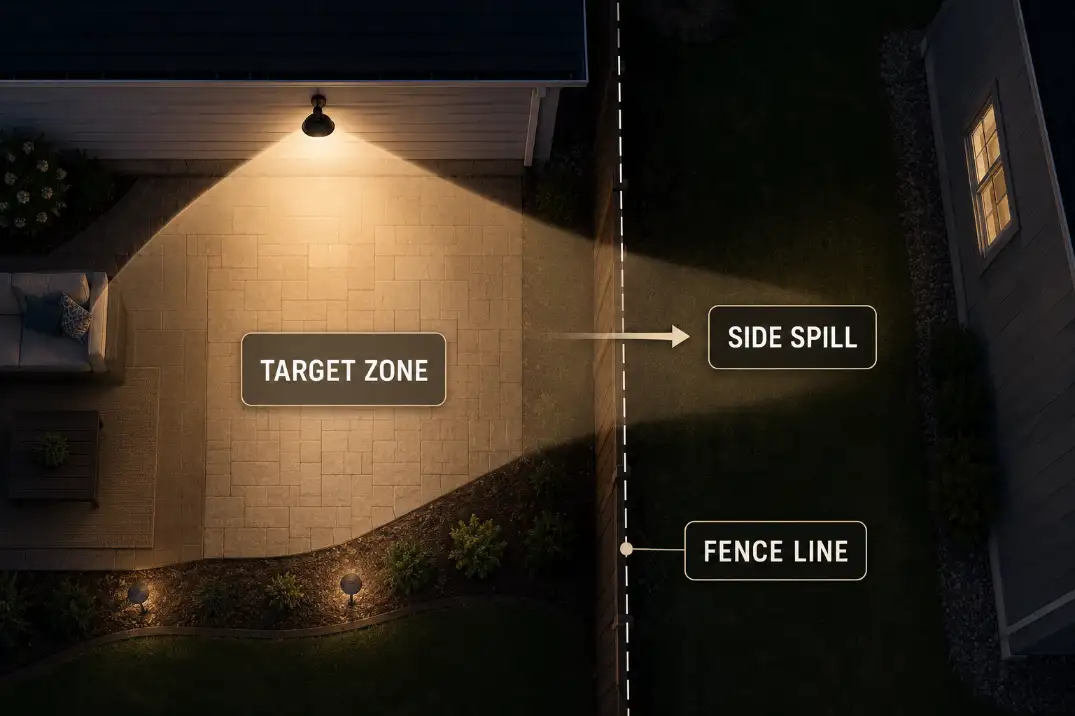
Side Spill
The fixture may point down and still leak sideways
Side spill happens when the main beam points generally downward, but light escapes through the sides of the fixture. This is common with adjustable floodlights, exposed wall packs, globe fixtures, decorative sconces with clear glass, and multi-head security lights.
The important distinction is this: if the lens is hidden from below but still visible from the side, you are dealing with side spill, not simply bad aiming. Tilting the head lower may reduce the problem, but it can also create a harsh bright patch near the wall and leave the middle of the yard underlit.
This is where the standard fix stops making sense. If you have already aimed the light down, rotated it inward, and reduced output, but the bright lens still shows from the property line, the fixture shape is wrong for that location.
Shielding beats extreme aiming
A side visor, deeper hood, full-cutoff shape, or better-shielded fixture usually does more than forcing the head into an awkward angle. Extreme downward aiming can create a bright oval on one small patch of ground while the route beyond it remains dark.
For neighbor-facing walls, the better fixture hides the source and lets light fall where it is needed. That is especially important beside bedrooms, narrow side yards, and shared patios where even a small visible lens can feel sharp after dark.
Low Light Zones
One floodlight should not do every job
The best neighbor-friendly backyard lighting is not always dimmer. It is more local. A 300–700 lumen shielded light near a door, a few low path lights, and a small step light can outperform one 3000-lumen floodlight because each light has a smaller job and none of them needs to cross the yard.
Think in zones instead of coverage. The lock zone needs enough light to use a key or keypad. The step zone needs edge visibility. The walking route needs gentle continuity. The seating zone needs comfort. The fence line usually needs nothing.
This is where adding another bright fixture wastes time. If the first light already spills across the line, the second often adds more glare, more reflection, and more conflict. Balance should come from controlled lower zones, not competing floods.
A related mistake is treating every neighbor complaint as a window problem. Sometimes the light does not hit the glass directly; it lights the fence, siding, or patio surface beside it. If the issue is specifically a window line, Stop Outdoor Lights From Shining Into Neighbor Windows is the more exact fix path.
Motion settings can make spill feel worse
A steady low-level light is often less annoying than a bright motion light that snaps on repeatedly. A 20-second burst may sound brief from your side, but if it triggers every few minutes near a bedroom window, it becomes harder to ignore than a constant low glow.
For boundary locations, use the shortest useful detection field. Aim the sensor across the walking route, not across the neighbor’s yard. If the light turns on when trees move, cars pass, or pets cross the far side of the fence, the detection zone is too loose.
Runtime matters too. A motion light that stays on for 5 minutes after every trigger can create far more nuisance than one that shuts off after 30–60 seconds. The best setting is the shortest time that still lets someone walk safely from the door to the target area.
Boundary Check
Test from where the problem is seen
Do not judge the light while standing under it. Stand at the fence line, near the side gate, at the far corner of your own yard, and along the neighbor-facing window line. Run the test after full dark, not at dusk.
Your eyes need about 10–20 minutes to adapt. A fixture that looks mild at 7:45 p.m. can feel much sharper at 9:30 p.m. once the surrounding yard is fully dark. In northern states during winter, this matters even more because outdoor lights may run for 12–14 hours overnight instead of only a short evening window.
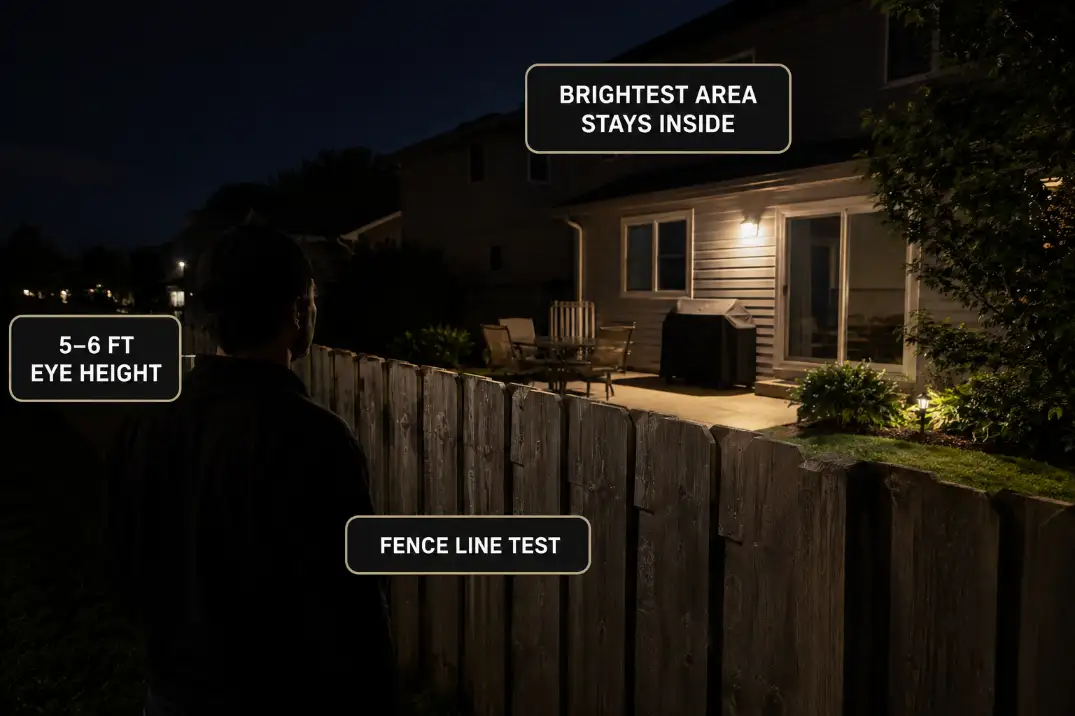
Use this quick check before buying anything:
- Can you see the bulb, LED chips, or lens face from the property line?
- Is the fence brighter than the ground, steps, or route the light is supposed to support?
- Does the beam still look strong 5 feet beyond the boundary?
- Does the motion light trigger more than once every 10 minutes without a person using the area?
- Can you see the door, latch, steps, and route without lighting the fence top?
- After aiming down and inward, is the lens still visible from the side?
The replacement boundary
Replacement makes sense when the fixture cannot be shielded, cannot aim downward without creating a hot spot, or exposes the lens from the neighbor side even after adjustment.
At that point, the issue is no longer a simple aiming mistake. The fixture is too exposed, too wide, or too high-output for the boundary location.
Look for a shielded or full-cutoff shape, a warmer color temperature around 2700K–3000K, and a beam pattern matched to the actual task.
If the current fixture is a wide exposed floodlight near a shared fence, a more controlled option from Best Neighbor-Friendly Outdoor Lights is usually a better use of money than tape-on diffusers, taller plants, or another bright fixture.
Some cities, HOAs, and dark-sky communities may also set stricter rules for glare, shielding, or light at the property line, so treat the boundary test as a practical fix standard, not a legal limit.
But even without a formal complaint, the best backyard lighting passes a simple test: the useful light stays on your tasks, the lens is not visible from the property line, and the brightest surfaces are inside your yard.
Questions People Usually Ask
Are backyard lights illegal if they cross the property line?
It depends on local rules. Some places treat glare or light shining into windows as a nuisance issue, while others have more specific lighting standards. The safer practical standard is to shield and aim the light so the useful beam stays on your own property.
Should I use warmer light near a neighbor’s yard?
Yes, but warmth is not a complete fix. A 2700K–3000K light usually feels softer than a cool 5000K light, but a warm unshielded beam can still cross the boundary. Color temperature helps comfort; fixture control solves the main problem.
Do fences block light trespass?
Only partly. A solid fence may block low light, but high fixtures, wide beams, side spill, and reflected glow can still cross above or around it. Treat the fence as a boundary marker, not a lighting shield.
For broader responsible outdoor lighting guidance, see DarkSky International’s lighting principles.