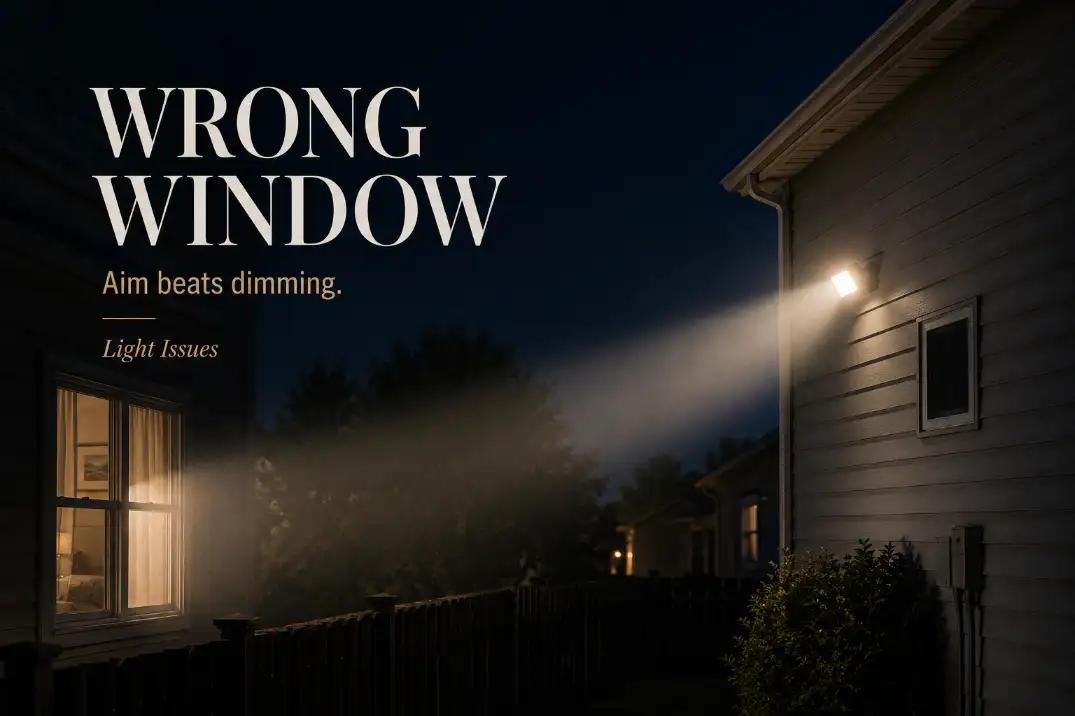
The fastest way to stop outdoor lights from shining into a neighbor’s windows is usually not to make the yard darker. It is to make the beam belong to your property again.
Most window complaints come from one of three patterns: an exposed bulb, a fixture aimed above horizontal, or a motion light that stays on too long after being triggered.
Start with three checks after dark. Can the neighbor see the bulb, LED board, or bright lens directly? Does the beam hit window glass instead of the ground?
Does a motion light stay on for more than 2 minutes each time? If yes, the problem is not simply brightness. It is uncontrolled light trespass. A shielded 1,200-lumen fixture aimed down can be less intrusive than a 700-lumen bare floodlight aimed sideways.
The Real Problem Is Beam Ownership
A useful outdoor light can still be a bad neighbor light. That sounds contradictory, but it is the core of the issue: the light may help your driveway, gate, or backyard while also spilling into someone else’s bedroom.
Brightness is the symptom, not always the cause
When a neighbor says your light is too bright, they may be describing the symptom they can feel, not the mechanism causing it. The more useful question is: where is the beam going?
If the light source is visible from the neighbor’s window, lowering the bulb wattage may reduce intensity but leave the glare point in the same place. If the beam crosses the fence at eye level or above, the fixture is still sending light into the wrong visual zone.
A practical rule: if the beam center crosses the property line above about 4–5 feet, it is more likely to hit faces, glass, fences, or second-story surfaces than useful ground. That is especially common on narrow side yards where houses may sit only 10–20 feet apart.
Direct source view matters more than soft spill
There is a difference between soft reflected light and direct glare. A faint glow on a fence is usually less disruptive than a visible LED chip aimed toward a bedroom. The direct source is what makes a window feel invaded.
This is why outdoor lighting privacy problems are rarely solved by one cosmetic change. If the same setup also makes your own yard feel exposed or stage-like, the broader issue overlaps with Outdoor Lighting Privacy Problems, not just fixture brightness.
What to Fix First
Do not start with shrubs, blackout curtains, or a warmer bulb. Those may reduce discomfort, but they do not correct the beam path. The first fix should happen at the source.
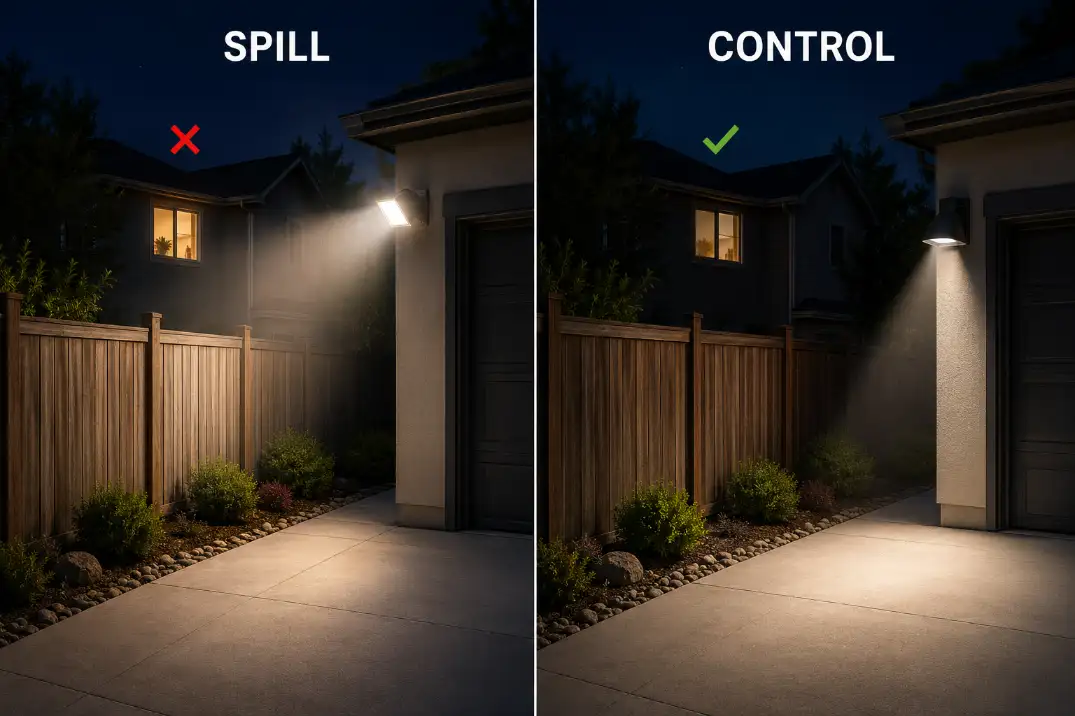
Aim the fixture below the window line
For wall-mounted lights, tilt the fixture down until the center of the beam lands on your driveway, walkway, gate, steps, or patio surface. A small adjustment can make a large difference.
A floodlight mounted 10 feet high and aimed nearly straight out can easily throw light across a fence and into upper-story glass.
A good first adjustment is usually 15–30 degrees downward. Then test from the neighbor-facing side, not just from your own driveway. If the ground is lit but the fixture face is no longer visible from the window angle, you are much closer to a real fix.
Add shielding before changing the whole setup
A visor, side shield, barn-door shield, or full-cutoff fixture blocks the part of the beam that escapes sideways or upward. This often solves more than a bulb swap because it changes where light is allowed to travel.
Shielding matters most when the fixture is mounted high, such as above a garage, on a second-story wall, or near a roofline. At those heights, even moderate output can reach bedroom windows.
If your own view of the fixture feels sharp or uncomfortable, the problem may also connect to glare, which is covered more directly in Why Outdoor Lights Create Glare.
Pro Tip: After adding a shield, stand where the neighbor sees the light. If you can still see the bright source, the shield is too shallow or the fixture is still aimed too high.
Use a narrower beam for small targets
Many neighbor-window problems come from using a floodlight where a focused beam would work better. A side gate, trash area, driveway apron, or short path usually does not need a 100-degree spread. A 30–60 degree beam can light the task area without washing the neighbor’s wall and windows.
This is where homeowners often overestimate how much light security requires. A controlled 800–1,200 lumen fixture can feel safer and cause less conflict than a 2,000-lumen floodlight that lights everything except the exact place people need to see.
Fixes That Often Waste Time
Some fixes sound reasonable because they reduce the visible annoyance. But they do not solve the underlying trespass problem.
| Common fix | Why it often fails | Better first move |
|---|---|---|
| Lower-watt bulb only | The light source may still be visible | Aim down or shield first |
| Warmer color only | Softer light can still enter the window | Use 2700K–3000K after beam control |
| Shrubs only | Slow, seasonal, and weak for upper windows | Block the beam at the fixture |
| Blackout curtains | Shifts the burden to the neighbor | Fix the spill at the source |
| Bigger security light | Adds glare and darker shadows | Use controlled task lighting |
The curtain problem
Blackout curtains may help the person receiving the light sleep, but they are not a fair primary solution. They treat the neighbor’s room as the repair site, even though the beam originates outside.
The stronger fix is to prevent direct light from reaching the window in the first place. Landscaping can support that goal later, especially for privacy along a fence, but it should not be the main answer to a mis-aimed fixture.
If the broader goal is to keep a backyard usable without making nearby homes feel exposed, How to Light a Backyard Without Losing Privacy gives a better design frame.
Adjust Motion Lights Before They Become a Pattern
Motion lights create a special kind of neighbor problem because they interrupt the room repeatedly. A steady low-level glow may be tolerable. A bright floodlight snapping on six times per hour feels more aggressive even if each activation is brief.
Keep the timer short
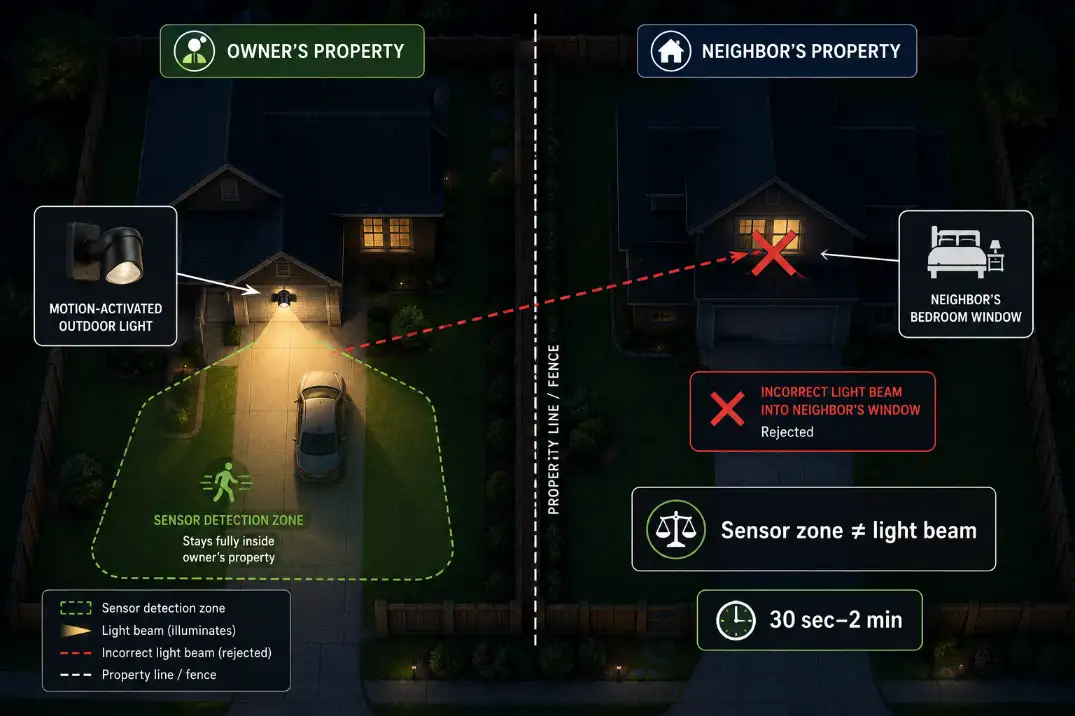
For most residential driveways, gates, and side yards, a 30-second to 2-minute on-time is enough. Settings of 5, 10, or 20 minutes often create unnecessary conflict, especially when the sensor is triggered by pets, branches, passing cars, or activity near the property line.
Time changes the experience. One 45-second activation is very different from repeated 10-minute bursts aimed at the same window.
Separate sensor aim from light aim
Many motion lights let you aim the sensor separately from the lamp heads. That matters. The sensor should watch the area you care about, while the beam should land only where illumination is needed.
If the sensor points toward a sidewalk, driveway across the fence, swaying shrubs, or a neighbor’s side yard, the light may behave like a nuisance even after the lamp heads are adjusted.
In that case, the repair logic is closer to Outdoor Motion Sensor Light Too Sensitive than ordinary brightness control.
When Adjustment Is Not Enough
Most outdoor lights can be improved with aim, shielding, lower output, and better timer settings. But some fixtures are wrong for the location.
Replace clear-glass fixtures that expose the bulb
A decorative sconce with clear glass can look attractive in daylight and still be a glare source at night. If the bulb is visible from the neighbor’s window, changing from cool white to warm white may soften the feel, but the visible source remains.
A shielded downlight, frosted lens, or full-cutoff design is usually the cleaner choice. The goal is not just a prettier fixture. It is a fixture that hides the source and sends light downward.
Move lights that face the bedroom directly
If a fixture is mounted on a wall that points straight toward the neighbor’s bedroom, every minor adjustment becomes a compromise. You may reduce the spill, but the geometry still works against you.
Moving the light 6–10 feet to a corner, under an eave, or closer to the actual task area can solve more than repeated bulb changes. Lighting a gate from the gate side is usually cleaner than blasting it from a distant wall.
Stop asking one fixture to do four jobs
One high-output floodlight should not be responsible for the driveway, patio, side yard, and back fence. Wide coverage creates wide spill. Several lower-output lights aimed at specific surfaces usually perform better and cause fewer complaints.
If the beam misses your target area while hitting fences, siding, or neighboring windows, the issue is not the neighbor being sensitive. It is poor placement. That diagnosis is closer to Fix Poor Outdoor Light Placement than a simple bulb problem.
If You Are the Neighbor Receiving the Light
If the light is coming from someone else’s property, start with evidence and a specific request. A vague complaint like “your light is too bright” is easy to dismiss because brightness is subjective. A clearer request is: “The beam is shining directly into this bedroom window. Could you aim it down, add a shield, or shorten the motion timer?”
Document the pattern without escalating first
Take a photo or short video from the affected window at the same time of night for 2–3 evenings. Note whether the light is constant or motion-triggered, how long it stays on, and whether the bulb or lens is directly visible.
This keeps the conversation technical instead of personal. You are not asking the neighbor to remove useful safety lighting. You are asking them to keep the beam on their own driveway, yard, or entry area.
Ask for the fix that matches the problem
If the light stays on all night, ask about shielding, downward aim, or lower output. If it snaps on repeatedly, ask about reducing sensitivity and setting the timer closer to 30 seconds–2 minutes. If the fixture is a clear-glass sconce, ask whether a shielded or frosted design would work.
Local code, HOA rules, or nuisance-light procedures are better as later steps, not the first message. Most neighbors simply have not stood where the light is landing.
Practical Repair Order
Use this order before replacing everything:
- View the light from the neighbor’s window angle or property line after dark.
- Confirm whether the bulb, LED chips, or bright lens are directly visible.
- Tilt the fixture down until the beam lands inside your property.
- Add a shield if the source is still visible.
- Reduce brightness only after aim and shielding are corrected.
- Set motion timers to 30 seconds–2 minutes where safety allows.
- Replace or relocate the fixture if it cannot be aimed or shielded cleanly.
The point is not to make your property dark. It is to stop lighting the wrong surface. A good outdoor light should reveal steps, gates, driveways, and dark corners without turning a neighbor’s bedroom into part of the lighting plan.
Questions People Usually Ask
Is a dimmer bulb enough?
Only if the beam is already controlled. If the neighbor can still see the light source, a dimmer bulb may reduce intensity but not fix the trespass.
What color temperature is best near neighbors?
Warm white light around 2700K–3000K is usually less harsh than 4000K–5000K cool white. But color temperature should come after aiming and shielding.
Should security lights stay on all night?
Usually not at full brightness near neighboring windows. A lower steady level or a motion light with a short timer is usually less intrusive and more precise.
When should I replace the fixture?
Replace it when the source remains visible after aiming, when the fixture cannot accept shielding, or when its location points directly into a neighbor’s window.
For broader responsible-lighting guidance, see DarkSky International.