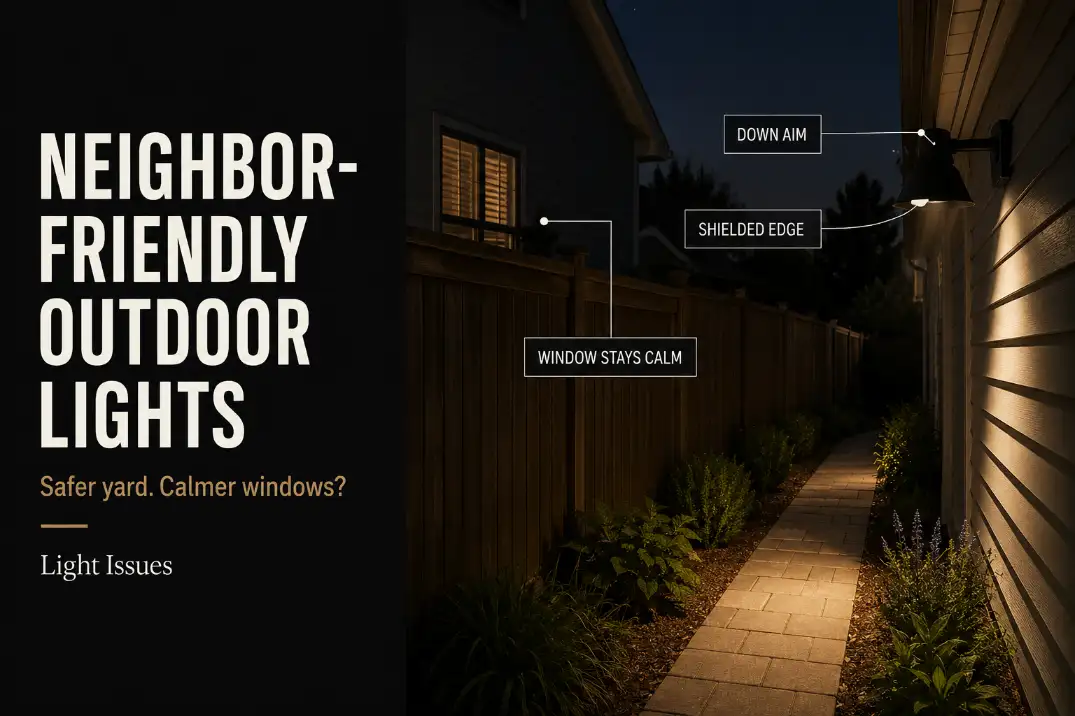
Neighbor-friendly outdoor lights are not just dimmer lights. The best choices control where the beam goes, hide the visible bulb from side views, use warm color, and avoid sudden motion bursts that hit fences or bedroom windows.
For most homes, the first buying filter should be shielding, then color temperature, then sensor control. Brightness comes later.
A good neighbor-safe fixture usually keeps most light below eye level, uses about 2700K to 3000K color, and lights the target area within roughly 6 to 15 feet instead of throwing a wide beam across the property line.
If a light looks comfortable from your walkway but painful from the fence, the fixture is not really low-glare. That is a beam-control problem, not a brightness problem.
Best Shielded Lights
Choose fixtures that hide the bulb from the side
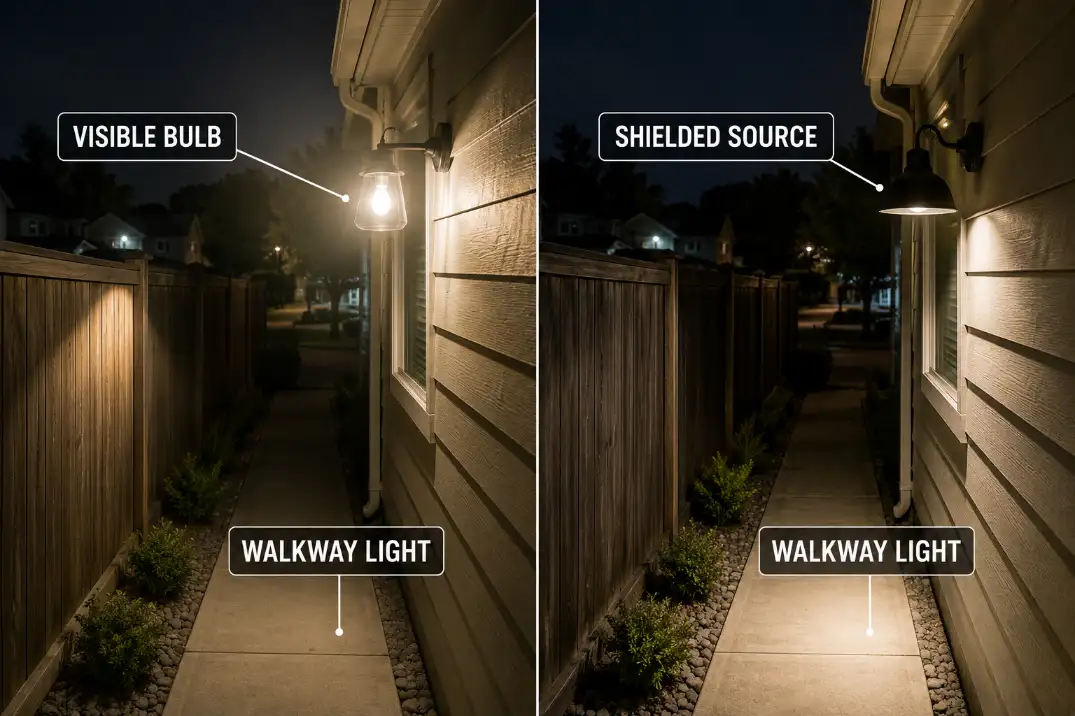
The safest first upgrade is usually a shielded wall light, not a brighter security light. Shielded fixtures, full-cutoff wall lights, and down-facing sconces hide the bulb or LED source from side views, so the eye sees the lit walkway instead of the glowing source.
This matters more than the advertised lumen number. A 700-lumen exposed fixture can feel harsher than a 1,000-lumen shielded fixture because the exposed source hits the eye directly.
If the product photo shows a clear glowing lens facing forward like a small headlight, assume it may create window spill unless the mounting location is very isolated.
Best for controlled walkway and entry lighting: Use this when the bulb is visible from the side or the fixture sits near a fence.
🟧 Shop shielded outdoor wall lights if exposed glare is the main problem.
For side yards, garage entries, porch doors, and back steps, the light should exit downward, not outward.
A shielded fixture is especially useful when the light sits within 10 to 20 feet of a property line, where even a modest exposed bulb can become annoying from the neighbor’s side.
Best Warm Lights
Warm color is not decorative here
Warm outdoor light is not just a style preference. It changes how aggressive the light feels at night. For most residential outdoor lighting, 2700K is the safest neighbor-friendly range.
3000K can still work for entries and security zones, but 4000K and 5000K often feel sharper and more commercial near homes.
People commonly overestimate how much “white” light they need for safety. The ground does not need to look like daylight. It needs enough contrast to show steps, edges, locks, and the walking path.
A warm 700- to 1,200-lumen shielded fixture usually performs better around a home than a cold, exposed 2,000-lumen fixture that bounces off fences and windows.
Best for softer porch, patio, and side-yard lighting: Use this when cold white light makes a fence, seating area, or bedroom-facing wall feel harsh.
🟧 Shop low-voltage fence lights when the fixture sits close to a shared fence.
When 3000K makes sense
Use 3000K where task visibility matters: garage doors, trash areas, side gates, and back steps. Use 2700K near patios, bedroom-facing walls, fences, and seating areas.
The difference is subtle on the box, but noticeable at night. A cooler fixture can make a small yard feel watched and overlit even when the lumen number is not extreme.
Buying Check: If two fixtures are otherwise equal, choose the warmer one first. You can usually add brightness later, but you cannot make a harsh LED spectrum feel softer without replacing the bulb or fixture.
Best Fence Lights
Keep fence lighting low and broken up
Fence lights can be neighbor-friendly, but only when they stay low, warm, and visually quiet. The safest products are small downlights, cap lights, or low-output fixtures that mark the edge of the yard without turning the fence into a bright wall.
Avoid fence lights that shine outward through clear lenses. A fence is often the closest surface to the neighbor’s property, so any sideways beam has very little distance to soften.
In narrow side yards, even a 300- to 500-lumen fence fixture can feel intrusive if the lens faces across the property line.
Best for shared fence lines and side yards: Use this when you need edge visibility without lighting the neighbor’s side.
🟧 Shop adjustable dual-head motion lights if the sensor needs tighter control.
Fence lights make the most sense along patio edges, side gates, and trash-bin paths where people need orientation rather than full visibility. They are weaker as security lights because they sit low and often create shadows behind objects.
If privacy is the main concern, Shared Fence Outdoor Lighting and Privacy is a better planning reference than simply adding more fence fixtures.
Better fence lighting usually uses more control, not more output. Place lights 6 to 8 feet apart only if they are very low-output and shielded.
For brighter fence-mounted fixtures, wider spacing or fewer fixtures usually looks calmer. If every post glows, the yard can feel like a boundary marker instead of a usable outdoor space.
Best Motion Lights
Sensor control matters as much as the fixture
Motion lights are often the most annoying outdoor lights because they change suddenly. A steady low-level light may be barely noticed, while a 2,000-lumen motion burst at 1:00 a.m. can feel hostile even if it only stays on for 60 seconds.
For neighbor-friendly motion lighting, look for adjustable sensor range, adjustable heads, timer control, and lower-output modes.
The better products let you aim the sensor across the walking path instead of toward the street, driveway, sidewalk, or neighbor’s yard. That distinction matters because many complaints come from false triggers, not from normal use.
A good motion light should trigger when someone enters the target zone within about 8 to 20 feet, not every time a car passes 40 feet away.
If the fixture turns on more than a few times per hour on a normal quiet night, the sensor is probably too wide, too sensitive, or aimed at the wrong movement path.
The same failure pattern shows up in Motion Sensor Lights That Annoy Neighbors at Night, especially where sensors catch sidewalks, driveway-edge movement, or fence-line activity instead of the actual gate path.
Avoid the “more coverage” trap
Wide coverage sounds safer in product copy, but it is often the wrong feature near neighbors.
A broad 180-degree sensor can be useful over a driveway, but it can be a poor fit for a side yard or fence line. Narrower detection is usually better when the goal is to light a gate, step, or door.
This is where people underestimate timer behavior. A 90-second timer may sound short, but if the light triggers 15 times overnight, the neighbor experiences repeated flashes, not one brief event.
The fix is usually sensor narrowing and lower output, not a brighter fixture.
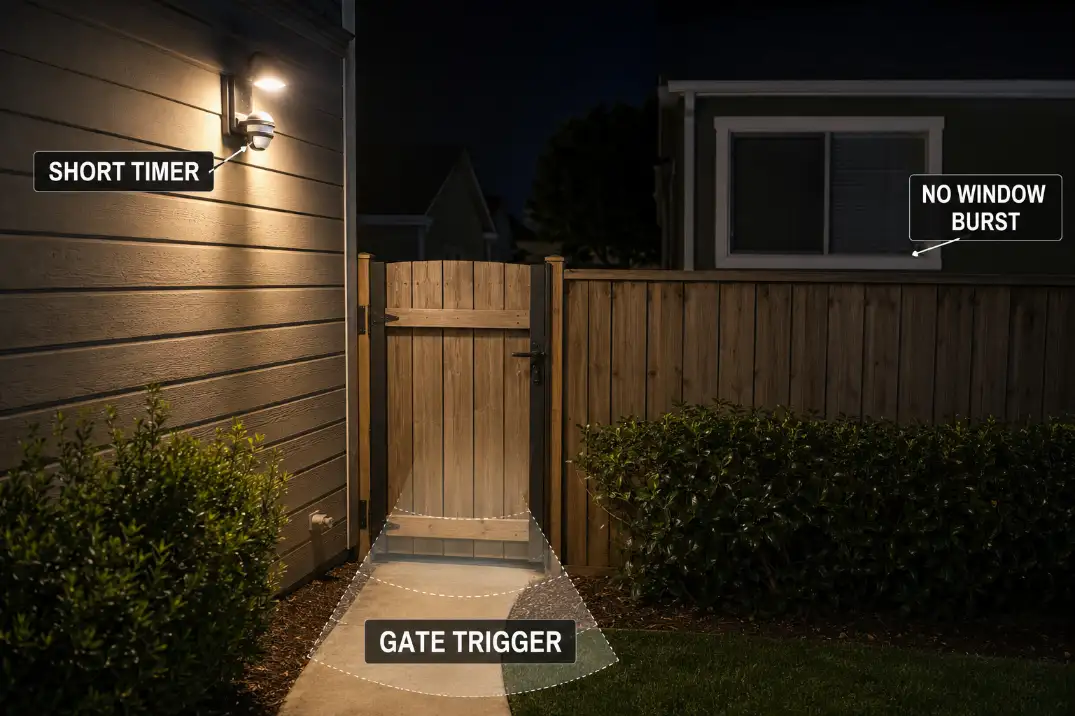
Motion lights are worth buying only if the fixture lets you narrow the trigger zone. If the sensor is fixed, wide, and paired with high output, it may solve your dark entry while creating a new neighbor problem.
Best Low-Spill Fixtures
Low spill means the beam stops where the job ends
Low-spill fixtures are the right choice when the light is close to a neighbor-facing window, bedroom wall, apartment patio, or narrow lot line.
This category includes full-cutoff wall packs, down-facing sconces, step lights, bollards with shielded heads, and low-voltage path lights with covered caps.
The useful test is simple: stand near the likely neighbor view line and check whether you see the lit surface or the glowing source. Seeing the ground is fine. Seeing the LED chip, bulb, or clear lens is the warning sign.
Low-spill lighting should create a visible target zone and a calm edge. For a walkway, that may mean a soft pool of light every 6 to 10 feet. For a back door, it may mean a 3- to 5-foot bright zone around the lock and step, not a flood of light across the yard.
This is the difference between a symptom and the mechanism: the symptom is “the light feels too bright,” but the mechanism is uncontrolled beam direction.
That same distinction is why Outdoor Security Lights Without Glare focuses on beam control before simply adding output.
When standard fixtures stop making sense
A standard porch light stops making sense when the fixture is mounted high, exposed, and aimed toward a shared view. Above about 7 or 8 feet, an exposed source can become more visible from surrounding windows.
In that situation, replacing the bulb with a lower-watt option may reduce intensity but not fix glare.
That is the fix that often wastes time: buying weaker bulbs for a fixture that still points sideways. A 450-lumen exposed bulb can still annoy people if the source is visible from a bedroom window.
A shield, hood, or new down-facing fixture usually changes the outcome more reliably.
A “Dark Sky” label helps, but it is not the whole buying decision. Near neighbors, still check color temperature, lumen output, side visibility, and whether the beam can stay below the fence line.
For existing lights that already create complaints, How to Stop Outdoor Lights Shining Into Neighbor Windows is the more direct fix guide. For new purchases, build that logic into the product choice before the fixture goes on the wall.
| Fixture type | Best use | Neighbor-friendly strength | Watch out for |
|---|---|---|---|
| Shielded wall sconce | Doors, porches, side entries | Hides source and pushes light down | Clear glass side panels |
| Full-cutoff wall light | Garage, side yard, utility zones | Strong beam control | Too much output for small areas |
| Warm fence downlight | Fence paths and patio edges | Low, quiet orientation light | Side-facing lenses |
| Adjustable motion light | Gates, driveways, back doors | Control over aim and trigger zone | Wide default sensor settings |
| Shielded path light | Walkways and garden edges | Low eye-level glare | Fixtures placed too close together |
| Step light | Stairs, deck edges, thresholds | Puts light exactly where needed | Poor waterproofing in exposed spots |
Features to Avoid
Clear lenses facing sideways
Clear glass can look attractive in daytime product photos, but at night it often exposes the bulb from multiple angles. Frosted glass is better, but shielding is better than both. If the fixture is near a property line, the side view matters as much as the front view.
Cold white security modes
Selectable color fixtures are fine if they can stay warm. Be careful with products that default to cool white, “daylight,” or extra-bright security mode after a power interruption.
A cold 5000K burst near a fence feels much stronger than a warm light with the same lumen rating.
Fixed wide-angle flood heads
Fixed floodlights are the least forgiving near neighbors. They often solve one homeowner’s dark-yard concern by creating glare somewhere else. If the head cannot be aimed downward, narrowed, dimmed, or shielded, skip it for shared-lot areas.
If the current problem is harsh light crossing into a nearby view, Why Outdoor Lights Create Glare can help separate fixture brightness from the real source-control problem.
Decorative string or strip lighting on fence lines
String lights and LED strips can be neighbor-friendly on patios, but fence-line placement is risky. The issue is not usually brightness on the ground; it is the repeated visible points of light at eye level.
That glow can feel busy from the other side of the fence, especially in compact suburban yards.
Oversized lumen claims
For most residential entries and side paths, more than 1,500 lumens is rarely the first thing to buy. Placement, shielding, and color usually decide whether the light feels safe or annoying. High output only helps after the beam is controlled.
Quick Buying Checklist
- Choose 2700K first near patios, fences, and bedroom-facing walls.
- Use 3000K only where extra task visibility is needed.
- Prioritize shielded or full-cutoff fixtures over exposed decorative bulbs.
- Keep motion timers short, usually 30 to 90 seconds.
- Avoid wide sensors near sidewalks, driveways, and shared fences.
- Check the side view of the fixture, not just the front product photo.
- Treat visible glare as a fixture-control problem before reducing brightness.
Questions People Usually Ask
Are solar lights neighbor-friendly?
They can be, but only when they are low, warm, and shielded. Many solar path lights are mild enough to avoid complaints, but solar spotlights aimed upward or toward fences can still create glare.
Runtime also changes by season, so a solar light that seems weak in winter may become much more noticeable after longer summer charging days.
Is 5000K outdoor lighting bad for neighbors?
It is usually a poor choice near homes. 5000K can look crisp on a product page, but outdoors it often feels stark, especially when viewed from a bedroom window or across a dark fence line. Use it only where there is a clear task need and no shared view path.
Do dimmers solve neighbor complaints?
Sometimes, but not when the bulb or LED source is still visible. Dimming lowers intensity, but shielding changes the direction and comfort of the light. If the complaint is glare, dimming is secondary.
What is the safest first upgrade?
Replace exposed side-facing fixtures with warm, shielded, down-facing fixtures. That single change usually improves comfort more than adding more lights, using a brighter bulb, or moving immediately to security floodlights.
The safest purchase is not the brightest fixture. It is the one that hides the source, points down, stays warm, and lets you control the trigger zone before the light crosses into someone else’s view.
For broader official guidance on responsible outdoor lighting, see the U.S. Department of Energy Light at Night resource.