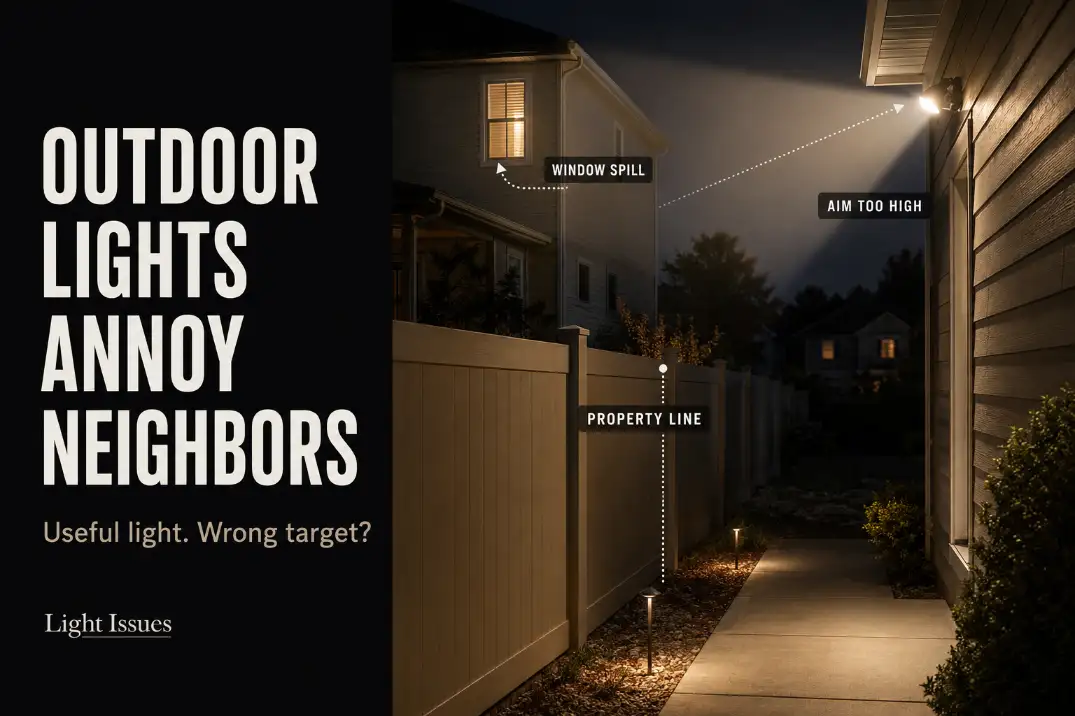
Outdoor lights usually annoy neighbors because of light trespass, not because the yard has lights at all. The problem is uncontrolled direction: a visible bulb, a beam crossing the property line, a glowing fence, or a motion light that snaps on again and again after dark.
Start with three checks. Can the neighbor see the bulb or LED source directly? Does the brightest part of the beam land beyond the area you actually use?
Does a motion light stay on longer than about 30–90 seconds after movement stops? A 900-lumen shielded fixture aimed down can feel calmer than a 500-lumen exposed fixture aimed sideways into a bedroom window.
This is different from a yard that still feels dark after adding lights. Here, the light reaches too far or hits the wrong surface.
Quick Neighbor-Light Diagnostic
Check the source before blaming brightness
The fastest test is not standing under the fixture. Stand where the neighbor would experience the light: near the fence line, across the driveway, or at the side of the house facing their windows.
If the bulb, LED chips, or reflector are directly visible from that angle, glare is likely even if your own patio or walkway does not look extremely bright.
This is why replacing the bulb with a slightly weaker one often disappoints. The light source is still exposed. It is just a little dimmer. A shielded fixture that hides the source usually feels softer than an open fixture with lower output.
Separate useful light from spill
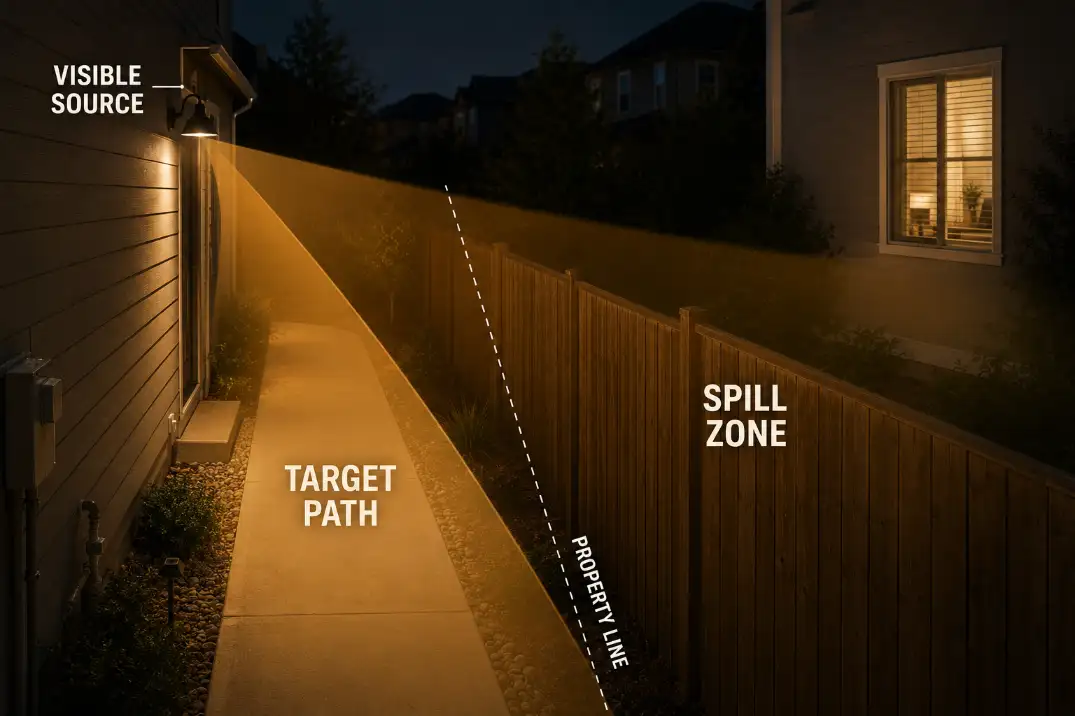
Useful light lands on the step, lock, gate, walkway, driveway edge, or patio zone you actually need. Spill is the part that keeps traveling after the useful job is done.
For a side path, the real target may be only 3–6 feet wide. If the light paints a 20-foot section of fence to illuminate a 4-foot walking route, the issue is not safety.
It is beam control. If the main complaint is bedroom glare, the same diagnosis overlaps with Stop Outdoor Lights Shining Into Neighbor Windows, but the broader problem can also include fence glare, motion surprise, and harsh color.
When Light Spills Into a Neighbor Window
The window problem is usually angle, not wattage
Windows make small lighting mistakes feel larger. Glass catches reflected light, blinds glow from inside, and a fixture that seems harmless from your patio can become sharp from a bedroom or living-room angle next door.
The most likely cause is a fixture aimed too high or too far outward. When the neighbor sees the source itself, they are not only seeing light on a surface. They are seeing glare. That direct-source view is usually more irritating than the amount of light on the ground.
A common overreaction is turning the fixture off completely. That can make your own steps, latch, or side path less safe while leaving the real design issue unresolved.
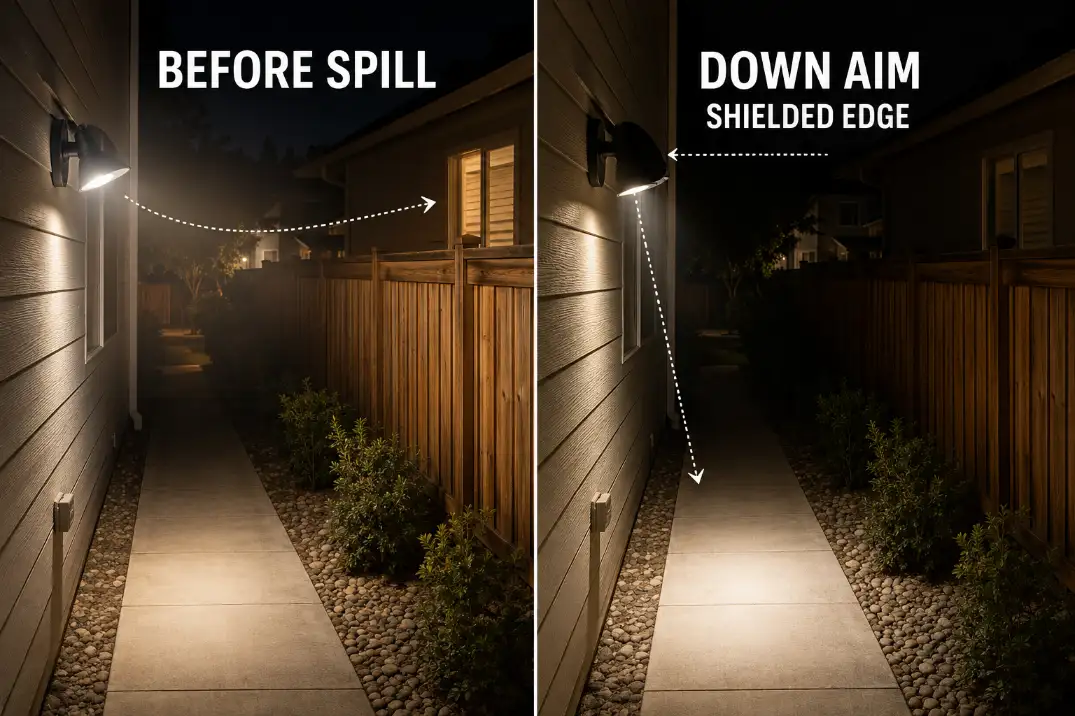
Lowering the aim by even 10–15 degrees can move the brightest part of the beam from a window line to the ground.
Use the 10-minute night test
Test the light after it has been on for at least 10 minutes. Your eyes adjust, reflections become easier to notice, and harsh angles show up more clearly.
Walk the property edge and check the light from standing height, seated height, and the likely height of a neighboring window.
If the beam still reaches glass after the head is aimed down, a bulb change alone is probably not enough. Add a side shield, switch to a shielded downlight, or move the fixture so the beam runs parallel to the property line instead of across it.
Pro Tip: Test the fixture with nearby indoor rooms dark. Window spill is often invisible when your own kitchen, garage, or porch light is also on.
When the Fence Becomes the Bright Surface
Fence glare is reflected glare
A fence can turn into the problem even when the light never enters a window directly. White vinyl, pale painted wood, and glossy metal panels can reflect enough light to make the neighbor’s yard feel lit from your fixture.
This is easy to miss because homeowners usually look at the ground. The fence becomes a glowing vertical surface in the background. If the fence looks brighter than the walking surface, the fixture is lighting the wrong plane.
For shared boundaries, the safest pattern is downward and inward. The beam should fall toward your walking surface, gate latch, or patio edge.
It should not rake across the upper half of the fence. When the issue is a shared boundary, Shared Fence Outdoor Lighting Privacy is a closer fix path than simply shopping for a weaker bulb.
When lowering output stops helping
Lower lumens help only when the fixture shape already controls the beam. If the light is open-sided, globe-shaped, or mounted high with a visible source, the fence may still glow after the bulb is changed.
The routine fix stops making sense when you have already reduced output once and the fence still lights up above waist height.
At that point, the issue is fixture shape or aim. Another weaker bulb may make your own path worse without removing the neighbor-facing glare.
| Neighbor Complaint | More Likely Cause | Fix That Usually Works | Fix That Often Wastes Time |
|---|---|---|---|
| “Your light shines in my window” | Beam angle or visible source | Lower aim, add shield, use downlight | Buying a lower-watt bulb without shielding |
| “The fence is glowing” | Wide spill on vertical surface | Narrow beam, aim inward | Adding another light along the fence |
| “It flashes on all night” | Motion zone too wide | Reduce range, shorten timer | Covering the sensor randomly |
| “It feels harsh” | Cool color and exposed LED | Warm shielded fixture | Frosted bulb in an open fixture |
| “It lights up my yard too” | Property-line spill | Aim parallel to boundary | Raising the fixture higher |
When Motion Lights Feel Like a Surprise Event
Sudden light feels stronger than steady light
Motion lights annoy neighbors in a different way. A steady low light can fade into the background, but a bright security light snapping on at 11:30 p.m. feels like an event. It gets worse when the sensor catches sidewalks, street traffic, tree movement, pets, or a neighbor’s driveway.
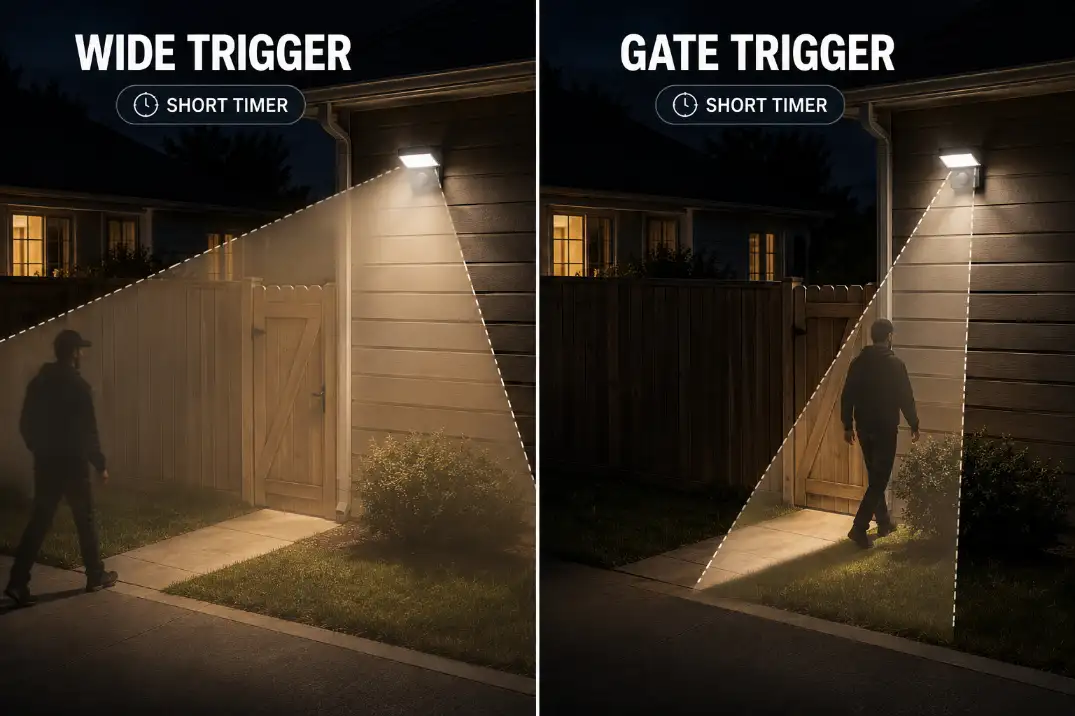
The key distinction is trigger control. A motion light that turns on when someone reaches your back door is useful. A motion light that fires every 5–10 minutes because it sees beyond your usable yard is visual noise, not better security.
If motion behavior is the main complaint, the deeper repair path is Motion Sensor Lights That Annoy Neighbors at Night.
The important point here is that both parts matter: the sensor zone and the beam direction. Fixing only one can leave the neighbor problem intact.
Timer length matters more than range
Many motion fixtures stay on for 3, 5, or even 10 minutes after a trigger. That may be acceptable for a long driveway, but it is usually excessive for a short side gate, trash-bin path, or 12-foot walkway.
For neighbor-facing areas, 30–90 seconds is usually enough for normal movement. The condition people overestimate is sensor range. Longer range sounds safer, but it often catches movement unrelated to your property.
The condition people underestimate is repeat triggering. A light that stays on for 60 seconds but retriggers 20 times in one evening feels almost continuous.
When Brightness Shock Is Really Source Glare
Lumens are not the whole problem
Brightness shock is rarely just a lumen problem. It is usually a combination of exposed source, cool color, wide beam, and bad angle.
A cool white LED around 5000K can feel sharper than a warmer residential light because it reads as more bluish and alert at night.
For neighbor-facing areas, warm white around 2700K–3000K usually feels calmer while still supporting visibility. That does not mean every outdoor light should be dim.
Door locks, steps, and uneven paths still need enough light to see. But the light should be controlled and aimed.
A shielded 700–900 lumen fixture aimed down at a door or step can be more neighbor-friendly than an exposed 500-lumen fixture aimed outward. The symptom is “too bright.” The mechanism is often glare.
Floodlight logic can backfire
Floodlights feel decisive because they are brighter and wider. But wide flood patterns easily cross fences, flatten depth, and create glare pockets. That can make both properties less comfortable at night.
For security, it is usually better to light the approach, latch, step, or driveway edge than to blast the whole yard.
If the light makes someone squint from 30–40 feet away, the viewing angle is probably exposed. The fix is closer to Outdoor Security Lights Without Glare than to buying a stronger fixture.
Use the Property Line as the Cutoff Test
The useful beam should stop before it becomes their light
The property line is the practical decision point. Stand on your side of the boundary and look for the brightest landing zone. If that zone is on your path, gate, steps, or driveway edge, the light is doing useful work. If it lands on the fence, neighbor-facing wall, window, or their driveway edge, the fixture is misdirected.
This test also prevents a common mistake: judging the light only from underneath it. A fixture can look comfortable below the wall and still be harsh from the side.
Local rules vary, and this is not a legal measurement guide, but many lighting complaints come down to the same physical idea: light should not trespass into a neighboring property in a way that creates glare or sleep disruption. For homeowners, the practical question is simpler. Where does the brightest part stop?
The hand-shadow check
At night, stand near the property edge with the light on. Hold your hand between the fixture and the neighbor-facing direction. If your hand throws a sharp shadow toward the neighbor side, the fixture is still projecting in that direction. If the shadow falls mostly downward or back into your own yard, the beam is better controlled.
This is not a lab test, but it reveals direction quickly. For more precise fixture aiming, the same logic in Where to Aim Outdoor Security Lights applies here, with one added question: does the useful beam stop before it becomes someone else’s light?
Softer Fixes That Keep Safety Without Spill
Fix the light path before replacing everything
The best first fixes are physical: lower the aim, rotate the head inward, add a shield, shorten the timer, or narrow the motion sensor zone. These changes attack the light path directly.
Then adjust output. Use warm color, reduce lumens only where the task still remains visible, and avoid exposed LED sources. If the source is still visible from the neighbor’s side, the fixture may remain annoying even after a bulb change.
A softer lighting setup is not weak lighting. It is lighting with boundaries. The right fixture lets you see the step, latch, walkway, or driveway edge without turning the fence and windows into part of the lighting plan.
Before it becomes a neighbor dispute
If a neighbor complains, test the light before defending it. Take one photo from your side showing the fixture and one from the property-line angle showing where the beam lands. Then make one visible correction: lower aim, shorten the timer, or add a shield.
That before-and-after change matters. It shows whether the problem was brightness, direction, repeat triggering, or visible-source glare. It also keeps the conversation practical instead of turning it into a debate about whether outdoor lights are necessary.
The most useful response is not “I need the light for safety.” It is “I adjusted it so the light stays on my path and out of your window.”
When Replacement Makes More Sense
Adjustment works only if the fixture can be controlled
Adjustment is enough when the fixture head rotates, the source can be hidden, the timer is adjustable, and the beam can be aimed below the fence or window line. If those controls exist, do not replace the fixture first. Aim it correctly and test it after dark.
Replacement makes more sense when the fixture has no shielding, the LED source is exposed from the side, the motion sensor cannot be aimed separately, or the lowest practical bulb still creates glare. It also makes sense when the fixture is mounted so high or so close to the boundary that every useful beam angle crosses into the wrong place.
A better replacement is usually not the brightest model. Look for a shielded or full-cutoff shape, adjustable heads that can point down, warm color temperature, and a timer that can be set close to 30–90 seconds for small zones.
If the source itself is the discomfort point, Why Outdoor Lights Create Glare explains why a fixture can feel harsh even when it is not especially powerful.
Questions People Usually Ask
Should I turn off outdoor lights if a neighbor complains?
Not automatically. First check whether the issue is window spill, direct glare, repeat triggering, or harsh color. A step, lock, or side path may still need light. The better fix is usually controlled direction, shorter runtime, shielding, or warmer color.
Is a motion light better than a steady low light?
Only when the motion zone is tight. A steady low, warm, shielded light can be less annoying than a bright motion light that fires repeatedly through the night.
Can I measure light trespass myself?
Phone apps are not formal measuring tools, but they can help compare before and after changes from the same spot. For homeowner troubleshooting, direction matters more than pretending to take a perfect measurement.
If the brightest zone moves from the neighbor-facing fence to your own walkway, the fix is working.
What color temperature is best near neighbors?
Warm white around 2700K–3000K is usually the safer residential range. Cooler light can feel sharper, especially when the bulb or LED source is visible from the neighbor’s side.
When is the fixture itself the problem?
The fixture is the problem when the source is visible from neighbor-facing angles, the beam cannot be aimed below the fence or window line, or the motion sensor cannot be narrowed enough to avoid unrelated triggers.
For broader responsible-lighting principles, see DarkSky International’s Five Principles for Responsible Outdoor Lighting.