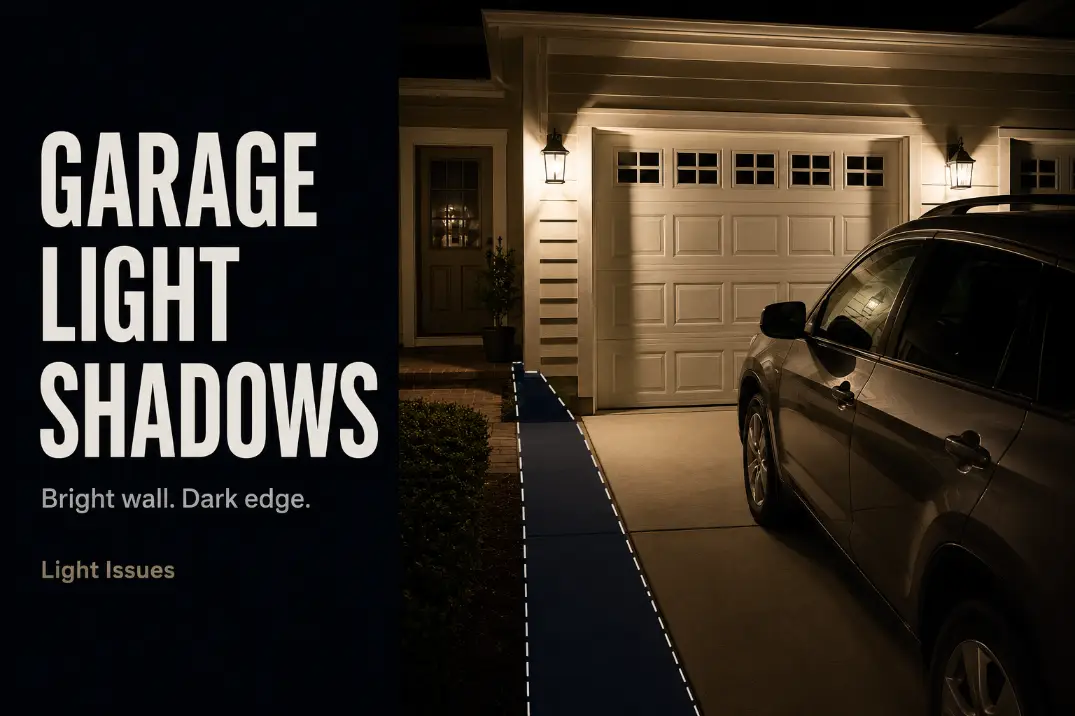
Garage lights create harsh shadows when the fixture lights the garage face better than it lights the path people actually use. The most common pattern is not weak output.
It is a bright wall, a parked car blocking part of the beam, and a dark edge near the side door, bumper, or driveway corner.
Start with three checks: stand 20–30 feet back, park the car where it normally sits, and look at the route from the car door to the house. If that route is not readable within 3–5 seconds, the light is not doing its safety job.
This is different from a simple “not bright enough” problem. The symptom is darkness, but the underlying mechanism is contrast: bare light hits the garage door, your eyes adapt to the bright patch, and the walking edge drops into shadow.
Doorway Shadow
Where the shadow actually lands
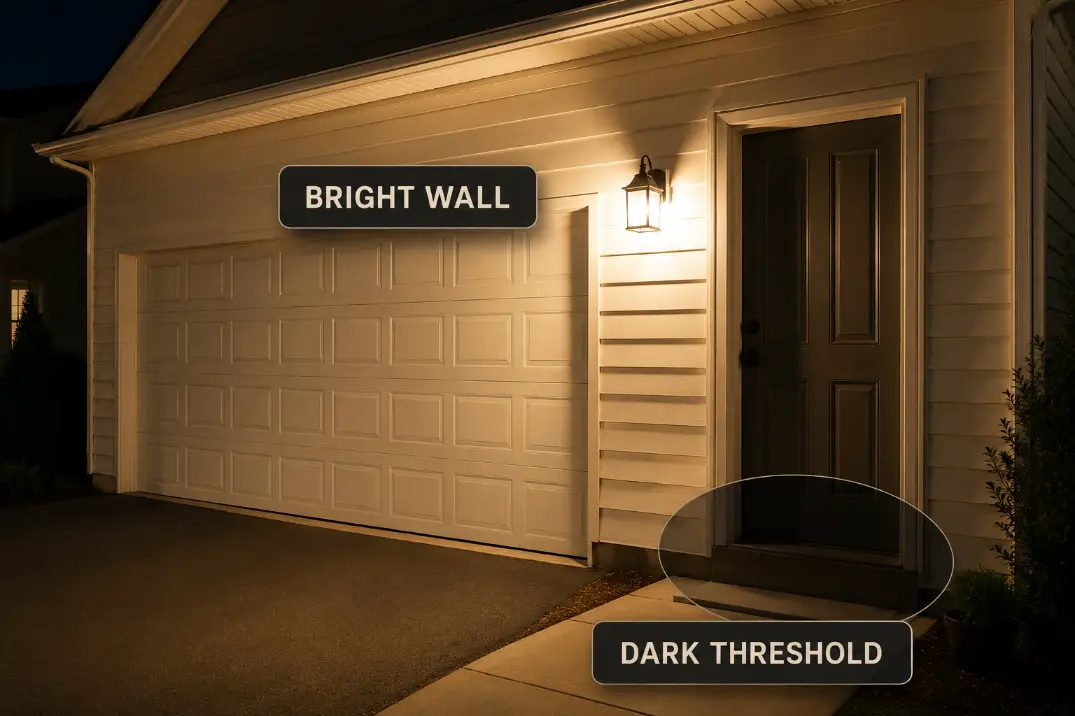
A doorway shadow usually appears beside a garage service door, side entry, or recessed lock area. From the street, the garage may look well lit. Up close, the handle, step edge, or jamb can still disappear into a hard shadow.
The useful test is not whether the fixture is bright. It is whether the door area stays readable where someone actually pauses.
A garage entry should show the lock, threshold, and first 3–6 feet of walking space without forcing someone to look directly into the fixture.
Why a stronger bulb disappoints
This is where many fixes waste time. A brighter bulb may make the garage door glow more, but if the beam still lands across trim or siding instead of into the recessed entry, the shadow remains.
Sometimes it gets worse because the eye adapts to the brighter wall first.
Change the angle before adding output
If the wall gets brighter but the threshold does not, stop increasing output from that same position. The better correction is usually softer downward aim, a shielded fixture, or a small secondary light closer to the entry zone.
Car Blocking
Test the driveway with the car in place
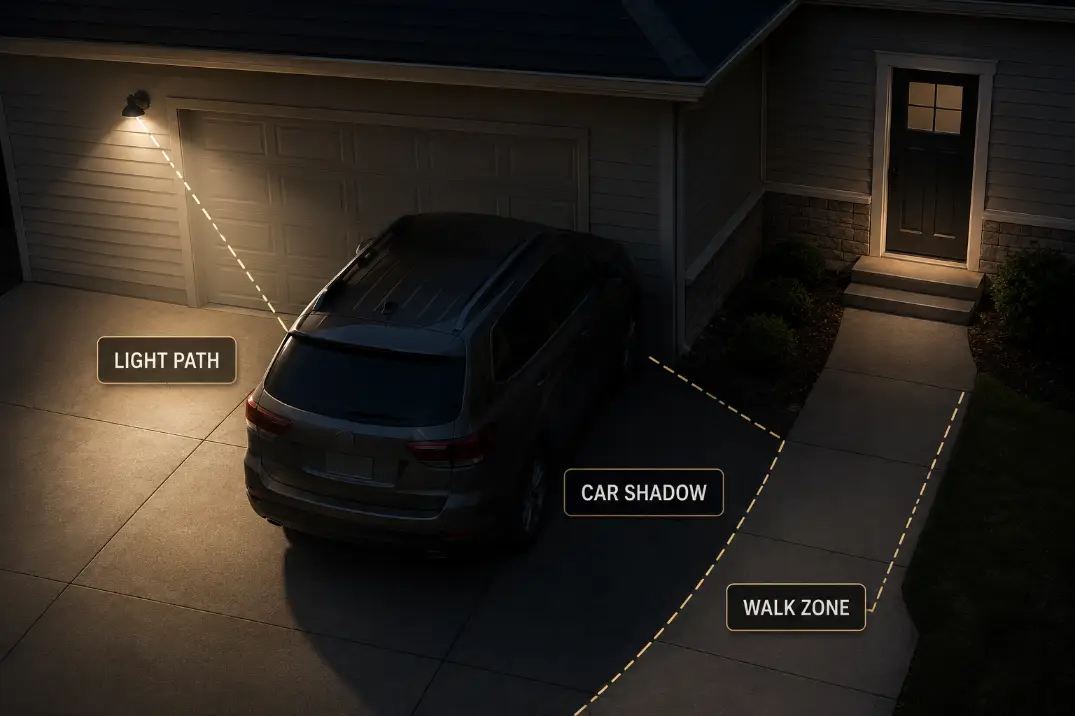
A garage light can look acceptable when the driveway is empty and fail the moment the car is in its normal spot. The hood, roofline, side mirror, and open door can interrupt the beam before it reaches the walking route.
This is especially noticeable with SUVs and pickups. A taller vehicle can create a shadow wall across 4–8 feet of driveway, often right where someone unloads groceries, walks around the bumper, or steps toward the house.
Bright from the curb is not the same as safe underfoot
Do not test garage lighting with the vehicle moved out of the way. The parked car is part of the lighting system at night. If the safe route only exists when the driveway is empty, the layout is not reliable.
The same pattern shows up when driveway lights are hard to see even though the fixtures appear strong from the curb. Brightness from the street is not the same as usable ground visibility beside the vehicle.
When aiming is not enough
A small aiming correction can help when the beam is just skimming the car. It will not help much if the fixture is low, far to one side, or aimed straight across the vehicle body.
In that case, the real fix is a wider, softer source or a second low-glare light that reaches the walking edge from another angle.
Side Wall Bounce
The garage face can glow while the ground stays weak
Side wall bounce is the shadow problem that fools people because the scene looks bright.
Pale siding, white trim, glossy garage doors, and wet concrete can all reflect light back toward your eyes. The vertical surface glows, but the driveway edge still lacks detail.
That is why a 2,000-lumen fixture can feel worse than a lower-output fixture with better beam control.
The first one may create a hot wall and a black edge. The second may create less drama but more usable visibility.
Glare can hide the coverage you already have
If you can see the bare LED source from about 25 feet away and it feels uncomfortable, glare is part of the failure. Your eyes narrow around the hot spot, so nearby shadows feel darker than they really are.
For garages connected to wider exterior lighting plans, the same issue appears when outdoor security lights create glare instead of improving recognition. The fixture can be powerful and still make the space less readable.
Shield first, then judge brightness
Do not judge the layout until the glare is controlled. Shielding the source, aiming slightly downward, or choosing a fixture with a wider cutoff can reveal details that were already receiving some light but were being hidden by contrast.
Dark Corners
Some corners are outside the beam path
Not every dark garage corner deserves the same fix. The important ones are the corners people move through: the side door edge, trash-bin path, car-to-house route, and narrow strip between the garage and landscaping.
A corner that sits 12–15 feet from the fixture and behind a garage return, parked vehicle, fence, or shrub is usually outside the useful beam path.
More brightness from the same fixture often adds glare near the garage without improving the hidden edge.
A dark pocket is a symptom, not the real cause
The fixture may be working exactly as designed and still miss the corner. That is the difference between a symptom and a mechanism. The symptom is a dark pocket. The mechanism is blocked or misdirected light.
This matters around doors because lock areas and step edges need visibility at the exact point where people slow down.
A related version appears when back door security lights create lock shadows instead of helping the person at the entry.
Hidden corners need a second angle
If the corner is physically blocked from the main garage light, do not keep forcing that fixture to do a job it cannot reach. A smaller secondary source, placed lower and aimed along the edge, often works better than a brighter main fixture.
Two-Light Balance
Two fixtures can still create two hard shadows
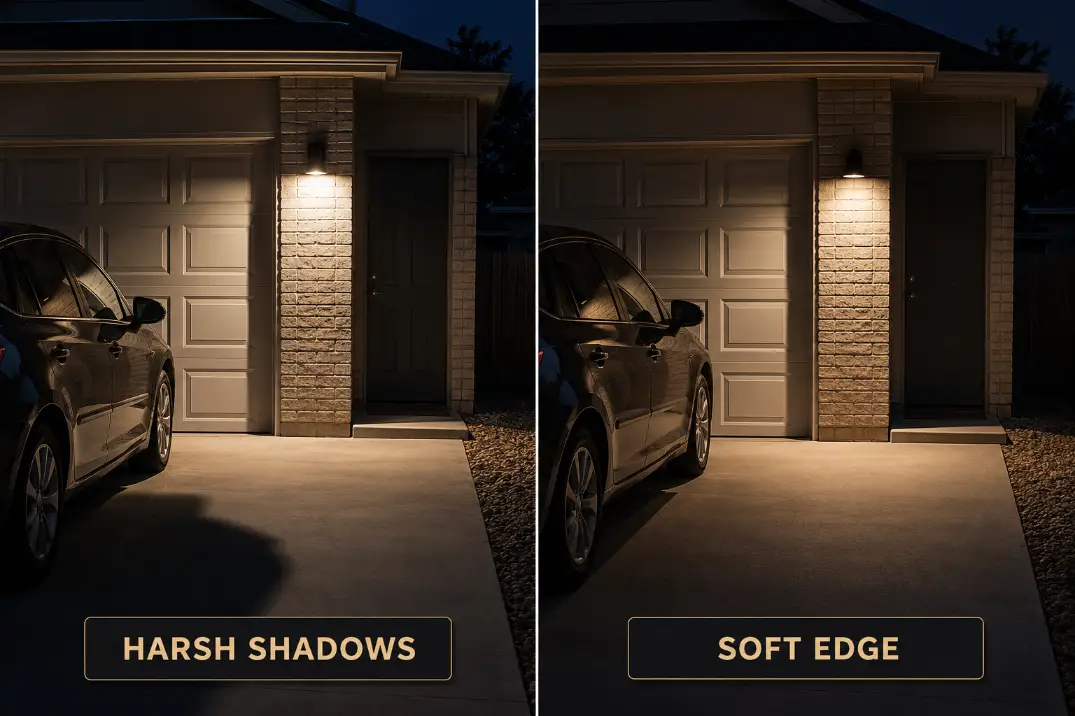
Two garage lights can improve coverage, but they can also create competing shadows. This happens when both fixtures are exposed, mounted high, and aimed outward.
The garage face looks symmetrical, but the driveway surface becomes a pattern of hot spots and dark strips.
Good balance is not about matching fixture brightness. It is about overlap. The walking edge should receive soft coverage from more than one direction, not two bright beams crossing over the same garage door.
Matching fixtures do not guarantee balanced light
Matching fixtures can still fail if both are aimed at the wrong surface. A pair of identical lights may look clean in daylight but produce glare and shadow at night.
This is where poor outdoor light placement creates dark spots and glare because the fixture position is doing more damage than the bulb or fixture rating.
| Garage light pattern | What it looks like | What it usually means | Better fix |
|---|---|---|---|
| Bright center, dark edges | Garage door glows, side path fades | Beam is too centered | Widen coverage or add side fill |
| Shadow beside parked car | Route changes when car is present | Vehicle blocks the beam | Test with normal parking |
| Painful fixture glare | LED source is visible from the street | Bare source controls the eye | Shield or replace fixture |
| Dark lock area | Door hardware stays dim | Entry zone is outside beam | Add entry-side coverage |
| Double driveway shadows | Two shadows cross underfoot | Fixtures compete | Re-aim for soft overlap |
More output is the wrong balance tool
If two lights already create hard contrast, raising both outputs usually makes the scene harsher. Balance comes from softer optics, lower glare, and better aim. The goal is not a brighter garage face. It is a more readable garage edge.
Safer Garage Edge
Follow the route people actually use
A safer garage edge follows the route people actually walk: car door to house, garage door to walkway, trash bins to side yard, or driveway to porch. If the light misses that route, the garage can look bright and still feel unsafe.
Recheck the scene after 20–30 minutes of full darkness, not during dusk. Also check after rain. Wet concrete or asphalt can reflect an exposed fixture into your eyes while making the curb line harder to read.
Control beats maximum brightness
People often overestimate brightness and underestimate control. A lower-glare fixture around 2700K–3000K, aimed down and shielded from direct view, can show more useful detail than a colder, brighter fixture blasting across the garage face.
When an adjustable fixture is still usable, how to aim outdoor security lights is the cleaner next step than replacing everything.
Aim should be tested with the car parked, the door area in view, and the normal walking route included.
Replace only when the fixture cannot be controlled
Replacement makes sense when the fixture is bare, fixed in a poor direction, painfully visible from eye level, or still leaving the walking edge dark after aiming changes. At that point, the fixture is not failing electrically. It is failing optically.
If the garage faces a driveway, neighbor window, or street, the fixture also needs to control spill, not just throw light farther.
A harsh fixture in that position can make the garage wall brighter while making both visibility and neighbor comfort worse.
This is where a lower-glare fixture category becomes relevant. If the existing light keeps creating glare and hard shadow after basic aiming, best low-glare outdoor security lights is the more useful comparison than another high-output floodlight.
Quick Garage Shadow Check
Use this after the car is parked normally and the lights have been on for a few minutes.
- Stand 20–30 feet back and look for dark strips beside the car, door, and driveway edge.
- Check the entry door from the actual standing position, not from the street.
- Look at the fixture from normal eye level; if the LED source hurts to view, glare is part of the problem.
- Walk the car-to-door route and notice whether the shadow moves with the vehicle.
- Recheck after rain if the garage light suddenly feels harsher.
- Stop raising brightness if the wall gets brighter but the walking surface does not.
The best garage light fix is usually not more light. It is less glare, better aim, and coverage that follows the way people actually move around the garage.
For a technical definition of glare and visibility loss, see the Illuminating Engineering Society glossary on glare.