
Unplugging every visible outdoor light clears one group of suspects. It does not clear the electrical path protected by the GFCI. The decisive clue is that the reset button still will not latch after those removable loads are gone.
If the GFCI resets after a particular light is disconnected, the diagnosis stays with that light, cord, plug, or attached equipment. If removing every visible load changes nothing, the diagnosis moves away from the obvious lights and toward three remaining conditions: the GFCI is not receiving proper incoming power, a fault remains somewhere on its protected downstream path, or the GFCI itself can no longer provide protection.
That is the useful reframe. The unplug test is not a circuit-isolation test. It establishes where the problem was not removed—and where homeowner-level investigation should stop.
What the Unplug Test Actually Rules Out
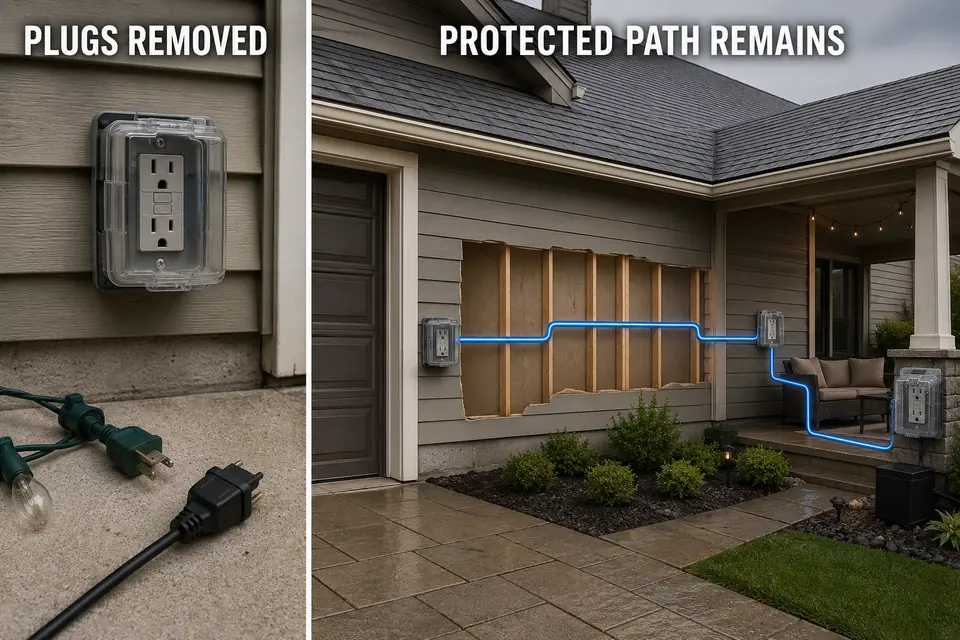
The unplug test clears individual loads, not the circuit behind the receptacle. It rules out only the plug-connected lights and equipment that were physically removed.
If the GFCI resets afterward and trips again when one light is reconnected, that item becomes the leading suspect. That familiar plug-by-plug process belongs to the broader outdoor-light GFCI trip diagnosis. This article begins when the obvious load-removal test produces no change.
“Everything is unplugged” usually means everything visible near the problem receptacle. It may not include another exterior outlet around the corner, a garage receptacle, a timer or transformer connected elsewhere, or hardwired equipment sharing the protected path.
A GFCI can also protect ordinary receptacles that do not have Test and Reset buttons. Emptying the two sockets on its face therefore does not disconnect the boxes or wiring beyond it. The failed test narrows the diagnosis, but it does not prove that the GFCI is defective.
Why an Upstream or Downstream Fault Can Remain
A GFCI can refuse to reset for two opposite electrical reasons: usable power may not be reaching it, or a fault may still exist after it. Those conditions can look identical from the front of the receptacle.
The supply side may not be delivering power
The line side supplies incoming power to the GFCI. If a breaker, connection, or another protective device upstream has interrupted that supply, some GFCIs cannot latch even with empty sockets.
This is not the same as detecting one defective light. The device cannot confirm that protection is available if its required supply conditions are missing. A powerless GFCI and one responding to a continuing fault may therefore produce the same visible result: Reset does nothing.
If the circuit breaker also trips, follow the separate diagnosis for outdoor lights that trip the breaker rather than only the GFCI. Cycling both devices repeatedly will not reveal which condition is present.
The protected path may still contain a fault
The load side allows one GFCI to extend protection to other receptacles or equipment. Moisture or damaged insulation anywhere along that protected path can remain relevant after the nearby lights are unplugged.
This explains why a dry-looking GFCI can refuse to latch while the real problem sits in another exterior box. A receptacle near a patio, deck, garage door, irrigation zone, or seasonal-light connection may still be electrically connected even when it appears unrelated.
A recently installed or replaced GFCI introduces another possibility: an installation or line/load error. Confirming that requires access to the device and conductors. It is not an exterior observation test and belongs with a licensed electrician.
Wet Receptacle vs Failed GFCI
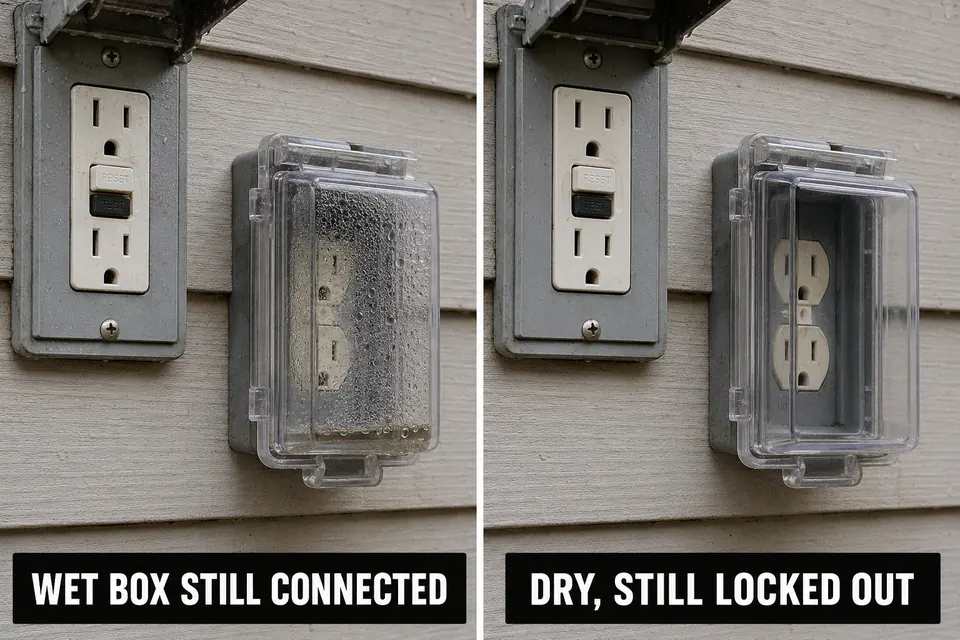
Weather timing is a stronger clue than surface appearance. A GFCI that stops resetting immediately after rain points toward moisture exposure, but a dry receptacle face does not prove that the box or downstream path is dry.
What the exterior can—and cannot—reveal
Water can remain behind the GFCI, at a cable entry, or inside another protected outdoor box. Rain, irrigation, snowmelt, and heavy condensation can all create the timing pattern without leaving obvious droplets on the device face.
An exterior cover does not guarantee a dry enclosure. Cover fit, drainage, gasket condition, box orientation, and the space occupied by connected plugs all affect exposure. The guide to outdoor outlet covers with lights left plugged in explains that enclosure problem without assuming the cover is automatically responsible for this reset failure.
Device failure becomes more plausible when the condition continues through genuinely dry weather, the buttons are physically damaged, or normal Test and Reset behavior has disappeared. Some current GFCIs intentionally remain locked out when their protective function is unavailable. Indicator colors cannot settle the diagnosis because their meanings vary by manufacturer and model.
Moisture more plausible
- The failure follows rain, irrigation, or snowmelt.
- Water or condensation is visible without opening anything.
- The problem repeatedly disappears and returns with weather.
Device failure more plausible
- The condition continues through genuinely dry weather.
- Test or Reset no longer behaves normally.
- The device shows physical deterioration or a model-specific fault indication.
These clues guide the next decision; they do not confirm the cause. Professional isolation of the supply, GFCI, and protected path may still be required.
Safe Dry-Time and Reset Boundaries
Drying is a condition, not a countdown. No fixed number of hours can prove an exterior electrical box is dry because a splash on the cover and water trapped behind a receptacle do not clear at the same rate.
Temperature, humidity, enclosure drainage, damage, and the depth of water entry all change the result. If water is visible at the receptacle or inside its cover, do not touch the buttons. A hair dryer, heat gun, compressed air, or opened enclosure is not a safe shortcut.
Use a restrained sequence:
- Leave the lights disconnected and stop using the affected receptacles.
- Allow natural drying through genuinely dry weather without opening any electrical enclosure.
- If there is no visible water, damage, heat, odor, or sound, make one normal reset attempt.
- If the GFCI refuses to latch or immediately trips again, stop.
A successful reset does not close the diagnosis when the failure returns with rain. That recurring pattern belongs to outdoor lighting that works normally until wet weather returns and indicates an exposure problem that still needs correction.
When to Stop Resetting and Call an Electrician
One failed reset attempt after dry conditions return is enough. Repeating the same action does not separate missing supply power, a downstream fault, and an internally failed GFCI.
The refusal is the boundary
Professional diagnosis is appropriate when the GFCI still will not latch after visible loads are removed. The same boundary applies when it resets and immediately trips, several protected outlets remain dead, or the failure returns with every rain or irrigation cycle.
An electrician may need to verify incoming power, isolate the protected load side, test the downstream path, and determine whether the GFCI has failed. Those operations require access and electrical testing that this homeowner-level diagnosis deliberately does not provide.
Stop using the receptacle and call an electrician if:
- Water is visible at the receptacle or inside its cover.
- The device is warm, buzzing, loose, cracked, or corroded.
- There is a burning odor, discoloration, or evidence of arcing.
- One dry-condition reset attempt fails or immediately retrips.
Until the cause is identified, keep the lights unplugged and the affected receptacles unused. The correct next move is not a stronger press on Reset. It is professional isolation of the part of the protected path that the unplug test could never clear.
For technical context, Leviton’s GFCI reset guidance explains how loss of incoming power, a continuing ground fault, moisture, installation errors, or device damage can prevent a reset.