
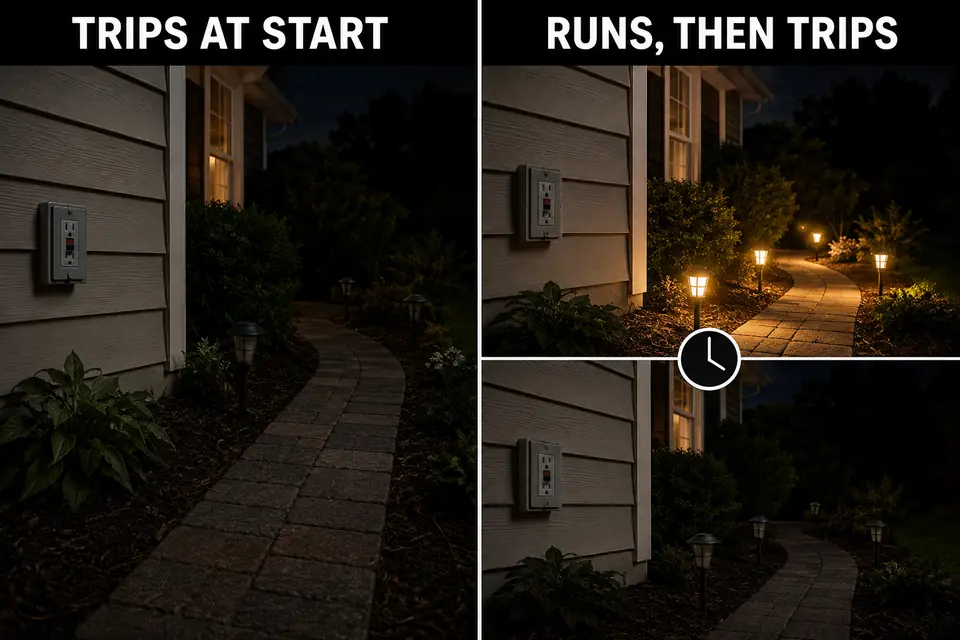
A GFCI trip that occurs the moment outdoor lights switch on begins with a fault already present. A trip that waits 10, 20, or 30 minutes tells a different story: the protected system starts in one condition and moves into another while operating.
That delay is the best evidence in the problem. Heat may build inside an LED driver or transformer, moisture may gradually establish a leakage path, or another lighting load may enter operation later. None of those possibilities can be confirmed from timing alone, but timing determines how the system should be narrowed.
The useful first check is therefore not another immediate reset. It is the elapsed run time, the lighting groups that were active, and whether anything changed shortly before the trip. A homeowner may compare one safely accessible plug-in group at a time, but opening equipment, disconnecting hardwired fixtures, or taking energized measurements belongs to an electrician.
Why a Delayed Trip Is Different From an Immediate Trip
The first diagnostic decision is whether the fault exists at startup or develops during operation. Treating those two patterns as interchangeable wastes the strongest clue the system provides.
An immediate trip means the fault condition is already present when the lights are energized. A damaged cord, heavily contaminated connection, water-filled enclosure, or another active fault may place the protected circuit over the GFCI’s operating threshold almost at once.
With a delayed trip, the system initially remains stable enough to operate. During the next several minutes, a condition develops or another part of the system changes state. That time-dependent behavior is what separates this problem from the broader causes of outdoor-light GFCI trips.
The distinction also prevents a common misdiagnosis: assuming that several lights simply “used too much power.” A GFCI watches for an imbalance indicating that current is leaving its intended path. It is not the circuit’s primary overload protection, so a breaker and a GFCI can respond to different electrical conditions.
The 10–30-minute range is not a code threshold or a clock that identifies a particular component. A trip after 12 minutes does not prove a bad driver, just as a trip after 25 minutes does not prove moisture. The interval matters because it shows how long the system remains stable and whether that period repeats under similar conditions.
A similar delay across successive cycles strengthens the pattern. A delay that becomes shorter is more concerning because the system may not be returning to the same starting condition between cycles. Residual heat, retained moisture, or progressive deterioration can change the next result—and that is a reason to stop, not an invitation to collect more trips.
Heat, Moisture, and Load Changes Over Time
A delayed trip requires a changing condition. The practical task is to identify what can change after startup without assuming that the most visible fixture is the source.
Three mechanism families deserve attention: warming equipment, a developing moisture path, and a load that switches on after the first lights are already operating.
Heat Can Expose a Weak Driver or Connection
LED drivers, low-voltage transformers, and electronic controls normally warm during operation. Normal warmth should not trip a GFCI, but deterioration inside a component, damaged insulation, or contamination around a connection may behave differently as temperature rises and materials expand.
This is why a light can appear normal at startup. It may reach full brightness and remain visually steady even while electrical leakage develops elsewhere along its supplied path. Normal light output does not prove that the driver and its connections remain electrically sound.
Some driver failures first appear as flickering, repeated shutdowns, or failure to start. Others can interact with protective devices before producing an obvious lighting symptom. The separate guide to how an outdoor LED driver begins to fail explains that component without treating every delayed GFCI trip as a driver problem.
Heat becomes a stronger clue when the trip occurs after a similar operating interval and that interval shortens during a closely spaced restart. It remains only a clue: the weak point could be inside a fixture, transformer, plug, cord, receptacle, connector, or another part of the protected path.
Moisture Can Create a Gradual Leakage Path
Moisture does not have to flood a fixture and cause an instant trip. Condensation, damp debris, corrosion residue, or water retained around a compromised seal may create a less direct path that changes during operation.
Heat can move condensation within an enclosure or change where moisture collects. A damp, contaminated surface may also become more conductive. The system can therefore start successfully even when moisture is involved in the later failure.
Use environmental context rather than trying to inspect inside electrical equipment. Recent irrigation, heavy humidity, overnight condensation, a wet planting bed, or a pattern that appears only during damp conditions strengthens the moisture possibility. None of those observations makes it safe to open a fixture or handle wet equipment.
Visible water changes the decision. If water is present inside a cover or fixture, or the failure appears specifically after rain, skip the timed operating test and leave the affected system off for professional evaluation.
A Switching Load Can Change the System Mid-Cycle
A delayed trip does not always require slow warming or moisture migration. Sometimes the system itself changes after startup.
A photocell may switch another zone, a timer may bring a second lighting group online, or a transformer may enter a different operating state. Note whether another light appeared, changed brightness, or switched modes shortly before the trip. A repeatable switching event may be more diagnostic than the total number of minutes.
“Load change” does not mean the GFCI needs greater capacity. It means another piece of equipment or operating state has entered the fault path. Increasing or removing protection would conceal the warning rather than identify its source.

Isolating Fixtures Without Repeatedly Resetting
The useful test changes one accessible group—not the reset count. Repeatedly resetting the entire connected system recreates the failure without revealing which branch changes the outcome.
Proceed only when conditions are dry and all accessible equipment appears intact. Use ordinary switches and plugs that can be reached without removing covers. Do not handle a wet plug, open a fixture, separate a connector, or disconnect a hardwired light.
- Record every lighting group operating when the trip occurred.
- Turn the system off through its normal controls and disconnect only one dry, safely accessible plug-in group.
- Run one observed cycle under conditions as similar as practical, then record the trip time or the absence of a trip.
- Stop when one group clearly changes the pattern or when the fault repeats without a safe, accessible distinction.
If the GFCI does not trip with one group absent, the disconnected group and its supplied path become the primary suspects. The result does not prove that the visible fixture is defective. That path may include a cord, driver, transformer, receptacle, or connection between the power source and the lights.
This distinction matters in landscape lighting because a connection may sit well away from the fixture it supplies. Understanding why outdoor connection locations affect diagnosis prevents the isolation result from being mistaken for a component verdict.
If the trip continues, record the result before changing anything else. Avoid rapidly reconnecting several groups or running repeated back-to-back cycles. Residual heat can make later tests incomparable, while multiple changes erase the value of the comparison.
Fix Boundary: Stop testing if the trip repeats, the delay becomes shorter, the GFCI will not reset normally, or you notice water inside equipment, a damaged cord or cover, heat, odor, buzzing, discoloration, or evidence of arcing. Do not bypass the GFCI or open electrical equipment to continue the diagnosis.
Recording the Exact Run Time
The record should convert “after a while” into a pattern an electrician can use. “Tripped after 17 minutes with the path lights and two tree uplights operating” is far more useful than an estimated delay recalled later.
Record when the lights switch on and when the GFCI trips. Note which groups were active, whether a timer or photocell changed another zone, and whether the system had cooled completely before the cycle began.
Environmental context can separate a stable warm-up pattern from a damp-weather pattern. Note whether the area was dry, humid, recently irrigated, or exposed to rain earlier in the day. Approximate temperature is useful only when conditions differed substantially; a detailed weather log adds little.
Read the pattern conservatively:
- A similar interval suggests a repeatable operating condition.
- A shorter interval may indicate retained heat or a worsening fault.
- A damp-weather-only pattern strengthens the moisture question.
- No trip with one group absent narrows the suspect path.
- A trip immediately after another zone activates points toward that change.
These observations narrow the service call; they do not identify the failed component. Once the fault is repeatable or one group changes the outcome, the record has done its job. Continuing for days to create a larger sample only keeps a suspected fault in service.
When Delay Points to a Failing Component
The professional boundary arrives when the pattern becomes repeatable—not only when the lights fail completely. Timing can narrow the affected path, but it cannot separate a failing component from damaged fixed wiring.
One group consistently changing the outcome gives the electrician a better starting point. Report the group, approximate run time, environmental conditions, any timer or photocell event, and whether the interval shortened between cycles. That evidence is more valuable than replacing the most visible fixture on a guess.
If all safely accessible plug-in groups are removed and the GFCI still trips, the remaining protected path requires professional diagnosis. The same applies if the GFCI no longer resets normally, because the problem has moved beyond the delayed operating pattern addressed here.
An electrician can de-energize and inspect the relevant path, evaluate the protective device, perform appropriate leakage or insulation testing, and distinguish a failing component from fixed-wiring damage. Those procedures should not be recreated through homeowner trial and error.
A repeatable delayed trip, shortening run time, retained water, physical damage, unusual heat, odor, buzzing, or discoloration has already crossed the point where an outdoor-lighting problem needs an electrician.
The practical judgment is simple: use the delay to define the pattern, use one controlled group comparison to narrow the path, and stop before diagnosis turns into repeated energization of a suspected fault.
The U.S. Consumer Product Safety Commission explains that a GFCI interrupts power when current leakage to ground exceeds a safe level.