
When hardwired outdoor lights and an exterior outlet stop working at the same time, the timing is the first useful clue. Two separate devices can fail independently, but a truly simultaneous outage makes a shared upstream interruption more likely.
That shared point could be a GFCI receptacle located elsewhere, a section of the same branch circuit, or another fixed connection supplying both paths. It does not mean the exterior outlet directly powers the hardwired lights. The safe first move is to confirm exactly what lost power and then look for accessible upstream protection—not to open either failed device.
What the Shared Failure Reveals
Begin by establishing whether the failures were actually simultaneous. Discovering a dead outlet today and remembering that the lights stopped working sometime last week does not create strong evidence of one event. If someone saw the lights go out while a device plugged into the exterior outlet also stopped, the shared-supply hypothesis becomes much stronger.
Check the surrounding area as well. A garage receptacle, another outdoor outlet, or nearby hardwired lighting may have stopped at the same time. A wider group of dead loads points away from an isolated bulb, fixture, or receptacle failure and toward something common to the group.
The loads do not have to look related to share protection. A hardwired light may be operated by a wall switch, timer, photocell, or motion sensor while an exterior outlet remains continuously available. Their controls can be separate even when part of their supply path or GFCI protection is shared.
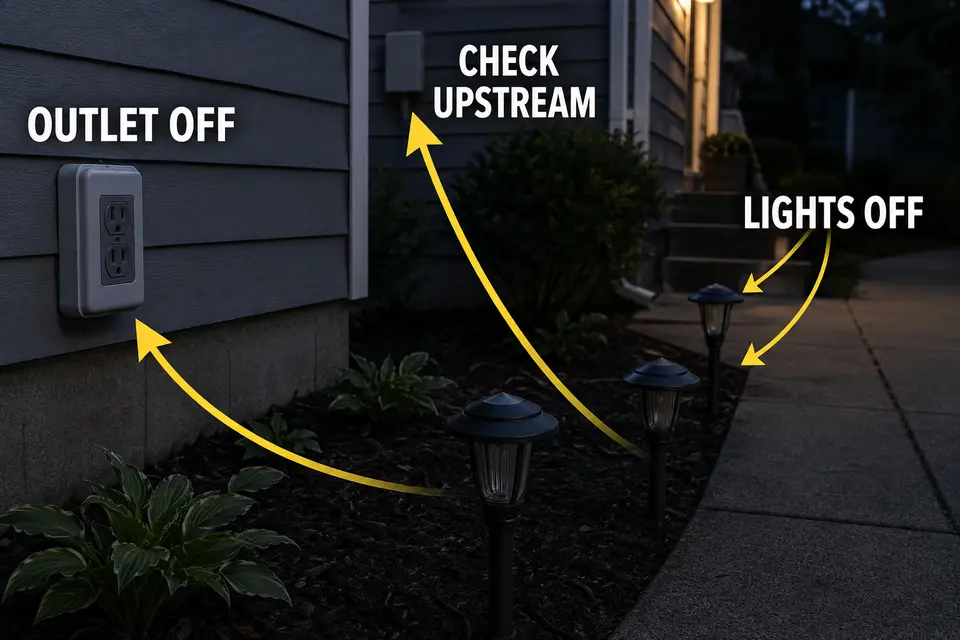
The opposite result matters too. If other loads on the property remain normal, that narrows the affected area but does not prove the two failed endpoints are independent. Treat the common timing as evidence to investigate, not as proof of a particular concealed wiring arrangement.
Finding Upstream GFCI Protection
The dead exterior outlet may not have TEST and RESET buttons. A plain receptacle can be protected by a GFCI located upstream, sometimes in the garage, basement, utility area, another exterior location, or a different accessible part of the house. The exact arrangement varies by home, and labels may be missing or outdated.
Before attempting a reset, look at the accessible device and its surrounding enclosure. The face should be intact, and there should be no obvious water inside the enclosure, scorching, cracks, melted material, or displaced parts.
Warning Sign: Do not reset or touch equipment that appears wet or damaged or produces heat, buzzing, or a burning odor. Keep the affected area out of use and arrange qualified electrical service.
Use a restrained search sequence:
- Confirm which lights, outlets, and nearby loads are affected.
- Check accessible GFCI locations that could plausibly protect the outdoor area.
- Visually inspect the GFCI and enclosure before operating its buttons.
- If everything appears dry and intact, make one normal reset attempt.
A successful reset followed by the immediate return of both the outlet and lights strongly supports a shared upstream interruption. It does not explain why the GFCI operated, however. If it will not latch or trips again, stop resetting it. The next diagnosis belongs in the separate path for an upstream GFCI that still will not reset.
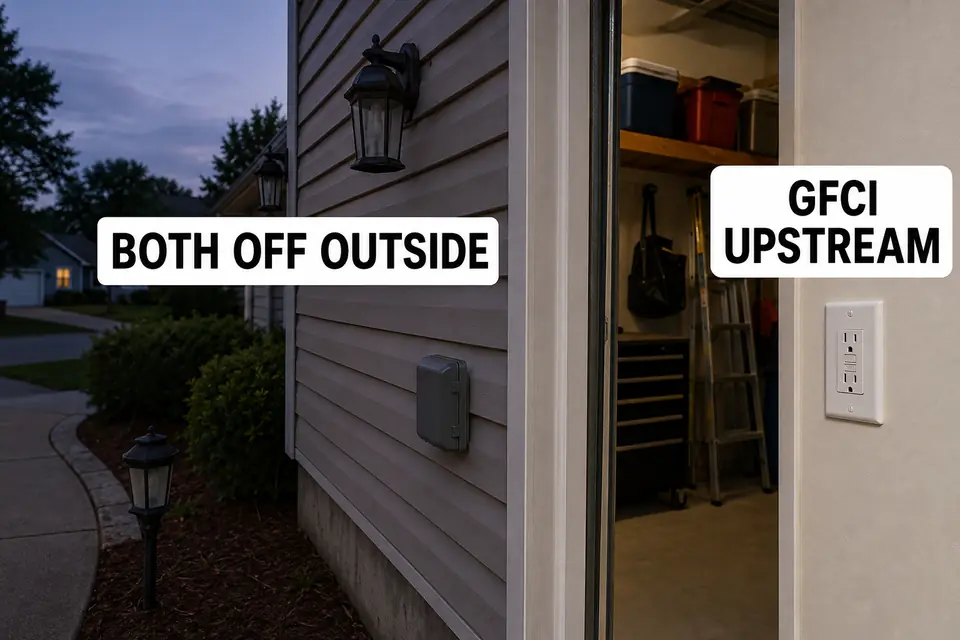
Ordinary switches and lighting controls are also worth checking from their normal operating positions. A timer may have lost its schedule, or a wall switch may have been turned off. But one lighting control usually does not explain why an unrelated always-on receptacle also died. Keep the paired symptom in view rather than accepting the first convenient explanation.
Breaker On Does Not Mean the Branch Is Live
A breaker handle that appears to be on does not confirm that usable power reaches every downstream load. An upstream GFCI can interrupt the protected portion of a branch while the breaker remains on. A failed or damaged fixed connection can also leave downstream endpoints without power even though nothing obvious has changed at the panel.
Breaker position should therefore be treated as one observation, not a complete circuit test. Do not remove the panel cover or attempt live measurements. If a breaker is the protective device that actually operates, the diagnosis shifts to outdoor lights that trip the breaker rather than a GFCI.
A breaker that will not remain set—or is associated with abnormal warmth, sound, odor, or visible damage—marks the end of homeowner troubleshooting. That condition needs qualified evaluation rather than repeated operation.
Separating Outlet Failure From Lighting Failure
After a successful upstream reset, check both endpoints again instead of assuming the whole problem is resolved. Test the receptacle with a simple, known-working plug-in device appropriate for the location. Operate the lights through their normal wall switch, timer, photocell, or motion-control condition. Do not use exposed leads, improvised testers, or removed device covers.
If both return together, the result supports a shared upstream interruption. If the outlet works but the hardwired lights remain off, the diagnosis has separated: the remaining issue may lie in a lighting control, fixture, or fixed lighting path. A dead receptacle with restored lighting similarly points toward a more local outlet or supply-path problem.
If neither returns, the GFCI you reset may protect something else, another interruption may remain upstream, or the two failed endpoints may not share the assumed point. This is where guesses based only on physical proximity become unreliable.
Recurrence provides another useful distinction. If both loads return and later lose power together after a repeatable operating period, record the run time and follow the diagnosis for outdoor loads that operate normally before the GFCI trips. Do not keep cycling the circuit to reproduce the event.
A successful reset identifies where power was interrupted, not necessarily why. Weather exposure, damaged equipment, or a concealed fault may still require attention when the outage returns.
The Shared-Circuit Service Boundary
Homeowner diagnosis should stop before locating a concealed conductor, opening a hardwired fixture, removing a receptacle, or accessing a junction box or electrical panel. Those actions cross from observing the outage into testing fixed wiring.
Arrange qualified service if no accessible GFCI explains the outage, a GFCI will not latch, protection operates again, or the paired failure persists after normal controls have been checked. Visible water inside an enclosure, scorching, melting, cracking, corrosion with deterioration, heat, buzzing, or a burning odor also requires an immediate stop.
Recent construction, excavation, impact, flooding, or water entry near the affected area should be reported even if no exterior damage is obvious. These details can materially change where an electrician begins testing.
When requesting service, describe which loads stopped, whether they failed at the same observed time, which GFCIs were found, what happened during the single reset attempt, and whether the breaker actually tripped or merely appeared on. Mention any weather event, unusual odor, sound, damage, or recurring timing pattern. That information is more useful than naming an unverified failed component.
The goal is not to prove what is hidden inside the circuit. It is to determine safely whether the two dead endpoints behave like one supply interruption and recognize when only fixed-wiring testing can take the diagnosis further. Additional outdoor-lighting warning signs that require an electrician can help define that boundary when the symptoms extend beyond this shared outage.
For further guidance on outdoor electrical protection, see the U.S. Consumer Product Safety Commission’s electrical safety resource.