You walk past the garage, hear a click from the motion light, and the driveway stays dark. The useful question is whether that control response ever produces light. A click alone is not a reason to replace the sensor—or declare it healthy.
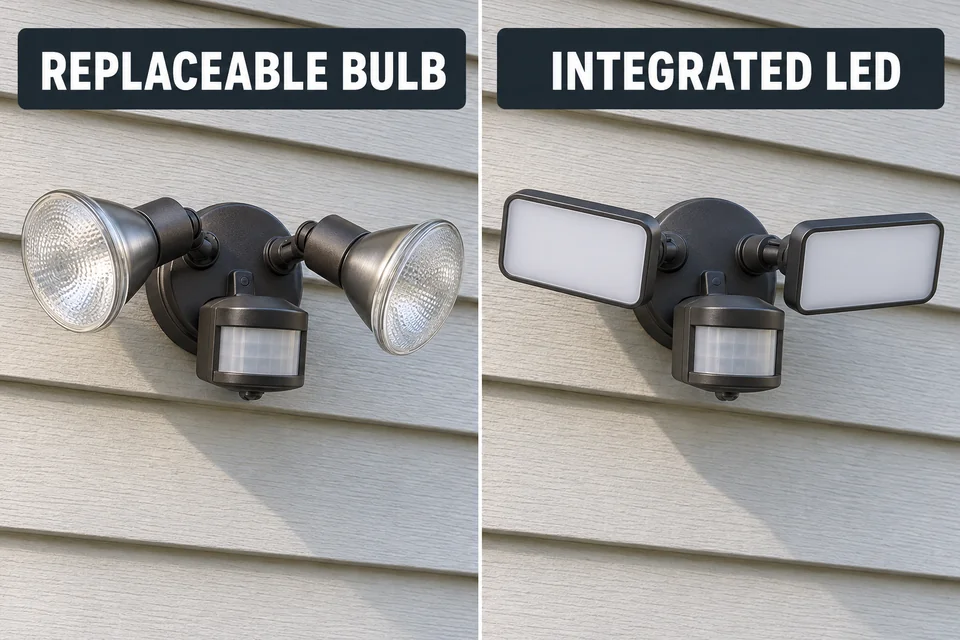
Start by identifying whether the fixture has replaceable bulbs or integrated LEDs. Then establish an operating mode in which the light should illuminate. On a bulb-based fixture, one compatible, verified working lamp can narrow the problem. On a sealed LED fixture, the same symptom reaches the service boundary sooner because there is no ordinary bulb to substitute.
What the Click Confirms
A click that repeatedly follows movement is more useful evidence than a single click when power is first restored. Listen from a safe position and establish that the sound comes from the fixture. Allow its normal operating cycle to finish before trying again.
In a relay-equipped light, the sound may come from the mechanism that operates the electrical contacts. That mechanism can move without the contacts successfully delivering usable power to the lamp.
If the sound occurs only at startup, comes from another device, or does not consistently follow movement, the broader motion-light troubleshooting path is more appropriate. Those observations do not establish the specific control response being examined here.
A repeatable motion-associated click narrows the investigation, but it leaves the lamp, electrical connections, and supply under load unverified. Treat it as evidence that part of the control is responding.
Some motion lights switch electronically without an audible relay. Silence alone is therefore not a failure test; this diagnosis applies to a light that actually produces the reported click.
Bulb vs Integrated LED Output Failure
Confirm that the lamp is replaceable before attempting removal. A round light head is not necessarily a bulb, and a visible lens does not establish how the fixture is serviced. The model’s instructions determine which check is available.
Fixtures with Replaceable Bulbs
A failed bulb can leave the motion control responding normally while producing no light. This makes a compatible lamp substitution useful before considering an entire fixture replacement.
A screw-in LED bulb contains its own electronics. If it fails, the fault may be inside the bulb rather than in a separate driver mounted in the fixture. Appearance rarely settles the question: an intact-looking LED lamp can still be defective.
Use the fixture’s specified replacement method. If a cover must come off, confirm how it and its seal are restored before starting.
Fixtures with Integrated LEDs
An integrated head contains LEDs that are not replaced like an ordinary bulb. Missing illumination may involve the driver, LED module, control output, or an internal connection.
The distinction matters because outdoor LED driver failure is only one explanation for a dark integrated fixture. A click does not establish that the driver receives its required input, so it cannot confirm driver failure.
Do not twist or pry a sealed head open to look for a bulb. Check whether the manufacturer offers an approved service module or warranty support. Some fixtures are serviceable; others require replacement once the failed assembly has been identified.
Test and Daylight Settings
A dark lamp is a useful test result only when the selected mode should turn it on. Use the exact model’s instructions: TEST may allow daylight illumination, while another fixture’s diagnostic mode may only indicate detected movement.
Allow the specified startup period, then observe the lamp itself. A sensor indicator or another click is not a successful light-output result. If the manual says TEST bypasses daylight restrictions, continued darkness in that mode should not be dismissed simply because it is daytime.
A fixture that illuminates during this check has demonstrated that it can produce light. If it works in test mode but not at night, follow that separate operating-pattern diagnosis instead of continuing toward a failed-lamp or relay conclusion.
If there is no suitable TEST mode, evaluate normal operation after dark as the manual directs. Avoid repeated switch-flipping experiments: on some models, switching sequences change operating modes. Restore the intended normal setting when the check is finished.
A Known-Good Lamp Check
Use one verified, compatible lamp to answer a specific question: can this fixture illuminate a working bulb under the same test conditions? A bulb taken straight from a new package has not yet demonstrated that it works. Choose one proven in another suitable fixture.
Compatibility matters as much as condition. Match the base, voltage, permitted lamp technology, physical fit, and fixture wattage limit. For LED bulbs, compare actual wattage with the fixture limit, not the advertised incandescent-equivalent number. Follow any enclosure and outdoor-exposure requirements.
Avoid using a smart bulb or one with its own automatic controls unless the fixture specifically supports it. Otherwise, the substitute adds another reason for darkness rather than simplifying the check.
Field Check: Turn off the circuit breaker before handling the lamp, allow it to cool, and follow the manufacturer’s replacement instructions. A dark bulb does not mean the socket is de-energized. Stop if access is unsafe or the socket shows moisture, scorching, or damage. Do not probe or bend socket contacts.
- Choose a compatible, verified working lamp. Confirm that its ratings meet the motion fixture’s requirements.
- Isolate power and allow cooling. Do not handle the lamp while the fixture is powered.
- Replace only the user-serviceable lamp. Seat it as instructed without forcing it, and restore any cover and seal.
- Restore power and wait through startup. Use the model’s specified delay rather than assuming immediate readiness.
- Repeat the same operating check. Keep the mode and ambient-light conditions consistent with the earlier observation.
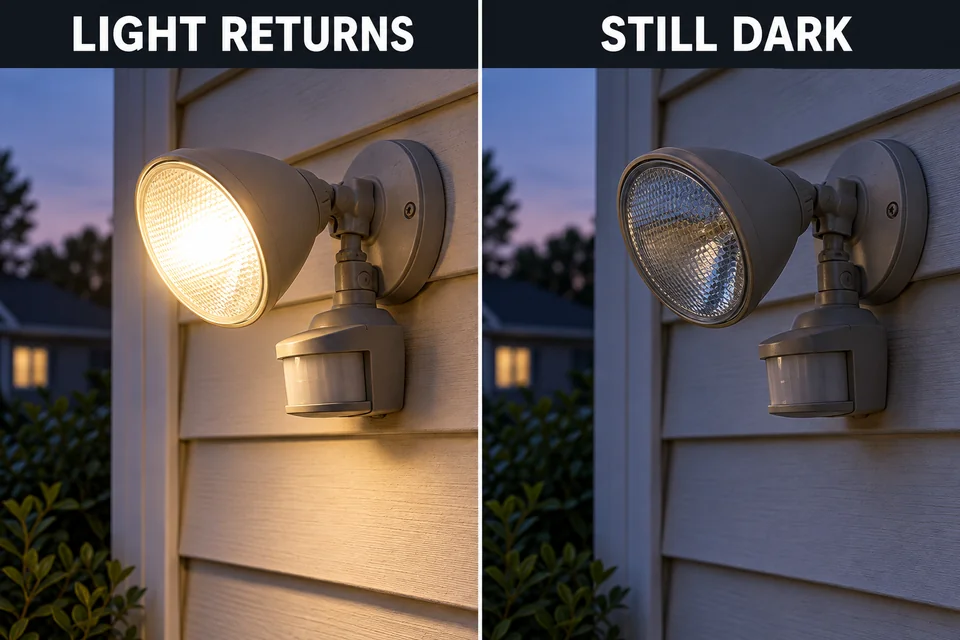
If the light now illuminates, the original lamp or its seating is implicated. That result gives no reason to replace the sensor immediately. It does not establish whether the original lamp itself failed or whether reseating corrected poor contact.
If the verified compatible lamp stays dark while the fixture clicks, lamp failure alone becomes less likely. The socket, control output, internal connections, and supply remain unresolved. Another speculative bulb purchase adds little once this controlled substitution has failed.
If one head illuminates while another stays dark, record that distinction. A partially working multi-head fixture presents a different problem from complete loss of output. For an integrated LED fixture, skip lamp substitution entirely and proceed to the service boundary below.
When the Internal Relay Has Failed
Relay failure becomes a repair diagnosis only when the switching fault has been distinguished from supply and lamp problems. Clicking plus darkness does not make that distinction. Worn or damaged contacts can fail to deliver usable output even though the mechanism moves, but other faults produce the same outward behavior.
A compatible working lamp that remains dark under valid test conditions directs attention beyond the bulb. In an integrated fixture, the driver and LED module also remain possibilities. Neither branch supports ordering a replacement relay from the sound alone.
A documented manual mode can add evidence if it successfully illuminates the light. That establishes that output was possible in that condition. It does not automatically prove that manual mode uses a separate electrical path or physically bypasses the relay.
A qualified electrician can distinguish a supply problem from failed switching or a defective load. The homeowner’s useful contribution is a clear account of the mode used, whether the click followed movement, and whether a compatible lamp changed the result.
Stop further testing if clicking becomes rapid chattering or accompanies a burning smell, scorching, water intrusion, or repeated breaker or GFCI trips. Repeatedly cycling power does not resolve those conditions.
Where the manufacturer supports a replaceable sensor or control module, an approved repair may preserve the fixture. If a failed assembly is sealed and nonserviceable, replacement may be appropriate after supply faults are ruled out. At that point, low-glare security lighting options for the same location can help match the replacement to the entrance or driveway.
Once the mode is correct and a verified compatible lamp still stays dark, stop treating the problem as bulb maintenance. Have the remaining electrical path diagnosed before committing to parts. For integrated LEDs, manufacturer-supported service or qualified diagnosis takes the place of that bulb check.
For the technical distinction between relay movement and electrical continuity, see OMRON’s explanation of general-purpose relays.