
The light comes on when you walk outside, then switches off while you are still sitting at the table or working near the wall. Getting up brings it back. That pattern can mean the sensor detects your arrival but misses the smaller movements you make afterward.
Start by separating two questions: can the sensor detect movement where you remain, and does its hold-on timer cover the pauses in your activity? A longer delay may help with quiet intervals. It will not correct a position where movement consistently goes undetected.
Presence vs Detectable Movement
A passive infrared, or PIR, sensor responds to changes in infrared energy across its detection pattern. Your body remaining nearby does not necessarily produce another detectable change. Walking into the area and sitting there are different sensing conditions.
Reading, using a phone, or sorting small items may involve mostly finger and wrist movement. Whether that registers depends on the sensor, distance, viewing angle, and how much of your movement is visible. Some PIR designs detect fine movement better than others; “PIR” alone does not tell you how reliably a particular fixture will respond to seated activity.
The useful clue is what happens when your activity changes. If the light remains on while you walk around but shuts off after you settle into one position, investigate continued detection before assuming the fixture has failed. A motion sensor light that stays on all night presents a different problem: it is not completing the shutoff behavior you are observing here.
Notice what restores the light. A broad arm movement from the same chair suggests that some movement is detectable there. Having to stand up and move elsewhere raises a coverage question, but does not identify exactly where detection occurred. Neither result proves that every part of the fixture is healthy.
The Dead Zone Beneath the Sensor
Standing directly beneath a motion sensor can put you outside its useful detection pattern. A sensor aimed outward may catch someone crossing the yard while missing activity close to the wall. Being nearer does not automatically make you easier to detect.
This is not a universal blind spot. Some sensors include downward coverage, and the actual pattern depends on the lens, mounting position, and permitted aim. Check the model’s coverage diagram before treating the area beneath it as either covered or excluded.
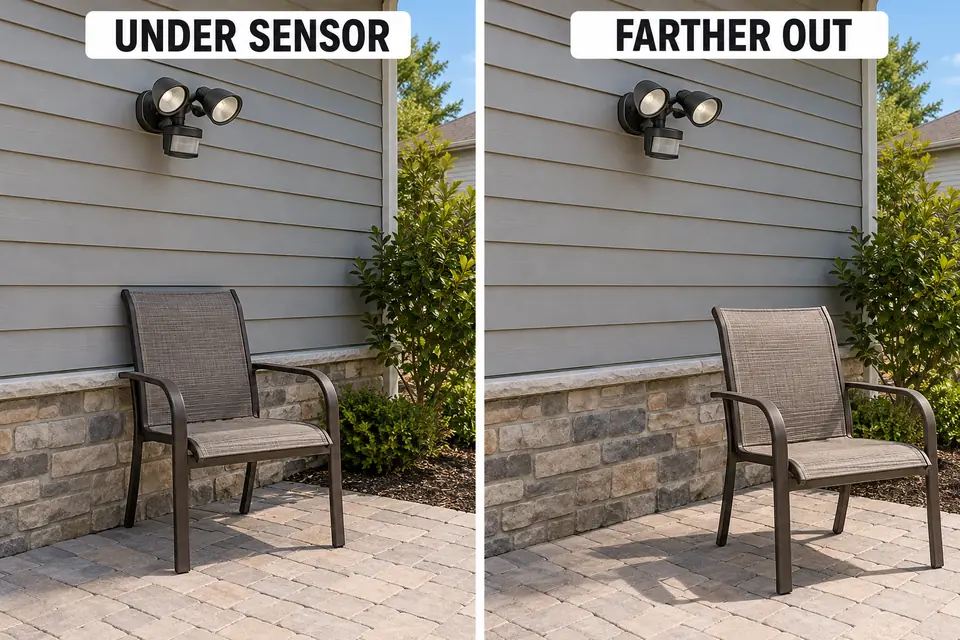
Compare similar movements at the problem spot and a nearby position while keeping settings unchanged. Test each position separately after the light has switched off and any documented rearm interval has passed. Activation while walking between the positions does not establish that movement at the destination is detectable.
Direction matters too: movement across a PIR pattern is often easier to detect than movement straight toward the sensor. However, a motion light that misses the walk path needs an initial-activation check. Here, the important comparison happens after you have arrived.
Also look at what stands between the sensor and your task. A chair back, post, or other obstruction may hide much of your movement. The lamp can illuminate a tabletop even when the sensor has a poor view of the person using it. Brightness on the task is not evidence of detection coverage.
Timer Length vs Detection Pattern
The hold-on timer determines how long the light remains on after a qualifying detection. In typical retriggerable motion operation, another registered movement renews that period. Confirm your model’s behavior rather than assuming every fixture follows identical timing logic.
For a useful baseline, start with the light off and make a deliberate movement that activates it. Then remain still and observe the interval before shutoff. Timing only from your arrival can mislead you because later movements may renew the timer without any visible change in the already-lit lamp.
A repeatable shutoff after quiet activity is consistent with timeout behavior, but timing alone does not confirm it. The stronger clue is that a deliberate movement at the same position reliably restores the light after any documented rearm interval. That establishes detection of that movement—not necessarily the smaller movements involved in your task.
A longer supported delay may bridge the quiet pauses between detectable movements. Test that possibility with the activity position and sensor aim unchanged. If the light simply stays on longer and then switches off while normal task movements still fail to restore it, the detection limitation remains.
Check that the control is set to a normal operating delay rather than a short setup or test setting. Use the fixture’s marked options or manual; there is no single correct delay for every light and activity.
Choose a delay that accommodates normal pauses without keeping the light on unnecessarily after departure. Prolonged stillness can outlast even a generous setting. A timer measures an interval; it does not independently confirm that someone is still present.
Repositioning Activity Within the Zone
When the position comparison identifies a more responsive location, try moving the chair or task there before changing the fixture. Keep the route clear and the activity practical. The goal is to make ordinary movement visible, not require a special seating position that only works when you repeatedly wave.
If repositioning the activity is impractical, check whether the sensor head can be adjusted independently. Moving the lamp heads changes where light falls. It does not necessarily change where the PIR sensor detects movement.
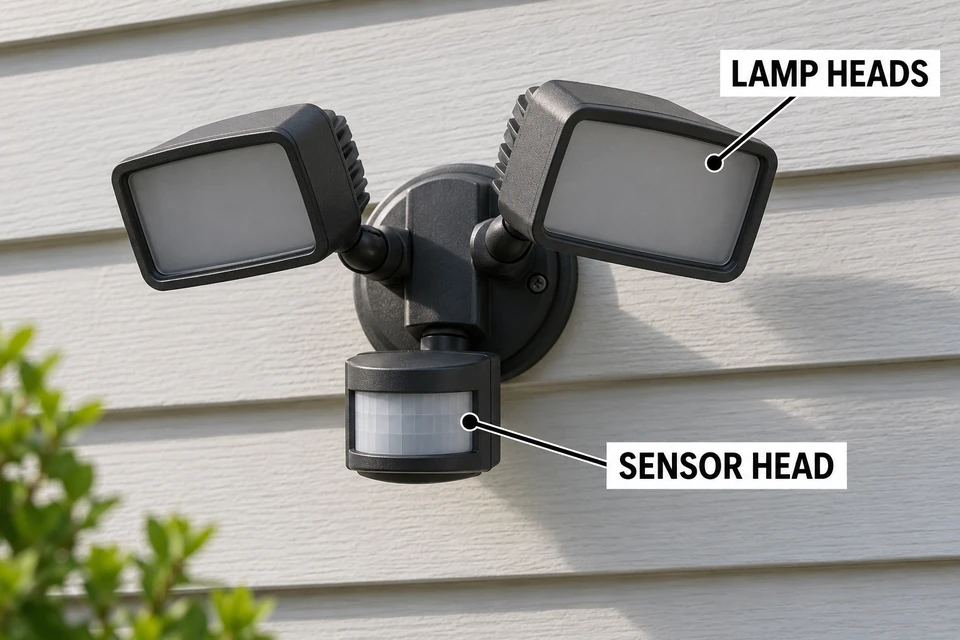
Before physically adjusting hardware on a hardwired fixture, isolate power. Follow the manufacturer’s permitted movement and locking instructions without opening the enclosure or forcing the joint. If the fixture cannot be reached safely, have the adjustment made by someone equipped to access it.
Make one modest adjustment, secure it as directed, and retest. If the sensor head will not stay in position, the changing angle creates a separate mechanical problem. Repeating detection tests while the head drifts produces unreliable comparisons.
After an aim change, verify the original arrival route as well as the task position. Improving near-wall detection is not a successful correction if the light now misses someone entering the area.
The Stay-in-Area Test
Judge the result using the activity that caused the complaint. A successful walk-by or exaggerated wave establishes less than a repeatable period of normal use.
- Record the starting conditions. Test after dark in normal motion operation. Note the selected delay and allow any manufacturer-specified startup period to finish.
- Confirm arrival detection. Enter by a route that reliably activates the light. This establishes the starting response.
- Perform the actual task. Remain at the original position and read, sit, or work normally. Do not add deliberate waving to keep the light on.
- Compare the positions separately. After shutoff and any documented rearm interval, make a deliberate movement without leaving the task position. For the comparison location, move there first, remain still until the light switches off again, and allow the rearm interval before repeating a similar movement. Do not count activation during the walk between positions as evidence of detection at the destination.
- Change one variable and repeat. Adjust the activity position, permitted sensor aim, or supported hold time according to the earlier findings. Repeat the same task without extra movements intended to sustain lighting.
- Check departure behavior. Leave the detection area and confirm normal shutoff. If aim changed, also repeat the arrival check.
Use repeated observations rather than treating one response as a verdict:
| Observation | What it supports | Next decision |
|---|---|---|
| Broad movement works at the task spot, but quiet activity does not sustain lighting | Large movement is detectable there; ordinary task movement may not be | Try a supported longer delay for pauses, then repeat without deliberate waving |
| Comparable movement fails near the wall but works elsewhere | A location-dependent detection gap | Reposition the activity or adjust permitted sensor aim |
| Position or aim changes improve the repeated task test | Coverage contributed to the symptom | Retain the change; verify arrival and vacant shutoff |
| Movement at a previously reliable position no longer restores dependable operation | The presence/timeout explanation is insufficient | Continue with broader diagnosis |
If the last pattern persists, use broader motion-sensor troubleshooting instead of repeatedly extending the timer. This test does not identify a failed sensor, wiring fault, or lamp problem by itself.
A workable result is ordinary activity keeping the light available, followed by normal shutoff after departure. If the task requires uninterrupted illumination during prolonged stillness, a manufacturer-supported continuous-on function may be more suitable where provided. Follow its documented operation rather than assuming a universal switch-toggle sequence.
For technical background on major and fine-motion detection, see Lutron’s Residential Sensor Specification Guide.